Week-6 Challenge: EV Drivetrain
AIM: Study of power converters used in EVs/HEVs, calculation of steady-state speed of an EV, mathematical modeling of a D.C. motor & brief explanation of a blog on Induction motors vs Brushless D.C. motors by Wally Rippel.
OBJECTIVES:
- To list out the different types of power converters used in Electric Vehicles & Hybrid Electric Vehicles.
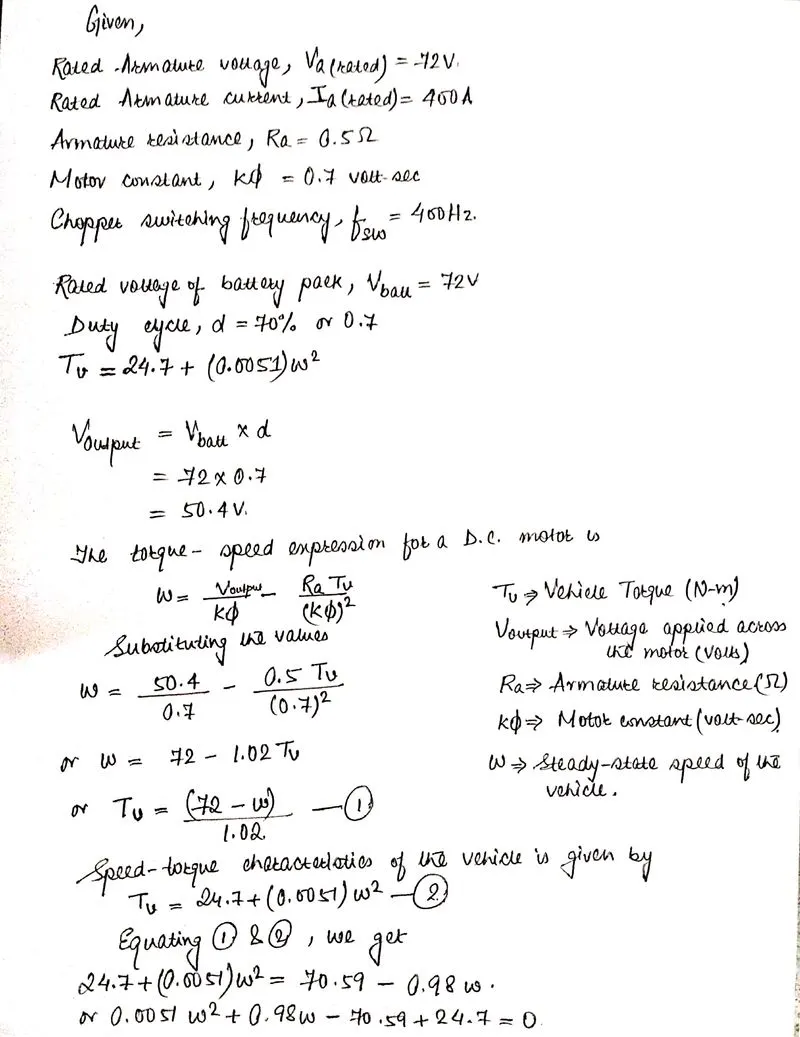
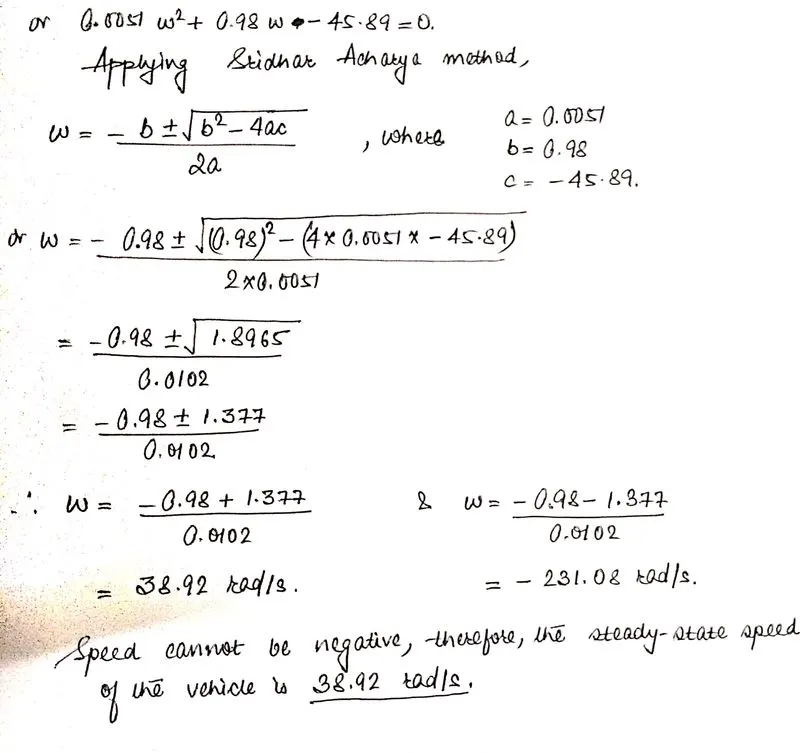
- To calculate the steady-state speed of an Electric Vehicle (with given data).
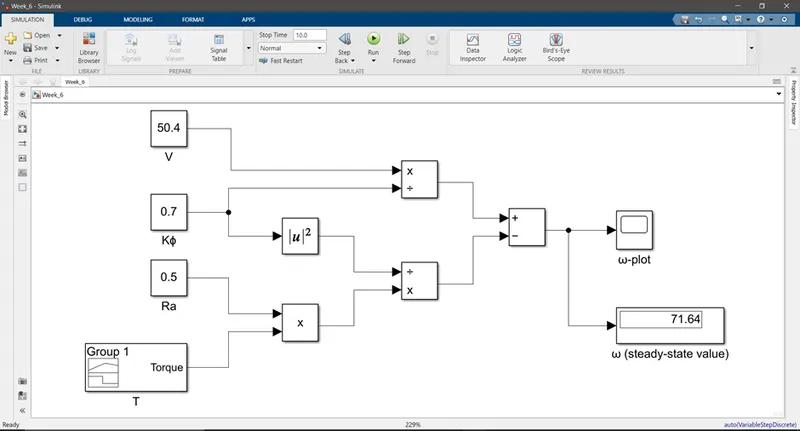
- To develop a mathematical model of a D.C. motor in Simulink with the given expression.
- To briefly explain the author's explanation from the blog: Induction Versus DC brushless motors by Wally Rippel, Tesla
STUDY:
1. Different types of power converters used in Electric & Hybrid Electric Vehicles:
Power electronic converters are used everywhere in normal daily routines at home, in commercial workplaces, or in an industrial environment.
Due to the high-power handling with higher efficiencies, these converters become an integral part of industrial electric drives, high electric power supplies, electric traction systems, and automobile control equipment.
There are different types of power electronic converters used for performing different functions (such as inversion, rectification, etc.) which are rated from a few milliwatts to a few thousand watts.
Depending on the type of function performed, power electronic converters are categorized into the following types:
- AC to DC converter (called Rectifier): It converts AC to unipolar (DC) current
- DC to AC converter (called Inverter): It converts DC to AC of desired frequency and voltage
- DC to DC converter (called Chopper): It converts constant to variable DC or variable DC to constant DC
- AC to AC converter (called Cycloconverter): It converts AC of the desired frequency and/or desired voltage magnitude from a line AC supply.
These types of power electronic converters may be found in a wide variety of applications such as switch-mode power supplies (SMPS), electrical machine control, energy storage systems, lighting drives, active power filters, power generation, and distribution, renewable energy conversion, flexible AC transmission, and embedded technology.
However, in the case of EVs the following types are used:
AC to DC converter i.e. Rectifier: It is used in the battery charging circuit. The supply is available in A.C. and batteries require D.C. for charging. The rectifier converts the A.C. supply available from the source into D.C. which is then used to charge the battery.
The D.C. supply from the battery is then transmitted to two different converter circuits:
DC to AC converter i.e. Inverter & DC to DC converter i.e. Chopper
DC to AC converter i.e. Inverter: Induction Motors are generally used as the traction motor in EVs. Also, the Induction motors operate on an A.C. supply. The Inverter converts the D.C. supply available from the battery to A.C. supply which is then fed to the Induction motor for operation.
DC to DC converter i.e. Chopper: It is used to power other auxiliary components of the EV/HEVs such as HMI, Headlamps, Sensors, etc.
2. EV Steady-state speed calculation:
3. Mathematical modeling of a D.C. Motor:
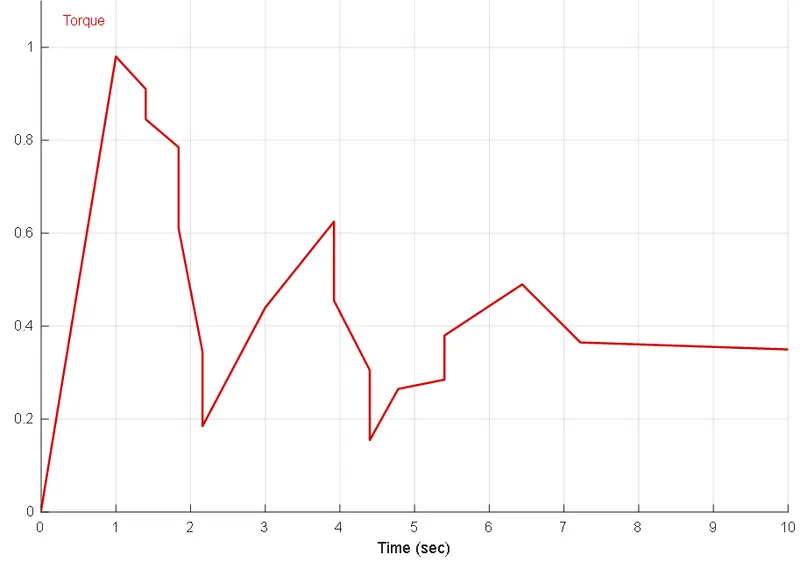
Torque using signal builder:
Simulink Model:
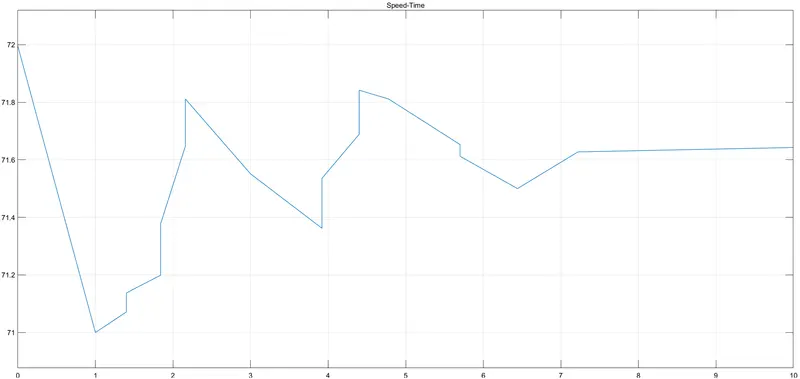
Output (from Scope):
4. Brief explanation of the blog on Induction Vs DC Brushless motors by Walley Rippel:
In his article, the author initially points out that in the olden days, Lead-acid batteries, Brushed D.C. motors and contactor controllers were used whereas nowadays Lead-acid has been replaced by Lithium. Brushless D.C. motors & Induction motors have taken the place of Brushed D.C. motors whereas modulated inverters have replaced contactors. He has also made a comparison of Brushless DC motors & 3-phase Induction motors, their principle of operation, advantages & disadvantages.
The stator of both the Brushless D.C. motor as well as an Induction motor is identical. Both have 3-sets of distributed windings inserted within the stator core.
In Brushless D.C. machines, two or more permanent magnets form the rotor. These permanent magnets form a D.C. magnetic field. This D.C. magnetic field interacts with the current flowing through the stator windings to produce a torque interaction between the stator and rotor. Also, it becomes necessary to vary the magnitude and polarity of the stator in such a way so as to generate constant torque and maintain optimal efficiency. Such control can only be achieved by means of an inverter.
An Induction motor has no permanent magnets in the rotor. Instead, it’s a compact structure with steel laminations stacked together along with conductors at the periphery and these conductors are shorted together. The currents in the stator winding produce a rotating magnetic field which cuts the rotor conductor bars, thereby inducing a voltage across the shorted conductor bars proportional to the difference in speed between the rotor & electrical frequency. As a result of this induced voltage, currents are produced within the rotor conductors proportional to the voltage. These induced rotor currents interact with the stator magnetic field to produce forces that help achieve the desired rotor torque.
A 3-phase Induction motor can start directly when connected to the supply without the help of any Inverter and also possess the ability to operate under no-load whereas, a brushless D.C. motor produces no starting torque when connected to the fixed-frequency A.C. supply. An inverter is needed to operate the Brushless motor by keeping its phase in step with the angular position of the motor. However, in the case of Induction motors, if we employ inverters then it adds up to the flexibility, i.e. it can also be operated using a D.C. supply and the speed control can also be achieved by adjusting the inverter frequency. Still, in comparison to D.C. machines, the torque capability is low. Feedback loops can be added to achieve desirable motor frequency which is required for vehicular applications.
In general, both brushless D.C. & Induction motor drives employ motors having similar stators. The main difference lies in the rotor of the two machines as well as the type of inverter control. Another difference is that brushless D.C. motors generate less heat and rotor cooling is easier. Moreover, they can operate at a unity power factor whereas Induction motors can achieve a maximum 0.85 power factor
In an induction motor, at light loads, the inverter can reduce the voltage which in turn will reduce the magnetic losses and maximize the efficiency. In brushless D.C. machines as the size increases, magnetic losses increase proportionately and part load efficiency decreases whereas, in the case of Induction motors, losses do not grow. Induction motor drives are favoured in situations where high performance is desired, peak efficiency may be less than its D.C. counterpart but average efficiency may be better.
Brushless D.C. drives will continue to dominate the Hybrid & Plug-in Hybrid EV market and Induction motor drives will continue to dominate wherever there’s a need for a high-power EV powertrain. In short, both types of motors will have their own demand based upon requirement and both will be required to run the show since much of the hardware is common for the two drives.
CONCLUSION:
Except for the cyclo-converters, all the other three types of converters are used in EVs & HEVs.
Both Induction, as well as DC Brushless motors, have their own advantages and both will continue to run the show for EVs, HEVs & PHEVs depending upon the requirement. Also, another reason for them to dominate is that much of the hardware is common for both the electric drivetrain i.e. AC Drivetrain (using Induction Motors) & DC Drivetrain (using Brushless DC Motors).