Week-6 Challenge: EV Drivetrain
1.
There are different types of power converter devices used in Electric Vehicles such as: -
- Inverter: - It changes the DC voltage to AC voltage. In case a AC induction motor is used which takes AC voltage Inverter converts the DC Voltage coming from Battery and changes it to AC.
- Rectifier: it changes AC voltage to DC voltage. When charging the battery power coming from the mains is AC power and the battery takes DC power. Hence a rectifier is used to convert AC power to DC power.
- Chopper: A chopper is a power Electronics device which changes the level of DC voltage to another level. IF the voltage level is increased then the chopper is called Boost chopper and when the voltage level is reduced the chopper is called Buck chopper. If the chopper can be used as both then it is called Buck-Boost chopper
- Switches: - In the vehicle control no. of switches are used such as BJT, MOSFET, IGBT, etc. It is due to this switches the control of electric vehicle is made extremely fast.
2.
Motor and Controller Parameters:
Rated Armature voltage= 72 V
Rated armature current= 400 A
Ra= 0.5Ω, KΦ= 0.7 Volt second
Chopper Switching frequency= 400 Hz
The vehicle speed-torque characteristics are given by the below equation
`T=24.7+0.0051*(ω)^2`………………………………… I
Dc motor equations are given below:
`E=V-I*R` ………………………………………………………. 1
`E=K*Ø*ω`……………………………………………………….. 2
`T=K*Ø*I`………………………………………………………… 3
E --> Back emf
V --> Terminal Voltage
R -->Armature Resistance
`ω`--> Speed of the motor
`Ø`-->Flux of the motor
K -->constant
From the above the 3 equation we need to find the relation between the Torque and Speed.
`T= ((k*Ø )*V)/R - ((k*Ø )^2)/R ω`
Again the voltage of the battery is passed through a chopper before it enters the motor terminals. Hence the output of the chopper becomes
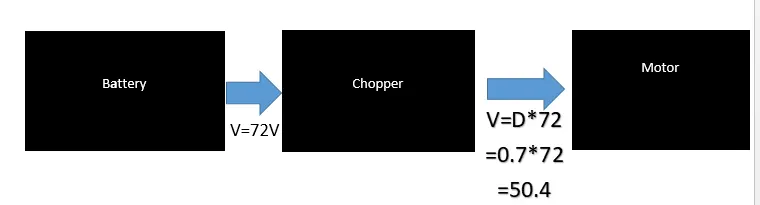
`T=70.56-0.98* ω` ……………………………………… II
From Equation I and II we get
`24.7+0.0051*(ω)^2 = 70.56-0.98* ω`
Solving we get,
`0.0051*(ω)^2+0.98*ω-45.86=0`
`ω=(-0.98±√((0.98)^2-4*0.0051*45.86))/(2*0.0051)`
`ω=38.23 (rad)/s,-233.8(rad)/s`
Since the speed cannot be negative hence .
`ω= 38.23 (rad)/s.`
3.
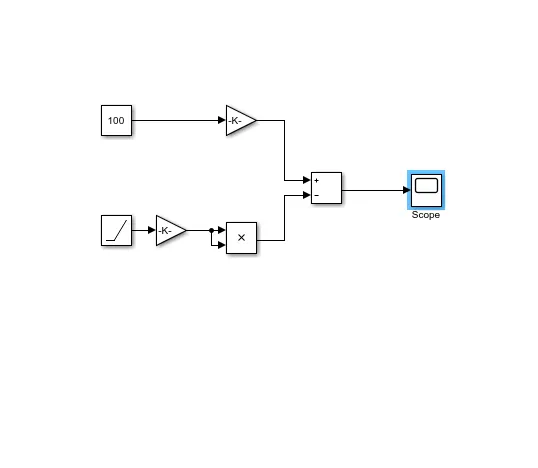
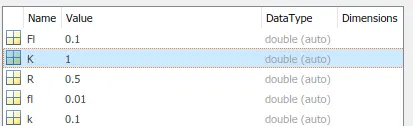
To model the Dc motor Speed Toque characterises equation using Simulink. The model is shown below with the values of the constant taken.
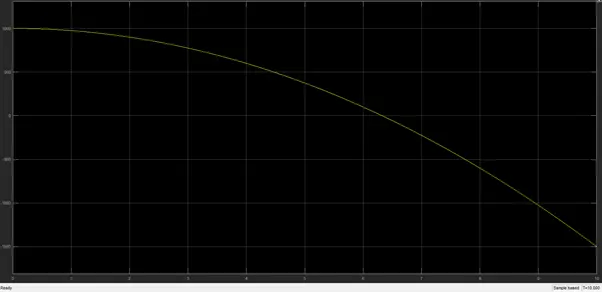
The result shows the typical speed torque characteristics of the DC motor.
4.
The Author Wally Rippel compares the 2 most popular motor used in Electric Vehicles which is Brushless DC motor and Induction motor.
The major difference between the 2 motor is their rotor. The stator of the 2 motor is more or less identical. The brushless DC motor has a permanent magnet at its rotor which produces a magnetic field that interacts with the Stator magnetic field due to the current in the stator winding. The interaction causes a rotating magnetic field which turns the rotor. Whereas in case of Induction Motor the rotor is a set of bars like a cage. The stator produces a rotating magnetic fields same as brushless DC. This magnetic field interacts with the rotor bars creating a magnetic field. This 2 magnetic field tends to remain in stationary with respect to each other and thus rotating the rotor. Both of the motor required the aid of the inverters for their efficient control
There are lots of disadvantages and advantages involving the 2 motors.
|
Brushless DC Motor |
Induction Motor |
|
Less rotor heat is generated |
Motor rotor heat |
|
More peak efficient power |
Low peak efficient power |
|
It can operate on a unity power factor |
The best power factor it can operate is 85% |
|
To control the dc brushless motor the B- filed need to be adjusted which is a bit complex process |
But the B- field in Induction motor can be easily controlled as it is proportional to the v/f ratio |
|
At high load the B-field gets saturated which results in increases eddy and hysteris loss. |
At high speed losses do not necessarily increases and hence the efficiency is more |
|
Permanent magnet are costly and they experience high force when placed close to a ferromagnetic material |
This problem does not exist with Induction motor |
|
Control laws are simple to implement |
Control laws of induction machine is more difficult |
To conclude the brushless DC is dominant with the hybrid and plug in hybrid electric vehicle whereas induction motor will be must at high performance pure electric vehicle.