Week-6 Challenge: EV Drivetrain
1) Types Of Power Converter Circuits Used in Pure Electric Vehicle & Hybrid Electric Vehicle:
A power converter is an Electrical Circuit that changes the Electric power from one form into another desired form as per the load requirement.The converters Converts the Fixed Source into Variable form.
There are several types of Power Converters used :
AC-AC (Ac voltage Regulator (or) Cycloconverter)
AC-DC (Controlled Rectifiers)
DC-DC (DC Chopper)
DC-AC (Inverter)
Diode Rectifier (AC-DC)
In Electric Vehicle and Hybrid Electric Vehicle mostly the AC-DC ,DC-DC & DC-AC converters are used.Ac to Dc Conversion is used in OnBoard chargers to Convert Ac supply from home to Dc supply to charge the Batteries.Where as Dc-Dc converters are used to convert Fixed Dc output from the batteries to variable Dc Supply for the motor Controller & inverters.The Dc-Ac converters that are inverters used to convert Dc supply from the Dc-Dc converter to Ac supply Required by the Motor.
2) What is EV steady state speed if duty cycle is 70%?
Given:
Rated Armature voltage= 72 V
Rated armature current= 400 A
Ra= 0.5Ω, KΦ= 0.7 Volt second
Chopper Switching frequency= 400 Hz
Tv=24.7+(0.0051)ω^2--------------- 1
Soln:
To Find Speed in rad/sec
T=V.K/R - K^2.ω/R------------- 2
T=Torque
V=Armature Voltage
R=Resistance
ω=Speed rad/sec
By Comparing both the Equations
24.7+0.0051ω^2 = ((V.K/R)-((K^2)*ω/R)
24.7+0.0051ω^2 = (50.4*0.7)/0.5-(0.7^2/0.5)*ω
70.56-0.98*ω=24.7+0.0051*ω^2
By Equating the Equations
-45.86+0.98ω+0.0051ω^2
That is
0.0051ω^2+0.98ω-45.86
As we want to get a quadratic equation divide the equation with the common number
0.0051/0.0051*ω^2+0.98/0.0051*ω-45.86/0.0051
ω^2+192.5ω-8992.15------------ 3
In order to find roots
The formula for the Quadratic equation ax^2+bx+c is
X1,2=-b±√b^2-4ac/2a
=-192.5 ±√192.5^2-4(1*(-8992.15))/2*1
= 38.95 rad/sec
therefore the Steady state Speed of the EV at 70% duty cycle is
ω= 38.95 rad/sec
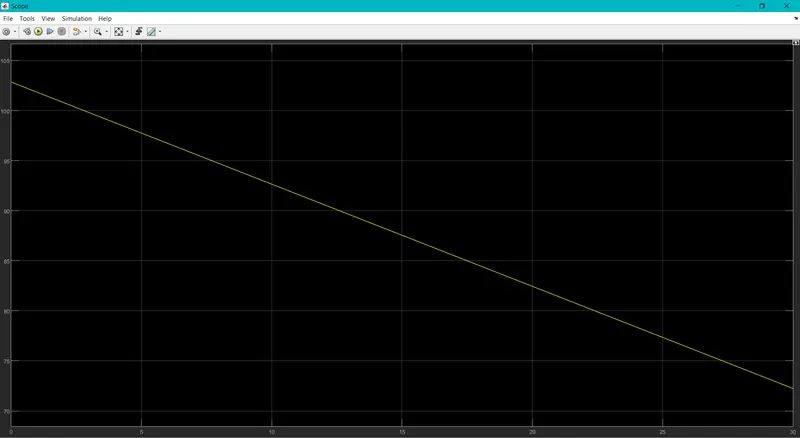
3) Develop a mathematical model of a DC Motor for the below equation using Simulink.
ω= V/Kϕ -Ra/Kϕ^2*T
Mathematical model using simulink:
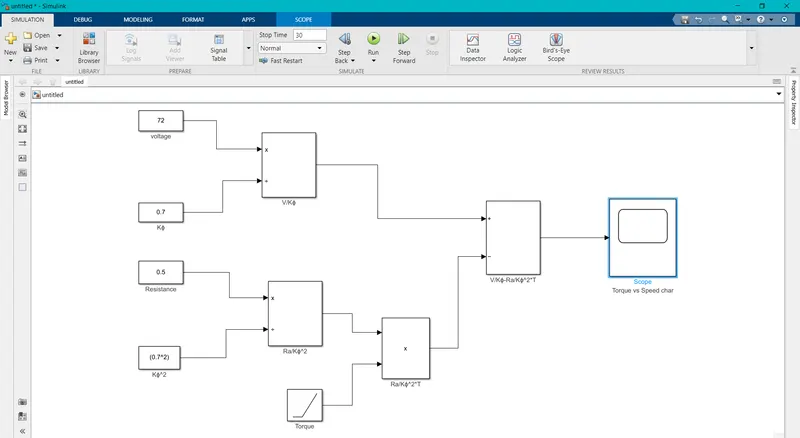
Output
4) Induction Versus DC brushless motors by Wally Rippel, Tesla
Explain in brief about author’s perspective.
Advantages of Dc brushless Motor:
1) As it is a brushless dc motor it has very low hysteresis loss,eddy current loss & I^2R losses.
2) No Need of Carbon Brushes to collect power from the Rotor.
3)Peak performance is slight Higher than the Induction Motor.
4)Less rotor heat is produced.Rotor cooling is Easier.
5)Dc brushless motor can work in unity Power factor.
Advantages of Induction Motor:
1) There is No B loss as there is no permanent magnet is used in it.
2)Average performance is higher enough than the brushless dc motors.
3)Only speed sensor is used for the feedback.
4)Even though the size of the Induction machine increases the losses need not increase.
5)Induction Motors are cost Efficient due to no Usage of Permanent Magnets.
Disadvantages of Dc Brushless Motor:
1)As there is usage of permanent magnets B loss is highly present.
2)As the rotor is a permanent magnet Any type of ferromagnetic materials may get into contact as disturbance.
3)As permanent magnets are used its cost is too high.
4)When the Size of the Motor increases the losses also Increases.
5)More Accurate feedback sensors are needed to control the rotor position and speed.
Disadvantages of Induction Motor:
1)I^2R losses is more due to usage of copper conductor in the rotor slots.
2)Induction motors are more tough to Control As its control techniques are quiet complicated.
3)The rotor gets heated and more adequate cooling is needed to cool the rotor.
4)Peak performance is slightly poor compared to Dc Brushless motor.
Conclusion:
Both Motors are best at its point as the only difference is mainly cost. The BLDC motors will always dominate in HEV,s & Plugin HEV,s.And the Induction motors dominance will be high in the High performance pure Electric Vehicle.