Week-6 Challenge: EV Drivetrain
Aim: The following challenge has 4 exercises:
- Which types of power converter circuits are employed in electric and hybrid electric vehicle?
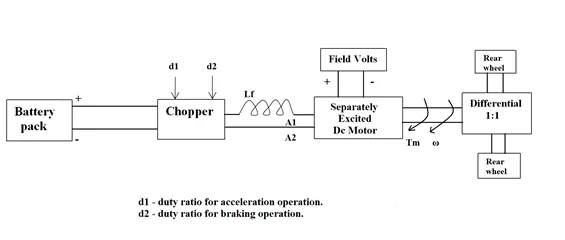
- An Electric Vehicle's powertrain with 72V battery pack in shown in the diagram below. The duty ratio for acceleration operation is 'd1' and for the braking operation the duty ratio is 'd2'.
The other parameters of the electric vehicle are given below,
Motor and Controller Parameters:
Rated Armature voltage= 72 V
Rated armature current= 400 A
Ra= 0.5Ω, KΦ= 0.7 Volt second
Chopper Switching frequency= 400 Hz
The vehicle speed-torque characteristics are given by the below equation

What is EV steady state speed if duty cycle is 70%?
- Develop a mathematical model of a DC Motor for the below equation using Simulink.
ω= V/Kϕ -Ra/(Kϕ)^2.T
- 4. Refer to the blog on below topic:
Induction Versus DC brushless motors by Wally Rippel, Tesla
Explain in brief about author’s perspective.
Software Used: Simulink, MS Word.
Solution:
- Which types of power converter circuits are employed in electric and hybrid electric vehicle?
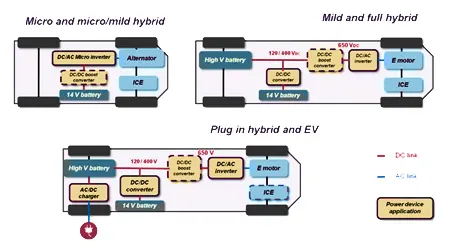
Following are the types of converters used in Hybrid electric vehicles:
AC – DC converter:
- Used to charge the High Voltage Battery as the power supply is AC current and the battery can only be charged using DC (only for pure electric).
DC – DC converter:
- Used for 14V battery which is connected in parallel to the High Voltage Battery.
- Also used to boost the battery voltage from battery to the motor.
- It is also used for any other Auxiliary Loads in the vehicle.
DC – AC converter:
- Used to convert the DC supply from High Voltage Battery to AC supply to the motor as AC Motor is used in the vehicle.
The following image shows the use of power converters in the vehicle:
- An Electric Vehicle's powertrain with 72V battery pack in shown in the diagram below. The duty ratio for acceleration operation is 'd1' and for the braking operation the duty ratio is 'd2'.
The other parameters of the electric vehicle are given below,
Motor and Controller Parameters:
- Rated Armature voltage= 72 V
- Rated armature current= 400 A
- Ra= 0.5Ω, KΦ= 0.7 Volt second
- Chopper Switching frequency= 400 Hz
The vehicle speed-torque characteristics are given by the below equation
What is EV steady state speed if duty cycle is 70%?
Given:
Battery Voltage (V) = 72V,
Battery Current (I) = 400A
Circuit Resistance (Ra) = 0.5 Ω,
Motor Torque Constant (K)*Flux per pole (Φ) = 0.7 Volt second,
Duty cycle for acceleration operation (d1) = 70% = 0.7
Solution:
Voltage used by the vehicle during the given time (Vu)
Vu = V*d1,
Vu = 72*0.7,
Vu = 50.4V.
Speed - Torque characteristics equation:
ω = (Vu/ KΦ) – (Ra/(KΦ)2) *Tv,
ω = (50.4/0.7) – (0.5/(0.7)2) *Tv,
Tv = 70.59 – 0.98* ω,
The vehicle speed - torque characteristics is also given by the equation:
Tv = 24.7 + 0.0051* ω2,
Comparing both the equations,
70.59 – 0.98* ω = 24.7 + 0.0051* ω2,
0.0051* ω2 + 0.98* ω - 45.89 = 0,
Solving the quadratic equation,
ω = -231.09, ω = 38.94
Therefore, ω = 38.94 Rad/s,
Converting to RPM,
ω = 38.94 * 60/2π,
ω = 372 RPM.
- Develop a mathematical model of a DC Motor for the below equation using Simulink.
ω= V/Kϕ -Ra/(Kϕ)^2.T
Program:
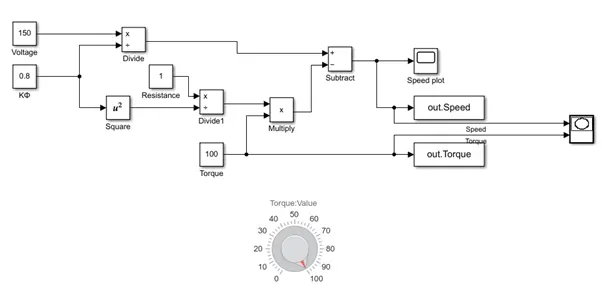
Here, Torque is a user input
Speed-Torque characteristics:
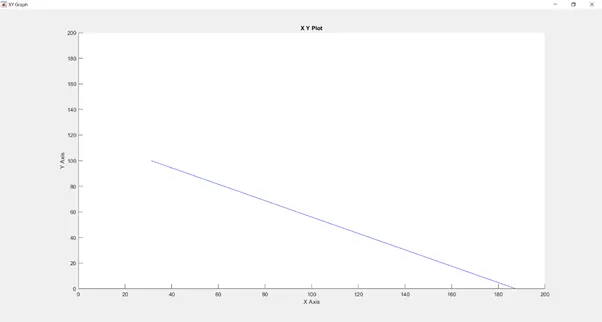
Here, X-axis is Speed (Rad/sec) and Y-axis is Torque (Nm).
As Speed-Torque characteristics represents a straight line equation, we can see a straight line in the graph.
- Refer to the blog on below topic:
Induction Versus DC brushless motors by Wally Rippel, Tesla
Explain in brief about author’s perspective.
Four points were discussed in the following blog:
One Size Does Not Fit All:
- In this part, the author describes about the various configurations of IC Engine and also there are various configuration in Electric vehicle too.
- The author discussed about the types of Batteries, Motor and controllers available before and today
A Closer Look:
Here, the author describes about the various configurations of EV:
- The first was DC Brushless drive motor and has explained the working of it.
- Next, he talked about Induction Motors which does not contain any magnets like DC Brushless drive motors. In Induction Motors, current flowing through the stator produces a rotating magnetic field in the stator windings. The main limitations of Induction motors are it can only operate in AC power supply.
Brushless or Induction?
Here, the author talks about the differences between both the motors and in which vehicle it is used:
- In DC Brushless drive, heat generated is less compared to Induction Motors and also the efficiency of Brushless is slightly higher compared to Induction.
- But for Induction Motors, inverter can reduce voltage such that magnetic losses are reduced and efficiency is maximized. Thus, the induction machine when operated with a smart inverter has an advantage over a DC brushless machine – magnetic and conduction losses can be traded such that efficiency is optimized.
- Next, he talks about that Induction Motors will cost less than Brushless but to control an Induction Motor is quite difficult compared to Brushless for achieving stability for the entire Speed-Torque region.
Still No Winner:
Here, the author talks about the dominance of both the motors:
He says that DC Brushless drives will likely continue to dominate in the hybrid and coming plug-in hybrid markets, and that induction drives will likely maintain dominance for the high-performance pure electrics.
He also says that Induction Motors and DC brushless live and work side by side during the coming golden era of hybrid and electric vehicles.