Week-6 Challenge: EV Drivetrain
Q1. Power Convertors used in EV and HEV systems-
Power controllers are used in EV and HEV systems for control and conversion of electric power. They process and control electric energy. The various types of power convertors used are as follows-
AC-DC convertor:
This type of convertors are called as Rectifiers. They convert AC supply to DC in order to be used. For EVs, they are used for Plug in chargers. The EVs get charged from a AC supply and the rectifier converts it to DC to store in the battery.
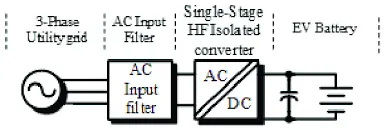
DC-AC convertor:
This type of convertor is called as an invertor. It converts DC power to AC. We can understand its use in EV and HEV as follows-
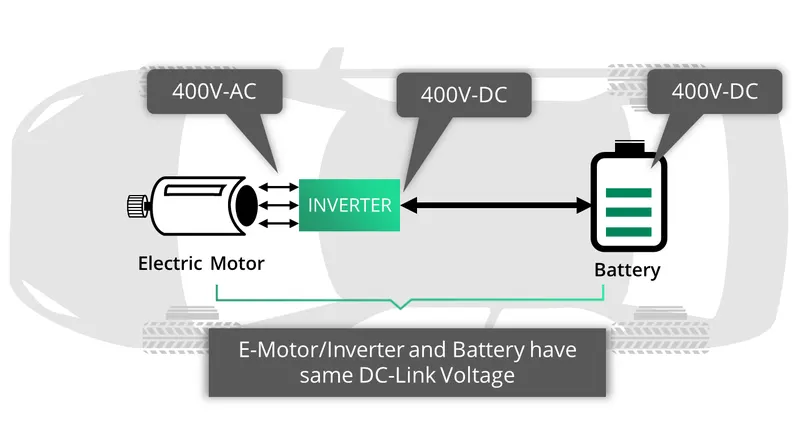
The battery power which is DC is converted to AC using the invertor and then fed to the AC motor for traction.
DC-DC convertor:
This convertor is called as a Chopper. It can be used to step up or step down the DC voltage level. It can be used to drive the auxiliary systems and the infotainment systems in the cars.
--------------------------------------------------------------------------------------------------------------------------
Q2. Steady state speed of EV-
The Given details are as follows-
`V_a`=72V
`I_a`=400A
`R_a`=0.5 `ohm`
`K_phi=0.7`
Chopper freq=400 Hz
Duty cycle=70%
Vehicle Speed torque equation- `T_v=24.7+.0.0051omega^2`
We know the formula of motor torque- `T_m=(V-omegaK_phi)*k_phi/R_a`
Putting values into this formula we get-
`T_m=(72*0.7-omega*0.7)*0.7/0.5`
=`(50.4-0.7omega)*1.4`
`therefore T_m=70.56-0.98omega`
Now from the block diagram we can see the `T_m=T_v`, equating them we get
`24.7+0.0051omega^2=70.56-0.98omega`
Rearranging to get a quadractic equation we get-
`0.0051omega^2+0.98omega-45.86=0`
Solving this equation we get two values for `omega`which are 38.91 and -231.07.
Taking the positive value we get -
`omega=38.91 (rad)/sec` or 371.56rpm
The point at which motor and vehicle characteristics meet is 371.56 rpm.
-----------------------------------------------------------------------------------------------------------------------------
Q3. Mathematical model of Motor-Torque equation
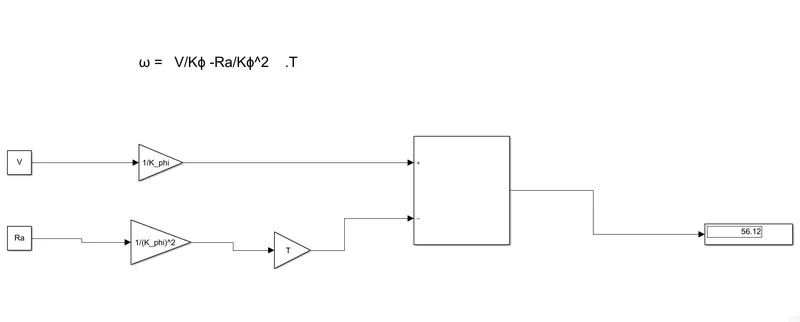
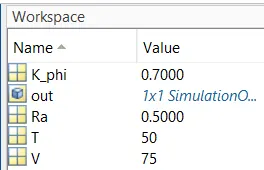
The inputs provided for the model in the workspace were as follows-
For which the output was 56.12 rad/sec as shown in the model. Now making a table with various inputs to compare the results-
| Torque | Speed(rad/sec) |
| 0 | 107.1 |
| 10 | 96.94 |
| 20 | 86.73 |
| 30 | 76.53 |
| 40 | 66.33 |
| 50 | 56.12 |
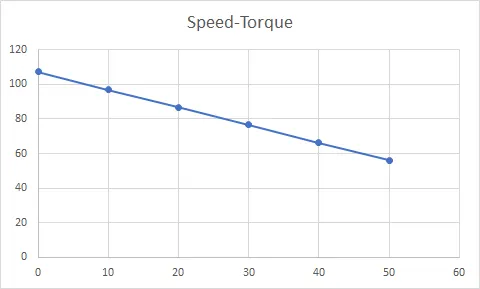
Inference:
We can see from the data that torque and speed are inversely proportionate, hence the correct model was designed.
-----------------------------------------------------------------------------------------------------------------------------------------------
Q4. Wally Rippel's take on motors used in EV-
This blog was written by Tesla's principle Power Electronics Engineer who was also involved with GM's EV1. He is discussing about the similarities and differences between Brushless DC motor(BLDC) and AC Induction motor (IM).
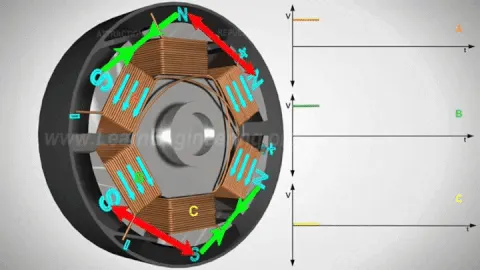
As their name implies, brushless DC motors do not use brushes. With brushed motors, the brushes deliver current through the commutator into the coils on the rotor. So how does a brushless motor pass current to the rotor coils? It doesn’t—because the coils are not located on the rotor. Instead, the rotor is a permanent magnet; the coils do not rotate, but are instead fixed in place on the stator. Because the coils do not move, there is no need for brushes and a commutator.
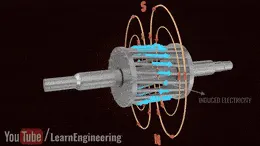
On the other hand, an induction motor or asynchronous motor is an AC electric motor in which the electric current in the rotor needed to produce torque is obtained by electromagnetic induction from the magnetic field of the stator winding. An induction motor can therefore be made without electrical connections to the rotor.
The author discusses how both of them are very useful and efficient and are widely used in the EVs. He also discusses the similarities in their stators. The main differences between them are the rotors and the invertor controls.BLDC motors need invertors to provide the right magnetic field whereas IM need frequency controllers to control their speed.And with digital controllers, the only control differences are with control code. (DC brushless drives require an absolute position sensor, while induction drives require only a speed sensor; these differences are relatively small.)
One of the main differences is that much less rotor heat is generated with the DC brushless drive. Rotor cooling is easier and peak point efficiency is generally higher for this drive. The DC brushless drive can also operate at unity power factor, whereas the best power factor for the induction drive is about 85 percent.
Efficiency of IM is better at light loads but at high loads BLDC is better. Cost wise IM are cheaper.
Finally he concluded saying that BLDC will rule the current market but IM will be used for high performance.