Week-6 Challenge: EV Drivetrain(Types of power converters used in EV and Hybrid electric vehicles, Calculating steady state speed of EV with duty cycle 70%,Mathematical model of DC Motor,Induction Versus DC brushless motors by Wally Rippel, Tesla)
CHALLENGE 6 (EV DRIVETRAIN)
1) Types of power converters used in EV and Hybrid electric vehicles.
In pure electric vehicles,AC to DC converters(Rectifiers) are used at charging ports as single phase or three phase AC supply are converted to DC supply to charge the battery.
Then according to the DC supply requirements DC to DC choppers are also used.
Then from battery to the motor,according to the motor types ,for induction motors DC supply converted to three phase AC supply by using 3phase inverter circuits.
And for bldc motors also regulated 3phase AC supply is given through DC to AC inverters.
For small auxilaries used in vehicles DC to DC choppers are used according to their requirements.(For head lamps,speakers,vehicle dashboard lights,Air condition unit,etc..)
In Hybrid model there are two types of vehicles.
a)Plug in hybrid model.
b)Without plug in model.
In both the models there is a necessary battery is present for using the vehicle in electric mode.
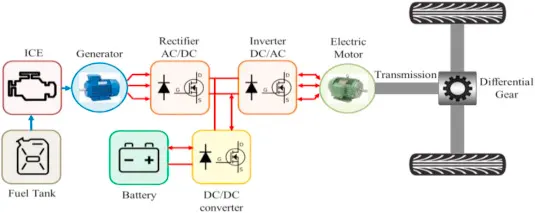
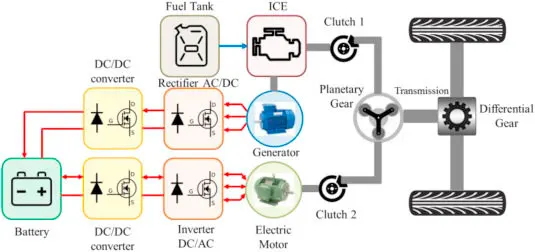
In non-plug in model the current generated by the generator coupled with engine is AC. So again AC to DC rectifiers are used to feed the battery.
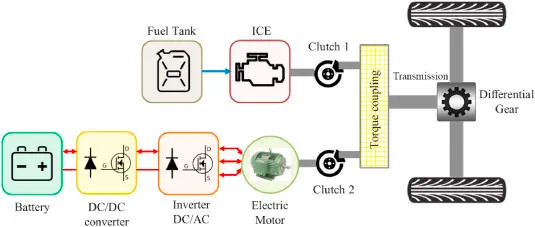
Again according to the motor requirements the power converters are used for motor input supply.
For auxilaries DC to DC choppers are used.
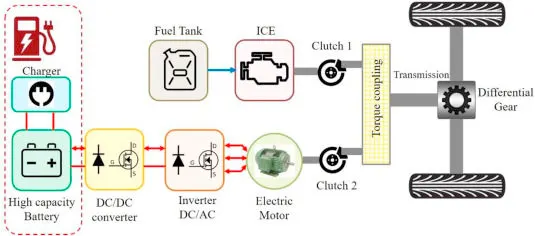
In plug in model rectifiers are used in charging ports to convert AC to DC supply.
If the vehicles are directly charging from fast charging DC Supply means DC to DC choppers are used to regulate the incomming DC supply to a regulated supply.
The below shown images clearly understand the useage of power converters in Electric vehicles.
Series HEV:
Parallel HEV:
Series-Parallel HEV:
Plugin HEV:
2) Calculating steady state speed of EV with duty cycle 70%
Given:
An Electric Vehicle's powertrain with 72V battery pack in shown in the diagram below.
The duty ratio for acceleration operation is 'd1' and for the braking operation the duty ratio is 'd2'.
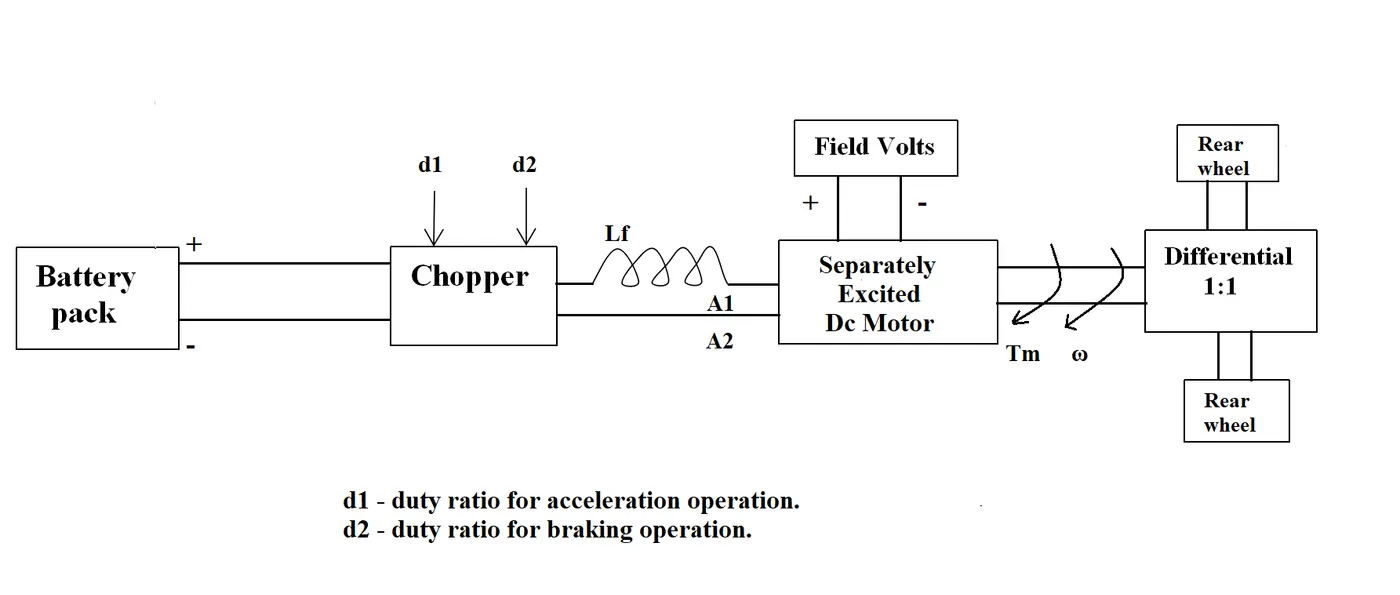
The other parameters of the electric vehicle is given below,
Motor and Controller Parameters:
Rated Armature voltage= 72 V
Rated armature current= 400 A
Ra= 0.5Ω, KΦ= 0.7 Volt second
Chopper Switching frequency= 400 Hz
The vehicle speed-torque characteristics are given by the below equation:
Tv=24.7+(0.0051)w^2 .....(1)
To find:
EV Steady state speed at duty cycle of 70%.
Calculations:
Step 1:
We Know velocity changes with respect to voltage applied to the motor.
Thus to change voltages steadly duty cycle should be change from 0 to 100%.
The duty cycle are produced as pulses of ON/OFF conditions as control signals from controller to power converter switches.
Here at 70% duty cycle we get rated armature voltage of,
V=(70/100)*72=50.4 V.
Step 2:
We know the torque equation of motor,
w=V/Kϕ - (Ra/(Kϕ^2))T
=> Tm= [-(w-(V/Kϕ))Kϕ^2] / (Ra)
Tm=[(V*Kϕ) - (w*Kϕ^2) ]/ Ra ......(2)
Subtitute values in (2)
Tm=[(50.4*0.7)-(w*0.49)]/0.5
Tm =[70.56 - 0.98w] ......(3)
Since differential(motor to Wheel) is in ratio 1:1 Tv=Tm,
equating (1) and (3),
24.7+(0.0051)w^2 = [70.56 - 0.98w]
=> 0.0051w^2 + 0.98w -45.86 =0
By solving equation,
w = -231.07 , 38.91
Result:
For motoring action the steady state speed in 38.91 rad/sec.
(i.e) steady state speed at 70% duty cycle is 38.91 rad/sec=371.5 rpm.
3) Mathematical model of DC Motor
Objective:
To model a DC motor of the given equation ω">ω= V/Kϕ">ϕ -(Ra/Kϕ">ϕ^2).T
Model:
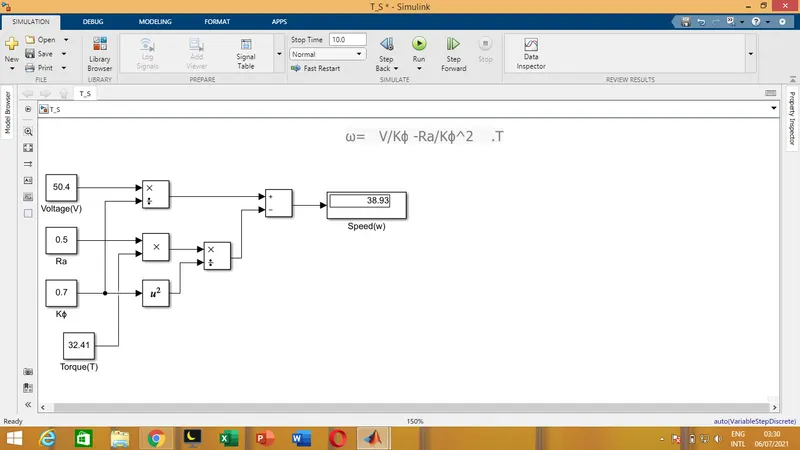
Working:
Here this model is created from torque speed equation ω">ω=V/Kϕ">ϕ -(Ra/Kϕ">ϕ^2).T using simulink.
Here we have verified this equation by giving the values of torque,Voltage,Ra,Kϕ.(From question 2).
Note: Model file attached outside.
4) Induction Versus DC brushless motors by Wally Rippel, Tesla
Here in this blog Wally rippel discussed about the brushless DC motor and Induction motors growth from 1960's to till future.He discussed about the major motors used for electric vehicles from late past to till dates. He come across the brushless DC motor and the induction motor invented by Nikola Tesla.The construction of Brush less DC motor are discussed as it has permanent magnet in its rotor, that produces magnetic linkage with the stator coils.However a inverter circuit is needed for BLDC motors as magnitude and polarity of the stator current should vary continuously to maintain the constant torque. Here the magnitude of the torque can be varried by changing the magnatic strength of stator coil(B). Here comes the action of inverter controllers to vary the magnetic strength.
While in induction motors there is no permanent magnet in rotors. Here also same as brushless DC motor, stator windings are driven by 3 phase utility power supply for varying the magnitude and polarity of the stator current.The rotor made up of thin lamination sheets connected by conductors.The rotating magnetic field produced in stator coupled with rotor conductors which inturn makeing current flow in conductors.This makes the rotor to rotate by producing rotation forces.It also need inverter action as induction motor not works in DC source.
And he said about the the difference between them only exist in rotor construction and inverter controls.
According to their effeciencies, BLDC motor works even in unity power factor which returns the meaning with peak effeiciency.Whereas induction motors works with nearly 85% effeiciency.
Both having their disadvantages and advantages as bldc motor size increases its magnetic losess and conduction losses increases whereas it will not affect in induction motors as it has no permanent magnets.Permanent magnets are in high cost.
Induction motors are more difficult to control over its speed rather than bldc motor ,that makes inverter operations much complecate to manufacture.
And he finally concluded that both the motors will shurely spark in coming future.BLDC make dominance in hybrid EV's and induction motors dominates the Pure EV's.And both motors having many components as similar makes them equally serving the automotives in side by side.
Thank you.
Submitted by,
Praveen Kumar L V
Date:05/07/2021.