Week-6 Challenge: EV Drivetrain
WEEK-6(EV DRIVETRAIN)
1. Which types of power converter circuits are employed in an electric and hybrid electric vehicle?
AC TO DC CONVERTER:
AC-DC converters are electrical circuits that transform alternating current (AC) input into direct current (DC) output. They are used in power electronic applications where the power input a 50 Hz or 60 Hz sine-wave AC voltage that requires power conversion for a DC output.
AC-DC converters can have more than one output and may feature overcurrent, overvoltage, or short circuit protection. Ruggedized devices are suitable for hard-wearing and shock-resistant, and used in military applications
AC-DC converters are used in computers, televisions, cell phone chargers, and other electronic consumer devices. They are also used in medical, military, and telecommunications equipment; kitchen appliances; industrial machinery; and commercial products that use DC motors.
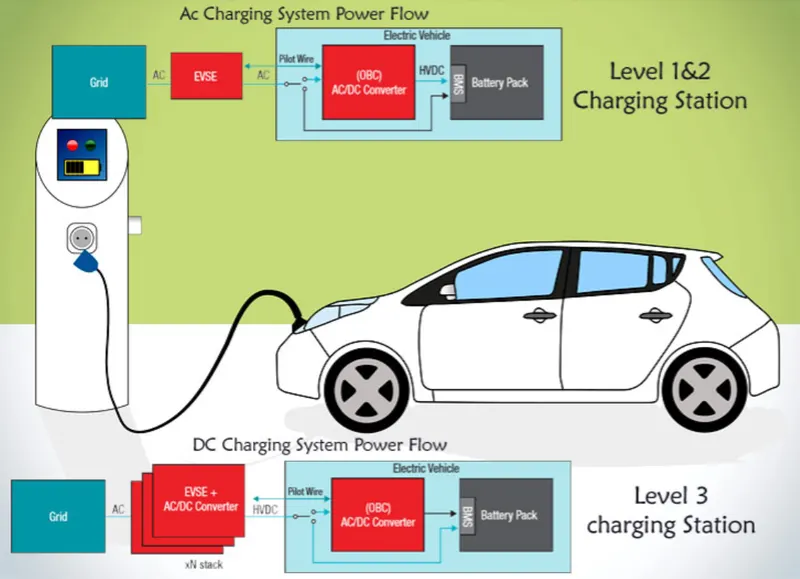
DC TO DC CONVERTOR:
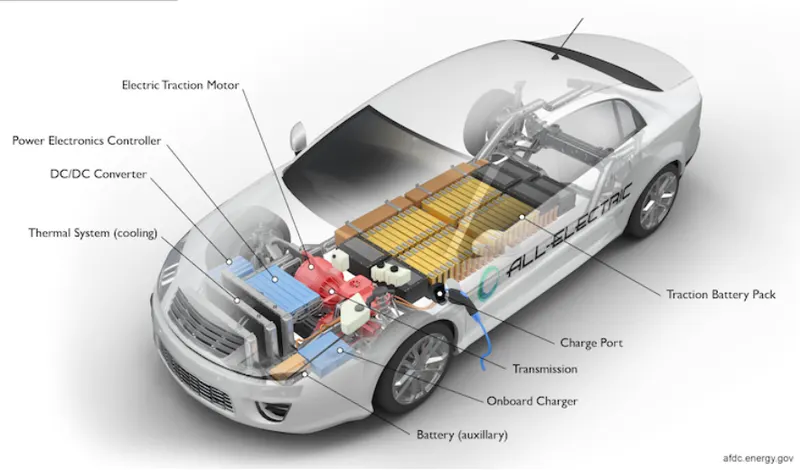
While DC/DC converters can be based on a number of different designs, the underlying function remains the same. a step-up converter, which turns a low-voltage input into a high-voltage output, or a step-down converter, which does the opposite.
DC TO AC CONVERTERS:
the conversion of DC voltage to AC voltage is a common problem. In any circuit, we can observe that if we design a circuit that takes the AC input and gives DC output. The inverter (converter) is frequently required in the circuits where DC to AC conversion is not possible. So, an inverter circuit is employed for converting the DC to an AC converter.
Electrical induction motors(AC) used dc to ac converters. convert the AC TO DC supply from the battery.
2.
Motor and Controller Parameters:
Rated Armature voltage= 72 V
Rated armature current= 400 A
Ra= 0.5Ω,
KΦ= 0.7 Volt second
Chopper Switching frequency= 400 Hz
The vehicle speed-torque characteristics are given by the below equation

What is EV steady-state speed if the duty cycle is 70%?
SOLUTION:
Vehicle output voltage(`V_v`)
`V_v`=Battery voltage*Duty cycle
`V_v`=72*0.7
Vehicle voltage=50.04v
torque equation:
Where
`T_v`= vehicle torque(N-M)
`V_v`= vehicle voltage(VOLTS)
`omega`= speed of the vehicle
`K_phi`= Motor constant
`R_a`=Armatire resistance
substitute all values in the equation
`T_v`=(50.O4-0.7*`omega`)/(0.5) = `70.56-0.98*`omega`
SOLVING THE ABOVE TWO EQUATIONS
`70.56-0.98*`omega`=24.7+0.0051*`omega^2`
0.0051.`omega^2`+0.98*`omega`-46.94=0
we get `omega` value is
`omega=38.85`
speed of the vehicle is =38.85rad/sec
3.
Develop a mathematical model of a DC Motor for the below equation using Simulink.
ω= V/Kϕ -Ra/Kϕ^2 .T
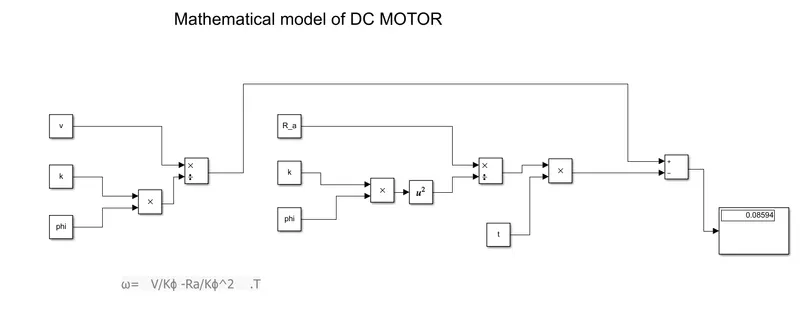
- Drag 3 constant blocks for give it names as V, K, phi.
- multiplied k and phi with using multiply block. than drag divided block and v divided with out putvalue
- create (Ra/Kϕ^2) drag constant blocks and create same as 1st equation
- Drag the sum and subtract block and 1st equation out put value connected with positive sign, and 2nd equation out put value connected with negative sign.
- Total out put connected with display bleck. Equation ω= V/Kϕ -Ra/Kϕ^2 .T of mathematical model created with using simulink.
4.INDUCTION AND DC BRUSHLESS MOTOR:
- An induction motor (also known as an asynchronous motor) is a commonly used AC electric motor. In an induction motor, the electric motor in the rotor needed to produce torque is obtained. The induction motor always runs at a speed less than its synchronous speed. The types of induction motor depend upon the input supply.
- With brushless machines, the rotor includes two or more permanent magnets that generate a DC magnetic field that enters the stator core interacts with currents flowing within the windings to produce a torque interaction between the rotor and stator.
- The DC brushless rotor, the induction rotor has no magnets.
- While 3-phase induction motors have great utility, they also have some severe limitations. They cannot operate from DC; AC is a must. Shaft speed is proportionate to line frequency.
- The induction motor is now capable of competing with DC and DC brushless for vehicle applications
- DC brushless drives will likely continue to dominate in the hybrid and coming plug-in hybrid markets, and that induction drives will likely maintain dominance for the high-performance pure electrics.