Week-6 Challenge: EV Drivetrain
1. Which type of power converter circuits are employed in electric and hybrid electric vehicles?
The electronic circuits used to control the powerflow in a circuit is called as power electronics. The components used in power electronics are power converters.
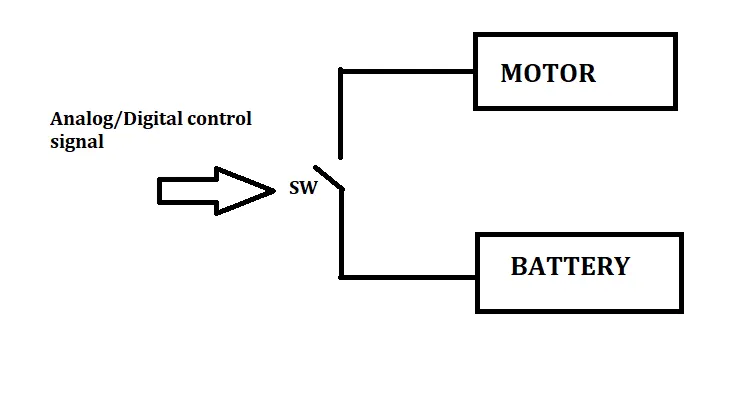
Here a switch SW is assigned between a battery and a motor in order to control the flow of current and voltage across the motor. This control can result to increase/decrease the speed of the motor according to the voltage provided with the opening and closing of the switch. Here the power flow between the battery and motor is purly controlled by the switch. The command to the switch is provided from the acceleration/braking pedals, i.e the change in angle of pedals are converted to a proportional base current which may be analog/digital in form.
There are mainly four types of converters:
1. AC to DC converter : It is refered as a rectifier, which converts AC form of a quantity to DC form.
In EV or HEV, the battery is DC and charging a DC battery needs DC but the grid are of AC type and there a convertion is required.
2. DC to AC converter : It is called as an invertor, which converts DC into AC of desired voltage and frequency.
In HEV and EV the inverter circuits are used to convert the battery DC voltage to AC if induction traction motors are used.
3. DC to DC converter : It is called as chopper, where high voltage DC can be converted to low voltage DC and vise versa.
It is used to power other components and auxillaries such as headlamps, entertainment system, Air conditioner etc.
4 AC to AC converter : It converts hih=gh voltage AC into low Voltage AC and vise versa.
There are no prominant application of this types of converter in HEV and EV. In ceiling fan regulators these types of coverters are used.
2. An electric vehicle's powertrain with 72V battery pack is shown in the diagram below. The duty ratio for acceleration operation is d1 and for the braking operation the duty ratio is d2.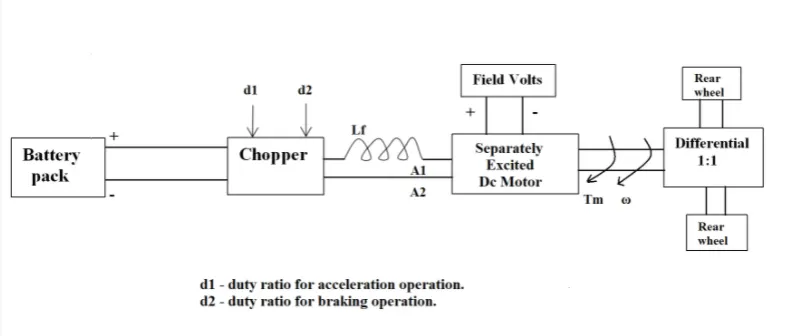
The other parameters of the electric vehicle is given below.
Motor and controller parameters:
Rated armature voltage : 72V.
Rated armature current : 400A.
Ra = 0.5`ohm`.
K`phi` = 0.7 Volt second.
chopper switching frequency = 400Hz.
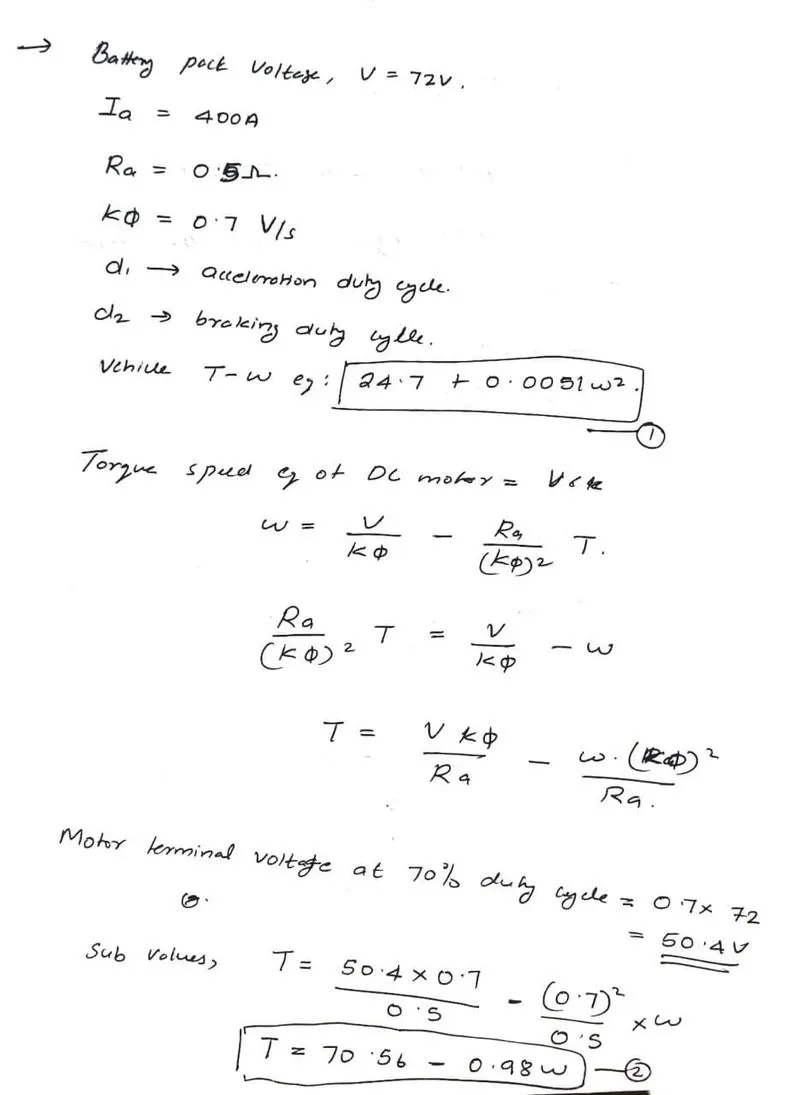
The vehicle torque-speed characteristics are given by the below equation,

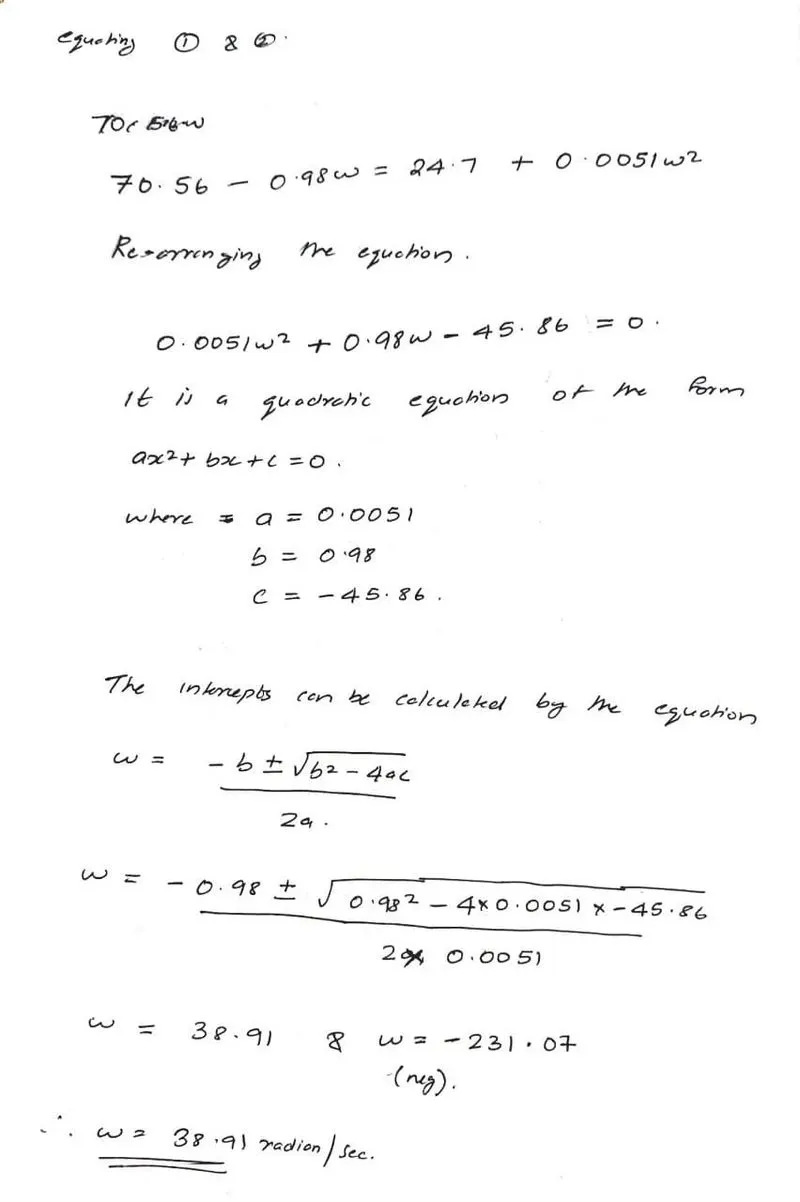
What is the EV stady state speed if duty cycle is 70%?
3. Develop a mathamatical model of a DC motor for the below equation using simulink.
`omega` = V/K`phi` - Ra/(K`phi`^2)*T
Here the above equation is plooted in simulink and speed is calculated with all other values inputted as constant.
A scope is placed at the speed terminal in order to trace the point of speed in the graph with respect to time. Here torque is calculated using the equation,
T= (total tractive force) * (radius of the wheel).
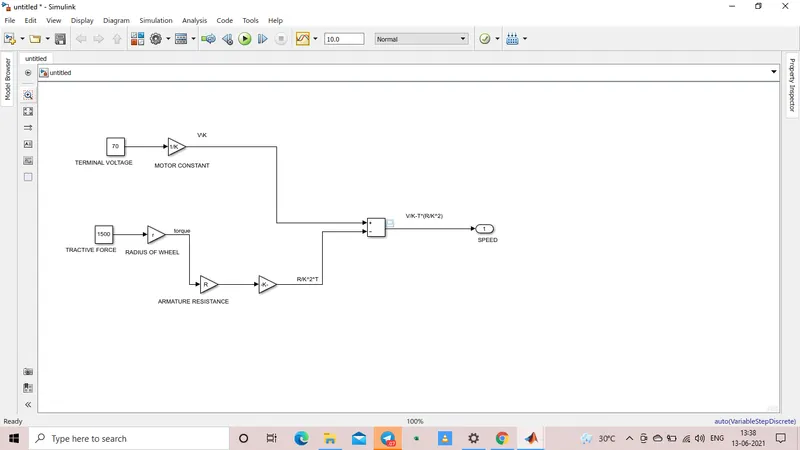
The values of constants are provided in the workspace by running a script file with the constant values. these values are then selected at the gain blocks and the simulink is then made run.
Here the values provided are:
K = 0.7 V/sec.
Ra = 0.5`ohm`.
F(t) = 1500N.
r= 0.6 m.
Terminal voltage = 70V.
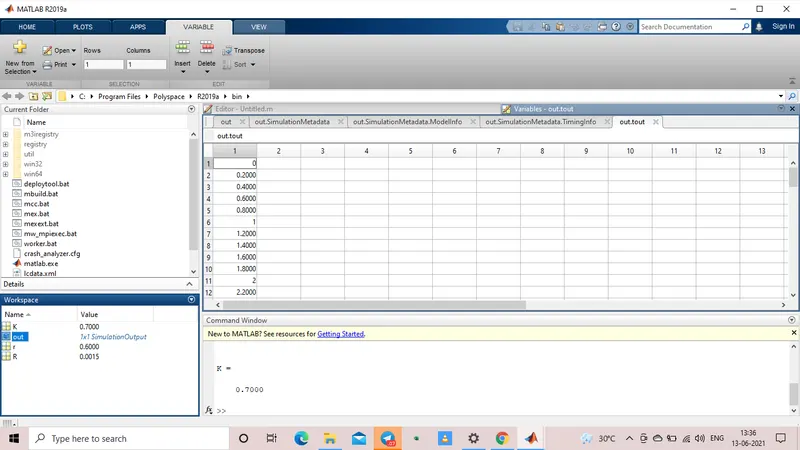
we get the speed at 97.65 radian/second which is made plotted in the graph against the time using a scope.

4.Refer the blog, https://www.tesla.com/blog/induction-versus-dc-brushless-motors
Explain in brief about the author's perspective.
The blog by Wally Rippel which tells the evolution of EV from years as an introduction. He briefed that the lead acid batteries are been replaced by lithium ion which is more efficient in all perspective, brushed DC motor being replaced by brushless DC (BLDC) and induction motor (IM).
He described the working principle, construction of both BLDC and IM and also compared both of them in terms of perfromance,efficiency,size etc which is explained below.
The construction of BLDC motor is such that the stator is made of thin and stacked laminations. The stator interacts with the current flowing within its winding to produce a torque interaction between stator and rotor. The rotor is made of two or more permanent magnets and it rotates only when the simultaneous action of current flow in the stator windings (ON and OFF for some time) happens. The BLDC type motor must have an inverter circuit othewise this motor is a total waste.
The construction of stator of an IM is same as that of the BLDC but we provide an AC supply from grid here. The rotor is of wounded or squirel cage type and no permanent magnet type are used here. Here for its working there is no need of inverter circuit but for better efficiency they are used. The working of IM is such that the stator magnetic field creataor is of rotating type in which the rotor is placed, when the current passes through the rotor the resultant magnetic fielf vector is generated and rotor tries to catch up with the resultant, as a result the rotor rotates.
He also compared the BLDC motor with the IM
1. In BLDC the heat generated in rotor is less when compared to the IM rotor.
2. The BLDC motor needs an inverter for its working but the IM doesn't need one but for better performance and efficiency IM also uses inverter and feedback circuits.
3. By increasing the size of BLDC motor for more power output, it may produce more losses when compared to the BLDC motor in small size but increasing the size of IM will not produce huge change in its losses.
4. Permanent magnets are expensive i.e BLDC motor are more expensive than IM.
5. since IM do not have any permanent magnet controlling the magnetic field is easy and easy to reduce hysterisis and eddy current losses, but in BLDC motor we cannot adjust the rotor magnetic filed strenght because of the permanent magnets.
6. Peak efficiency will be more in BLDC motor than IM but the average efficiency are almost same.
7. The IM provide a little low torque than the BLDC type.
By accomodating all the factors walley Ripple came to the conclusion that BLDC will rule the HEV and IM will be usefull in high power application electric vehicle. He also concluded that there are no ideal motor and each types of motor have there own advantages and disadvantages and selection is only based on the purpose.