Week-6 Challenge: EV Drivetrain
1.
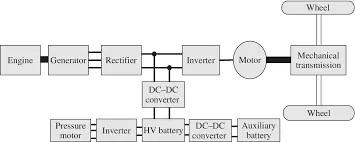
power converter circuits are employed in electric and hybrid electric vehicles.
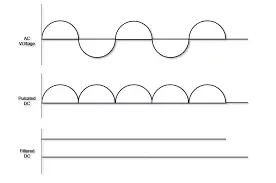
- Rectifier: this converts AC signal into DC signal mainly used to charge the battery from AC source.
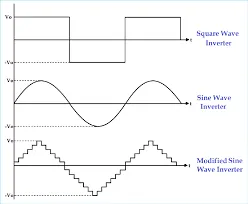
- invertor: this converts DC into AC used because when we are using induction motor as motor drive it requires 3-phase AC supply and hence batteries DC supply is converted to AC using invertor.
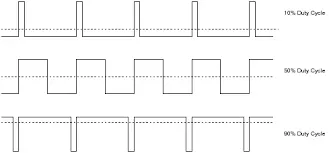
- DC TO DC converter: The main dc-dc converter changes dc power from an onbe.oard 200-800V high voltage battery into lower dc voltages (48V or 12V) to power headlights, interior lights, wiper, and window motors. this converter can be used both as a step-up and step-down. this converter depends on the duty cycle.
- buck converter: acts similar to a step-down transformer.
- boost converter: acts similar to a step-up transformer.
- buck-boost convertor: it can act both as step-up/down depending upon the duty cycle
2.
given:
- Vb= 72V
- d1= acceleration suty cycle= 70%
- d2= braking duty cycle
- Ra= 0.5ohm
- K`phi`= 0.7V/s
- chopper switching frequency = 400hz
- Va= 72V
- Ia= 400A
solution:
V= 70% of the battery voltage/supply voltage = 0.7*72= 50.4V
`omega` = `V/(k*phi)` - `R/(k*phi)^2*T`
the above equation can be rearranged as
T= `(V*kphi)/(Ra)-((kphi)^2)/(Ra)*omega` ------> 1
now,
substituting the above given values into the equation-1 above we get.
T= `70.56-0.98omega` -------->2
The vehicle speed-torque characteristics are given by the below equation
 -------->3
now comparing equations 2&3 we get
`70.56-0.98omega`= `24.7+(0.0051)omega^2`
rearranging the equation we get
`0.0051omega^2+0.98omega-45.86=0`-------->4
here the above equation is similar to a quadratic equation `ax^2+bx+c`
- a=0.0051
- b=0.98
- c=-45.86
know solving the quadratic equation using the formula:
`omega=(-b+-root2(b^2-4ac))/(2a)`
substituting the value of a,b,c we get
`omega`= 38.91rad/sec
therefore:
EV steady-state speed if duty cycle is 70%= 38.91 rad/sec.
3.
https://www.tesla.com/blog/induction-versus-dc-brushless-motors
from the above blog the authors perspective is as follows:
According to the author, there is no machine that is a winner of all time for this statement he gives an example of the changes that have occurred in batteries, where lead-acid is replaced by lithium-ion batteries and DC motors are replaced by induction and brushless DC motors. and later he gives brief working and construction of these two motors both the stators have three sets of distributed windings, the difference lies in the rotor where BLDC uses permanent magnets but the induction motor uses a stacked steel lamination with buried peripheral conductors that form a shorted structure and also BLDC requires inverter without which its useless by comparing them the author is inclined towards the induction motor even though they are not good at providing the required torque and also more difficult to control compared to BLDC in terms of long-range perspective their advantages are as follows: 1) at light loads the inverter can reduce voltage such that magnetic losses are reduced and efficiency is maximized. 2) magnetic and conduction losses can be traded such that efficiency is optimized. 3) as machine size grows, losses do not necessarily grow. 4) peak efficiency will be a little less than with DC brushless, but average efficiency may actually be better. 5) Permanent magnet (PM) rotors are also difficult to handle due to very large forces that come into play when anything ferromagnet gets close to them and also they are expensive. from these, the author concludes DC brushless drives will likely continue to dominate in the hybrid and coming plug-in hybrid markets, and that induction drives will likely maintain dominance for the high-performance pure electrics.