Week-6 Challenge: EV Drivetrain
Problem statement:
1. Which types of power converter circuits are employed in electric and hybrid electric vehicle?
2. An Electric Vehicle's powertrain with 72V battery pack in shown in the diagram below. The duty ratio for acceleration operation is 'd1' and for the braking operation the duty ratio is 'd2'.
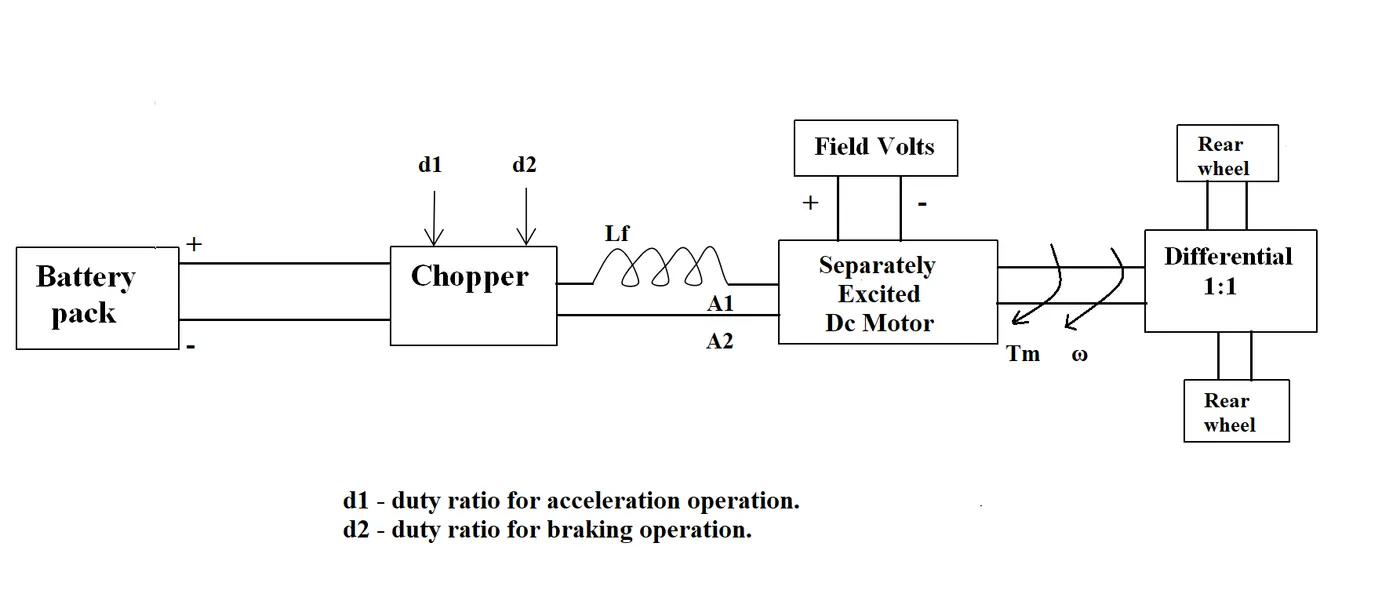
The other parameters of the electric vehicle is given below,
Motor and Controller Parameters:
Rated Armature voltage= 72 V
Rated armature current= 400 A
Ra= 0.5Ω, KΦ= 0.7 Volt second
Chopper Switching frequency= 400 Hz
The vehicle speed-torque characteristics are given by the below equation

What is EV steady state speed if duty cycle is 70%?
3. Refer to the blog on below topic:
Induction Versus DC brushless motors by Wally Rippel, Tesla
Explain in brief about author’s perspective.
Solution:
1. Power converter circuits in Electric Vehicle:
A power converter is a device that processes and controls the flow of power from the source to the load in suitable form and magnitude.
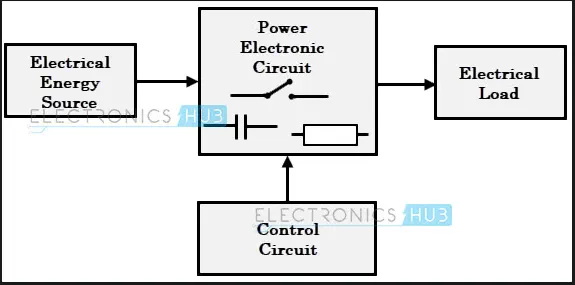
Power electronic circuit consists of power electronic components such as MOSFET, IGBT semiconductor devices which work as switching devices. The power electronic circuit has two inputs: power from source and control signal from controllers; and it has one output: load.
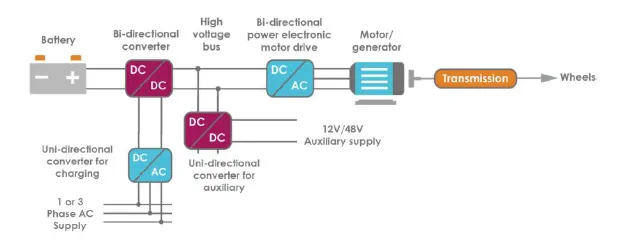
- AC/DC converter: This device converts the AC power to DC power and it enables the vehicle to accept single or three-phase AC power from the grid and convert it to a suitable form of power to charge the battery. It is unidirectional in nature. This power converter is bypassed if the vehicle is charged with DC power, wherein the AC/DC converter is present within the charger. It is also called a rectifier and it alters both the form and amplitude of the power supply. It is absent in the vehicles that do not charge the battery from external power sources such as HEVs.
- DC/DC converter: It is bidirectional in nature and present between the battery and the motor if it is of DC type. The battery supply voltage is lower than that required by the motor drive. Hence this power converter does not change the form of power but increases the amplitude. It is a step-up converter. During the regenerative braking, the motor drive supplies energy to the battery. In this case, the converter works to step-down the power to suit the battery rated voltage.
- DC/DC converter: It is unidirectional in nature and present between the battery and auxiliary devices. The battery supply voltage is high and unsuitable to power auxiliary devices that require a supply of 12 V. Hence, this power converter works as a step-down converter by reducing the amplitude.
- DC/AC converter: It is bidirectional in nature and present between the battery and motor if it is of AC type. This power converter alters both: form and amplitude of electric power. It steps up the power if the power flows from battery to motor drive and steps down the power if the power flows from motor drive to battery in the case of regenerative braking. It is also known as an inverter.
2. Calculation of Steady Speed of EV:
The average voltage supply to the motor: V_avg= V_battery*Duty_cycle = 72*70/100 = 50.4 V
As seen in the schematic diagram, there is no gear and the differential has gear ratio of 1:1. So, it can be inferred that the motor and vehicle speed and torque are the same. `tau_m=tau_v` and `omega_m=omega_v`
From the motor characteristics equations, we obtain: `omega_m=V_t/(kphi)-R_a/(kphi)^2*tau_m = 50.4/0.7-0.5/0.7^2*tau_m = 72-1.0204*tau_m`
where `omega_m`=angular velocity of motor
`V_t`is terminal voltage applied to battery, that is same as `V_(avg)` due to applied duty cycle.
`kphi`is the design constant of motor which is given as 0.7
`R_a`is the armature resistance of the motor, given as 0.5 ohm
`tau_m`is the motor torque
The speed-torque characteristics equation of the vehicle is given as: `tau_v=24.7+0.0051omega_v^2`
Substituting the Motor equation in the above equation: `omega=72-1.0204(24.7+0.0051omega^2) implies 0.0052omega^2+omega-46.796=0`
Solving the above quadratic equation we get: `omega=38.92`radians/second
3. Summarization of Induction motor vs brushless DC motor perspective of Wally Rippel:
- The author stresses the fact that there is no one best engine, likewise, there is no one best motor to be used in Electric Vehicles. Different EVs are built for different purposes such as off-roading, city driving, track racing etc. Hence, to suit these purposes, different motors are used to provide traction force.
- The similarity between the induction motor and DC brushless motor is with the stator. In both motors, three sets of windings exist in the stators. In DC brushless motor, the stator is located at the center of motor and in induction motor, the stator is located towards the periphery of the motor.
- The difference between both kinds of motors is with the rotor construction. DC brushless motor has a pair or more permanent magnets as the rotor surrounding the stator. Whereas, the induction motor has stacked steel laminations with conductors at the periphery of the rotor surrounded by the stator.
- The induction motor is compatible with the utility 3-phase power and hence, no inverter is needed. It has the ability to start under load. Whereas, DC brushless motor cannot produce starting torque with fixed frequency power. It needs inverter with phase difference compatible with angular position of rotor.
- Though the induction motor can run with utility power it cannot run on DC power. The speed of the shaft is proportional to frequency of the power supply, hence it is constant speed motor unless the supply frequency is varied.
- The induction motor is not compatible with EVs. Since EVs have batteries as the power source that supply DC current. In order to make it compatible, the inverter is used. The feedback loop to the inverter varies the frequency of the current to match the desired speed of the vehicle.
- Another difference between the two kinds of the motor is that the DC brushless motor requires a position sensor for rotor and induction motor requires speed sensor.
- The advantage of the DC brushless motor is that it generates much less rotor heat and can be easily cooled. It has higher efficiency and can operate at utility power factor.
- The advantage of the induction motor is that it does not have permanent magnets, hence the magnetic field can be electrically adjusted since it is proportional to voltage/frequency of supply power. This minimizes the eddy, hysteresis and I^2 losses.
- The DC brushless motor is expensive since the permanent magnet costs 50 US dollars per kilogram but the motor control is simpler and easy. With the capability to reduce magnetic field strength, induction motor is cheaper, since it can use a lower rating inverter but the motor control is complex and difficult.
- DC brushless motor dominate in the HEVs and induction motor dominate in high performance EVs. However, there is the possibility for HEVs to accommodate both drives to work parallelly as HEVs become more electrical.