DRIVETRAIN OF AN ELECTRIC VEHICLE
AIM :
To perform the various operations corresponding to an Electric vehicle inorder to fulfill the required objectives that were provided.
OBJECTIVE :
- To study the various types of power converter circuits employed in electric and hybrid electric vehicle.
- To calculate the EV steady state speed for the given Electric Vehicle's powertrain.
- To study and brief the blog done by Wally Rippel from Tesla.
1. Study of the various types of power converter circuits employed in electric and hybrid electric vehicle
Power Electronics :
Power electronic converters are used everywhere in normal daily routines at home, commercial workplaces or in an industrial environment
Due to the high power handling with higher efficiencies, these converters become an integral part of industrial electric drives, high electric power supplies, electric traction systems and automobile control equipments.
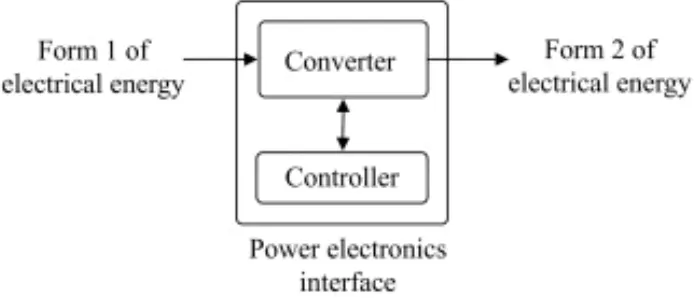
There are different types of power electronic converters used for performing different functions (such as inversion, rectification, etc.) which are rated from a few milliwatts to a few thousand watts. Let us look at these converters in detail.
The primary task of power electronics is to process and control the flow of electric energy by supplying voltages and currents in a form that is optimally suited for user loads. Modern power electronic converters are involved in a very broad spectrum of applications like switched-mode power supplies, active power filters, electrical-machine-motion-control, renewable energy conversion systems distributed power generation, flexible AC transmission systems, and vehicular technology, etc.
Alternating current (AC) :
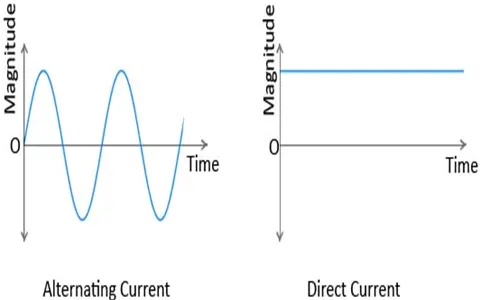
Alternating current describes the flow of charge that changes direction periodically. As a result, the voltage level also reverses along with the current. AC is used to deliver power to houses, office buildings, etc.
AC can be produced using a device called an alternator. This device is a special type of electrical generator designed to produce alternating current.
A loop of wire is spun inside of a magnetic field, which induces a current along the wire. The rotation of the wire can come from any number of means: a wind turbine, a steam turbine, flowing water, and so on. Because the wire spins and enters a different magnetic polarity periodically, the voltage and current alternates on the wire.
Direct current (DC) :
Direct current is a bit easier to understand than alternating current. Rather than oscillating back and forth, DC provides a constant voltage or current.
DC current can be generated using a number of ways such as a commutator, rectifier and through batteries.
DC is defined as the "unidirectional" flow of current; current only flows in one direction. Voltage and current can vary over time so long as the direction of flow does not change. To simplify things, we will assume that voltage is a constant.
Types of Power converters :
The types of power converters include,
- AC-DC converter
- DC-AC converter
- DC-DC converter
- AC-AC converter
AC-DC converter :
AC-DC converters take the AC power from wall outlets and convert it to unregulated DC. These power supplies include transformers that change the voltage of the AC that comes through wall outlets, rectifiers to save it from AC to DC and a filter that removes noise from the peaks and troths of the AC power waves.
Ex : Rectifiers
DC-AC converter :
DC-AC converters converts DC electricity from sources such as batteries or fuel cells to AC electricity. The electricity can be at any required voltage, in particular it can operate AC equipment designed for mains operation, or rectified to produce DC at any desired voltage.
Ex : Inverter
DC-DC converter :
As its name implies, a DC-DC converter converts one DC voltage to another. The operating voltage of different electronic devices such as ICs can vary over a wide range, making it necessary to provide a voltage for each device.
Ex : Chopper
AC-AC converter :
AC-AC converters are also called as Cycloconverters.Cycloconverters are majorly called as frequency changers that convert the AC power with one input frequency to AC power with a different output frequency and can be used for changing the magnitude of the AC power also.
Ex : AC voltage regulator
2. Calculating the EV steady state speed for the given Electric Vehicle's powertrain
The Electric vehicle powertrain contains the battery pack which was attached below,
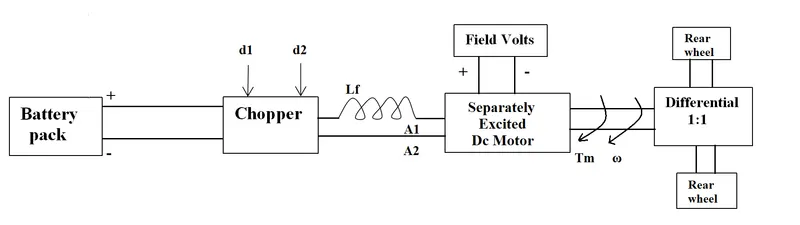
The Motor and controller parameters include,
Rated Armature voltage= 72 V
Rated armature current= 400 A
Ra= 0.5Ω
K= 0.7 Volt second
Chopper Switching frequency= 400 Hz
`omega` is the steady state speed to be found.
Speed-Torque characteristics is given by the below equation,
T = 24.7 + (0.0051)`omega^2`
We know that,
Vout = Vbat * duty cycle
= 72 * 0.7
= 50.4
Torque - Speed relation for DC motor,
T= Kt*V/Ra−Ke*Kt ω/Ra
Here Kt & Ke = K ,
∴ T = `50.4*0.7/0.5 - 0.7^2/0.5 omega`
T = 70.56 - 0.98ω
Equating both the Torque equations ,
70.56 - 0.98ω = 24.7 + (0.0051)`omega^2`
`omega^2` + 192.151`omega` - 8992.15 = 0
`omega` = 38.91 rad/s
The EV steady state speed was found to be 38.91 rad/s.
3. Induction versus DC brushless motor by Wally Rippel
In this blog the author precisely explains about the pros and cons of both Induction and DC brushless motor. The construction, advantages of both the devices taken for comparison has been explained in detail.
- The Electric vehicles differ in usage, performance and prices in the same way as the conventional vehicles.
- Initially lead acid batteries , DC brushed motors were used which were then replaced by lithium batteries and DC brushless motors respectively. Thus the author states the evloution of the technology from time to time.
- Considering the DC motors, the magnitude and polarity of the stator currents must be varied continuosly keeping the torque as constant.As a result the Electrical to Mechanical conversion is very efficient.
- Nikola Tesla invented the Induction motor sometime before 1889,which contains the same type of stators and number of windings as in the DC motor.
- The major difference between these two motors were the rotors, since they share the same type of stator.
- Induction motors doesn't have magnets instead they contain stacked steel laminations. The current produced within the rotor is propotional to the voltage. This current helps in producing the magnetic field. The best power factor here is 85%.
- Induction motor does not require inverters whereas DC brushless motors require inverters to develop torque.It maintains the step with the angular position of the motor.
- In DC brushless motors , by adjusting the frequency , Variable speed could be achieved.
- Nowadays most of the vehicles uses DC brushless motors. Some vehicles like GM EV1 and Tesla Roadster uses Induction motors.
- DC motors require absolute position sensor whereas Induction motors require a speed sensor.
- Induction motors are difficult to control compared to the DC brushless motors.
The Author summarizes that both the motors have their own pros and cons and they are widely used in various applications. Induction motors are mostly used only in Pure EVs unlike DC brushless motors which are used widely in HEVs and PHEVs. The fact that so much of the hardware is common for both drives could mean that we will see induction and DC brushless live and work side by side during the coming golden era of hybrid and electric vehicles.
CONCLUSION :
All the given objectives were satisfied with atmost perfection.
The calculations , images and files were attached wherever necessary.