Week- 5 - Solid meshing
AIM
Structural solid meshing in ANSA and defining a volumetric property for every without getting any quality failures for best mesh flow.
PROCEDURE
I started working on this model from the geometry clean up to see if it has any errors and unwanted cons generated and also to check the con errors.
After doing topology I see an triple con error in the model where the 3 parts are meeting. So I isolated all the parts and done topo again it do not consider it as a triple con error.
So isolated and working on each of the part will gives me a better mesh.
So 1st I suppressed the unwanted cons on the fillet areas because that is failing for the minimum length and then I go to the mesh.
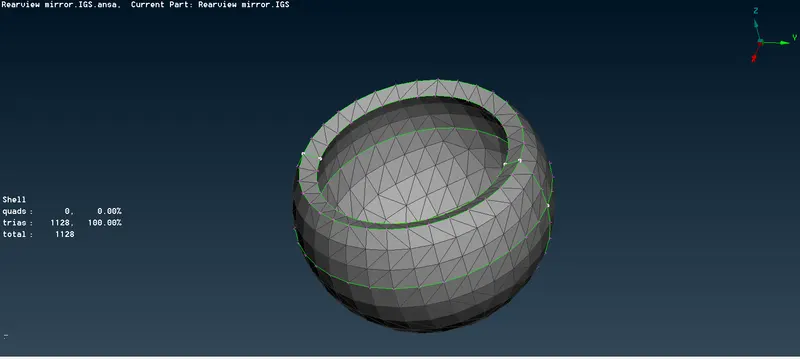
Here I used tria mesh in the flat surface and ortho tria in the bend areas, fillets, holes nearby.
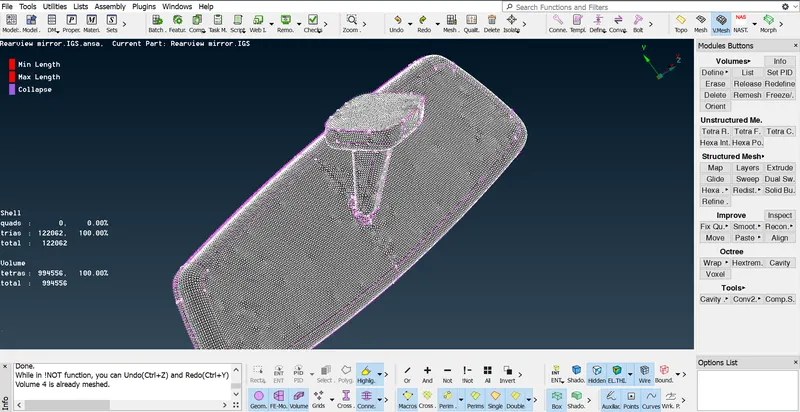
Isolating the mirror and the holder is good because it is failing for the Intersection error in the tetra mesh.
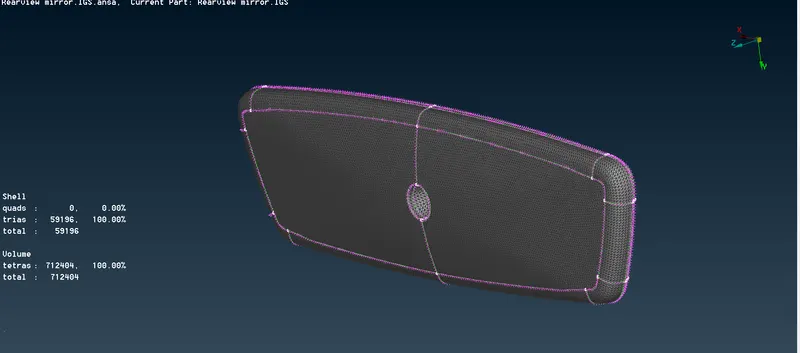
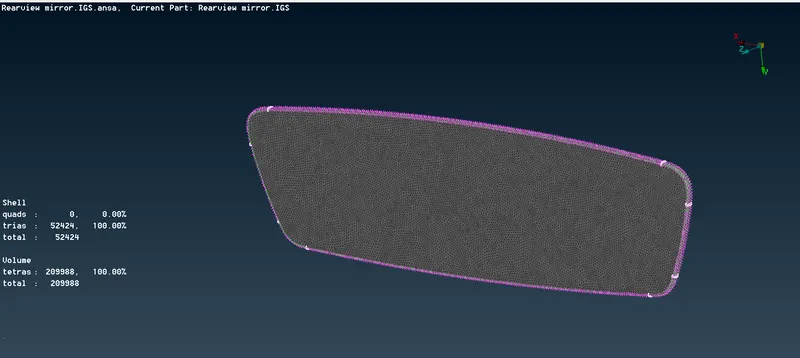
After doing all the surfaces meshed properly check for the min and max quality error.
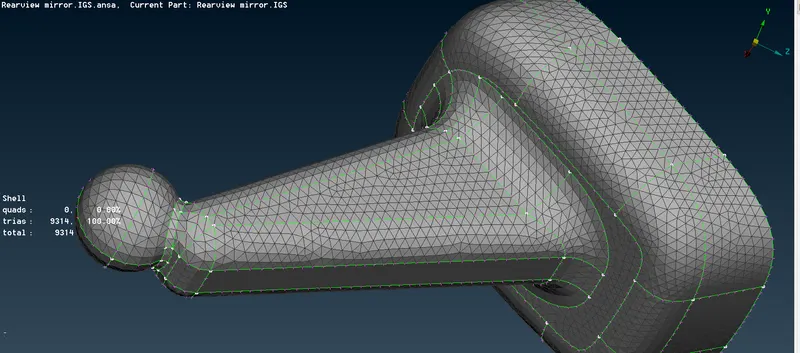
Now in the volume mesh deck, create a new volumetric PID for the every component because I got an penetration error in the tetra meshing.
Isolating and giving the PID in the list deck and giving the volume each part on by one in my idea.
After the tetra mesh check for the tet collapse error and also check any kinks and dips present in the model.
LEARNING OUTCOMES
- Volume deck and setting new volume PID for the every element.
- Tria and ortho mesh is very new & I done it perfectly without getting any errors.
- Tetra meshing is very easier than compared to 2d meshing.
- Ive done this model without getting any errors in the single shot.
- Understanding the ortho and tria meshing.
Conclusion
Solid meshing for the element is a method that we can done by ortho and tria mesh and it capturing a tetra fem model. Check only the tet collapse and kinks and dips present in the model.