Rayleigh Taylor Instability simulation
AIM: To perform a Rayleigh Taylor instability simulation for two different mesh sizes.
THEORY:
Rayleigh Taylor Instability: It is an instability of an interface between two fluids of different densities which occurs when the lighter fluid pushes the heavier fluid.
Atwood Number: It is a dimensionless number in fluid dynamics used in the study of hydrodynamic instabilities.
`A=(ρ_1-ρ_2)/(ρ_1+ρ_2 )`
ρ1 = density of heavier fluid
ρ2 = density of lighter fluid
Some practical CFD models based on the mathematical analysis of Rayleigh Taylor waves:
- Plateau-Rayleigh Instability: This instability explains why and how a falling stream of fluid breaks up into smaller packets with the same volume but less surface area. It is related to the Rayleigh Taylor instability.
- Richtmyer–Meshkov Instability: The Richtmyer–Meshkov instability (RMI) occurs when two fluids of different density are impulsively accelerated. Normally this is by the passage of a shock wave.
PROCEDURE:
Geometry: The geometry was constructed in SpaceClaim for both the top and bottom fluid surfaces having dimensions 20mm*20mm. Using the pull tool, the geometry was converted to a 2-D surface. And in order to have a conformal mesh, share topology was enabled.
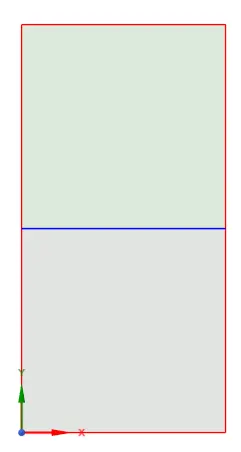
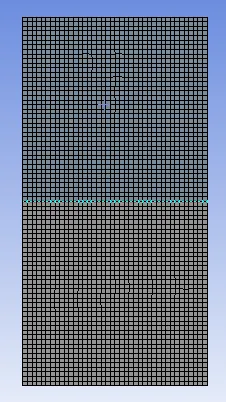
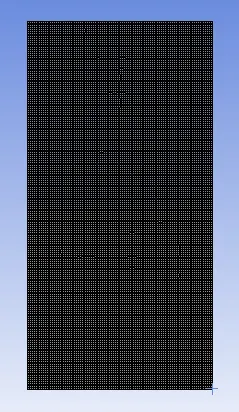
Mesh: Mesh sizes were taken as 0.5 mm and 0.2 mm.
Mesh size = 0.5 mm
Mesh size = 0.2 mm
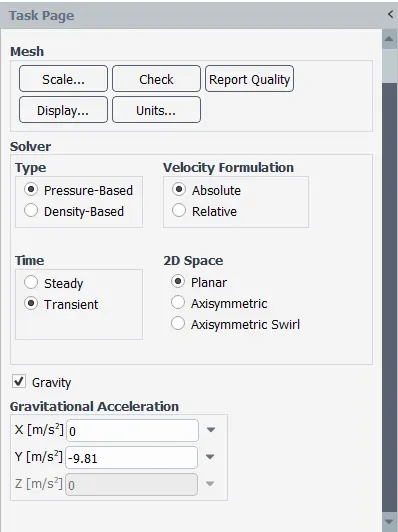
Setup and Solution:
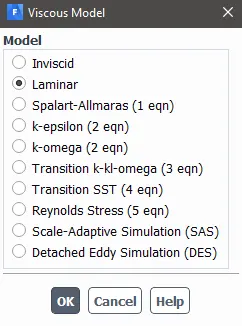
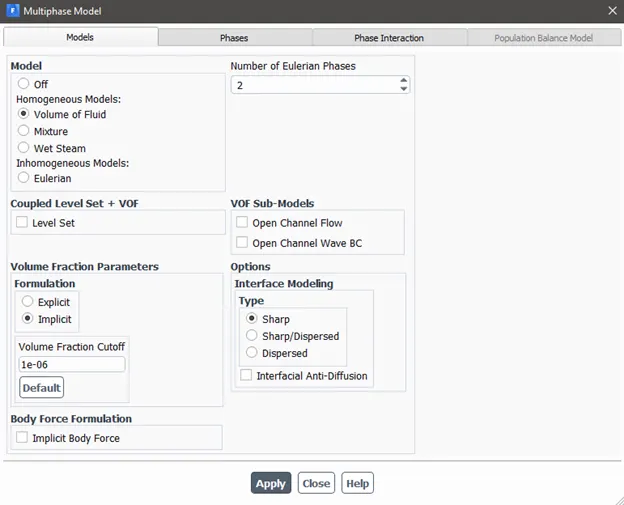
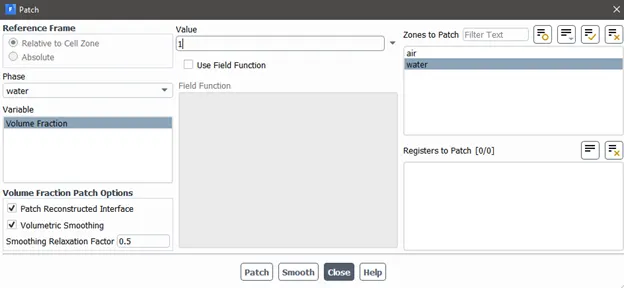
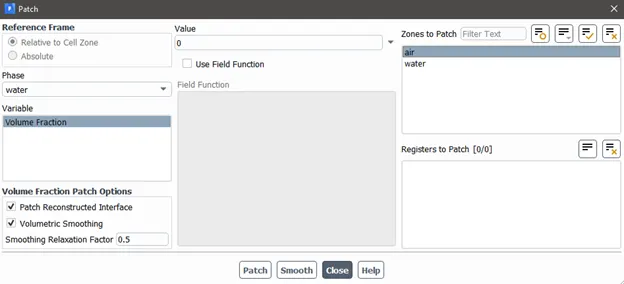
Results:
Case 1:
Mesh size = 0.5 mm
Primary phase – Air
Secondary phase – Water
Time step size = 0.005 s
No of time steps = 1000
Link for animation file: https://drive.google.com/file/d/1k0WR-LJzOs-BqFUAK2g8MpbPK0ZNL_9L/view?usp=sharing
Atwood number calculation:
ρ1 = 998.2 kg/m3
ρ2 = 1.225 kg/m3
`A=(998.2-1.225)/(998.2+1.225)`
`A=0.997`
Case 2:
Mesh size = 0.2 mm
Primary phase – Air
Secondary phase – Water
Time step size = 0.005 s
No of time steps = 1000
Link for animation file: https://drive.google.com/file/d/1k8d5p3kF9WREHiBN9aU_kno2Xx2rofIB/view?usp=sharing
Atwood number calculation:
ρ1 = 998.2 kg/m3
ρ2 = 1.225 kg/m3
`A=(998.2-1.225)/(998.2+1.225)`
`A=0.997`
Case 3:
Mesh size = 0.2 mm
Primary phase – User-defined fluid
Secondary phase – Water
Time step size = 0.005 s
No of time steps = 1000
Link for animation file: https://drive.google.com/file/d/1kAbkVyIu00B25uopUbKKRoa6b40bLRig/view?usp=sharing
Atwood number calculation:
ρ1 = 998.2 kg/m3
ρ2 = 400 kg/m3
`A=(998.2-400)/(998.2+400)`
`A=0.427`
Conclusion:
- A finer mesh captures the instabilities more properly than a coarse mesh.
- A transient approach is preferred since the instability simulation occurs in an unpredictable manner and changes as a function of time.
- Higher Atwood number refers to a higher rate of mixing, and the instability begins with a bubble-like formation.
- Lower Atwood number refers to a lower rate of mixing, and the instability begins with finger-like formations.