CHT Analysis on Exhaust Manifold
AIM: To simulate a Conjugate Heat Transfer analysis on an inline 4-cylinder exhaust manifold.
INTRODUCTION:
Conjugate Heat Transfer: Conjugate heat transfer corresponds with the combination of heat transfer in solids and heat transfer in fluids. In solids, conduction often dominates whereas in fluids, convection usually dominates.
In solids, if heat transfer occurs due to conduction, it is described by Fourier’s law.
For fluid motion, the following contributions to the heat equation are included:
- The transport of fluid implies energy transport too, which appears in the heat equation as the convective contribution.
- The viscous effects of the fluid flow produce fluid heating. This term is often neglected, nevertheless, its contribution is noticeable for fast flow in viscous fluids.
- As soon as a fluid density is temperature-dependent, a pressure work term contributes to the heat equation.
Applications of conjugate heat analysis:
- Effective heat transfer
- Energy Conservation, etc.
PROCEDURE:
Geometry:
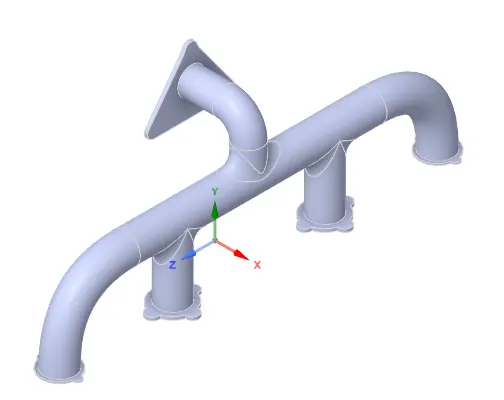
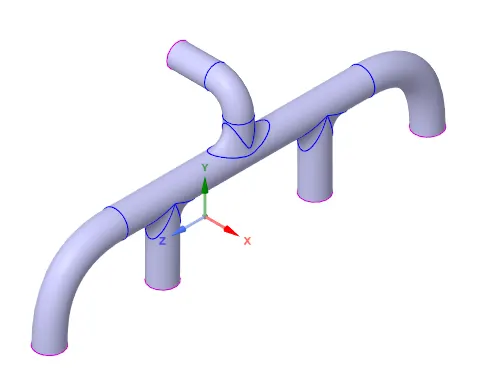
The exhaust manifold STEP file is imported into SpaceClaim and using the volume extract tool the volume of the exhaust manifold is extracted.
Mesh:
Setup and solution:
Results:
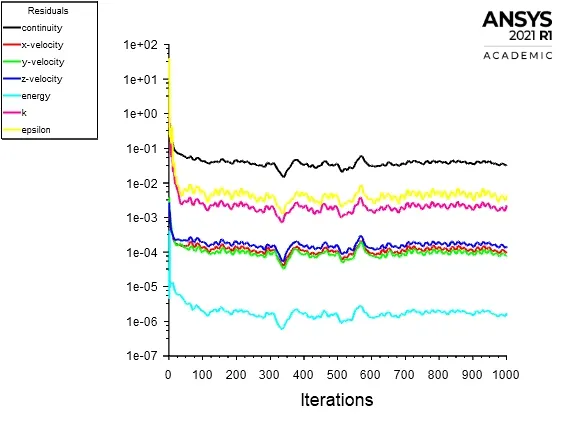
Residuals
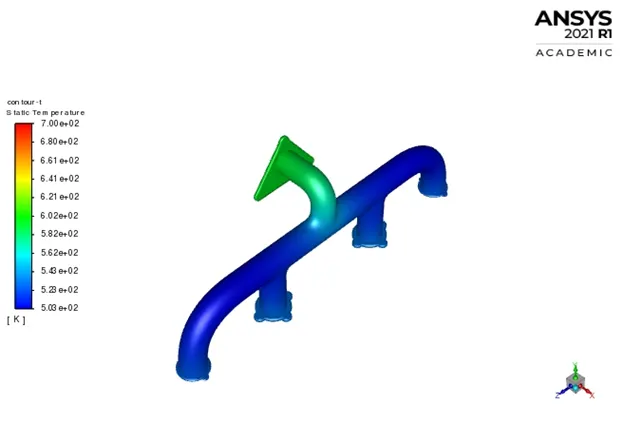
Temperature Contour
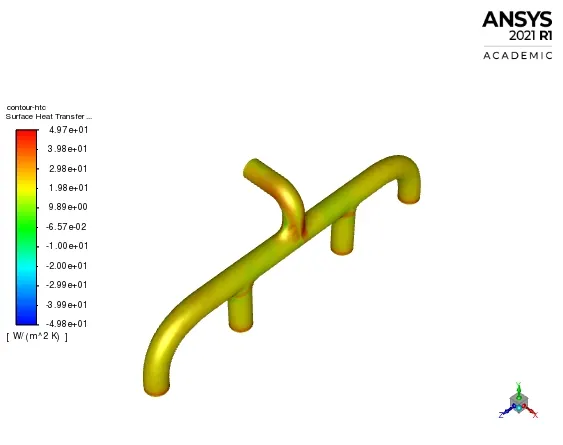
Surface heat transfer coefficient
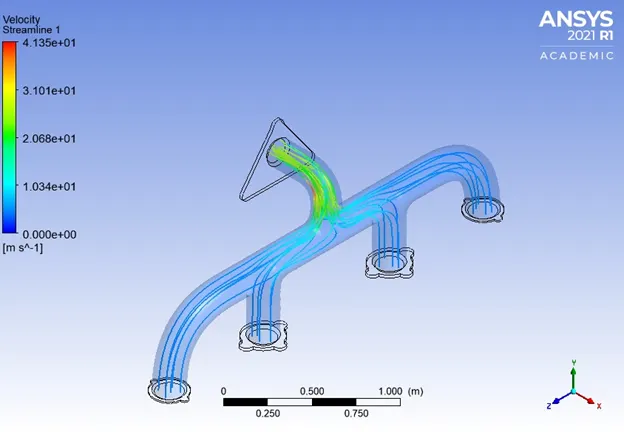
Velocity streamline
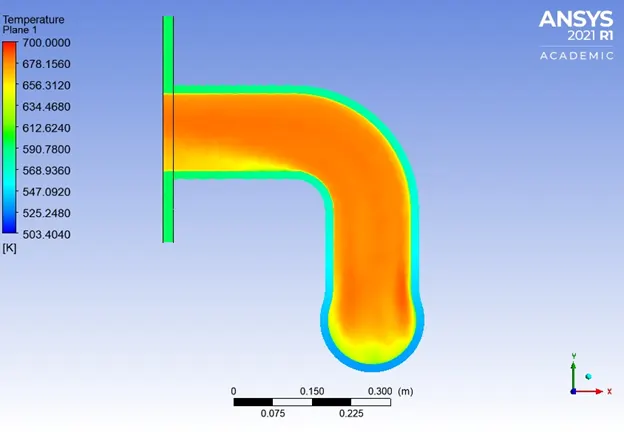
Cut-plane temperature contour
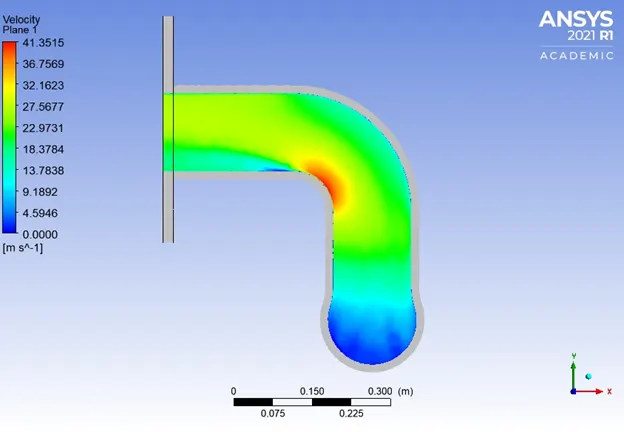
Cut-plane velocity contour
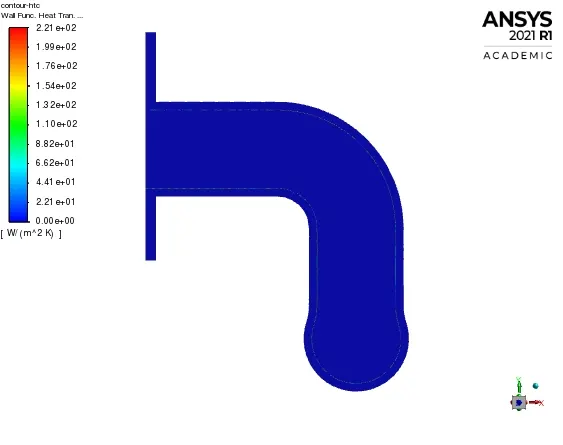
Wall adjacent heat transfer coefficient
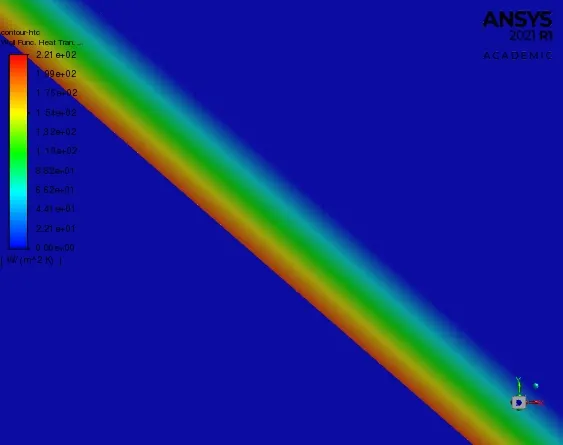
Wall adjacent heat transfer coefficient (zoomed)
Conclusions
- Since the velocity at the 4 inlets is low, the velocity at the outlet will be higher due to conservation of mass. Therefore, the velocity increases to a higher extent at the outlet leading to high turbulence at the bends of the pipe.
- Because of high velocity, Reynolds number will be higher. Higher Reynolds number implies higher heat transfer coefficient. And higher heat transfer coefficient means more heat transfer is taking place from the fluid to the solid.
High velocity → high Reynolds number → high heat transfer coefficient → more heat transfer from the fluid to the solid.
- Heat transfer coefficient is a quantity measured only at the walls. It is observed that heat transfer coefficient is higher at the bend of the outlet. Therefore, at this point maximum heat transfer takes place from the fluid to the solid. This results in higher temperature of the solid at this point.