Week 5 - Rayleigh Taylor Instability
Aim: Perfprm the Rayleigh Taylor instability simulation on two diffrent fluids and Perform grid independency test on Rayleigh Taylor instability for two different mesh size.
Introduction about Rayleigh Taylor instabilty
It is occurance instabilty between two fluids with different densities at interface. Rayleigh Taylor instability is based on the fluids and its shearing. RTI observed that when two fluids of different densities mixed together when one fluid is above another fluid the interface become unstable and the heavier fluid comes down due to gravity. The following suimulation going to simulate two different fluids air and water
Practical Applications of Rayleigh Taylor in CFD
Flow instabilties are used to increase the heat and mass rates as well as to fuse the fliuids of dissimilar properties like viscoucity, elasticity, density etc..
- Smother particle hydrodynamics
This method is computaional method is used for sumatung the mechanics and fluid flows. This method is increasingly used to model fluid motion.
- Single fluid model
It is a typical approach used for analysis of two phase flow mixture model i.e The indivisual fliud phases are assumed to behave as a flowing micture described in terms of the mixture properties.
- Two fluid model
In this method it seperate sets of the governing equation for the vapour and liquid phases have been used. the velocitybslip between the vapor and liquid phase is in this model taken account.
- Turbulance model
Turbulance models are needes to predict the average mixing behavior inflows that are on average one or two dimensional. The approach to the construction of the tile tubulance model guided by ecperimental. The equation governing turbulent flows can only be solved directly for simple cases of flow. for most turbulent flows CFD simulations used in tubulent models.
Atwood number:
Atwood number is a dimensionaless number in fluid dynamics used in the study of hydrodynamic instabilities. It is an importent parameter to study of Rayleigh tayler instability and it is related to density digfference between two fluids which are in interaction.
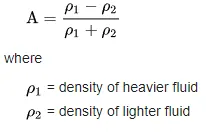
- Atwood number for air and water is 0.9975
- Atwood number for user defined and water is o.4278
Steps involved in simulation setup
Geometry Preparation
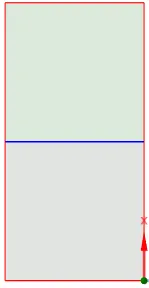
Create square box of dimension of 20*20mm and use full tool create surface in spalce claim and Repeate the procedure to create same surface adjacent it. and do share toplogy between two surfaces.
Mesh
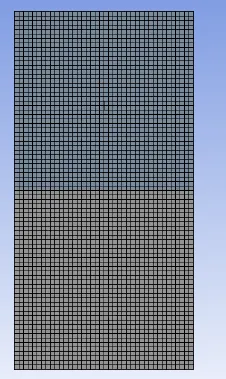
Base line mesh with 0.5mm element size
Setup
- Pressure based solver and absulute velocity used
- Transient time used and enable gravity, enter gravity accelaration value in -y axis 9.81m/s2
- In viscous select laminar flow
- In multiphase model turned on along with volume of fluid and select implicit method
- In phases give primary phase air and secodary phase as water
- In paching in water and volume fraction 1 for water surface and 0 for air surface
- finally define require plots
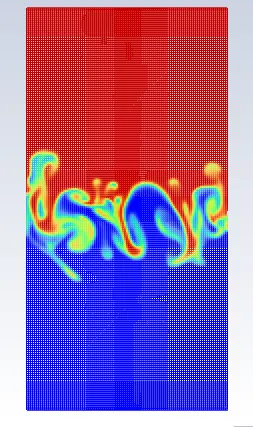
Animation plot air and water mixing with 0.5mm elemnt size
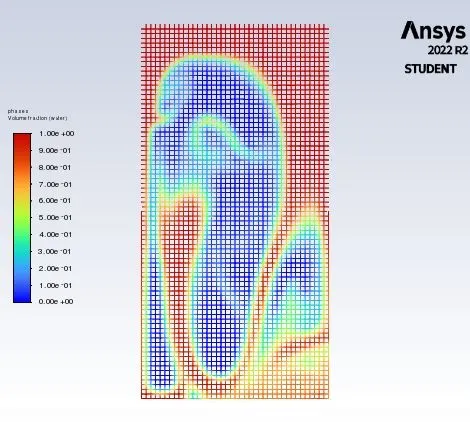
Refined mesh size 0.2mm
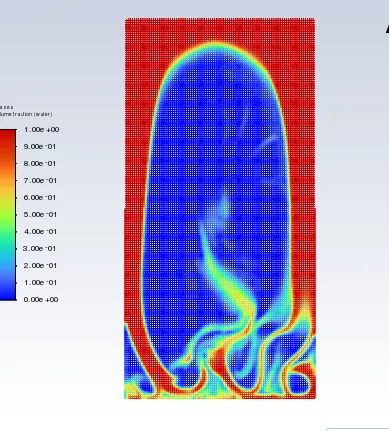
User material animation Density=400 kg/m3 and viscosity=0.001kg/m-s
Conclusion
- When we going to refining mesh we can observe air and water mixing also changing.
- When we can observe the air and water vortex formed large it starts quickly.
- In user defined material and water vortex formed but not start quickly
- Rayleigh taylor instabilty simulation performed in different case.