Week 5 - Rayleigh Taylor Instability
Aim: To simulate the Multiphase simulation and study the Rayleigh Taylor Instability. To also study the relationship between flow simulation and mesh size and Atwood Number
Theory:
- Rayleigh Taylor Instability (RTI) it arises when the two fluid of different density are subjected to a acceleration due to density gradient but in opposite direction.
- These are dynamic process wherein the two phase fluid interact with each other to reduce their stored potential energy.
- This interaction of fluid leads to turbulence mixing which affects many Man-made & Natural flow.
- In a hydrostatic equilibrium condition, When the lighter fluid is placed under the heavier fluid in gravitation flow field it creates Rayleigh Taylor Instability (RTI) at the interface which in turn generates shock waves across the heavier fluid.
- The lighter fluid acts like a piston and compress the heavier fluid in front this generates shock waves.
- This individual shock waves coalesces into a multidimensional normal wave whose strength increases as it propagates upwards.
- RTI phenomenon is observed in combustion, rotating machinery, inertial confinement fusion, Supernova explosions and geophysics.
CFD model:
- Saffman-Taylor instability: This is the formation of single finger pattern of two different viscous fluid in the porous medium. It mainly occurs when a less viscous fluid is being injected into the more viscous fluid in the rectangular configuration the pattern grows forming fingers by successive tip-splitting.
- Richtmyer-Meshkov instability (RMI): This occurs when two fluids of different density is impulsively accelerated. The instability begins with small amplitude but latter grows linearly with time. Which is followed by non linear regime with bubbles appearing in case of light fluid penetrating heavy fluids and spikes in case of heavy fluid penetrating light fluid. Then chaotic regime is reached with the mixing of two fluids.
- Kelvin-Helmholtz instability: This instability is found where the velocity shear in single continuous fluid or velocity difference across the interface between the fluids. This instability is observed in cloud formation of earth, Red spot on Jupiter etc.
- Plateau-Rayleigh instability: Falling stream of fluid breaks up into smaller packets with the same volume but less surface area. The driving force of the this instability is that liquids by virtue of their surface tensions, tend to minimize their surface area
Atwood Number:
- It is a dimensionless number which defines the dimensionless density ratio.
`At=(rho1 - rho2)/(rho1+rho2)`
where, `rho1`= Density of Heavier fluid
`rho2`= Density of Lighter fluid
Baseline Simulation: Air - Water fluid
- In Space claim 20 X 20 Square box is created and using the pull tool create the surface and name the surface as Air. Repeat the same process above the previous square and name it water.
- Select both the box and Click Workbench, Share now the interface between the two square is shared. Further click on the geometry and make share topology as well.
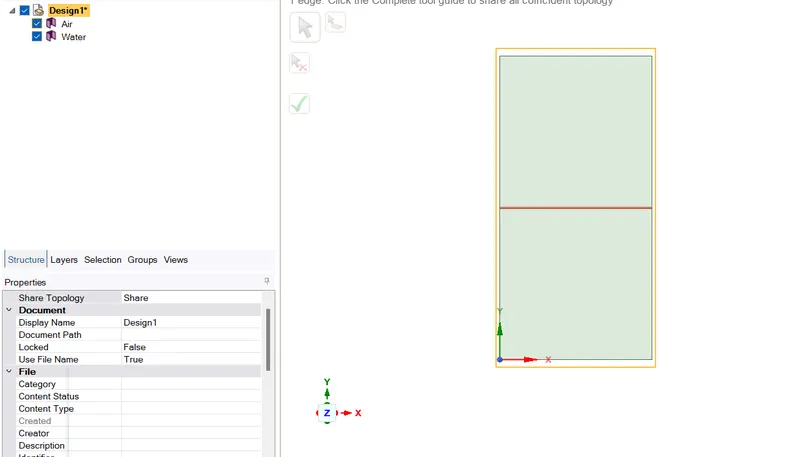
- In Ansys Mesh, select each face and name it water for the upper square and Air for the lower square then generate mesh for the element size of 0.5mm.
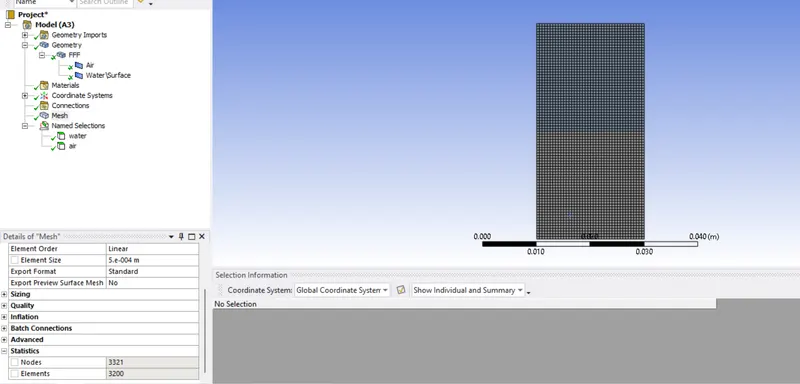
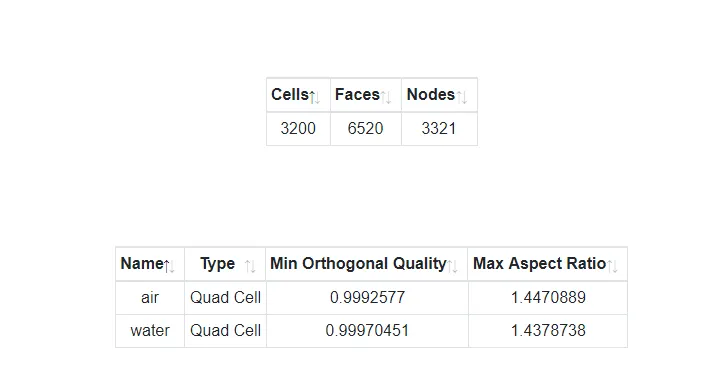
- In Ansys Setup, solve the simulation for the Laminar, transient, Pressure based, Velocity Absolute and click gravity and give -9.81 in the Y axis.
- Select the standard and initialize the simulation
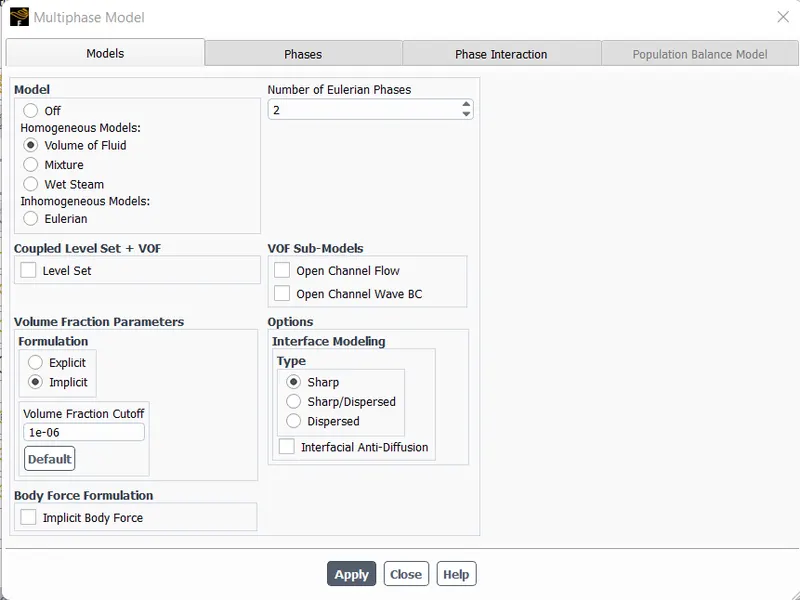
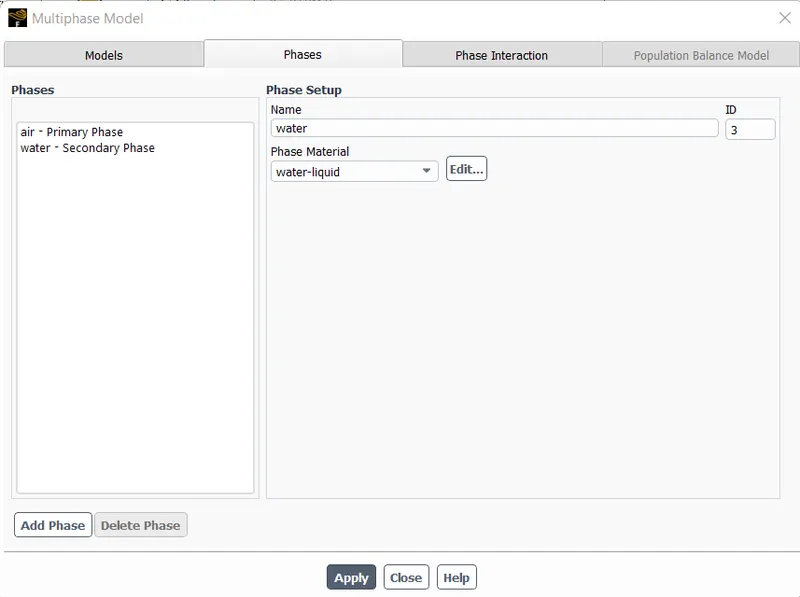
- Select the material and copy water-liquid, then click on the Multiphase and then mention Volume of Fluid, 2-Eulerian fluid. From phase name the Primary phase as Air, Secondary phase as Water.
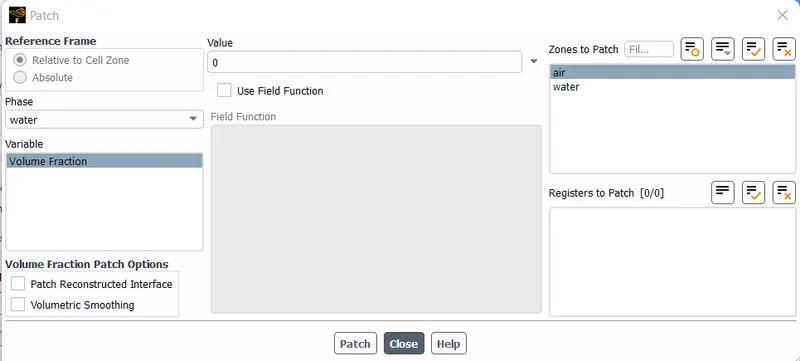
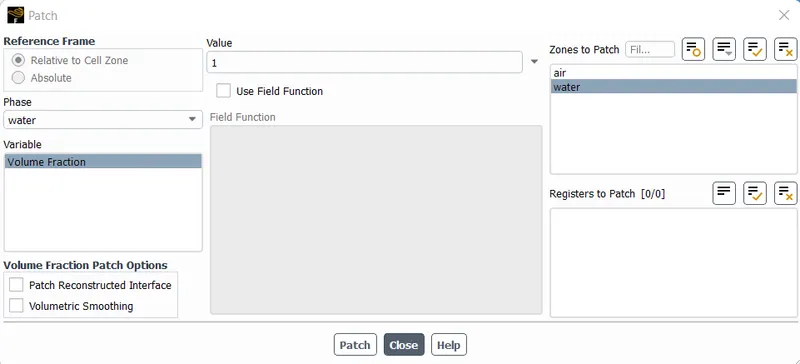
- Now Patch the different phase, Select the Water, Volume of Fluid, water and then enter patch value to be 1 click Patch now deselect water and select Air and enter value of 0 the again click Patch.
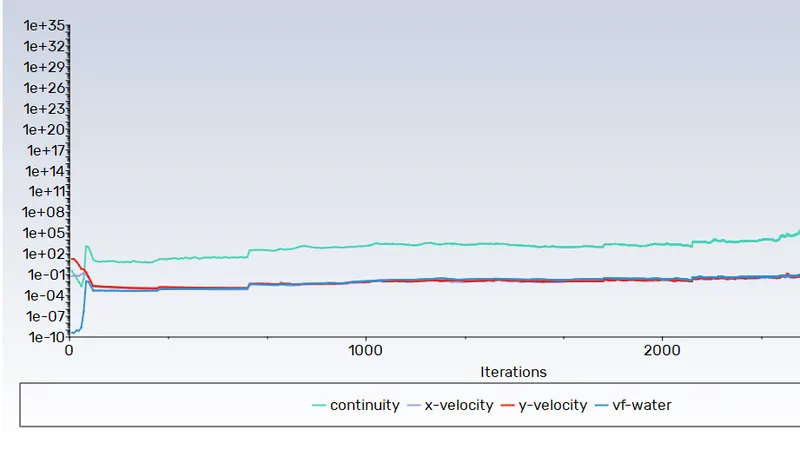
Residual:
- Now select New contour select the phase, water in order to verify the patching step and click ok. From create solution animation generate animation plot for the phase contour after every timestep and click ok.
- Similarly create the desired results and Animation.
|
Courant No. |
Time step size |
Iteration |
Run Calculation |
|
0.2 |
- |
0 - 300 |
Adaptive |
|
- |
0.0001 |
300 - 600 |
Fixed |
|
- |
0.0005 |
600 - 1800 |
Fixed |
|
- |
0.001 |
1800 - 2100 |
Fixed |
|
- |
0.005 |
2100 - 2400 |
Fixed |
- Above step is essential to prevent the solution from blowing up and further helps in reducing the simulation time.
- Atwood Number (At) = `(rho1 -rho2)/(rho1+rho2)=(998.2-1.225)/(998.2+1.225)=0.9975`
Video File_1:
https://drive.google.com/file/d/1Jy5_Lo4M3fi3V6WYQ_df2EwCdcj6-XB8/view?usp=sharing
Finer Simulation: Air - Water fluid
- Similar to baseline simulation all the setting are same except mesh element size is 0.1mm
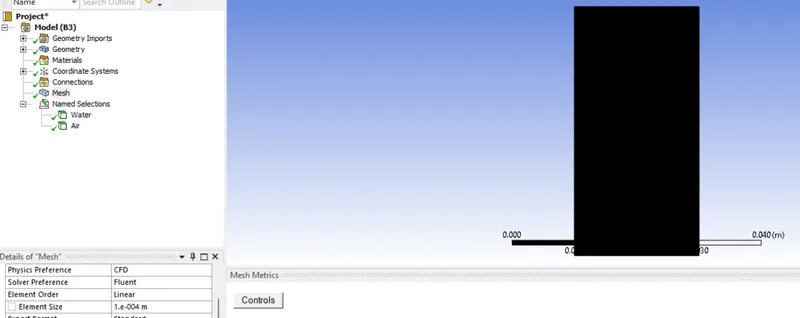

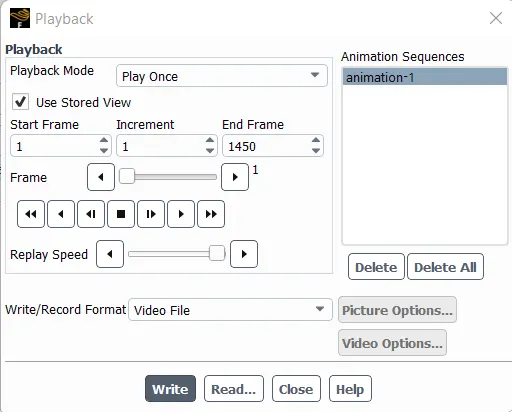
- Create the animation of the simulatrion from the solution create the solution animation for the preffered contour. further at the ened of the simulation convert the animation frames to video file by changing the animation frame to video file.
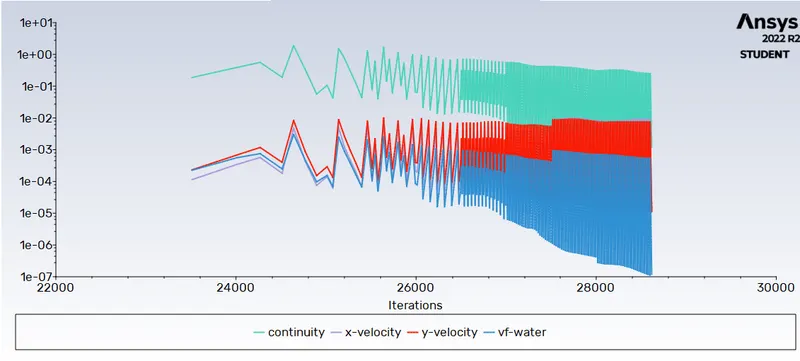
Residual:
|
Courant No. |
Time step size |
Iteration |
Run Calculation |
|
- |
0.001 |
0 - 600 |
Fixed |
|
- |
0.0008 |
600 - 900 |
Fixed |
|
- |
0.001 |
900 - 1200 |
Fixed |
|
- |
0.005 |
1200 - 1300 |
Fixed |
|
- |
0.008 |
1300 - 1450 |
Fixed |
- Atwood Number (At) = `(rho1 -rho2)/(rho1+rho2)=(998.2-1.225)/(998.2+1.225)=0.9975`
Video File_2:
https://drive.google.com/file/d/12znfd-LqjeZdrUi3rMDBK3Yw_cbIe3i1/view?usp=sharing
Finer Simulation: User Defined - Water Fluid
- Similar to baseline simulation all the setting are same except mesh element size is 0.1mm.
- User Defined material with density =400Kg/m^3, Viscosity =0.001Kg/ms. Which could be changed from the physics, material change.
Residual:
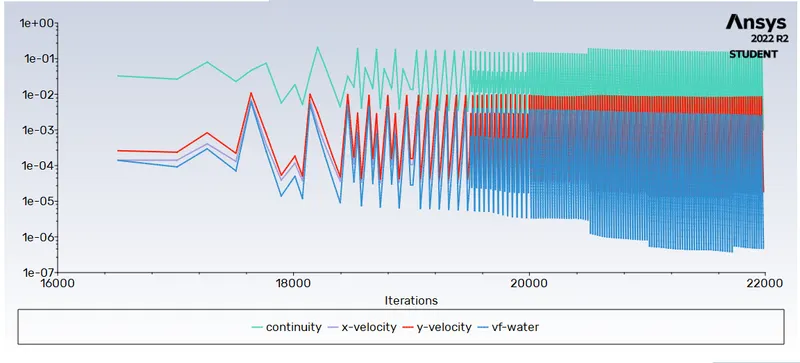
- Atwood Number (At) = `(rho1 -rho2)/(rho1+rho2)=(998.2-400)/(998.2+400)=0.4278`
Video File_3:
https://drive.google.com/file/d/13FjmIasTs20CJGaUpbYIluqkeS0O-eck/view?usp=sharing
Result:
- Effects of Mesh Size: With the Large mesh size the plumes are large but, since the formation of plumes and its motion is of importance so ideally for Volume of fluid method. Smaller mesh size leads to larger simulation time.
- Effects of Atwood Number: For Atwood number close to 0, Rayleigh Taylor instability flow takes the form of symmetric "fingers" of fluid, For Atwood number close to 1, Rayleigh Taylor instability flow takes the form of large bubble like plumes.