Week 5 - Rayleigh Taylor Instability
Rayleigh Taylor instability simulation model
Aim
To perform the reyleigh taylor instability simulation for 2 different mesh sizes with the base mesh being 0.5mm.
To compare the results with animations
To simulate water-user defined interface simulation with specifications given
To define and calculate atwood number from the simulations
Introduction
Tf the horizontal surface of a liquid at rest under gravity is displaced into the form
of regular small corrugations and then released, standing oscillatory waves are produced. Theoretically, a liquid could exist in a state of unstable equilibrium with flat lower horizontal surface supported by air pressure. If small wave-like corrugations
were formed on this lower surface and then released, they might be expected to increase exponentially so long as their height was small compared with the wavelength. This instability of the lower surface of a liquid might be expected to disappear if
the liquid were allowed to fall freely, and to pass over into stability if the liquid were forced downwards with an acceleration greater than that of gravity. Similarly, the initial stability of the upper surface of a liquid might be expected to pass over into
instability if the liquid were given a downward acceleration greater than that of gravity.
A large-eddy simulation technique is described for computing Rayleigh–Taylor instability. The method is based on high-wavenumber-preserving subgrid-scale models,combined with high-resolution numerical methods. The technique is verified to match linear stability theory and validated against direct numerical simulation data. A mixing transition is observed
in the flow, during which an inertial range begins to form in the velocity spectrum and
the rate of growth of the mixing zone is temporarily reduced. By measuring growth
of the layer in units of dominant initial wavelength, criteria are established for reaching the hypothetical self-similar state of the mixing layer. A relation is obtained between the rate of growth of the mixing layer and the net mass flux through the
plane associated with the initial location of the interface. A mix-dependent Atwood number is defined, which correlates well with the entrainment rate, suggesting that internal mixing reduces the layer’s growth rate.
Significance of Atwood number
In a liquid air interface with densities ρ1 and ρ2 and is deep compared to the wavelength of instability,the velocity potentials are defined by
ϕ1=Aexp(−ky+nt)coskx --------1 and
ϕ2=-Aexp(ky+nt)coskx----------2
At the interface,
n2=−k(g+g1)ρ2−ρ1/ρ2+ρ1
If (g+g1) is negative, the acceleration downwards is greater than g and n2 is
positive.
ρ2−ρ1/ρ2+ρ1 is the atwoods number,r (with ρ1 and ρ2 being the densities of the light and heavy fluids, respectively), g is the acceleration and t is time. This similarity solution results from dimensional analysis if the following conditions are met: (I) all memory of initial conditions is lost, (II) there are no boundary effects, and (III) viscosity and diffusivity (or surface tension) are not important. Satisfying all three of these requirements has proved extremely difficult, both experimentally and computationally.
The initial disturbance of the interface will increase exponentially with nt until it has attained a magnitude which is no longer small in comparison with the wavelength. The rate of development of the instability is proportional to
`(rho2-rho1)/(rho2+rho1))^(1/2)`.
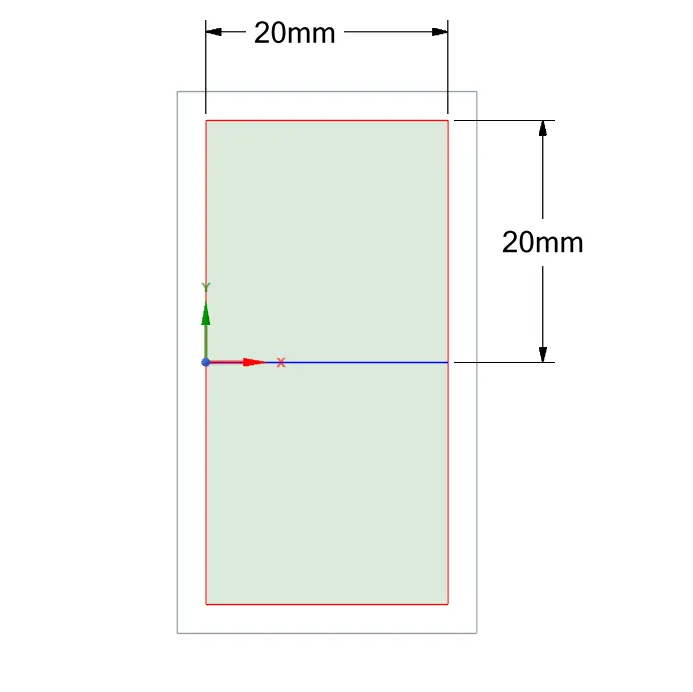
1.Geometry
2.Meshing
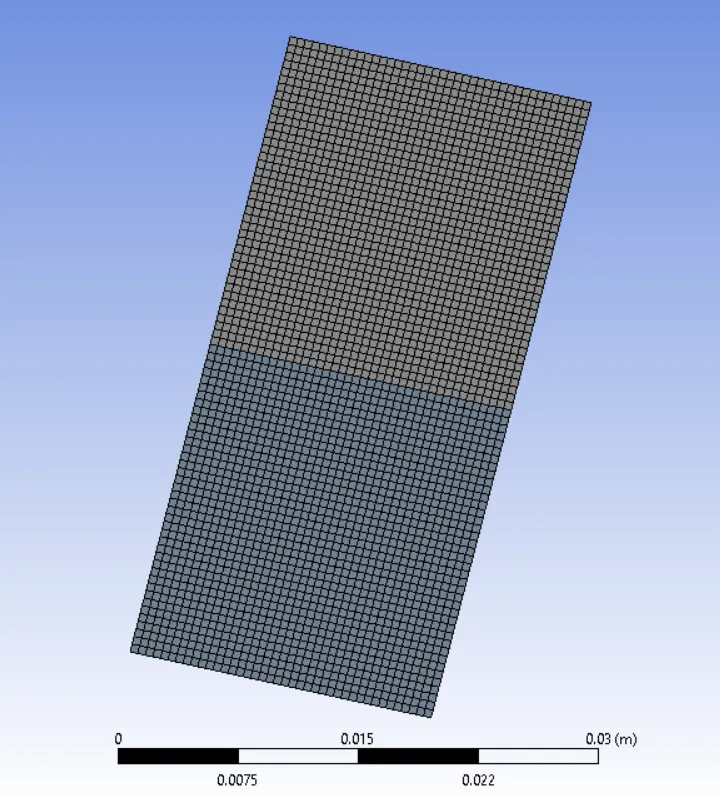
A base mesh of 5e-4 m is created and simulated with 2 phases, water being the upper phase and air being the lower phase.
The mesh is then refined to 8e-5m and simulated again.In the third simulation, the air is replaced by a user defined material with given specifications. The instability rates and pattern changes significantly with the refining of mesh and changing of phases.The rayleigh taylor wave like structures or the displacement deppends on the material being used and the element size.
3. Setup
A pressure based transient simulation under gravity along Y axis is simulated. The volume of fluid model which hase 2 eulerian phases (air and water in the initial 2 cases followed by user material and water in the last case is run).
The user defined material has the specifications of density=400 kg/m3 and viscosity=0.001kg/m3.
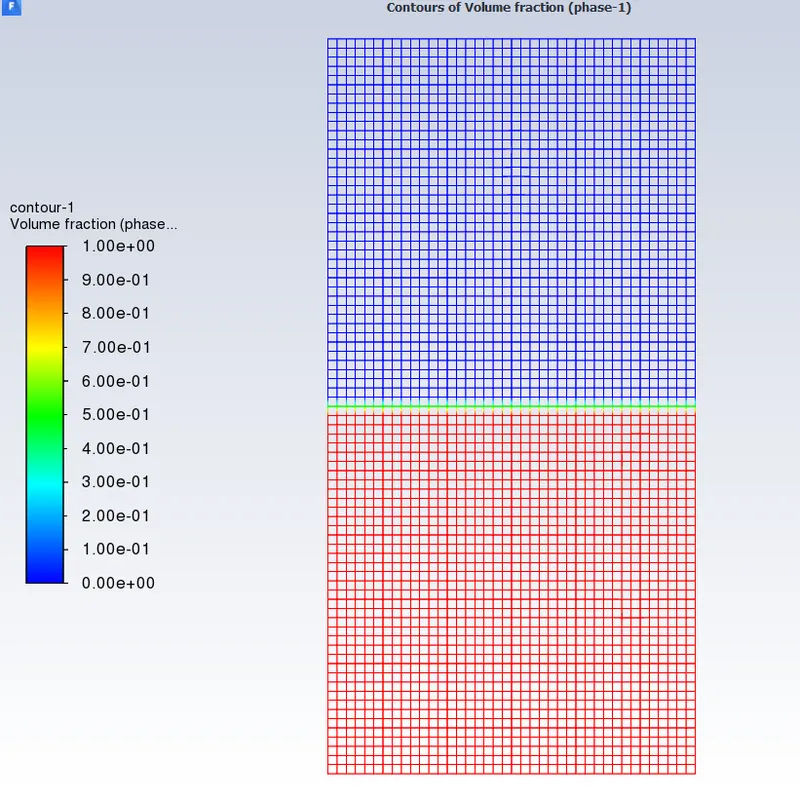 the volume fractio of phase 1(air).
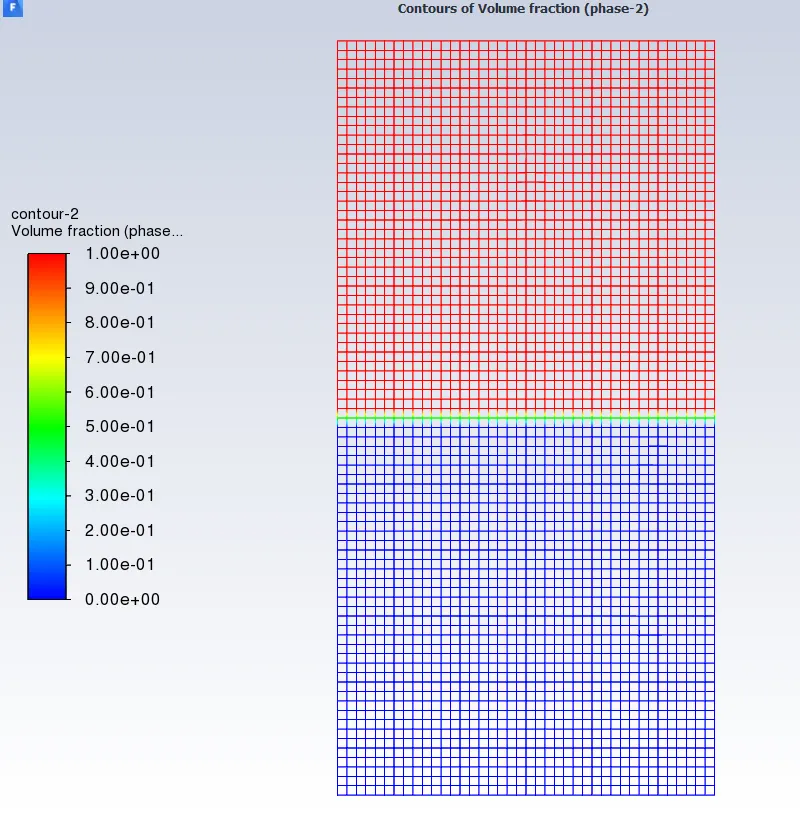 the volume fraction of phase 2(water).
As in the above figure the above phase represents water and the below phase is the air with (0 volume fraction of water).
Patching is done with corresponding materials in the phases and the calculations are done with time step size of 0.005s.
4.Results
The instabilities grow and the displacement of phases takes place in all three cases but, as the mesh is refined the flow rates and patterns have significant changes. More than a wave structure, the rayleigh taylor instability is well defined and more comples vortexes are observed.
A transient simulation is preffered in such simulations because a single end frame after a defined time period cannot expalin the whole system and phenomenon.
a.5e-3mm base mesh
b.8e-5mm refined mesh
c. user defined material and water