Week 2 - Flow over a Cylinder.
FLOW DYNAMICS OVER A CYLINDER
AIM
To simulate the flow over a clylinder and explain the phenomenon of Karman vortex street by through the following cases.
To simulate the flow for steady and unsteady cases with Reynolds number 100.
To calculate the coefficient of drag and lift over a cylinder with varying Ryenolds number in a steady solver and to discuss the effect of Reynolds number on the coefficient of drag based on any standard literature.
INTRODUCTION
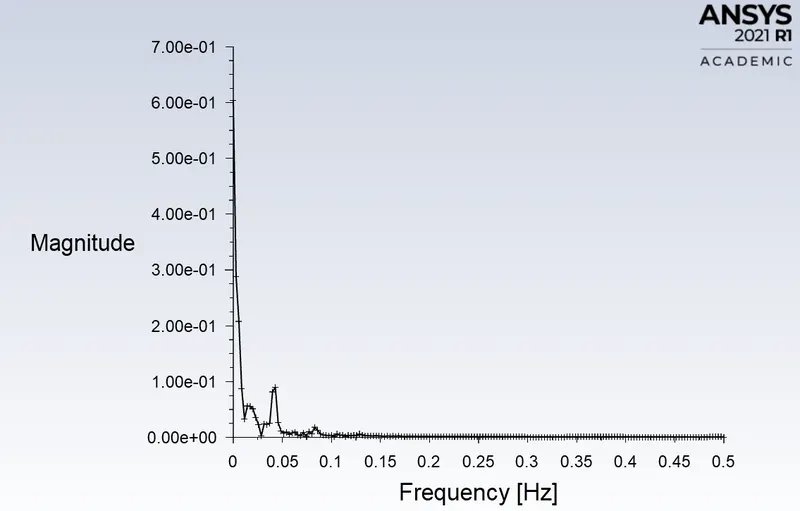
WHEN a fluid flows about a stationary cylinder the flow separates, vortices are shed and a periodic wake is formed. The frequency (f0 of pairs of vortices is a function of velocity(V) cylinder diameter (d) and Reynolds number (Re). S, the non-dimensional wake Strouhal number is defined as S =fvd/v, and over a wide range of Reynolds numbers I0^2 < Re< 10^5,
S =0.2. The absolute values of S also depend upon cylinder surface roughness, length/diameter ratio and turbulence level.
Each time a vortex is shed from the cylinder, it alters the local pressure distribution, and the cylinder experiences a time-varying force at the frequency of vortex shedding.When the cylinder is located near a wall, it is expected that the shedding of vortices will depend on the Reynolds number (Re), the gap ratio (G/D, G is the gap between the cylinder and the wall), and the characteristics of the wall boundary layer.
The flow of atmospheric air over obstacles such as islands or isolated mountains sometimes gives birth to von Kármán vortex streets. When a cloud layer is present at the relevant altitude, the streets become visible. Such cloud layer vortex streets have been photographed from satellites. The vortex street can reach over 400 km from the obstacle and the diameter of the vortices are normally 20-40 km.In some engineering problems, low turbulence, tall buildings can produce a Kármán street, so long as the structure is uniform along its height. In urban areas where there are many other tall structures nearby, the turbulence produced by these prevents the formation of coherent vortices.
THEORY
The velocity components are directly obtained from the Navier-Stokes equations, and the pressure is calculated from a pressure Poisson equation. The numerical method developed in this study has been validated against the benchmark problem of a uniform flow past an isolated circular cylinder. With this numerical procedure, the vortex shedding flow over a
circular cylinder near a wall at various gap ratios is investigated for different Reynolds numbers from 10 to 100000. The effects of Reynolds number on the vortex shedding are discussed.
The basic equations that are solved in this study are the 2D Navier-Stokes equations for unsteady incompressible viscous flows. The non-dimensional form of these equations in the Cartesian coordinate system are written as
∂u/∂t+u∂u/∂x+v∂u/∂y=∂p/∂x +1/Re(∂^2u/∂x^2+∂^2u/∂y^2)
v/∂t +u∂v/∂x +v∂v/∂y=-∂p/∂y+1/Re(∂^2v/∂x^2+∂^2v/∂y^2)
D=divV=∂u/∂x+∂v/∂y=0
Vortex shedding is a comprehensive physical phenomenon. When it occurs, vortices are shed alternatively from the top and the bottom of the circular cylinder. The shedding of vortices is always accompanied by some physical changes in the local
flow. It causes the fluctuation of the pressure and flow velocity in the near wake of the cylinder. It also generates fluctuating forces on the cylinder.The vortex shedding frequency is represented by the Strouhal number, St. The dependence of the Strouhal number on the gap ratio and the Reynolds number can be seen.

- f = vortex shedding frequency.
- d = diameter of the cylinder
- U = flow velocity.
This dimensionless parameter St is known as the Strouhal number and is named after the Czech physicist.
Geometry
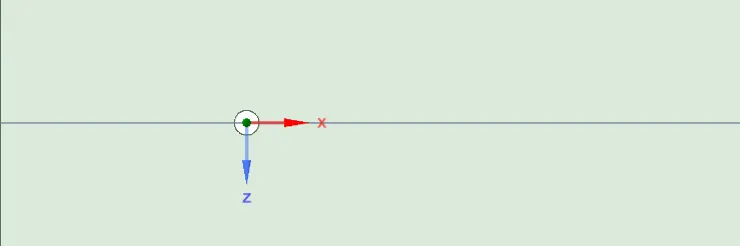
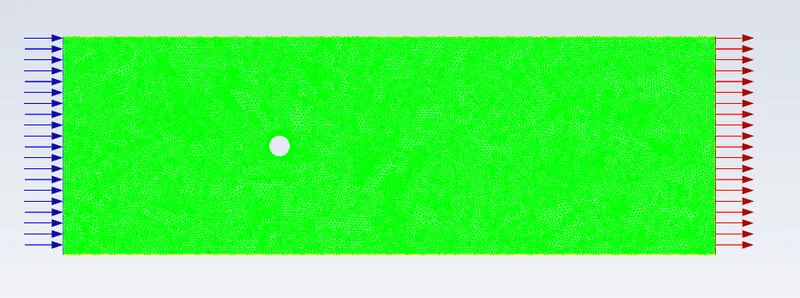
A 2D simulation to understand the effects of components in a CFD system effects the end result is carried out using a customized fluid.A rectangle computational domain is created with circle diameter of 2m. The cylinder is placed towards the inlet boundary with inflow velocity of 1m/s.The inlet is 20m from the centre of circle and the outlet is 40m from the centre of the circle along x axis.The total width of the rectangle domain is 20m.
MESHING
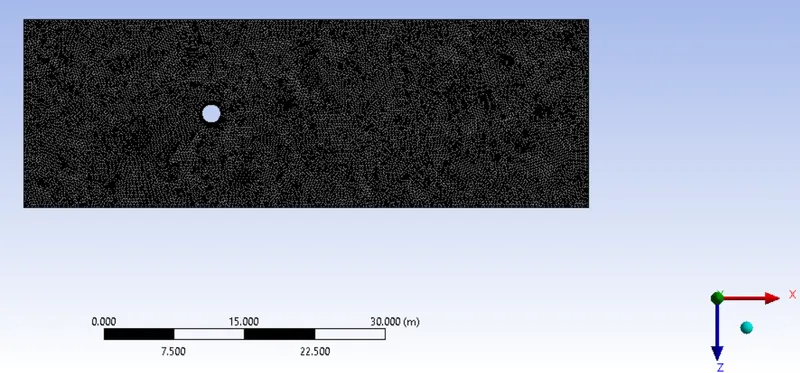
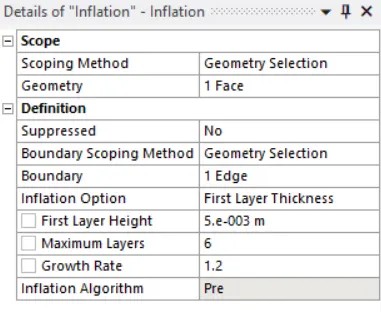
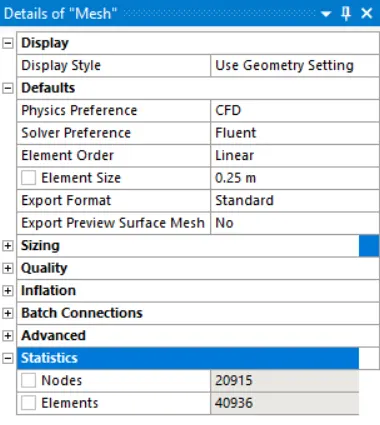
triangular mesh is generated with element size of 2 which is dependent on the diameter of the circle.Since the interface of the circle has many sharp edges,it may effect the fluid flow. The edges of the circle is made smoother with 36 No of divisions using sizing method. The flow around the circle also has its significance,so 6 inflation layers are added with the first layer thickness of 5e-3.The boundary regions include inlet and outlet and the symmetry walls.
SETUP
Both steady state and unsteady state , pressure based setup is simulated.Since the reynolds number (Re=100)is very small the viscous property is set to laminar flow.A monitor point is created at a distance of 8m from x axis (8,0,0). The velocity counter plot is created for the same.simulation is initialized for 350 iterations. The residual plot and counter plots are generated and animation file is also generated.Since the vortex shedding is highly dependent on the Reynolds number and the velocity of the flow, the element size is set to 0.025 when the oscillation starts finally.
RESULTS
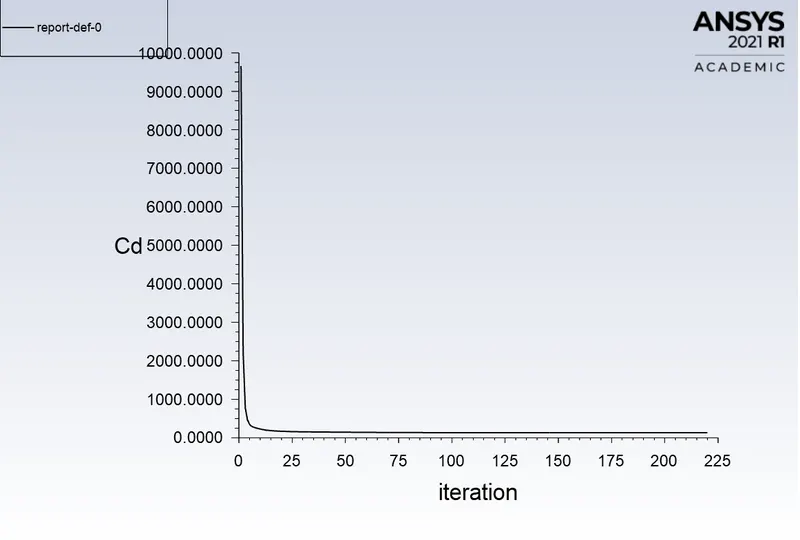
for steady state Reynolds no=100
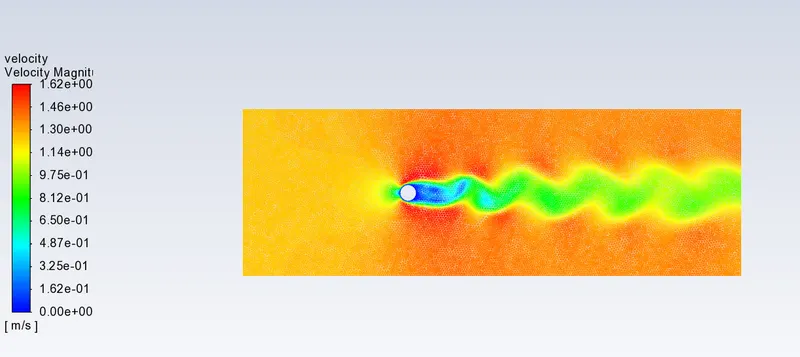
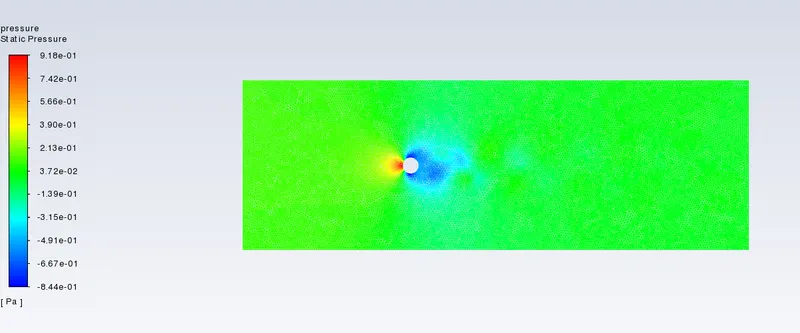
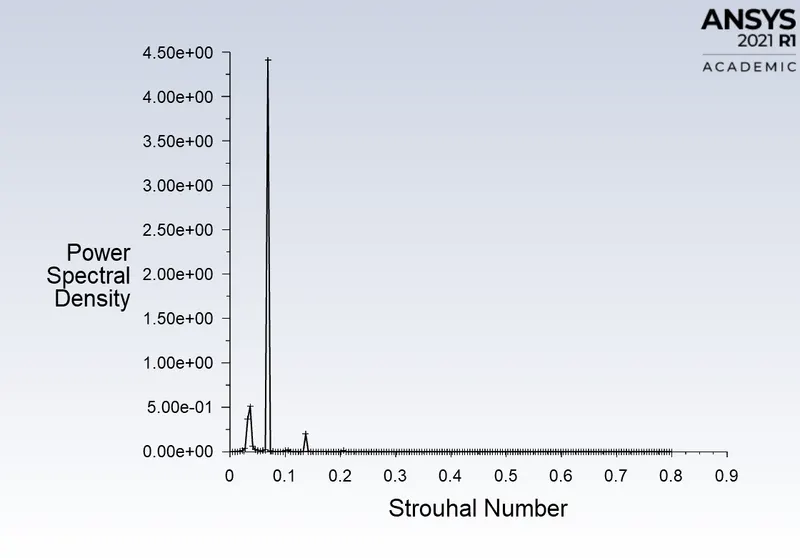
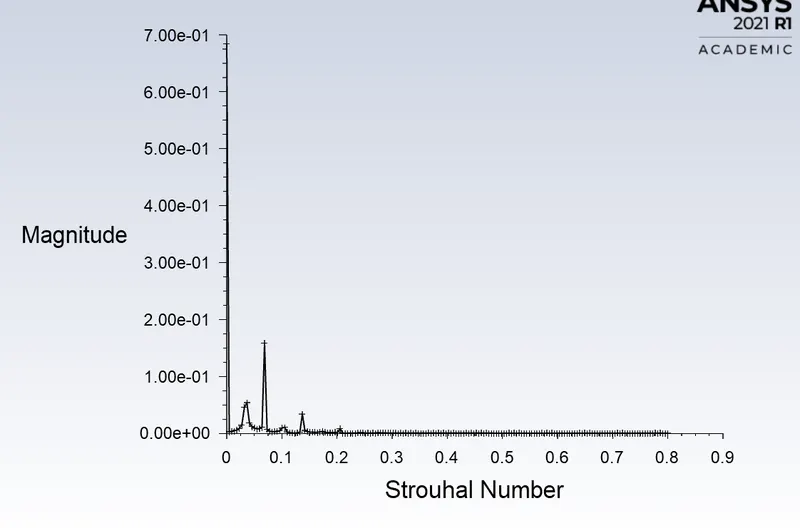
for reynolds number 100 steady state
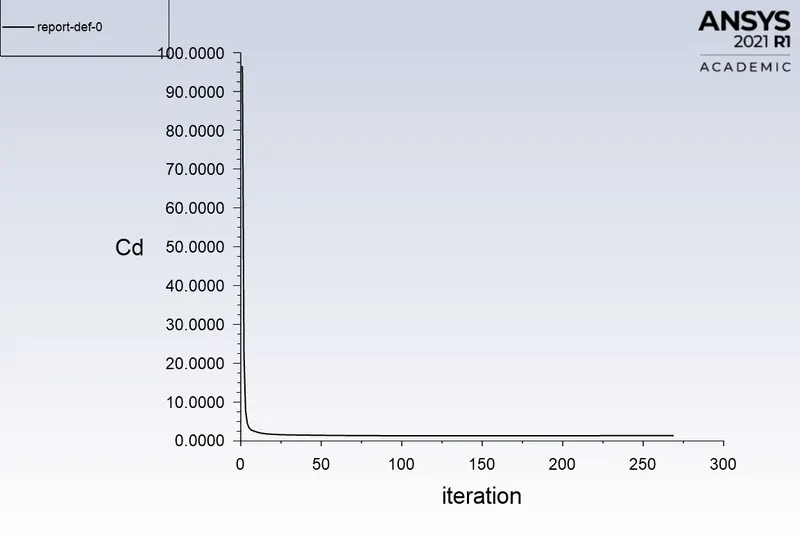
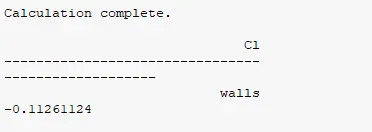
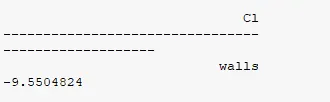
the coefficient of lift for steady state (reynolds number 100) is given by -0.11261124
from simulation cd=1.3286e-6
from literature coefficient of drag= 1.32761e-6
for reynolds number 10 steady state
for reynolds number 1000
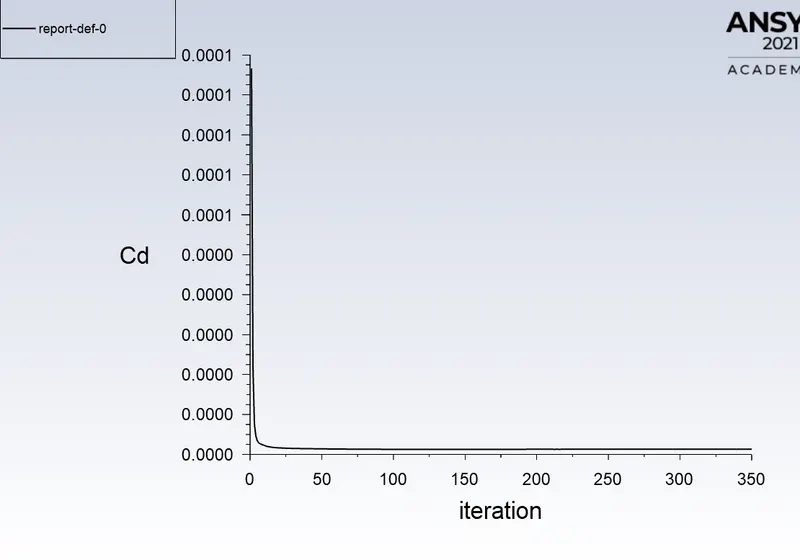
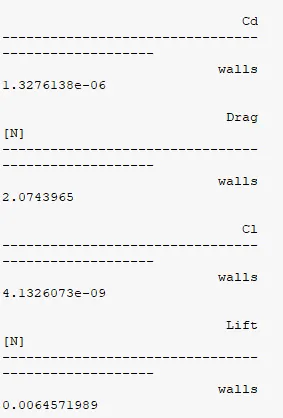
coefficient of drag simulation=
1.3276138e-06
coefficient of drag literature=1.324e-06
coefficient of lift=
4.1326073e-09
For reynolds number 10000
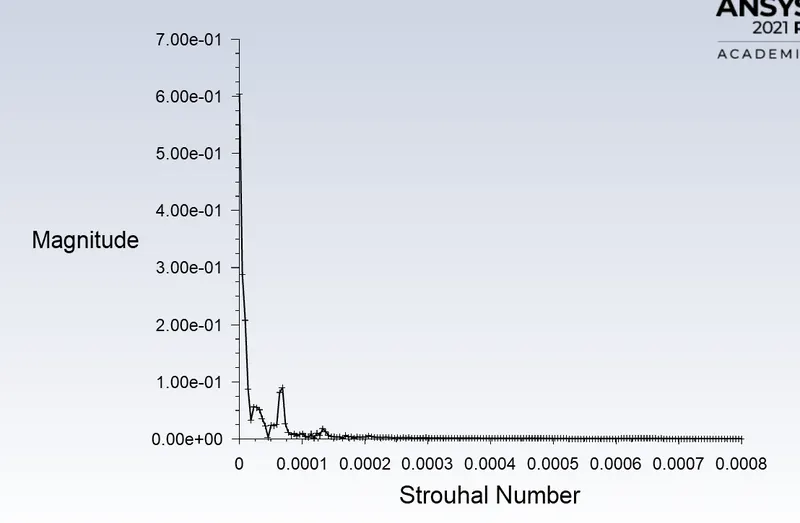
coefficient of drag from simulation=1.3276e-6
coefficient of drag from literature=1.326e-6
coefficient of lift=4.13260e-9
Conclusions
The effect of reynolds number on drag coefficient
The drag coefficient can be defined by the equation
`CD =D/1/2pA V 2`
where D is the drag force , V is the velocity, A is a reference frontal area and p is the density of air
which can also be written in terms of reynolds number as:
CD=α+βlog(Re)^γ
where Re is a Reynolds number based on object speed and length,α is the pressure drag (independent of Reynolds number) and the term βlog (Re)^ γ represents skin friction drag.For higher velocity the drag coefficient can vary significantly over the reynolds number.
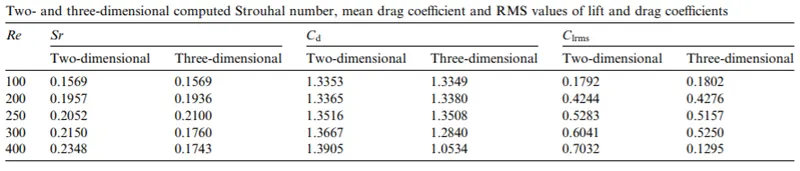
In one of the literature paper ,the two dimentional and 3 dimentional comparison between the reynolds number and drag coefficienyt were considered and found out that 100<Re<400 there is significant changes in both dimentions.less than 100 case the simulations overlapped and for greater values the results changes significantly.