Week 5 - Rayleigh Taylor Instability
1. What are some practical CFD models that have been based on the mathematical analysis of Rayleigh Taylor waves? In your own words, explain how these mathematical models have been adapted for CFD calculations.
Rayleigh Taylor Instability is used to measure the instability of two fluids of different densities, which occurs when the lighter fluid pushes the heavier fluid ( example: Gravity). The water floating atop the oil is an everyday example of this phenomenon.
The equilibrium here is unstable to any disturbances of the interface. If a liquid of higher density is displaced downward with an equal volume of lighter fluid displaced upward, the potential energy of the configuration is lower than the initial state. Thus the disturbance will increase and lead to an emission of potential energy, as the denser material move under the gravitational field, and the less dense material is displaced to the top.
The theoretical CFD models that have been based on mathematical analysis of RT waves are..
1. Plateau-Rayleigh Instability
2. Kelvin-helmholtz Insatbility
3. Richtmyer-Meshkov Instability.
2. Perform the Rayleigh Taylor instability simulation for 2 different mesh sizes with the base mesh being 0.5 mm. Compare the results by showing the animations( Attach them from your google drive). Observe the differences in the animation and explain the effect of mesh size on simulation. Also, explain why a steady-state approach might not be suitable for these types of simulation.[ Choose Air and Water for this simulation]
We are going to simulate the condition with two different types of cases.
Case 1 - Baseline Mesh, that is mesh with 0.5mm element size
Case 2 - This case is a little more refined, that is mesh with 0.25mm element size.
CASE 1
Geometry
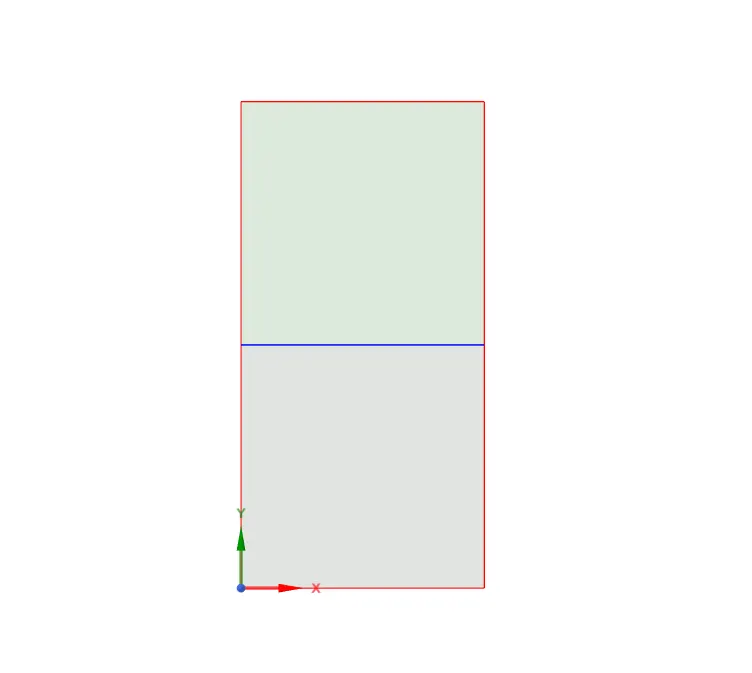
The geometry here is two square boxes of dimension 20X20mm aligned in height. The bottom box is considered to have air and the top box with water.
In this Geometry, we enabled the shared topology.
Meshing
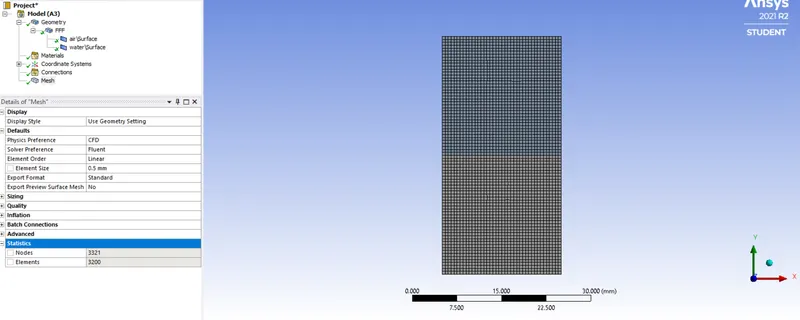
This is the case with baseline meshing, Element size = 0.5mm and the total cell count = 3200.
Set-up
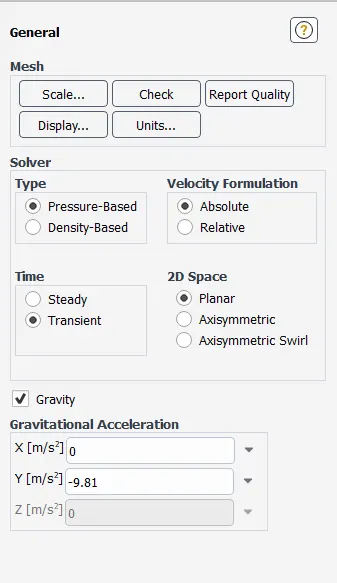
Here we use a Transient simulation and the gravity is enabled.
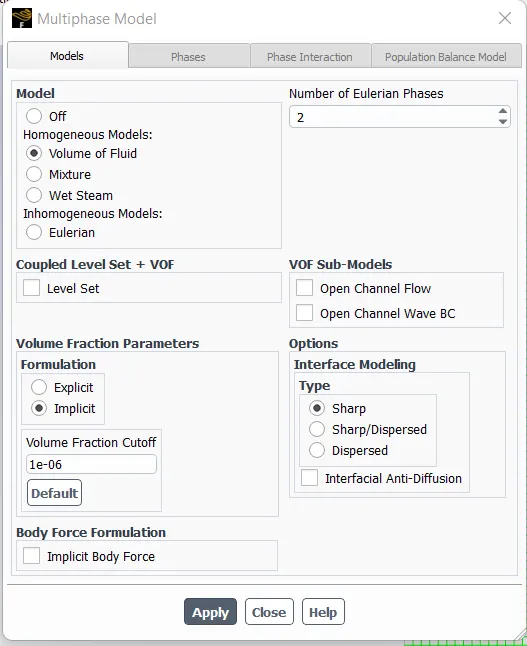
Now we enable the Multiphase model. In the Multiphase model, we choose the volume of fluid as the homogeneous model, also the formulation is set to Implicit.
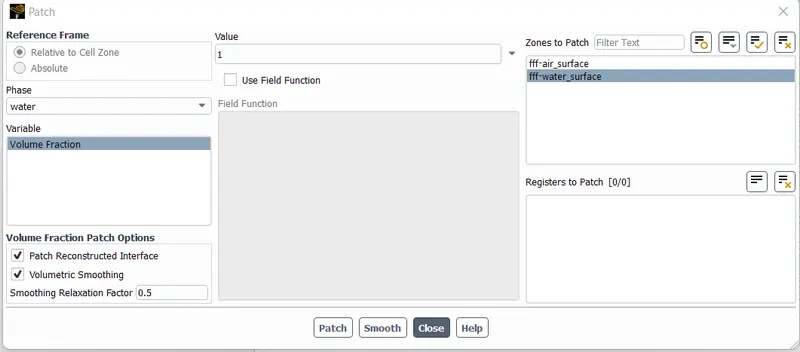
Now we do the patching of phase 2 (water) and put the value = 1 for water and 0 for air.
Results
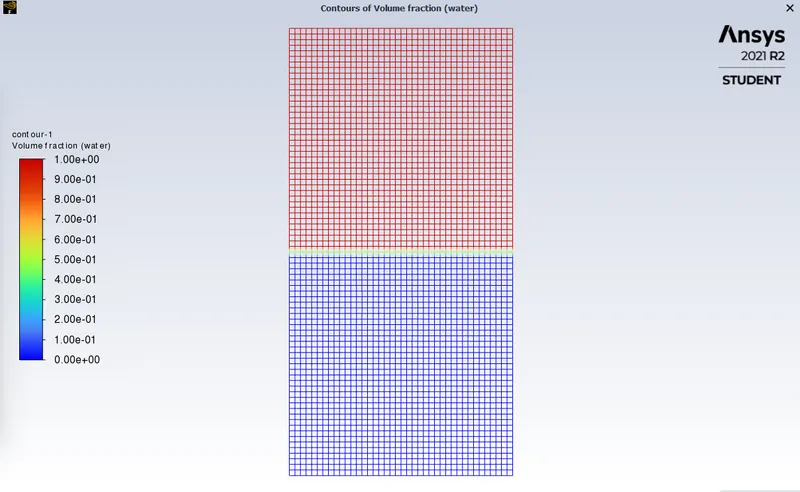
The volume fraction of water and air before the simulation. The water is represented in red color (Top), and air in blue color (Bottom)
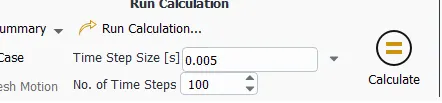
Number of time steps - 1000
Time steps - 0.005 seconds
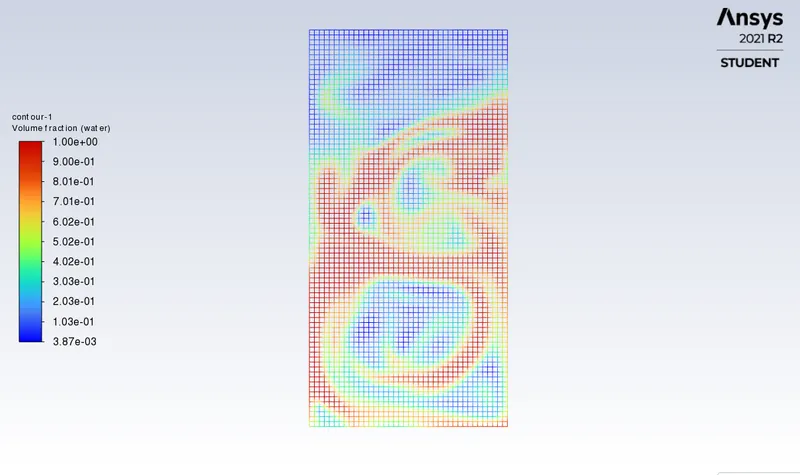
After running the iteration...
The volume fraction contour
Residual Plot
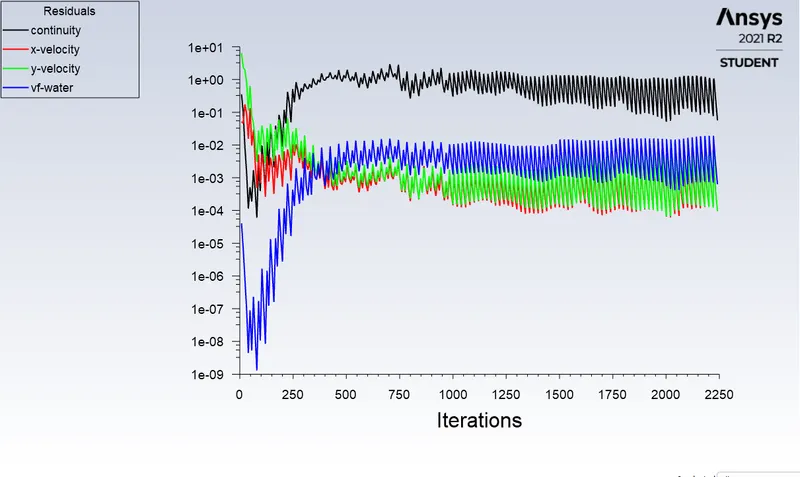
The animated video of the result is uploaded to this link.
https://drive.google.com/file/d/1TxLWHhonpHsyiAKIufdWDF4Op_KbBiBb/view?usp=sharing
CASE 2
Here the mesh size is a little more refined. The mesh size = 0.25mm
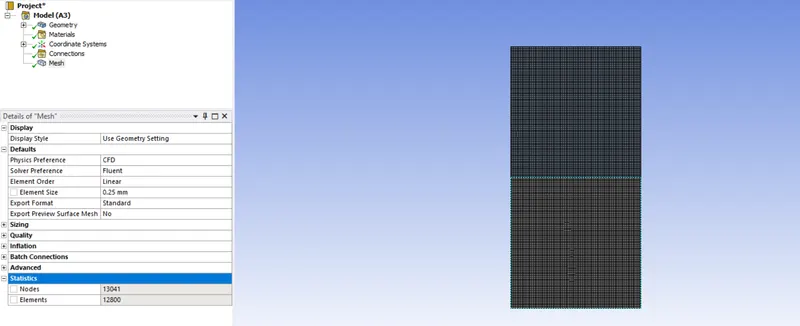
Element size = 0.25mm
Total number of elements = 12800
RESULTS
The volume fraction contour
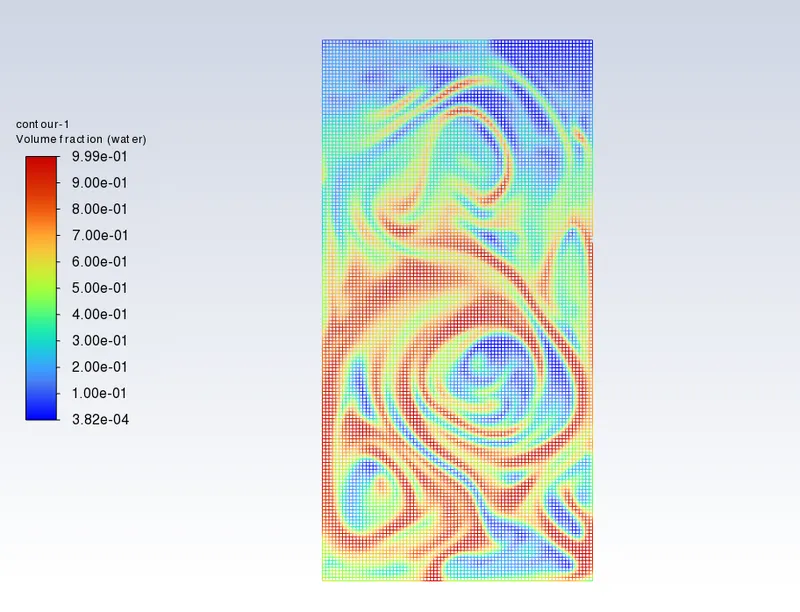
Here as the mesh is more refined than the previous one, we can see that the results are more accurate like a real condition.
Residual Plot
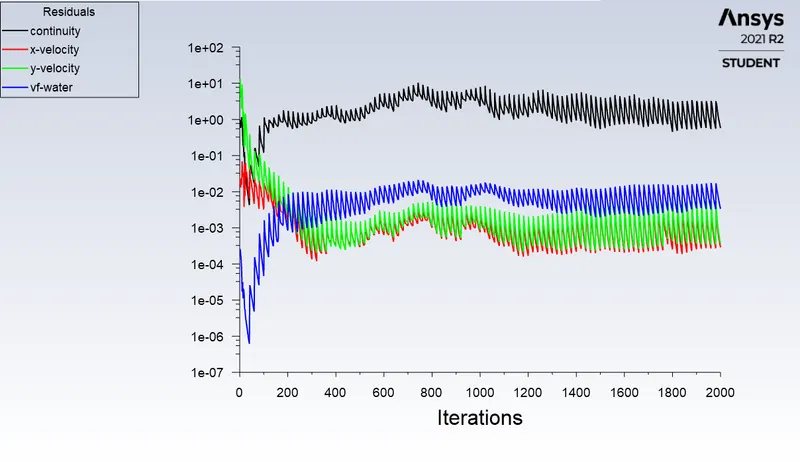
The animated video of the result is uploaded to this link.
https://drive.google.com/file/d/1zUeDQEP2zqpD_01d-RMeXRL39kItjqDS/view?usp=sharing
3. Run one more simulation with water and user-defined material(density = 400 kg/m3, viscosity = 0.001 kg/m-s) for refined mesh.
Here we are simulating it with water and a user-defined material. The user-defined material has the density = 400 and viscosity = 0.001.
after the iteration the results are..
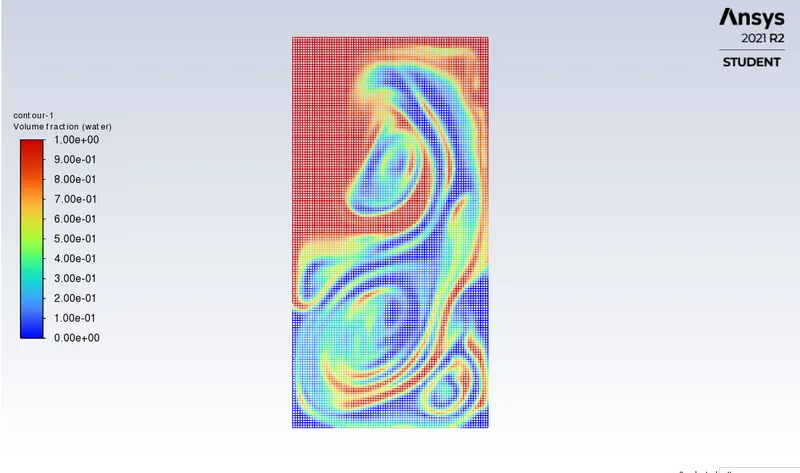
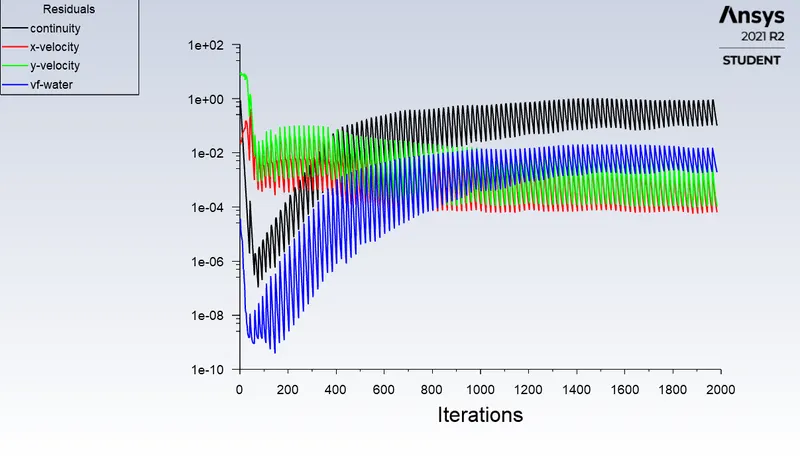
The animated video of the result is uploaded to this link.
https://drive.google.com/file/d/1CYybHVWLl7q7gYDXh4ssVibzCL0N8M8Z/view?usp=sharing
4. Define the Atwood Number. Find out the Atwood number for both the cases and explain how the variation in Atwood number in the above two cases affects the behavior of the instability.
Atwood Number is a dimensionless number in fluid dynamics used in the study of hydrodynamic instabilities in density stratified flows. it is a dimensionless density ratio defined as..
A = (rho1-rho2)/(rho1+rho2)
where rho1 = density of the heavier fluid
rho2 = density of lighter fluid
Application - Atwood number is an important parameter in the study of rayleigh-taylor instabilities and richmyer-mechkow instability. In RTI, the penetration distance of heavy fluid bubbles into the light fluid is a function of acceleration time scale, where g is the gravitational acceleration and t is the time.
For air& water, A = 0.995
for water and user-defined material, A = 0.4273
Conclusion
As Mesh becomes finer, the mixing becomes much clear and visible. Also, the computational time also increases with increase in mesh number.