Week 5 - Rayleigh Taylor Instability
AIM
Rayleigh Taylor Instability
OBJECTIVE
Ansys Fluent is the industry-leading fluid simulation software known for its advanced physics modeling capabilities and industry leading accuracy.Ansys Fluent gives you more time to innovate and optimize product performance. Trust your simulation results with a software that has been extensively validated across a wide range of applications. With Ansys Fluent, you can create advanced physics models and analyze a variety of fluids phenomena—all in a customizable and intuitive space.
Some practical CFD models that have been based on the mathematical analysis of Rayleigh Taylor waves are:
1.Richetmyer-Meshkov Instability:
The Richtmyer–Meshkov instability (RMI) occurs when two fluids of different density are impulsively accelerated. Normally this is by the passage of a shock wave. The development of the instability begins with small amplitude perturbations which initially grow linearly with time. This is followed by a nonlinear regime with bubbles appearing in the case of a light fluid penetrating a heavy fluid, and with spikes appearing in the case of a heavy fluid penetrating a light fluid. A chaotic regime eventually is reached and the two fluids mix. This instability can be considered the impulsive-acceleration limit of the Rayleigh–Taylor instability .
2.Kelvin-Helmholtz Instability:
The Kelvin–Helmholtz instability (after Lord Kelvin and Hermann von Helmholtz) typically occurs when there is velocity shear in a single continuous fluid, or additionally where there is a velocity difference across the interface between two fluids. A common example is seen when wind blows across a water surface; the instability constant manifests as waves. Kelvin-Helmholtz instabilities are also visible in the atmospheres of planets and moons, such as in cloud formations on Earth or the Red Spot on Jupiter, and the atmospheres (coronas) of stars, including the sun's.
3.Plateau Rayleigh Instability:
The Plateau–Rayleigh instability, often just called the Rayleigh instability, explains why and how a falling stream of fluid breaks up into smaller packets with the same volume but less surface area. It is related to the Rayleigh–Taylor instability and is part of a greater branch of fluid dynamics concerned with fluid thread breakup. This fluid instability is exploited in the design of a particular type of ink jet technology whereby a jet of liquid is perturbed into a steady stream of droplets.
The driving force of the Plateau–Rayleigh instability is that liquids, by virtue of their surface tensions, tend to minimize their surface area. A considerable amount of work has been done recently on the final pinching profile by attacking it with self-similar solutions.
EXPERIMENTAL PROCEDURE:
STEPS TO FOLLOW FOR MODELLING AND DEVELOPING MESH FOLLOWED BY PREPROCESSING ARE GIVEN BELOW.
THE STEPS ARE AS FOLLOWS.
STEP 1- FIRST WE NEED TO OPEN SPACE CLAIM
STEP 2- THEN WE NEED TO CREATE A RECTANGLE IN 2D PLANE OF SIZE 20mm X 20mm.
STEP 3- NOW WE HAVE TO USE THE PULL TOOL TO CREATE A SURFACE.THIS WILL FORM OUR AIR POCKET.
STEP 4- NEXT STEP IS TO CREATE ANOTHER RECTANGLE OF SAME DIMENSION JUST ABOVE THE AIR POCKET. THIS WILL ACT AS OUR WATER POCKET.
STEP 5- AFTER THIS WE HAVE TO ENABLE THE SHARE TOPOLOGY SO THAT WE HAVE A CONFORMAL MESH , MEANING WHAT EVER CHANGES HAPPENS IN THE LOWER PART WILL AFFECT TH UPPER PART AND VICE VERSA. HENCE WE HAVE TWO BLOCKS , WATER ABOVE AND AIR BELOW.
STEP 6- NOW WE HAVE TO OPEN THE MESHING WINDOW. WE WILL BE USING A BASE MESH AND 2 OTHER REFINED MESH, ONE BETTER THAN THE OTHER.
STEP 7-AFTER MESHING WE HAVE TO SET UP THE CASE.
STEP 8- TURN ON THE MULTIPHASE MODEL AND ENABLE VOLUME OF FLUID METHOD. WE WILL CHOOSE THE IMPLICIT METHOD FOR SOLVING.
STEP 9- NOW WE WILL ADD WATER IN OUR MATERIALS LOG AND AND DEFINE THE PHASE MATERIAL IN MULTIPHASE TAB.
STEP 10- NOW WE CLICK ON INITIALIZE AND PATCH THE TWO PHASES. WATER WILL HAVE VOF VALUE OF 1 WHERE AS AIR WILL HAVE 0.
STEP 11-THERE AFTER WE WILL CREATE A CONTOUR TO VISUALIZE THE PHASES AND RUN CALCULATION FOR 300 ITERATIONS OR MORE.
DENSITY OF WATER: 997 kg/m³
DENSITY OF AIR: 1.225 kg/m³
NOW LET US LOOK AT THE RESULTS:
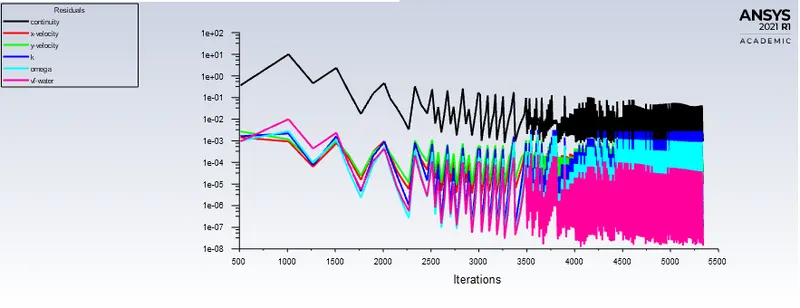
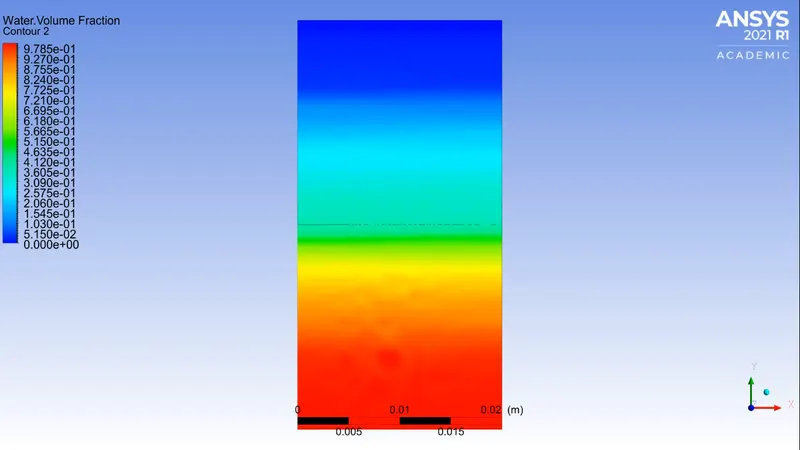
COARSE MESH: 0.5 mm
1.RESIDUAL PLOT.
2.FINAL MIXTURE OF MULTIPHASE.
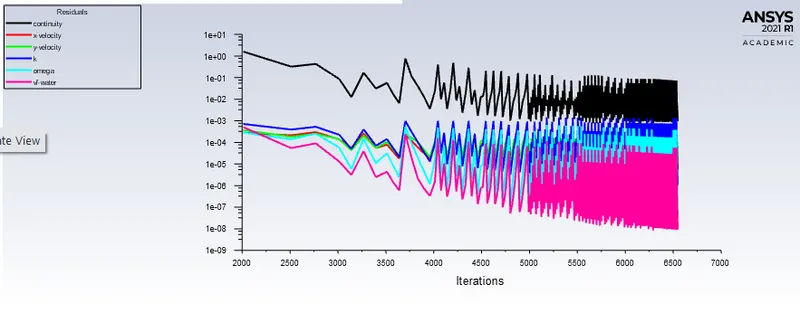
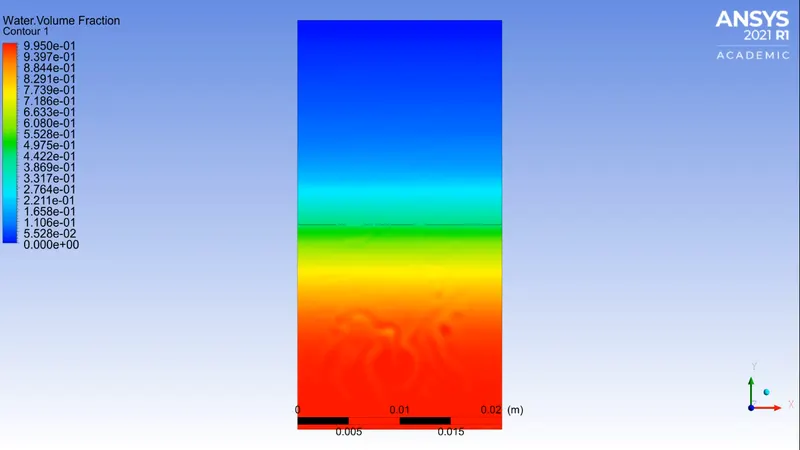
FINE MESH: 0.325 mm
1.RESIDUAL PLOT.
2.FINAL MIXTURE OF MULTIPHASE.
VERY FINE MESH: 0.15mm
1.RESIDUAL PLOT.
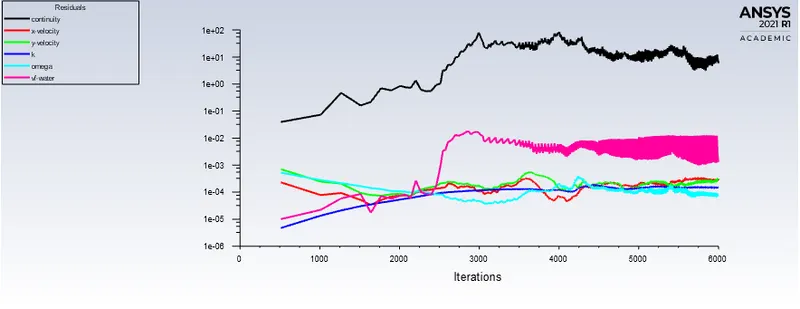
2.FINAL MIXTURE OF MULTIPHASE.
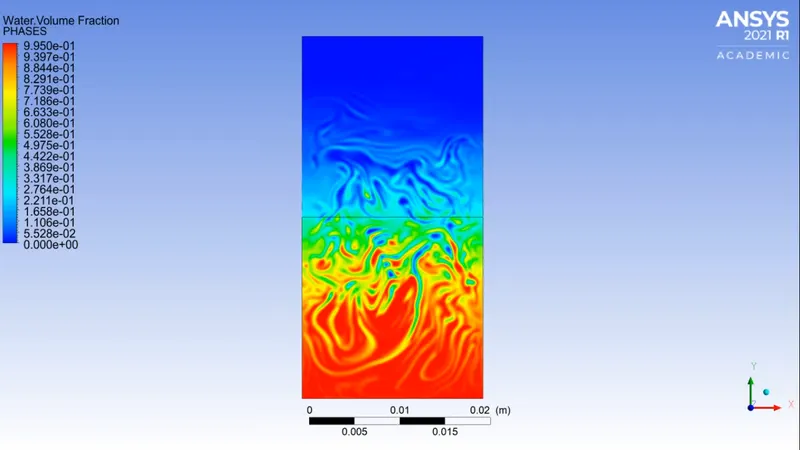
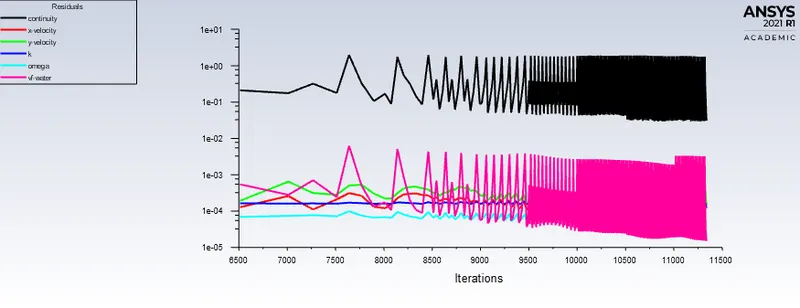
USER DEFINED MATERIAL AND WATER: MESH SIZE 0.15mm
MATERIAL 1 WATER WITH DENSITY 998 kg/m³
MATERIAL 2 USER DEFINED WITH DENSITY 400 kg/m³
1.RESIDUAL PLOT.
2.FINAL MIXTURE OF MULTIPHASE.
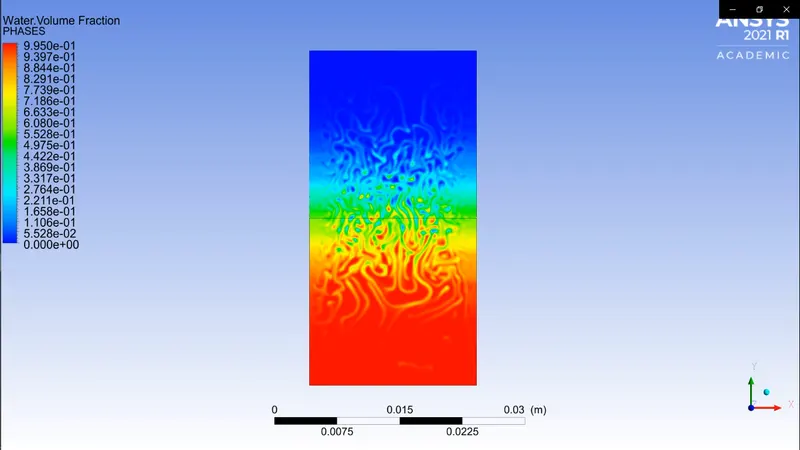
HERE WE CAN SEE A FEW THINGS.
1. AS WE REFINE THE MESH IN FIRST 3 CASES WE SEE THAT THE RESULY WITH THE FINE AND COARSE MESH GIVE US VERY SIMILAR RESULT AS THE TRANSITION TAKES PLACE VERY FAST AND THE ITERATIONS ARE NOT SMOOTH.
2. IN CASE OF VERY FINE MESH AND USER DEFINED MATERIAL WE SEE THAT THE BUBBLE FORMATION CAN ALSO BE SEEN AS THE MATERIAL IS PROCESSED VERY FINELY.
ATWOOD NUMBER
The Atwood number (A) is a dimensionless number in fluid dynamics used in the study of hydrodynamic instabilities in density stratified flows. It is a dimensionless density ratio defined as. where. Atwood number is an important parameter in the study of Rayleigh–Taylor instability and Richtmyer–Meshkov instability.
FORMULAE IS AS FOLLOWS.
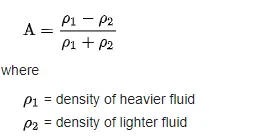
ATWOOD NUMBER FOR WATER AND AIR MIXTURE=0.9975
ATWOOD NUMBER FOR WATER AND USER DEFINED MATERIAL=0.4273
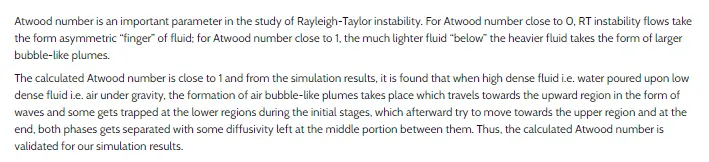
THE SIGNIFICANCE IS STATED BELOW.

ANIMATIONS FOR EACH CASE IS ATTCHED BELOW.
ANIMATION FOR COARSE MESH . MATERIAL AIR WATER
ANIMATION FOR FINE MESH . MATERIAL AIR WATER
ANIMATION FOR FINE MESH . MATERIAL AIR WATER
ANIMATION FOR FINE MESH . MATERIAL user defined mat and WATER