Week 5: Prandtl Meyer Shock problem
Aim: To simulate prandlt meyer shock problem using converge CFD package, and post processing.
Objective:
- Set the case for 2 different drichlet boundary conditions(specified value) for velocity at inlet.
- 100 m/s at 286.1k at which speed of sound is approximately 360m/s.
- 680 m/s at 286.1k at which speed of sound is approximately 360m/s.
- Plot and discuss the results for each case.
Introduction:
There are mainly 3 boundary condition which are most practiced in all fluid dynamic problems they are:
- Dirichlet boundary condition.
- Neumann or derivative boundary condition.
- Mixed or robins boundary condition.
We have equation for all internal nodes but does not have any equation to account for boundary of and flow, so the boundary conditions are important to solve any problem.
Shock flow boundary condition:
For shock flow problem the neumann boundary condition is used because we have specified value at inlet but not outlet.
In neumann boundary condition at outlet,
The gradient is zero for all the primitive variables, this is the main assumption with supersonic/hypersonic flows. This is widely accepted since all the characteristic leave the domain.
If you set the gradient to be zero at the outlet, basically you are saying that the primitive variables at the exit plane are the same from the plane right before the exit plane. using this assumption will provide us the value at the outlet boundary.
NOTE: While applying any boundary conditions we should take care that the governing equation are also statisfied at the boundaries or it will decrease the accuracy of solution. the boundary condition applied must have same order of accuracy as that of internal nodes.
Shock Waves:
It is the type of propagating disturbance that moves faster than the speed of sound in the medium.
Assume we have an object(missile) moving with speed greater then that of sound, also called as supersonic speed(M>1). When this happen the sound waves are left behind the object and creates a mach cone, the cone ends are what generally known as shockwaves.
Hence if person is standing below a supersonic object the person will hear a sound much after the object as been passed.
This technology is used in fighter jets, advantage is before we perceive the moving object it wouldd have done its work(Launching a missile). Ex: lockheed SR-71 blackbird.
Mach number :
Mach number is ratio of velocity of any object to velocity of sound.
M = velocity of object/ velocity of sound = v / a(acoustic velocity)
If,
M>1 : flow is supersonic.
M=1 : flow is transonic.
M<1 : flow is subsonic.
NOTE: There is also hypersonic speeds in which M=>5
Prandlt Meyer shock/expansion flow:
When we are dealing with a supersonic flow(M>1) which turns around the convex corner there is centered expansion which takes place at the corner, this produces a expansion fan.
The expansion fan consists of many mach waves, Along which the flow bends.
When the flow passes through this fan it accelerates(velocity increases) in turn Mach number increases but pressure, temperature, and density decreases. The flow through the expansion fan is isentropic( iso--entropic = entropy is constant) hence must be both adiabatic and reversible.
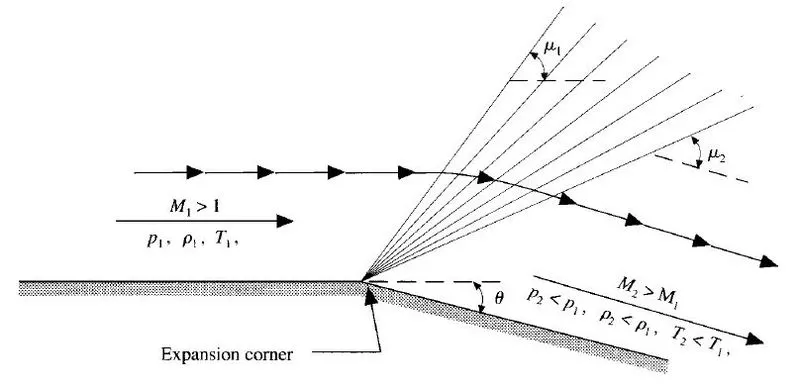
Prandlt meyer expansion waves are inclined at local mach angle μ ,
The μ for outer wave(μ1) and inner wave(μ2) can be calculated using formula,
sin μ1 = velocity of sound(constant)/ velocity of fluid at inlet(v1) = a / v1 = 1 / M1
sin μ2 = velocity of sound(constant)/ velocity of fluid at inlet(v2) = a / v1 = 1 / M2
To calculate the Ma2( Mach number at outlet) which is unknown, we have formula for turning angle 'θ' as,
θ = ν(Ma2) - ν(Ma1) ---------------------------------------- (1)
Where,
ν(Ma) = prandlt meyer function(degree/radians)
The formula for ν(Ma),
 --------------------- (2)
We specify inlet mach number(Ma1), and 'k' value for different fluid is provided, hence we can calculate ν(Ma1). Also the turning angle(θ) is set by us now using the eq(1) we can calculate ν(Ma2).
We have value for ν(Ma2) and 'k' which we substitute in eq(2) again and we get outlet mach number(Ma2) we can compare this value with running simulation in converge Cfd.
GRID CONTROL:
SGS( sub grid scale criteria):
Before learning SGS criteria let us have a briefing about AMR.
Adaptive mesh refinement(AMR) :
The numerical solution of problems in Science and Engineering usually requires grid that covers the computational domain. Discretization of the model equations is performed at the grid element level.Solution accuracy may be increased through the use of higher order discretization, or uniform refinement.
Both methods have drawbacks: higher order schemes are prone to producing oscillations, while uniform refinement is too expensive.
Adaptivity of the mesh is necessary to cluster grid points in the regions where it is most needed, while keeping the grid coarse elsewhere. There are two main adaptive strategies namely:
- Adaptive mesh redistribution, also called p-refinement.
- Adaptive mesh refinement, also called h-refinement.
The second type of mesh adaption, h-refinement, or more commonly AMR, adds new cells and deletes other cells that are no longer required.The AMR technique is extremely useful for applications involving discontinuities, shock waves, phase change or/and combustion interfaces, or any localized large-gradient regions. However, it is more complex to implement and program.
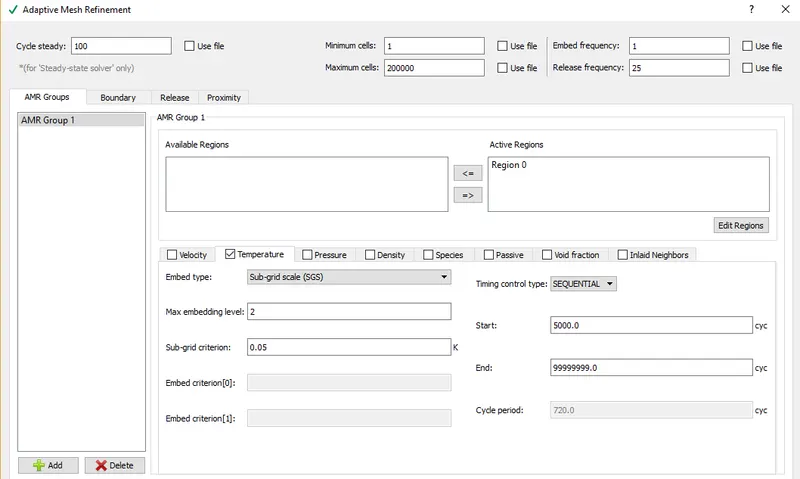
Now in converge for shock problems we generally use AMR in which we define a region in which the refinement must be done and the parameters whose change will cause the refinement.
Subgrid scaling:
Subgrid scaling mainly consist of subgrid criteria, and maximum embedding level.
If we assume that the parameter we need to include for refinement is temperature then subgrid criteria is a value of increase/decrease in temperature for which refinement is done, and embedding level defines the amount of grid scaling.
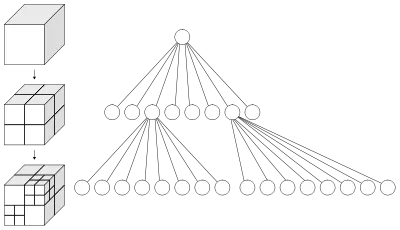
Refined grid size = Base grid size / 2^(embedding_level)
The converge use octree data structure which is applied in 3-dimensional space. An octree is a tree data structure in which each internal node has exactly eight children. Octrees are most often used to partition a 3-dimensional space by subdividing it into eight octants.
CASE SETUP:
Setup tree:
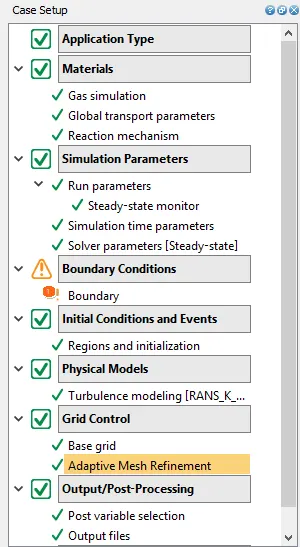
- The material properties are kept same with the gas as air.
- Run parameters are set for steady state simulation.
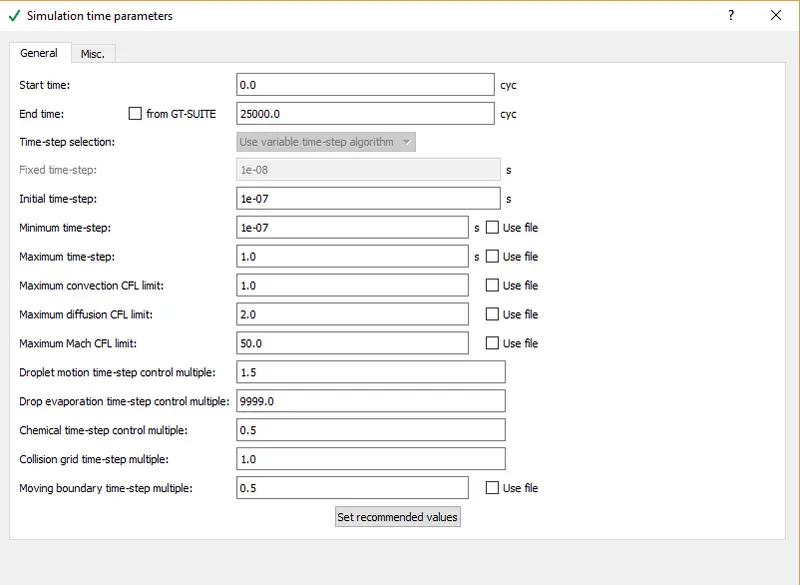
- We change the simulation time parameters in which we change the end time, initial time step, and final time step.
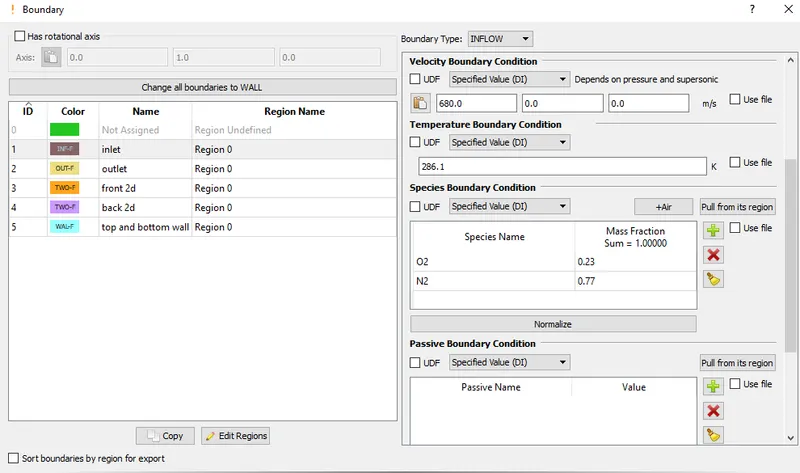
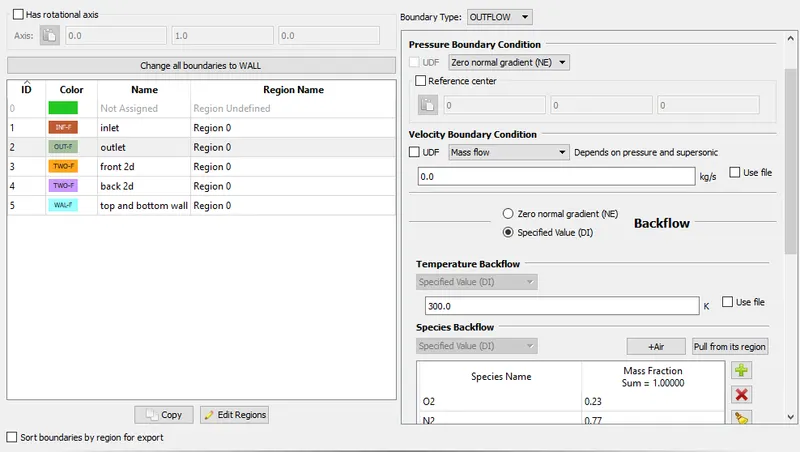
- In boundary condition we apply neumann boundary condition, in this boundary type for inlet we specify the value and for outlet we generally take the gradient to be zero(for supersonic flow).
- We simulate for two conditions,
- velocity 100 m/s
- velocity 680 m/s
- The wall is specified as slip boundary.
Inlet boundary:
Outlet boundary:
- We also define AMR (adaptive mesh refinement) for supersonic flow. In this we select the region, the parameter, and embed type(SGS).
- Import all the stl files
SUBSONIC FLOW RESULTS(100m/s):
Mesh for subsonic flow simulation:
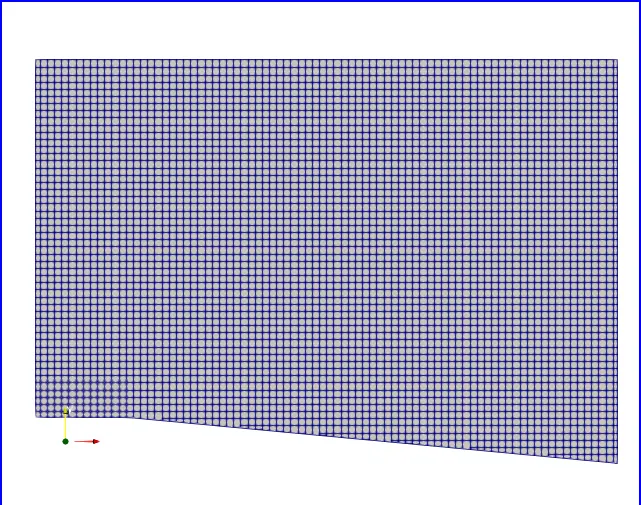
In subsonic flow we generally don't find amr working since the change is temperature throughout the process is not passing the subgrid criteria which was set to 1 in this case.
Pressure contour:
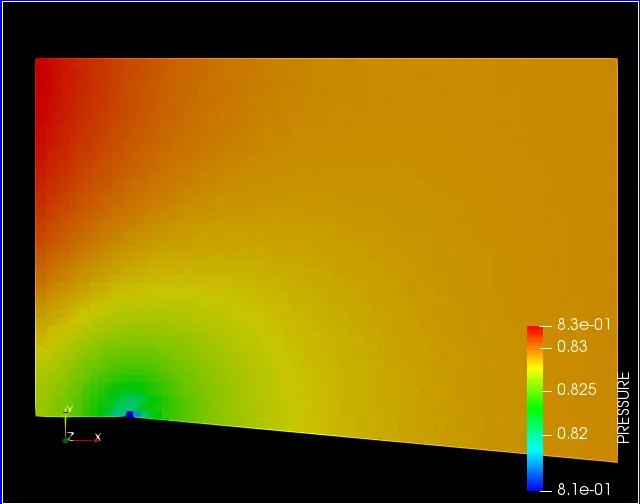
There is minimal effect on pressure in subsonic flow, there is slight increase in pressure.
Temperature contour:
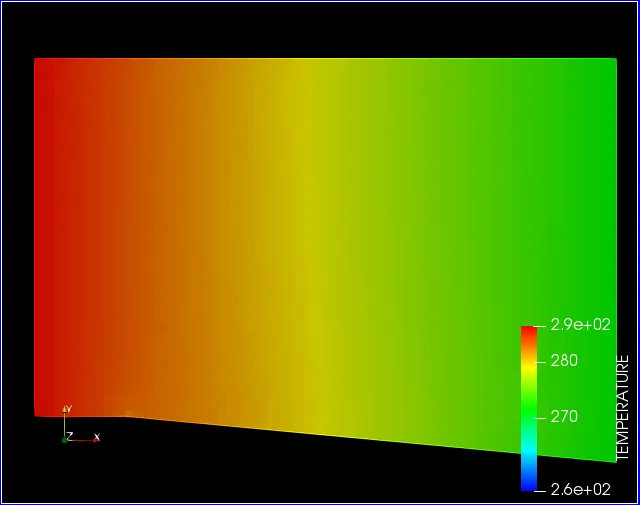
Temperature decreases in subsonic flow from inlet to outlet.
Velocity contour:
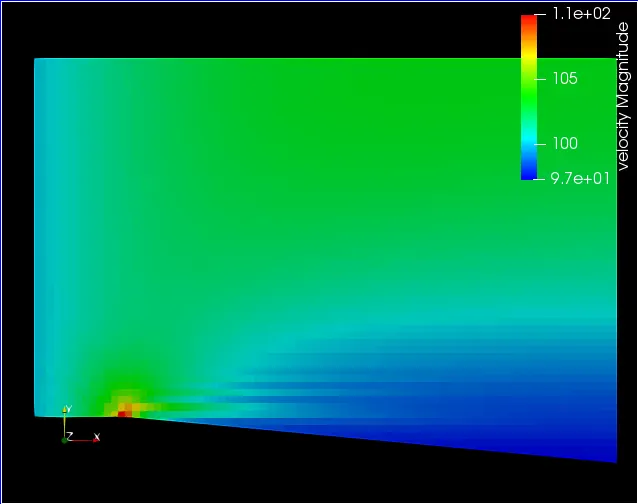
Velocity decreases at lower portion because of flow seperation which takes place due to sudden expansion in cross section and increases in upper portion.
Plots for cellcount, total pressure, temperature and mach number:
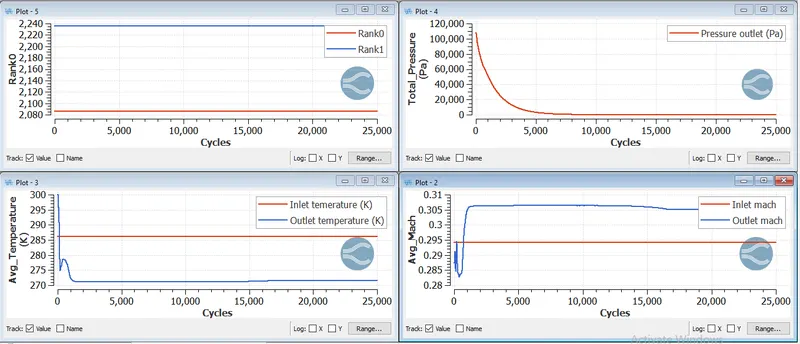
- Cell count remains constant since amr is not in function because SGS criteria is not met.
- Pressure decreases in subsonic flow.
- Outlet temperature also decreases.
- Mach number increases at outlet.
SUPERSONIC FLOW RESULTS(680 m/s)
Mesh for supersonic flow simulation:
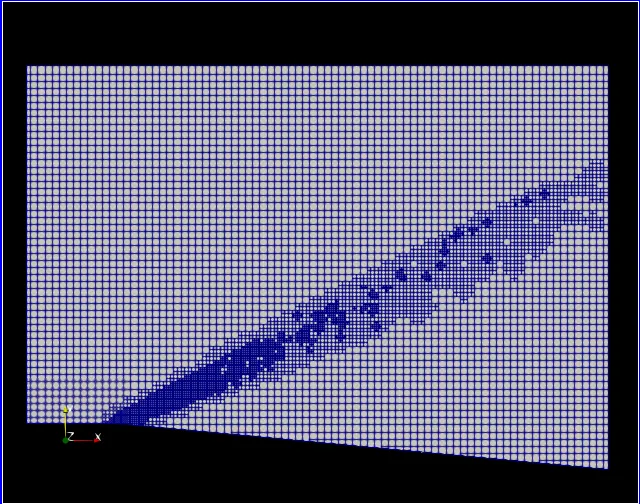
It can be seen that the grids are refined at certain region because the SGS criteria is met, the refinement is based on octree data structure.
Pressure contour:
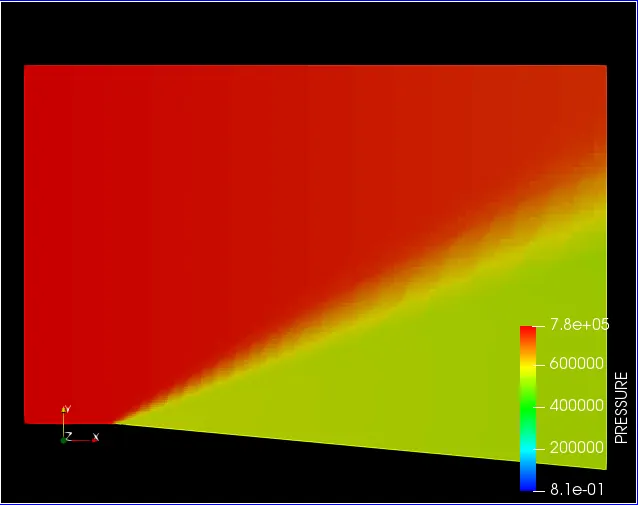
As discussed before the pressure decreases asit passes through the expansion fan at the convex edge.
Temperature contour:
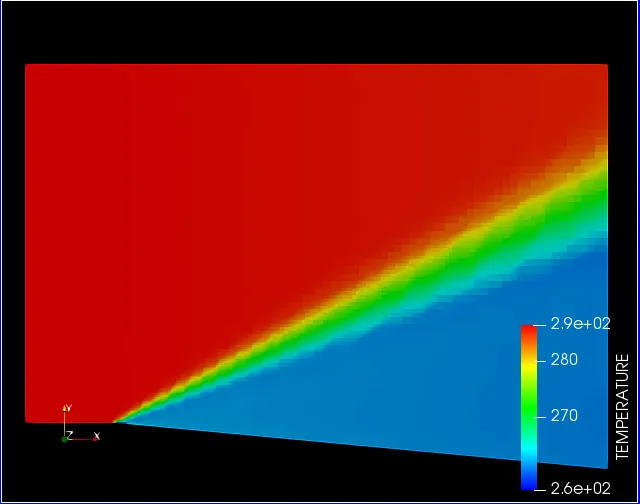
Temperature of fluid also decreases as it passes through expansion fan in supersonic flows.
Velocity contour:
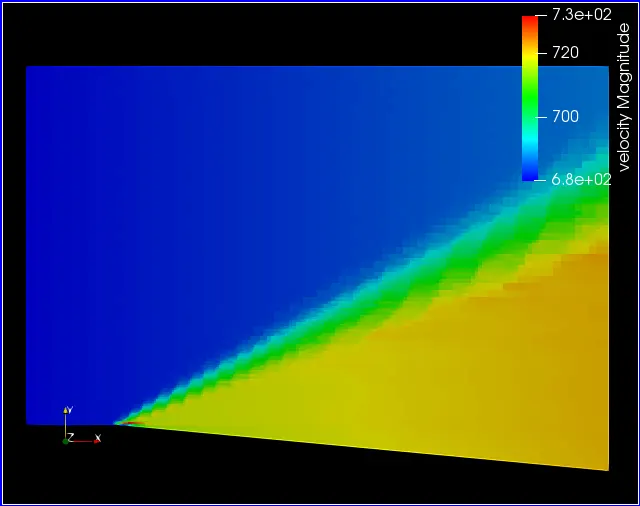
The velocity inceases and also mach number increases while passing through expansion fan in supersonic flow.
Plots for cellcount, total pressure, temperature and mach number:
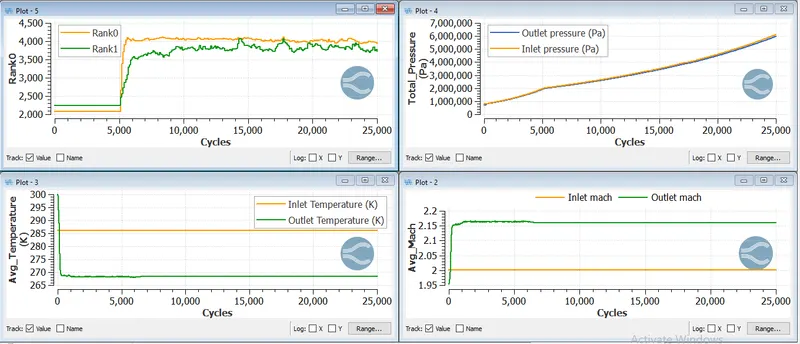
- Cell count value changes during a process because adaptive mesh refinement get activated.
- The mach number increases with pressure, density, and temperature decreases when it passes through expansion wave.
Results for supersonic flow with different SGS value(0.05,0.03,0.02):
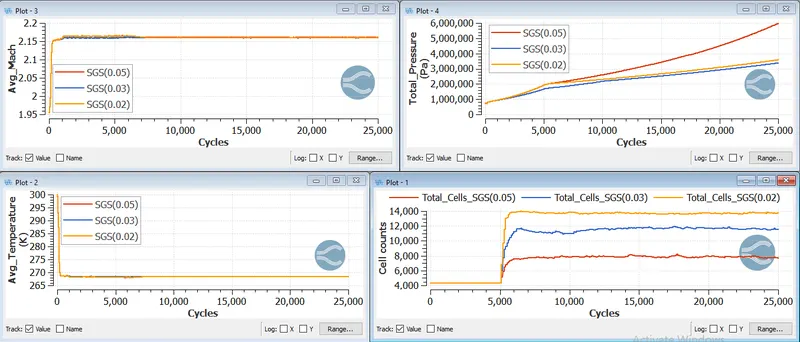
The conclusion from different sub-grid scale are:
- The cell count increases as we decrease the SGS value which is obvious from the fact that the parameter is more prone to the changes and hence for small changes there is mesh refinement.
- The other parameters such as pressure, temperature and mach number are minimaly changed, but we known as there are more mesh grid the accuracy of solution increases from which we jump into the conclusion that the smaller SGS value increases the accuracy of the solution.