Week 5: Prandtl Meyer Shock problem
PRANDTL MEYER SHOCK PROBLEM
AIM: Simulate a supersonic flow in a rectangular geometry provided and study the nature of shock waves produced and its impacts on the physical properties.
WHAT IS A SHOCK WAVE: A shock can be defined as a series of regular disturbances that are tend to occur when the fluid particles in the medium move faster than the speed of sound i.e. supersonic. A shock wave carries energy through the medium which it is travelling and it differs from a normal wave by altering the physical properties including Mach number, density, velocity etc. Day to day examples of a shock wave can be seen in nuclear or chemical explorations. A “sonic boom” that happens in an aircraft and the scene of bullet pushing the air from the barrel of the riffles which are shown in movies. A size of a shock wave is said to be in the order of few nanometres.
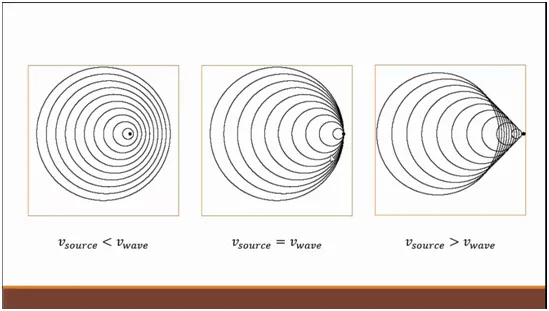
Figure 1: Different conditions of wave propagation.
HOW DOES SHOCK WAVE OCCUR: In aircrafts when the free stream airflow hits the airplane it creates a disturbance in airflow. This disturbance creates a disturbance sound wave and this information of the disturbance is passed onto the neighbouring molecules. When molecules travelling lesser than or with speed of sound i.e subsonic then the upstream airflow will have adjust itself and will travel around the aircraft smoothly but when the speed of the object molecules travel at supersonic speed then the upstream airflow will collide with disturbed molecules and will create a series of expansion waves known as the shock waves. The streamlines which move across these shock waves experience a decrease in Mach number, creates a drastic increase in static pressure thereby affecting drag and lift. So the design engineers make sure to adjust the dimension of the wings at both the sides because sometimes shockwaves can also be formed at high subsonic speeds so they affect the performance of the aircraft. The most common form of shock is oblique shock that usually occurs at an acute angle with respect to the solid surface. The other form of shock is normal shock that occurs at very high mach numbers>5. This type of shock is more prominent in rockets, missiles etc.
Mach number: is a dimensionless number and is the ratio of speed of the object in that medium to the speed of sound.
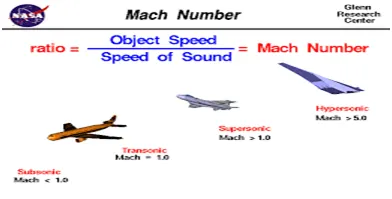
Figure 2: Image courtesy- NASA
TYPES OF BOUNDRY CONDITIONS
- Dirichlet boundary conditions: In dirichlet boundary condition the value is specified at the boundary.
Y=f.
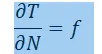
- Neumann boundary condition: The normal derivative of a function is specified. This Neumann boundary condition is applied to this problem because all the variables ( pressure, velocity, temperature, Mach number) are not available before solving the problem. Only the normal derivatives of variables are specified as zero or zero gradient.
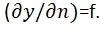
- Robin boundary condition: It is the combination of both the above boundary conditions specified at both the ends.
- Co*y +c1 *
PROCEDURE: The simulation is done for 2 cases of adaptive mesh refinements
CASE 1: The SGS criteria is set for 0.05
CASE2: The SGS criteria is set for 0.03
- Import the STL file provided to the converge
- Air is given as the predefined mixture
- The end time for the simulation is 25000 cycles with a minimum time step of 1e-8.
- A density based solver is used for this simulation. We use this type of solver because when stream lines flow across the mach wave they change the physical properties of the air by compressing them. This compressibility effect change the amount of resulting force on the aircraft.
- The Neumann boundary conditions are given at both the inlet and the outlets. The inlet and the outlet velocity is given at 680m/s.
- The front and the back geometries are given as 2D geometries whereas the Top and the bottom wall are given slip boundary condition.
- The RNG k-epsilon turbulence is given for the simulation.
- The base grid is set to 0.8 in all the directions
- Adaptive mesh refinement (AMR) is given as per the cases.
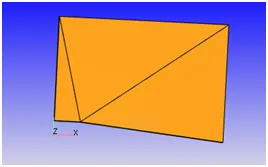
Figure 3: geometry
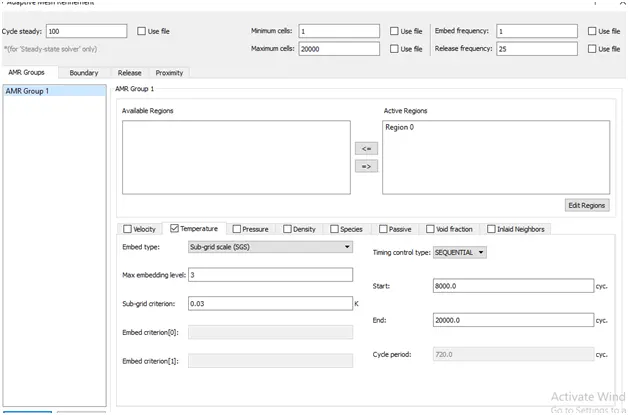
Figure 4: Adaptive mesh refinement
OBSERVATIONS( for case 1): The following contours and graphs were obtained for a value of sds of 0.05
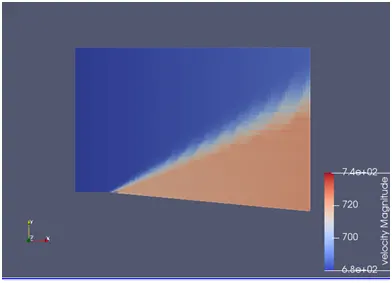
Figure 5: Velocity contour
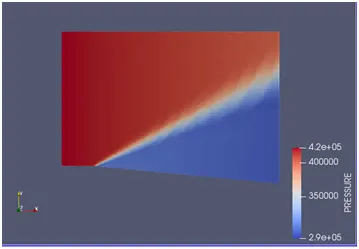
Figure 6: pressure contour
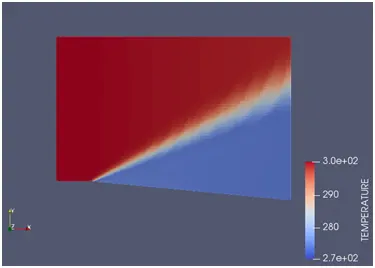
Figure 7: Temperature contour
GRAPHS:
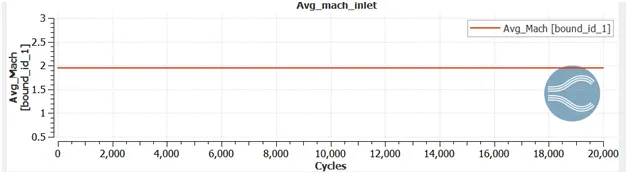
Figure 8: Mach inlet
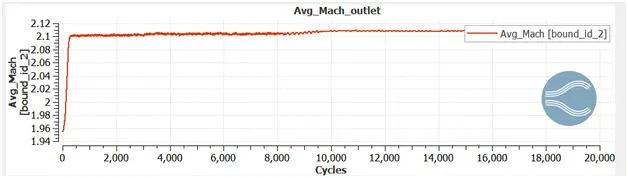
Figure 9: Mach outlet
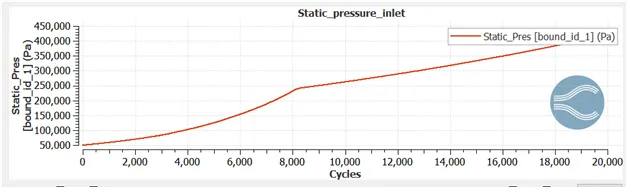
Figure 10: Static pressure inlet
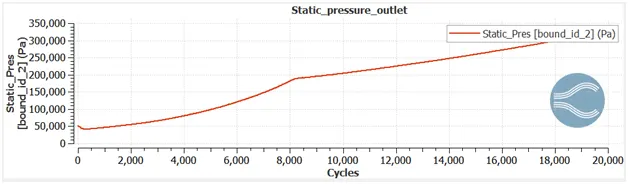
Figure 11: Static pressure outlet
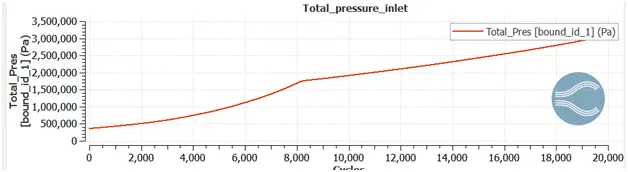
Figure 12:Total pressure inlet
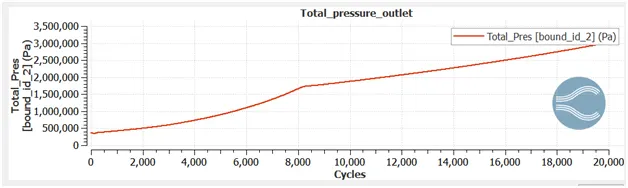
Figure 13: Total pressure outlet
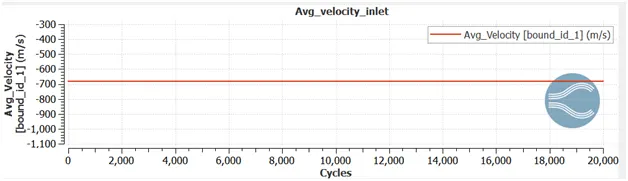
Figure 14: Velocity inlet
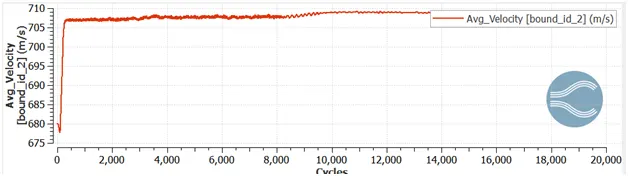
Figure 15: velocity outlet
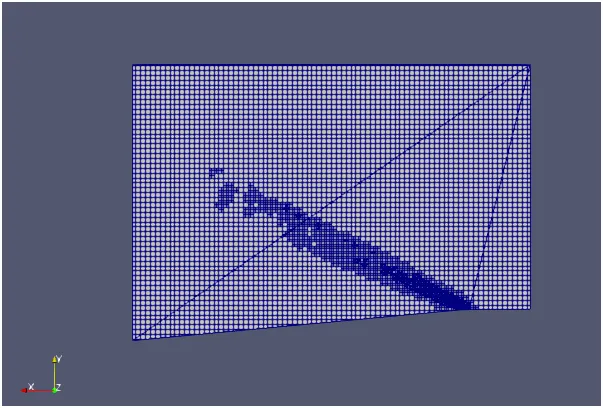
Figure 16: Mesh geometry
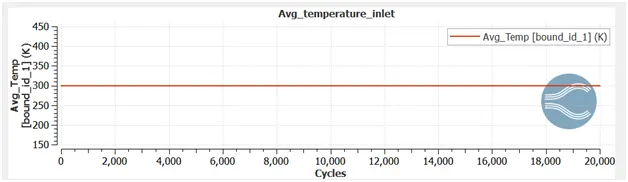
Figure 17: Temp inlet
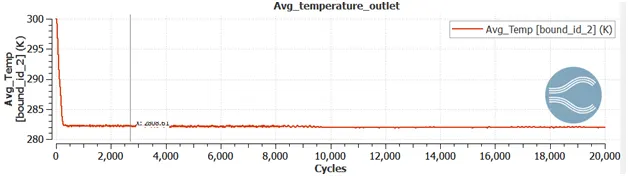
Figure 18: Temp outlet
CASE 2: The contours and the plots for the 2nd case i.e. 0.03 SGS are given below
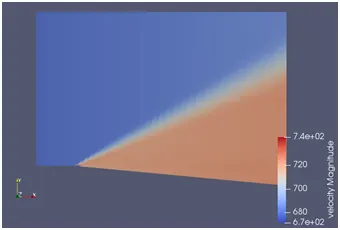
Figure 19: Velocity contour
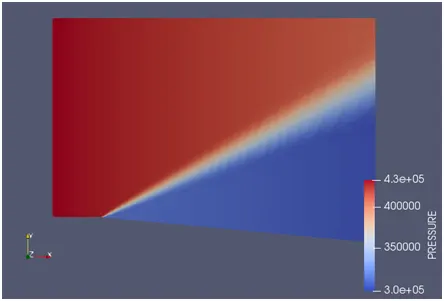
Figure 20:Pressure contour
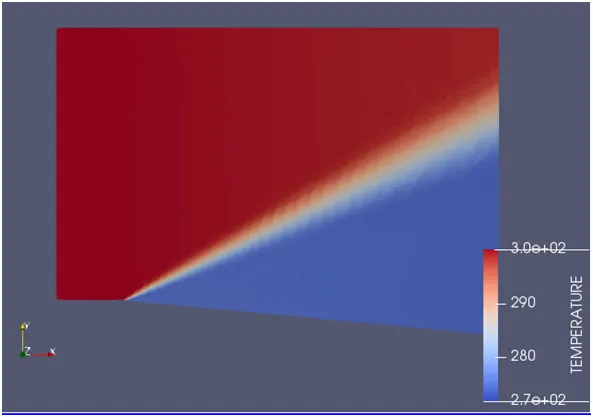
Figure 21: Temperature contour
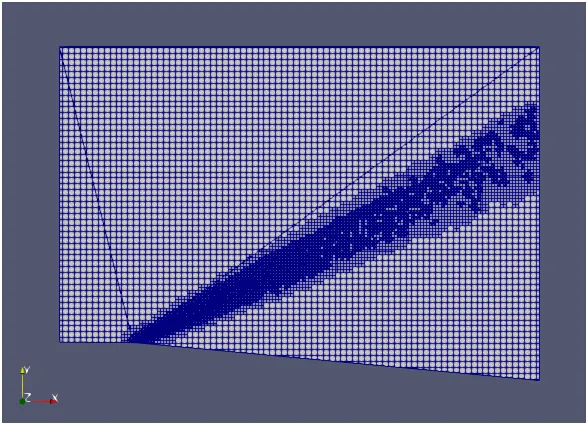
Figure 22: Mesh geometry
GRAPHS:
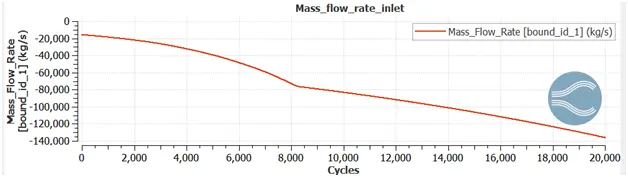
Figure 23: Mass flow rate inlet
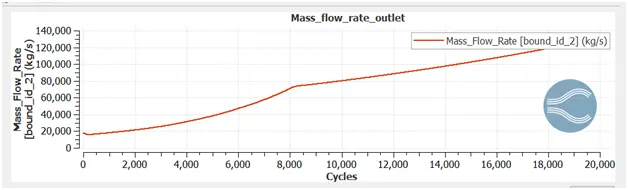
Figure 24: Mass flow rate outlet
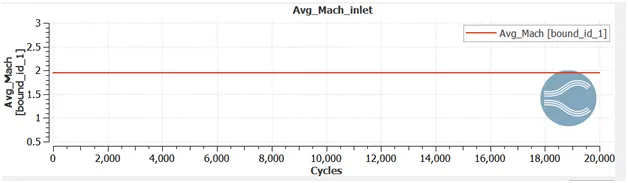
Figure 25: Mach inlet
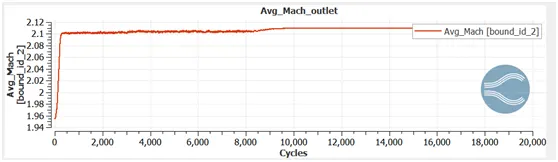
Figure 26: Mach outlet
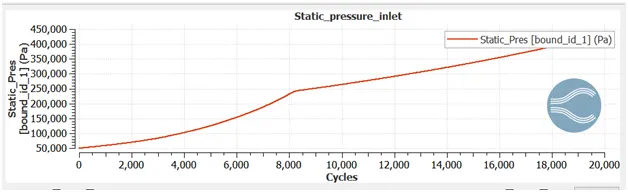
Figure 27: Static pressure inlet
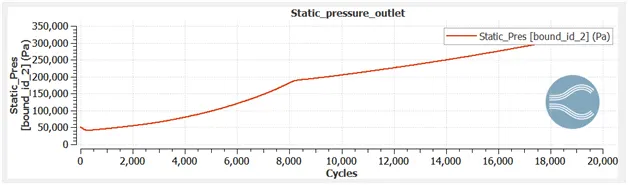
Figure 28: Static pressure outlet
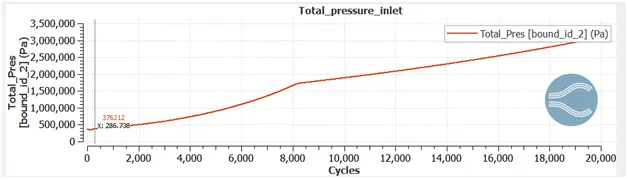
Figure 29: Total pressure inlet
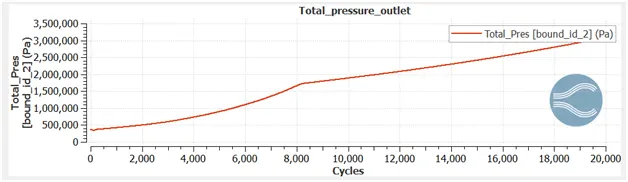
Figure 30: Total pressure outlet
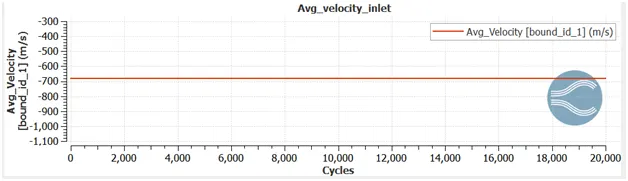
Figure 31: Velocity inlet
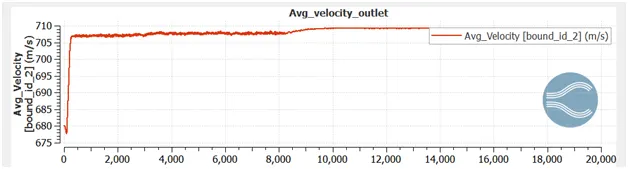
Figure 32: Velocity outlet
Figure 33: Temperature inlet
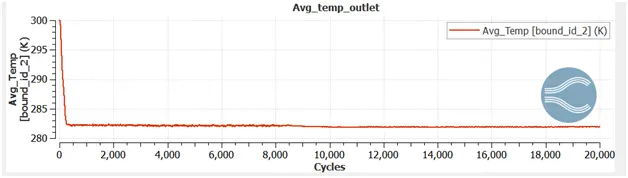
Figure 34: Temperature outlet
CONCLUSIONS: From the 2 cases performed with 2 diffrenet SGS (sub grid sizes) the adaptive mesh refinement has been used. The AMR can be used in any of the flow parameters such as velocity, pressure and temperature. It is noted that as the SGS parameter decreases the total number of cell count will increase and hence a more refined mesh geometry around the shock area thereby making the expansion waves more prominent in the contour diagrams. Hence, more accurate would be the solution as the values are converged closer to the set low tolerance limits.
As CFD engineers our aim is to study the effects of shock waves and we have done that successfully and make sure that the shock produced does not affect the performance of the object or obstruct the airflow around the object.