Week 8: Literature review - RANS derivation and analysis
RANS DERIVATION AND ANALYSIS:
OBJECTIVE: Apply reynolds decomposition to the navier stokes equation and derive the equation for the reynolds syress. Explain the diffrence between the turbulent viscosity and molecular viscosity.
TURBULENCE: Turbulence refers to the irregular and the uneven flow of the fluids where pressure of the fluid changes constantly as it flows over an irregular surface. In real life almost all the flow is associated are said to be turbulent in nature which also includes a smooth flow such as water flowing a pipe. It may be as insignificant as few bumps or as vital as causing a structural damage to the aircraft. It is mainly determined by a dimensionless quantity, namely the reynolds number.
REYNOLDS NUMBER: The reynolds number (Re) is an important parameter that determines the nature of the fluid that flows over a surface in fluid dynamics. For lower reynolds number i.e. upto 2500 the flow is said to be a smooth flow over a contour also called the laminar flow. For reynolds number greater than 4000 the flow is said to be a turbulent flow. A transtition flow prevails between these two limits. But in real life conditions almsot all the flows can be considered a turbulent flow because of the friction acting on the surface and the viscosity that happens due to the nature of the fluid as well.
REYNOLDS AVERAGED NAVIER STOKES EQUATION: The reynolds averaged navier stokes equations(RANS) are time averaged equations of motion for fluid flow. The principle behind the equations is reynolds decompostion whereby an instanteneous quantity is decomposed into its time averaged and fluctuating quantities. This idea was first proposed by Osborne reynolds and these set of equations are primarly used to describe a turbulent flow. The below figure represents the reynolds decomposition.
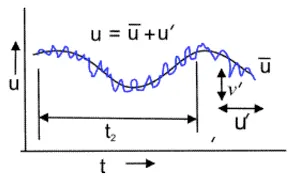
VELOCITY COMPONENTS:
u(x,y,z,t)= `bar u`(x,y,z)+`dot u`(x,y,z,t)
v(x,y,z,t)= `bar v`(x,y,z)+ `dot v`(x,y,z,t)
w(x,y,z,t)= `bar w`(x.y,z)+`dot w`(x,y,z,t)
Here
u= instantenous velocity
`bar u`= Average velocity
`dot u`= fluctation velocity
We take the overbar as averaging operator
`bar u`(x,y)= 1`div t``int_0^1u(x,y,t) dt`
`bar v`(x,y)= 1`div t``int_0^1 v(x,y,t) dt`
since `bar u` is the averaging operator
`bar u`=1/T `int_0^T(u+bar u) dt`
`bar u`= 1/T `int_0^T barudt+ int_0^Tudt`
so `bar u`is not a function of time
`bar u= baru(1) + int_0^Tudt`
We also decompose the pressure
p= `bar p+ dot p`
Now we substitute the decomposition into the navier stokes equation and seek a new equation governing the dynamics of average of time average flow field.
CONSERVATION OF MASS:
`del u`/ `del x`+ `del v`/`del y`=0
substitute u= `bar u + dot u`
and v=`bar v+ dot v`
`del/ delx( baru+ dot u) + del/ dely(barv+ dot v)`
Taking time average of the whole equation
1/T `int_0^T del/delx bar u dt`+ 1/T`int_0^T del/delx dot u dt+ 1/T int_0^Tdel/del y barv dt+ 1/T int_0^Tdot vdt`
So, `1/t int_0^Tdel/delx bar u dt+ 1/T int_0^Tdel/dely barv dt`
By solving the integration we get
`(del baru)/ (delx)+ (del barv)/(dely)=0`
Hence the average flow field obeys continuity equation
CONSERVATION OF MOMENTUM
`rho( (delu)/(delt)+ u(delu)/(delx)+v (delv)/(dely))= -(delp)/(delx)+mu (del^2u)/(dely^2)`
Adding continuity equation and applying the product rule we get
`(delu)/(delt)+ (del(u^2))/(delx)+ (del(u.v))/(dely)= -1/rho. (delp)/(delx)``+ v (del^2u)/(del y^2)`
substitute u= `bar u+ dot u`
and v=`bar v+ dot v`
and eiimnating the velocity fluctuation term we get
`(del baru)/(delt)+ (del baru^2)/(delx)+ (del( baru.barv))/(dely)`= `- 1/rho (del barp)/(del x)+ v (del ^2baru)/(del y^2)- (del dot u^2)/(delx)- (del(dot u. dot v))/(del y)`
Neglecting `u^2` term
`(del bar u)/(delt)+ (del bar u^2)/(delt)+ (del(bar u. barv))/(del y)`=`- (del bar p)/(delx)+1/rho del/(dely)(mu (del bar u)/(dely)-rho.baru.barv)`
Unsteady Reynolds Average Navier stokes is
`rho( (del baru)/(delt)+(delu^2)/(delx)+(del(bar u. barv))/(dely))`= `-(delbarp)/(delx)+ del/(dely)(mu(delbaru)/(dely)- ubrace(rho. bar u.barv))`
The term with the underbrace i.e. `rho. baru.barv` represents the added stress on the fluid.
REYNOLDS STRESS: Refers to the component of the total stress tensor in a fluid obtained from operating the navier strokes equation to account for the turbulent fluctuations.
TURBULENT VISCOSITY VS MOLECULAR VISCOSITY:
The turbulent transfer of eddies create internal fluid friction. It is the fundamental idea of how we define internal fluid friction in a turbulent flow neglecting the effects of eddies or the vortices. Such a type of property is called the turbulent viscosity.
Molecular viscosity is the transport of mass motion momentum solely by the random motions of individual molecules not moving together in groups.Molecular viscosity is analogous to a laminar flow of how eddy viscosity is in a turbulent flow. Molecular viscosity is the same as static viscosity. We can think of it as a macroscopic fluid property such as honey and water and the eddy viscosity is the viscosity that occurs due to the momentum of the flow due to turbulent velocity fluctations.