Week 5: Prandtl Meyer Shock problem
AIM: To conduct a study on expansion fan caused due to supersonic flow.
Introduction: This simulation is conducted to understand the sudden increase in the cross-section area that lead to creation of an expansion fan (Prandlt-Meyere shock) in a supersonic flow.
An expansion fan is a peturbation that is caused due to sudden change in the flow -sudden expansion of area of cross section in this case. In this case as the flow is super-sonic (compressible) and due to change in the geometry the flow experiences sudden expansion and hence lead to increase in the Mach number, reduction of static pressure and hence increase in the veloctiy. A Prandlt-Meyere equation gives the relationship between the angle with which the exapnsion fan will occure relative to the centerline axis (Hroizontal) of the body.
Expansion fan is not an abrupt change in the properties like a shock wave but a gradual change throughout the fan.
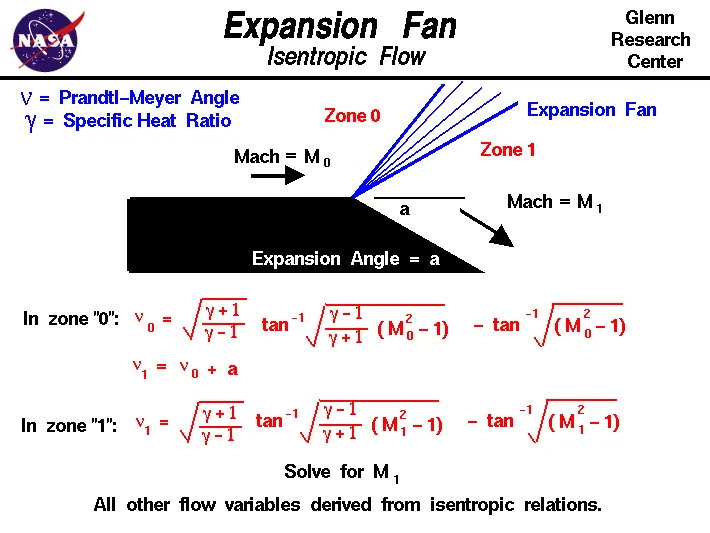 |
`nu0 = {sqrt[(gam+1)/(gam-1)]} * atan{sqrt[(gam-1)*(M0^2 - 1)/(gam+1)]} - atan{sqrt[M0^2 -1]}`
The above expression gives the angle at which the expansion wave will be at with the axis, it is a function of the incoming Mach number and the specifc heat ration of the fluid.
Using this equation we can calculate for the Mach number after the expansion and since this is gradual increse we can calculate the Mach number further downstream.
Boundary conditions for the Shockwave problem:
When it comes to a compressible flow across the body (Supersonic) we use peculair boundary conditions to understand the flow behaviour that usually causes shock or expansion waves.
In this study a region with 50,000 Pa, 678 m/s velocity and 300K temperature was initiated. For the boundary conditions it is necessary to gave condition that return to ther original state downstream as
the object passes through it i.e Normal zero gradient at the outlet. Whereas, for the inlet, specified values for velocity 678m/s, pressure 101000 Pa, temperature 286K is initiated.
Simulaltion and result:
For the above given configuration for the region and Boundary conditions and conducting the simulation with Adaptive grid refinement (SGS: 0.01, 0.05, 0.1) the following results were obtained.
| Sub-Grid Scaling | |||
0.01
|
|||
|
0.05
|
|||
|
0.1
|
Plots:
| Mass flow rate | 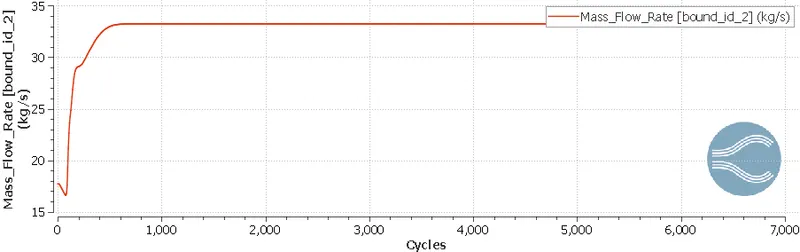 |
| Pressure | 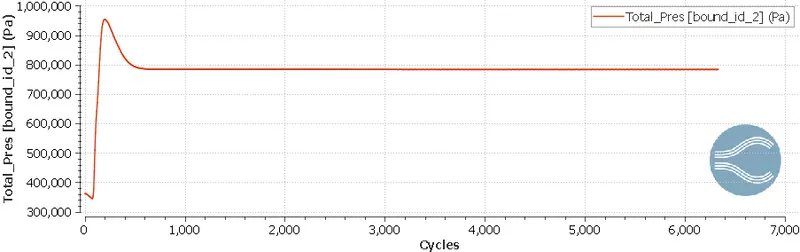 |
| Velocity | 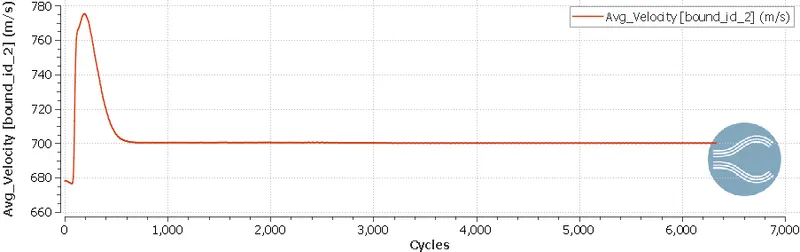 |
Contours:
Based on the SGS the grid at the last cycle is shown. A smaller SGS factor shows denser Refinement and smaller cells i.e it is catching even slight variation in temerature and refining the mesh. Hence giving a better resolution.
|
0.01
|
|
0.05
|
|
0.1
|
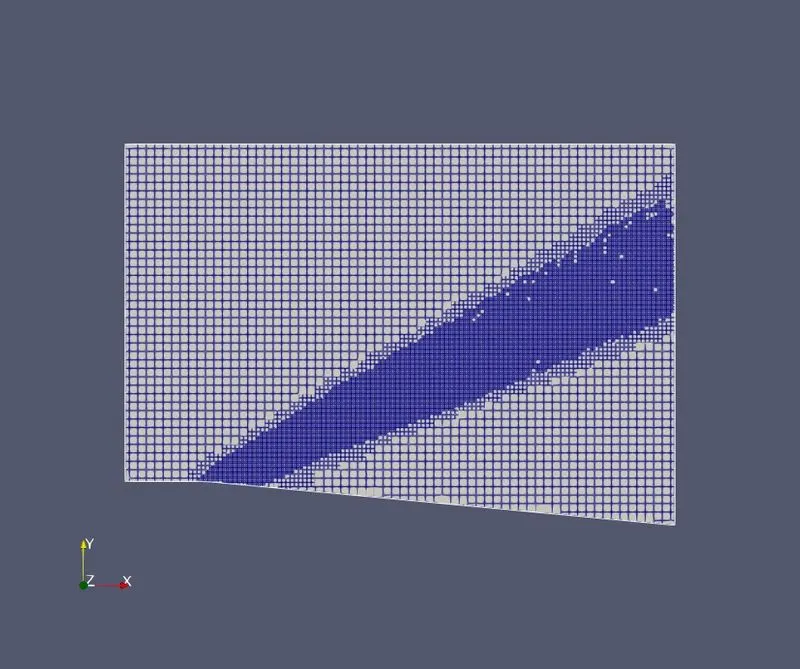
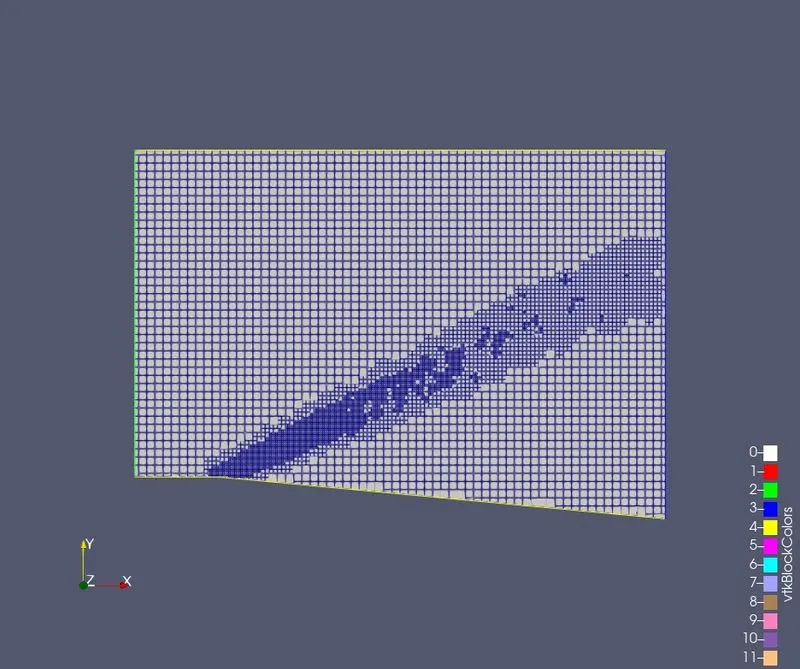
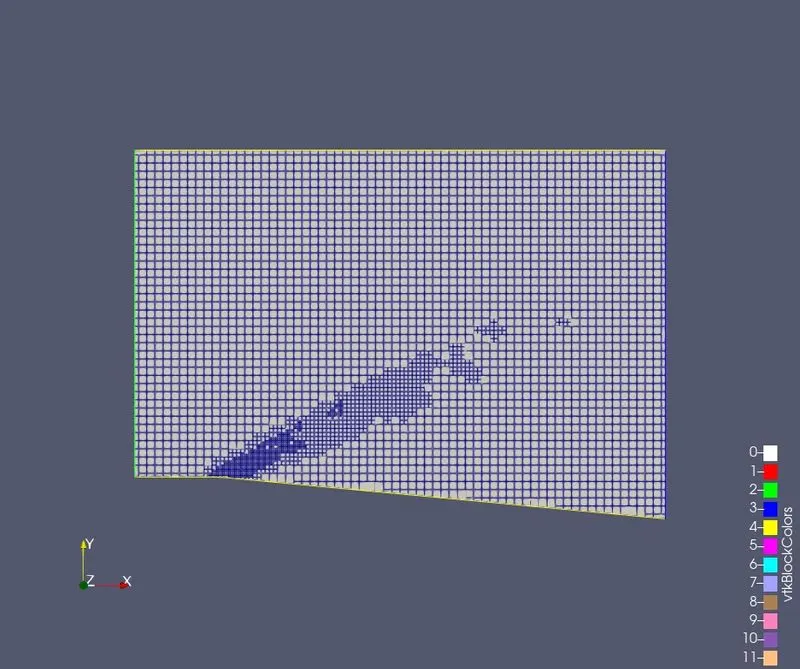
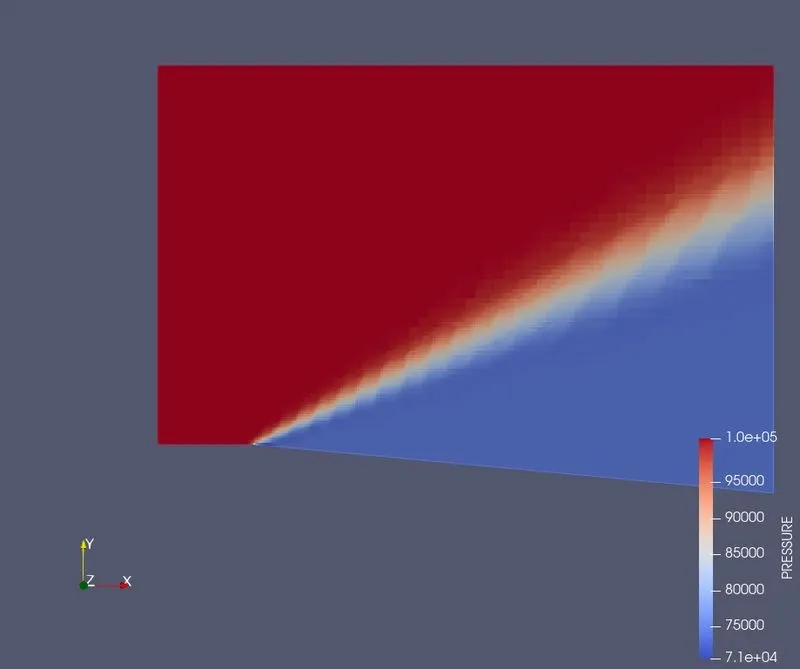
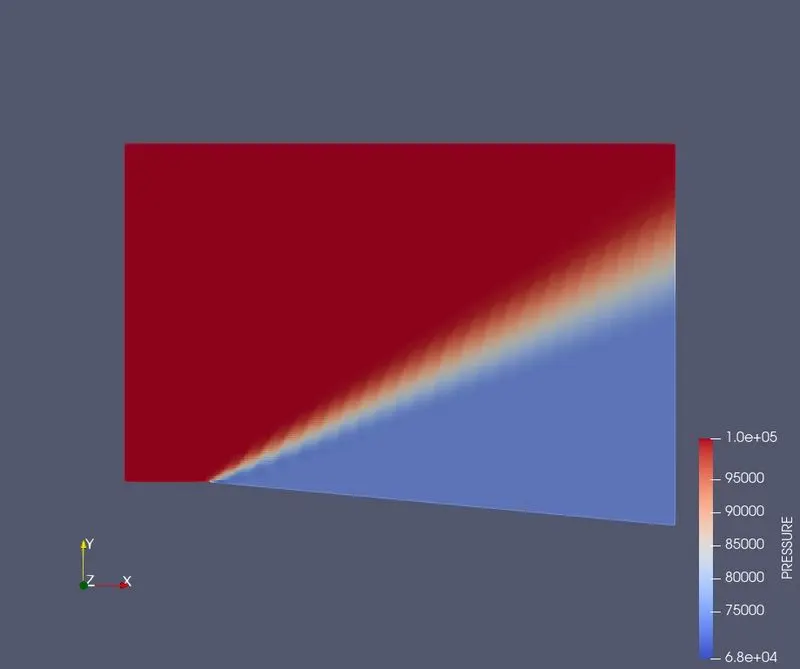
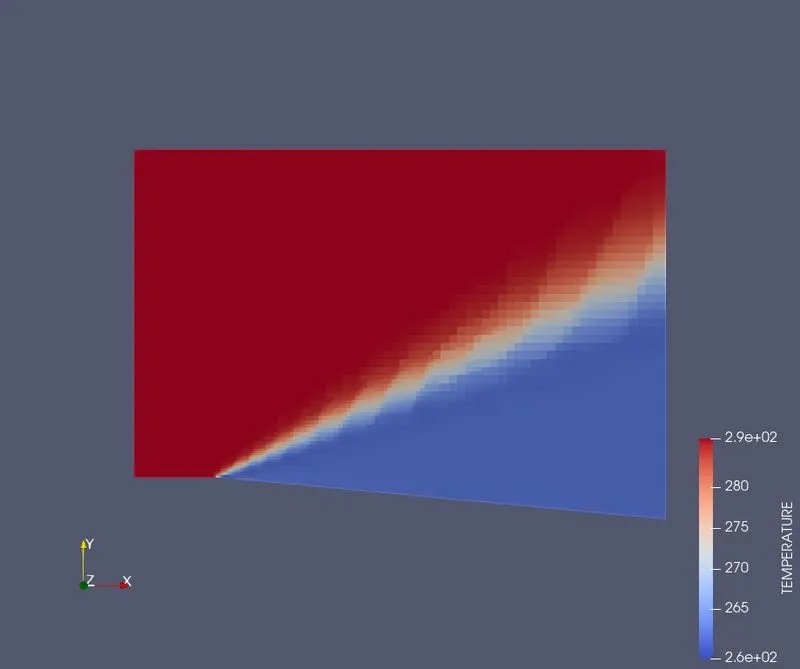
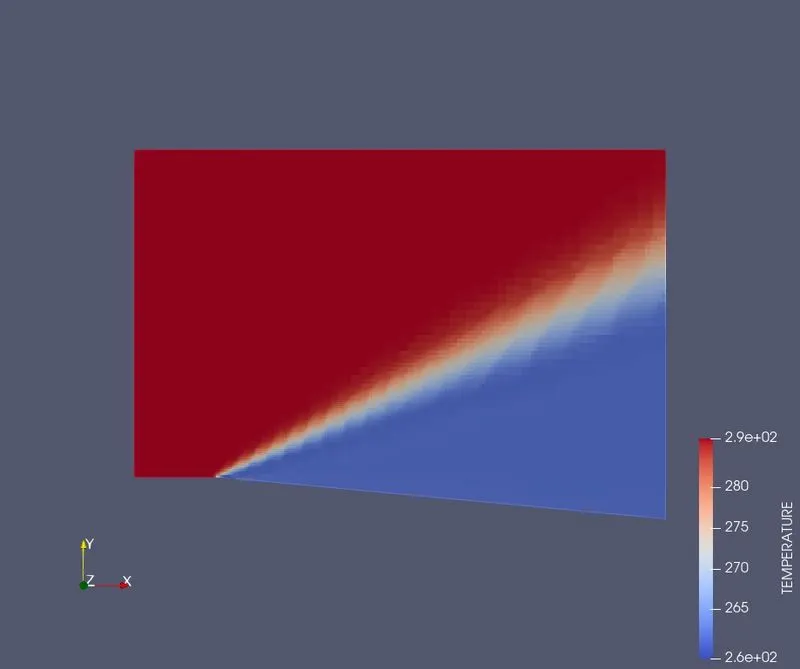
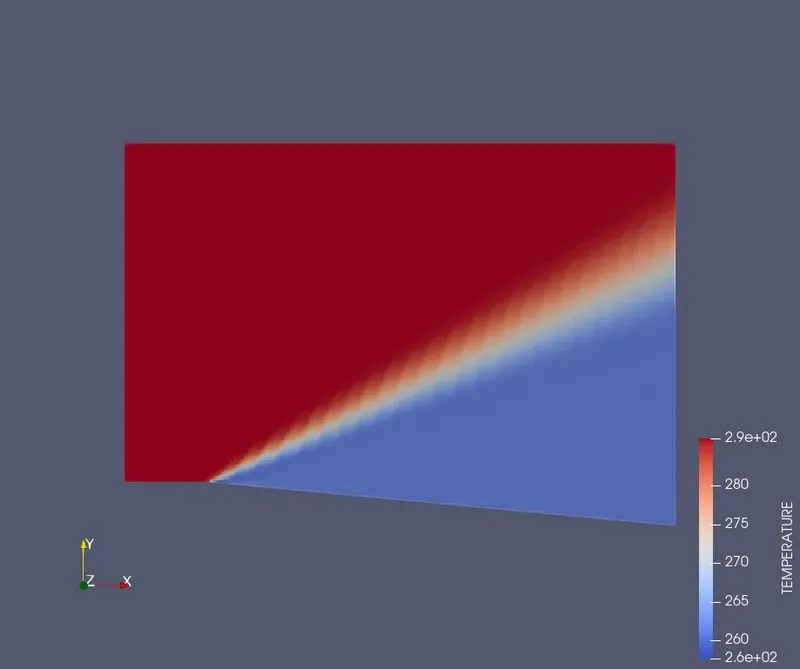
As the difference is clearly seen in the contours of Pressure and temperature below the resolution is affected as the Sub-grid Scaling changes.
| 0.1 | 0.05 | 0.01 |
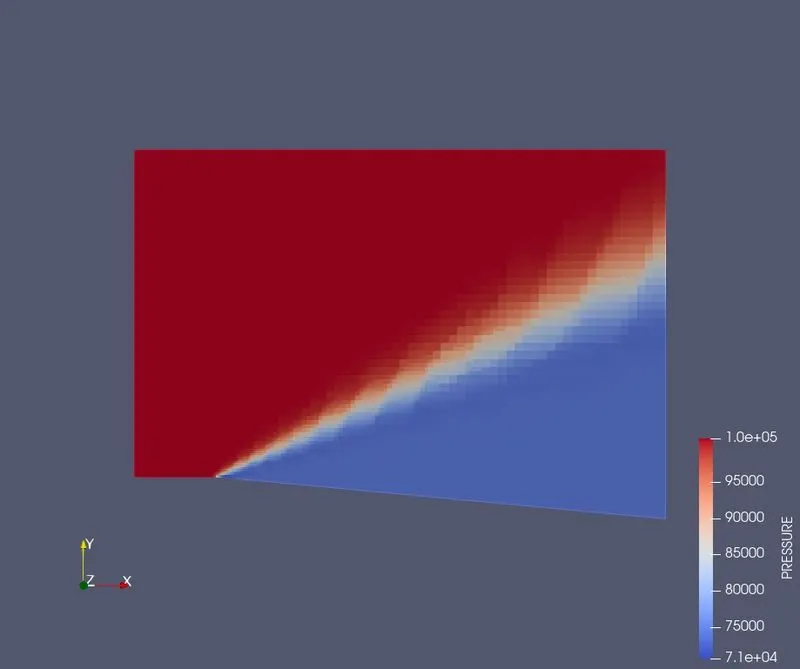 |
 |
 |
 |
 |
 |
Conclusion:
As the simulation is conducted for 3 SGS values for Temerature it can be seen as that a smaller SGS has better resolution and gives better image and provides more refinement in the region of intrest.
This is quite crucial to understand the Expansion fan, its effects and its behaviour.