Week 5 Challenge(Comparing average power and average density vs Cell voltages of different energy source devices by excel plots)
CHALLENGE 5
1) For the case of aggressive driving in city,it is FALSE that battery is better choice to supply power than UC(Ultracapacitors).
In the case of aggressive driving by rapid acceleration and harsh breaking ultracapacitors plays a major role to provide sudden high power reqirement from battery and sudden high current charging during breaking.
We can discuss how it is doing its actions in electric vehicles.
- Batteries and ultracapacitors do a similar job as storing electricity,but in completely different ways.
- Ultracapacitors deliver quick bursts of energy during peak power demands, then quickly store energy and capture excess power that is otherwise lost. They efficiently complement a primary energy source in today's applications because they discharge and recharge quickly.
- Batteries can hold large amounts of power, but they take hours to charge up. Capacitors, on the other hand charge almost instantly but store only tiny amounts of power.
- In our electric-powered future, when we need to store and release large amounts of electricity very quickly, supercapacitors (also known as ultracapacitors) come into action.
- This is the conditions where ultracapacitors having high power density and low energy density.
- While sudden acceleration from standby mode of EV,high torque is required which inturns require high power demand instantly.Which is provided by ultracapacitors as it disharge power instantly with short duration of time.
- While sudden harsh breaking conditions a high current is regenerated for short duration of time.which can be absorbed by ultracapacitor as it charge by instantaniously.
- Battery can't able to store this sudden regenerative power during breaking.
Working of battery:
- Batteries have two electrical terminals (electrodes) separated by a chemical substance called an electrolyte. When you switch on the power, chemical reactions happen involving both the electrodes and the electrolyte. These reactions convert the chemicals inside the battery into other substances, releasing electrical energy as they go.
- Once the chemicals have all been depleted, the reactions stop and the battery is flat.
Working of Ultracapacitors:
- Ultracapacitors also have two metal plates, but they are coated with a sponge-like, porous material known as activated carbon. And they are immersed in electrolyte made of positive and negative ions dissolved in a solvent.
- One carbon-coated plate/electrode is positive and another one is negative.
- During charging, ions from the electrolyte accumulate on the surface of each carbon-coated plate.
2) Comparing the average cell voltage values and its energy density for different battery types.
Here we are going to compare the cell voltage and energy density for the battery types,
- Lead acid battery-Cell voltage:2V, Energy density:30-50Wh/Kg.
- Nickel Cadmium battery-Cell voltage:1.2V, Energy density:45-80Wh/Kg.
- Nickel Metal Hydride battery-Cell voltage:1.2V, Energy density:60-120Wh/Kg.
- Li-ion (LMO -Lithium manganese oxide) battery-Cell voltage:3.8V, Energy density:100-135Wh/Kg.
- Ultra capacitors- Average Voltage:3V, Energy density 1-10Wh/Kg
Now we have to create a plot for these battery types and compare.
| Cell Type | Cell Voltage(V) | Average Energy density(Wh/Kg) |
| Lead acid | 2 | 40 |
| Ni-Cd | 1.2 | 62.5 |
| Ni-MH | 1.2 | 90 |
| Li-ion(LMO) | 3.8 | 117.5 |
| Ultracapacitor | 3 | 10 |
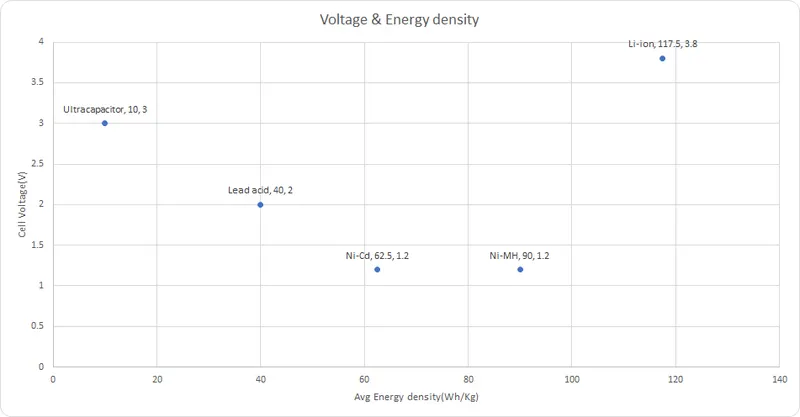
Here in the plot the values above the blue dots represents the energy density and cell voltages of corresponding cell types shown in table.
From the plot we undertand that,
Li-ion battery type having higher voltage level and higher energy density.
Nickel cadmium and Nickel metal hydride having nearly equal cell voltages but energy density is different.Nickel metal hydride having higher energy density than Ni-Cd battey type.
Lead acid battery type having medium voltage higher than Ni-cd and Ni-MH and its energy density is lesser than other types of batteries except ultacapacitors.
Ultracapacitors having high voltage range but its energy density is lesser than all types of batteries.
Thus ultra capacitors are used only in conditions where high power requirement at small amount of duration.
3)For the above mentioned same battery types now we have to compare by their voltage and power density values.
The voltage and power density values are mentioned below as,
- Lead acid battery-Cell voltage:2V, Power density:Less than 300 W/Kg.
- Nickel Cadmium battery-Cell voltage:1.2V, Power density:150-300W/Kg.
- Nickel Metal Hydride battery-Cell voltage:1.2V, Power density:Less than 200W/Kg.
- Li-ion (LMO -Lithium manganese oxide) battery-Cell voltage:3.8V, Power density:100-1000W/Kg.
- Ultra capacitors- Average Voltage:3V, Power density 600W/Kg.
For the above values we need to plot a chart,
| Cell Type | Average Power density (W/Kg) | Cell Voltage(V) |
| Lead acid | 155 | 2 |
| Ni-Cd | 225 | 1.2 |
| Ni-MH | 105 | 1.2 |
| Li-ion(LMO) | 550 | 3.8 |
| Ultracapacitor | 600 | 3 |
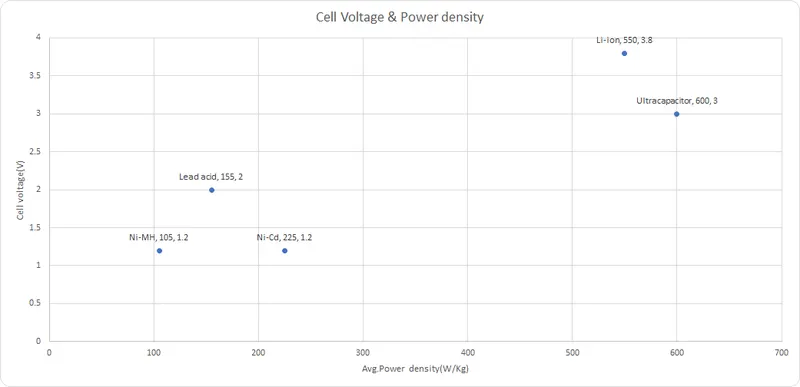
From the above plot we can see that,
Ultacapacitors are having high power density and its voltage level is also above medium level voltage as 3V.
Power density of Lead acid battery types are in between Ni-metal hydride and Ni-cadmium battery types.
Among all Ni-metal hydrise battery types are having lesser power density on average.
Conclusion:
By comparing plots from question 2 and 3 we can come to known that,
- Li-ion battery types are almost in the higer preferance range for better energy density,power density and voltage ranges.
- However Ultra capacitors are also suitable for the conditions were high power requirements in shorter duration.
- Other types excluding above are also used for applictions corresponding to their specification matching of loads.
4)
Question:
A battery has just been manufactured in the battery and has been connected to a charger for the first time. The electrode marked as (1) in the picture below is the negative electrode.
- True
- False
Image:
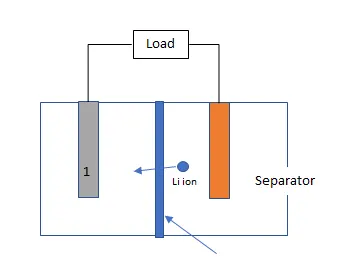
From the given figure it is clearly understand that the electrode marked as (1) is not a negative electrode(Anode),as when load connected externally the Li-ions move from anode to cathode(1) as showned above. Here above shown figure is discharging and not charging.
Thus the statement mentioned in question is FALSE.
Battery mentioned:
Here Li-ion is passing from anode to cathode(1) through seperator.
Thus this battery type is a Li-ion battery.
Reason:
Here in the question its given as the battery is charging for the first time after manufactured.
So, at initial condition the anode doesn't consist even a single Li-ion. All ions are in cathode side based on Li-ion chemistries.
For first charging the Li-ions move from cathode(1) to anode(safron as in image).
The electrons moves froom cathode(1) to anode via external load.
Conclusion:
Thus above question(First charging) and given figure(Discharging) both are different cases. Thus the statement is FALSE.
Thank you
Submitted by,
Praveen Kumar L V,
Date:3/09/2021.