Week 5 Challenge
Solution:
Q. No. 1:
False.
In this scenario, a battery is not necessarily a better choice to supply power than an ultracapacitor (UC).
When considering aggressive driving with rapid acceleration and harsh braking in a city setting, the demands on the energy storage system are high and dynamic. Both batteries and ultracapacitors have their advantages and disadvantages in this context:
Battery: Batteries typically have higher energy density, meaning they can store more energy per unit mass or volume compared to ultracapacitors. This higher energy density makes them suitable for providing sustained power over longer durations. However, batteries may struggle to deliver the rapid bursts of power required for aggressive acceleration due to their limitations in high power density.
Ultracapacitor (UC): Ultracapacitors, on the other hand, excel in delivering high power bursts quickly. They have high power density and can rapidly charge and discharge, making them suitable for applications requiring quick energy transfer, such as regenerative braking in vehicles. However, ultracapacitors typically have lower energy density compared to batteries, meaning they cannot store as much energy for longer durations.
In the scenario described, the rapid acceleration and harsh braking require frequent and intense bursts of power, which align more closely with the strengths of ultracapacitors. Their ability to quickly charge and discharge makes them well-suited for meeting the dynamic power demands of aggressive driving in city conditions.
Q. No. 2:
Considering the below table values of Average energy density and cell voltage,
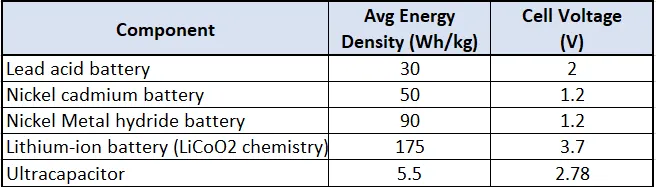
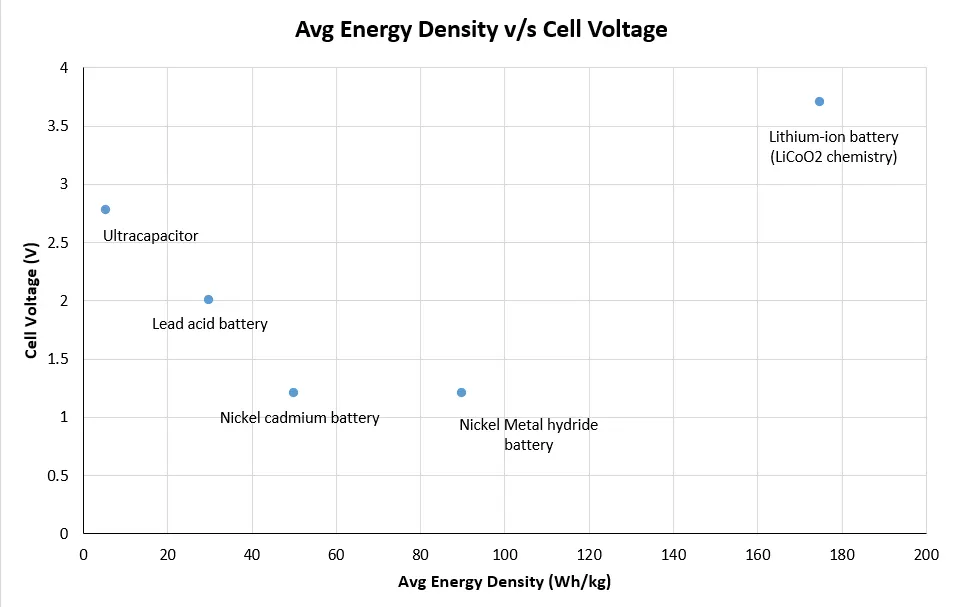
- Lead Acid Battery: Lead acid batteries typically have a moderate energy density and voltage compared to other battery types. They are commonly used in automotive applications, backup power supplies, and stationary energy storage systems. On the plot, lead acid batteries would likely have moderate energy density and voltage, falling somewhere in the middle of the range compared to the other batteries listed.
- Nickel Cadmium Battery (NiCd): Nickel cadmium batteries have been widely used in applications where high discharge rates and long cycle life are required. They have a moderate energy density and voltage. In the plot, NiCd batteries would likely have similar energy density to lead acid batteries but possibly slightly higher voltage.
- Nickel Metal Hydride Battery (NiMH): Nickel metal hydride batteries offer higher energy density compared to NiCd batteries and are environmentally friendlier due to the absence of toxic cadmium. They have a moderate to high energy density and voltage. On the plot, NiMH batteries would likely have higher energy density and voltage compared to NiCd batteries, possibly approaching lithium-ion batteries in energy density.
- Lithium-Ion Battery: Lithium-ion batteries come in various chemistries such as lithium cobalt oxide (LiCoO2), lithium iron phosphate (LiFePO4), lithium manganese oxide (LiMn2O4), etc. They offer high energy density and voltage, making them popular choices for portable electronics, electric vehicles, and renewable energy storage. On the plot, lithium-ion batteries would have high energy density and voltage, possibly the highest among the batteries listed, depending on the specific chemistry.
- Ultracapacitor (UC): Ultracapacitors have lower energy density compared to batteries but offer high power density and fast charge/discharge capabilities. They are often used in applications requiring quick bursts of energy such as regenerative braking in vehicles and smoothing power delivery in renewable energy systems. On the plot, ultracapacitors would likely have lower energy density compared to batteries but higher voltage.
Based on the plot, lithium-ion batteries would generally have the highest energy density and voltage, making them suitable for applications requiring high energy storage capacity. However, for applications requiring quick bursts of power and high power density, ultracapacitors would be more suitable despite their lower energy density. The other battery types fall somewhere in between, with varying degrees of energy density and voltage depending on the specific chemistry and design.
Q. No. 3:
Considering the below table values of Power density and cell voltage,
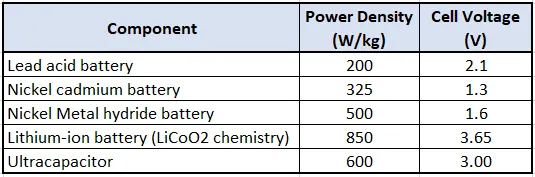
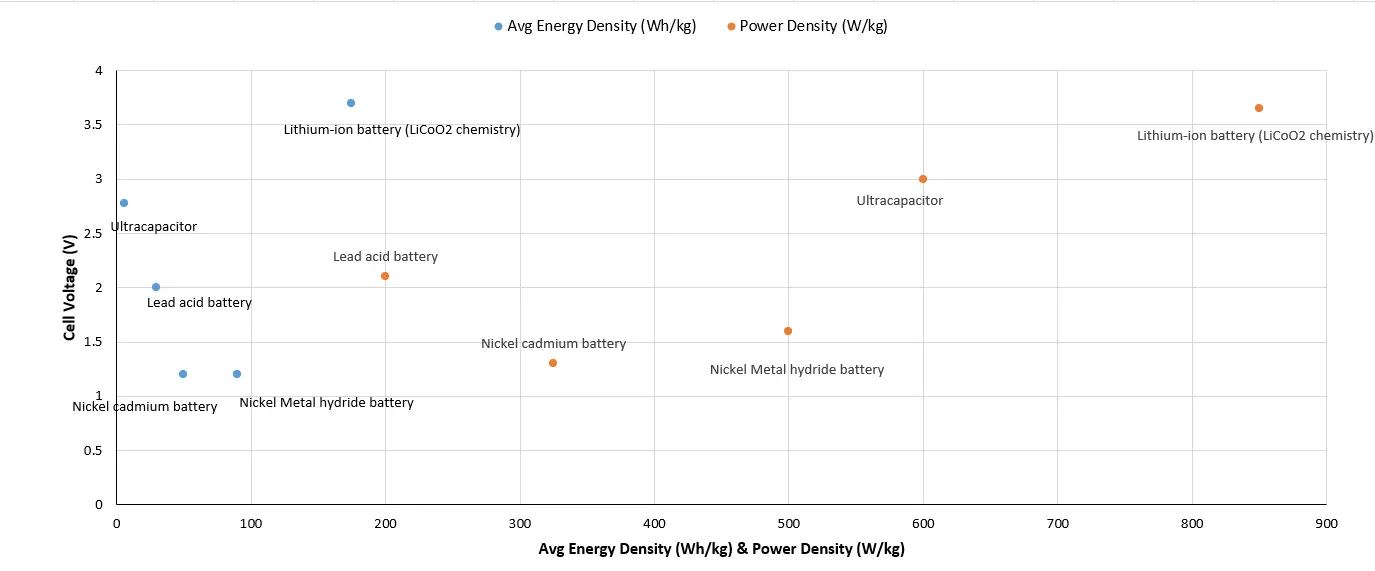
- Lead Acid Battery: Lead acid batteries typically have lower power density and moderate cell voltage. Power density values could range from around 100-300 W/kg, and cell voltage could be in the range of 2-2.2 volts.
- Nickel Cadmium Battery (NiCd): Nickel cadmium batteries have moderate power density and moderate cell voltage. Power density values could range from around 150-500 W/kg, and cell voltage could be in the range of 1.2-1.4 volts.
- Nickel Metal Hydride Battery (NiMH): Nickel metal hydride batteries offer moderate to high power density and moderate to high cell voltage. Power density values could range from around 200-800 W/kg, and cell voltage could be in the range of 1.2-1.4 volts.
- Lithium-Ion Battery: Lithium-ion batteries have high power density and high cell voltage. Power density values could range from around 200-1500 W/kg, and cell voltage could vary depending on the specific chemistry (e.g., lithium cobalt oxide, lithium iron phosphate, etc.), typically falling between 3-4 volts.
- Ultracapacitor (UC): Ultracapacitors have the highest power density among the components listed and moderate to high cell voltage. Power density values could range from around 1000-10000 W/kg or even higher, and cell voltage could be in the range of 2-3 volts.
Q. No. 4:
True.
The number indicated as 1 is a -ve electrode. Lithium-ion batteries generate DC power by utilizing chemical reactions.
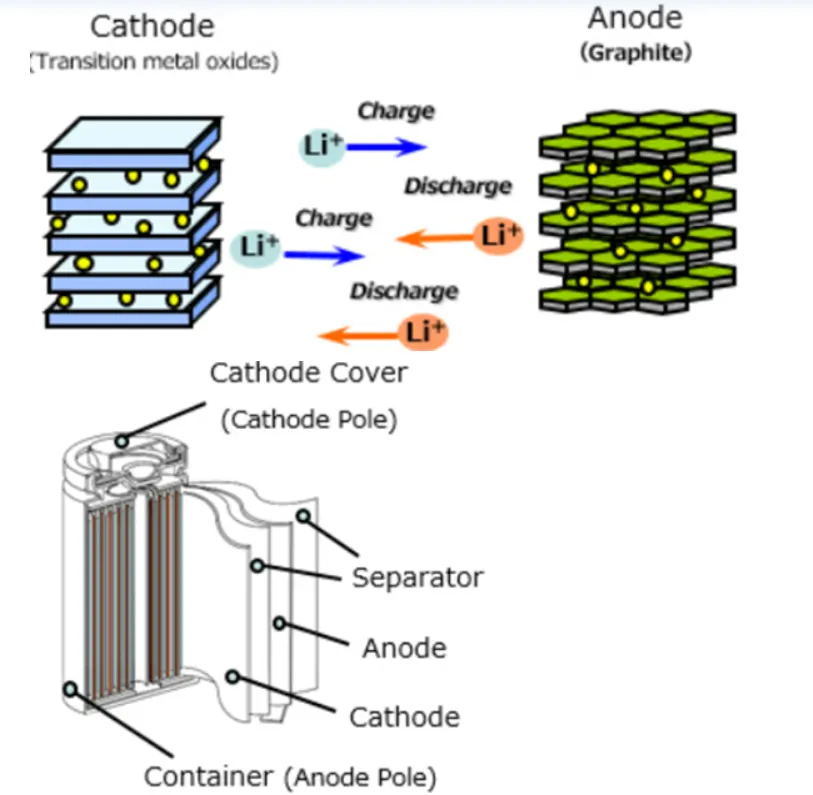
- During discharge, lithium ions from the -ve anode move through the electrolyte to gets intercalate the +ve cathode.
- During charging, electrons move from anode to cathode in the external circuit.
- Electrons flow to balance the cell voltage.
- During the electrochemical process, the anode is -ve and the cathode is +ve.
- At the first time charging, the lithium-ion from the cathode gets attached to anode and it forms the inseparable layer on the anode.
- A solid Electrolyte Interface (SEI) is formed at the anode. Anode gets decomposed if it comes in contact with the electrolyte. SEI protects the anode.