Week 5 Challenge
1. False
- Battery pack has less specific power capacity than ultracapacitor.
- To meet this amount of peak current, the battery has to designed as per this instant acceleration and braking.Hence the battery pack size and cost also increase.
- For this scenorio instantaneous high power for short duration of time, it is not efficient to increase the battery pack.
- But ultracapacitor has ten times high specific power than battery i.e., about 10kW/kg.
- Ultra-capacitors can take care of peak loads.
- Therefore sudden load can be used to meet sudden acceleration and braking.
- Sudden braking produces high regenerative current. This current can be used to charge the battery but it is not efficiently used.
- Ultracapacitor can be charged and discharged quickly.
- So, this current can be used to charge the ultracapacitor.
2. A plot has been created cell voltage vs energy density
| Energy Density (Wh/kg) | Cell Voltage(V) | Battery Type |
| 35-40 | 2.1 | Lead-Acid |
| 40-60 | 1.2 | Nickel Cadmium |
| 60-120 | 1.2 | Nickel Metal hybride |
| 100-265 | 3.6-4.1 | Lithium-ion |
| 89.6 | 3.5 | Ultra-Capacitor |
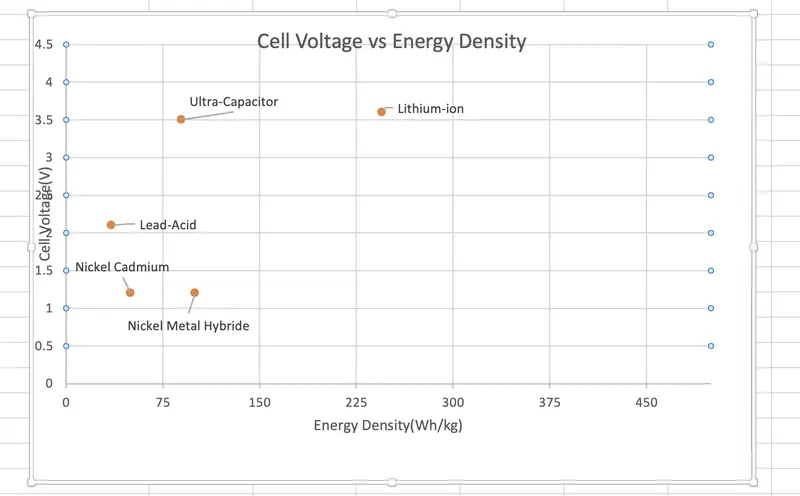
- Lead Acid batteries: Lead-acid batteries have relatively low energy density.
- Nickel-Cadmium Battery:Nickel Cadmium has a much higher energy density compared to lead-acid batteries.
- Nickel-Metal Hydride Battery:Ni-MH batteries can have two to three times the capacity of NiCd batteries of the same size, with high significance and also much less than lithium-ion batteries.
- Lithium-ion battery:Lithium-ion batteries have a high energy density.
- Ultracapacitor:Energy density is more in ultracapacitors compared to capacitors.
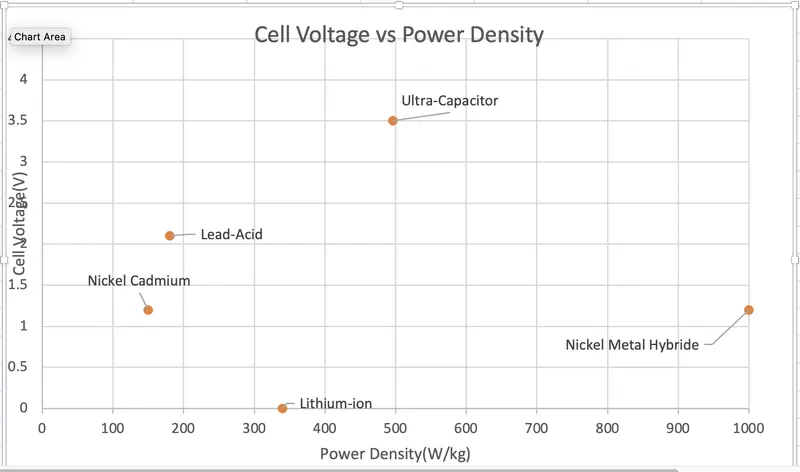
3. A plot has been created cell voltage vs power density
| Power Density(W/kg) | Cell Voltage(V) | Battery Type |
| 180 | 2.1 | Lead-Acid |
| 150 | 1.2 | Nickel Cadmium |
| 1000 | 1.2 | Nickel Metal hybride |
| 340 | 3.6-4.1 | Lithium-ion |
| 496 | 3.5 | Ultra-Capacitor |
4.
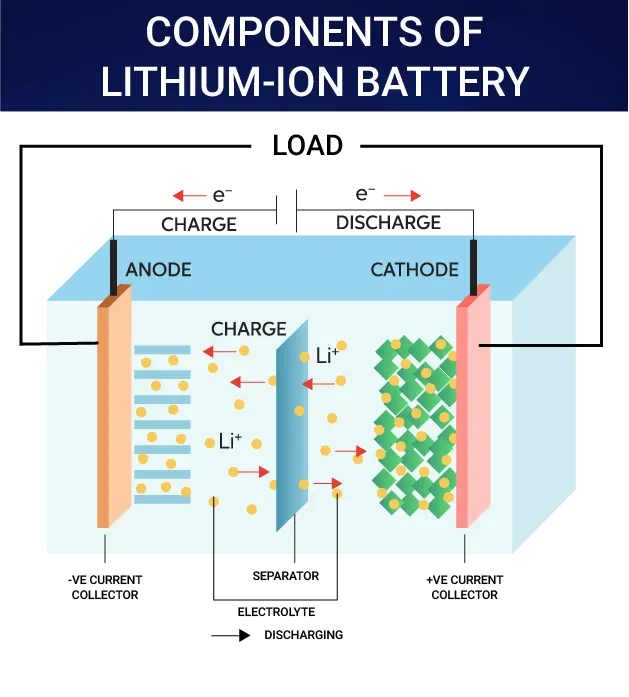
- During discharge, the lithium ions from the negative anode moves through the electrolyte to gets intercalates to positive cathode.
- In order the balance the charge, the electrons moves from the anode to cathode in the external circuit.
- The lithium gets deposited in the cathode. Not all the lithium ions are flows to the cathode.
- Because, if all lithium ions are extracted the structure of anode becomes reduced.
- Hence it leads to degradation of battery.
- During charging, external current is given to positive of the battery.
- The lithium ions from the positive electrode diffuses through the electrolyte and gets intercalated to the negative anode.
- The electrons flows in order to balance charge.
- During all electrochemical process, the anode is negative and cathode is positive.
- During first time of charging, the lithium ion from cathode gets attached to anode and it forms the inseparable layer on the anode.
- It leads to formation of SEl. The anode gets decomposes if it comes in contact with the electrolyte.
- This solid electrolyte formation protects the anode.
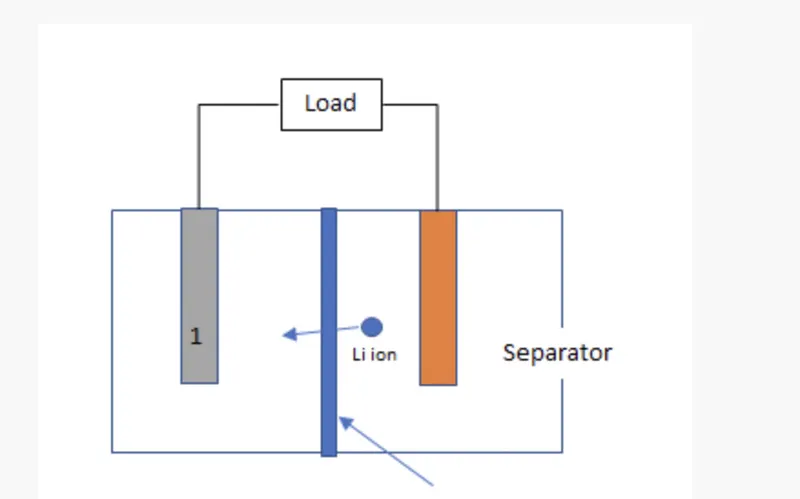
- A battery has just been manufactured in the industry and has been connected to a charger for the first time. The electrode marked as (1) in the picture below is the negative electrode is true