Project 1 Mechanical design of battery pack
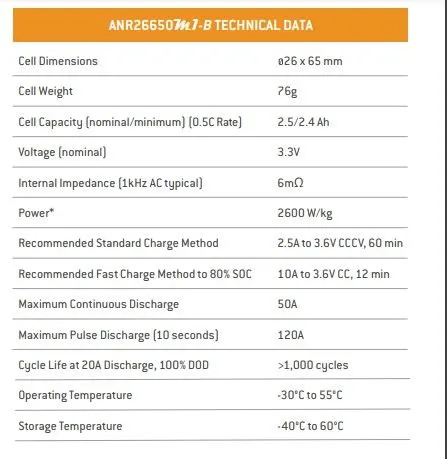
From the datasheet and it is attached
Nominal Voltage: 3.3 V
Cell Capacity: 2.5 Ah
Internal Impedance: 6m ohms
Cell weight: 76 g
Cell dimension = 26*65 mm
Operating Temperature = -30 to 55 0C
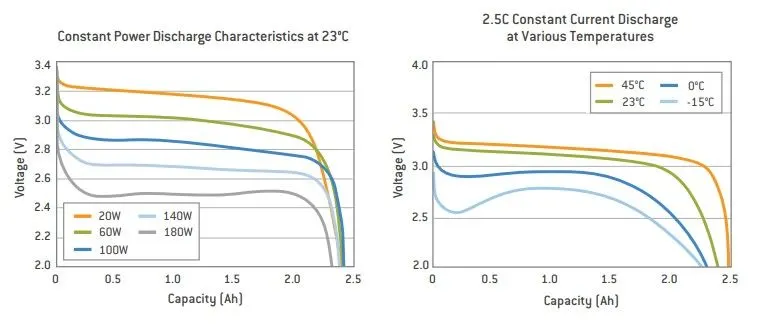
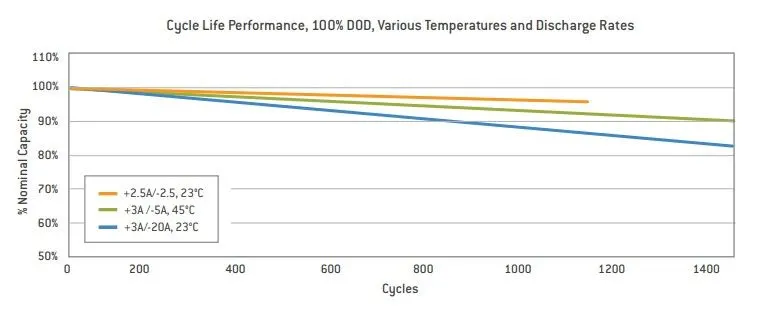
Depth of discharge characteristics of a cell form the datasheet
- Total no of Cells = Energy/ (nominal voltage * Capacity)
= 18000/ (3.3*2.5) =2182 cells
We need around 2182 cells for 18 KWh, battery pack capacity
Let’s assume battery pack voltage required for 18 kWh is around 500 V
- No of series cells = Required Voltage/Nominal Voltage
=500/3.3
= 151.51
Let’s assume the total no of series cells as 152
- Total cells = no of series * no of parallel
No of parallel = 2182/152= 14.35
Let’s assume the total no of parallel cells as 15
Now the cell architecture is 152s15p
- Rated Capacity of Battery pack = 15*2.5= 37.5 Ah
- After assumptions, the total battery pack capacity = (152*3.3) *(15*2.5) = 18.81 KWh
- Length = No of series * diameter = 152*26m = 3.95 m
- Width = No of parallel*diameter = 15*26m = 0.39 m
- Height = 65mm
- Area required for 152s15p = 2(Length + Width) *Height
= 2(3.95+0.39) *65m
= 0.564 m2
- Total Weight of the battery pack = Total cells*Each cell weight
=2182*76
= 165.83 kgs
The battery given is a cylindrical battery so we will use cells holders to make 152s15p architecture and spot welding for the connections in the battery pack.
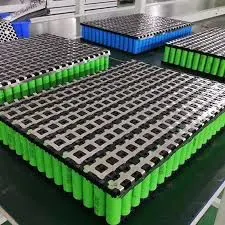
Exterior stability design and module of a battery pack
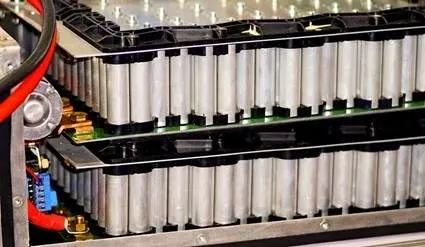
Various Interface in battery pack
|
Interface |
Remarks |
Solutions |
|
· Mechanical |
Design features for safety |
Cell spacers, damping pads, gaskets etc |
|
· Structural |
Protection and isolation |
Case, cover, end plates etc |
|
· Thermal |
To maintain cell temperature |
Coolant, fans, heat exchange etc |
|
· Electrical |
Transmits power from and to battery pack |
Bus bars, relays, fuse etc |
|
· Control |
To monitor and regulate the battery pack |
BMS, various sensors |
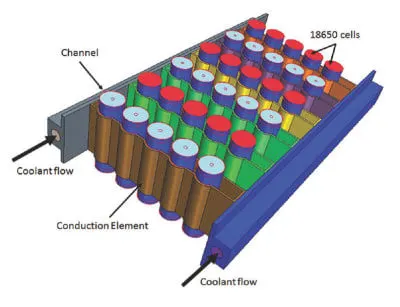
To maintain the temperature within the battery pack the coolant flow
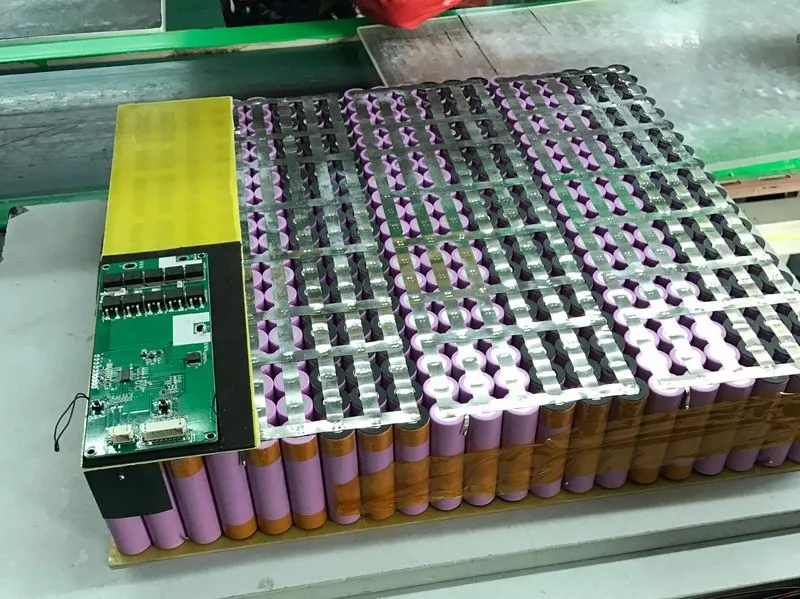
Battery Module with BMS
Characterisation of the impact during performance :
- Customer Usage : The driving range of an EV depends on the speed and acceleration
characteristics of each trip. Trips with faster acceleration or including ascents over high
altitude grades demand more kilowatts per kilometre travelled. Moreover, studies of the
driving patterns of EVs indicate that, unlike conventional ICE vehicles, EVs are rarely
driven under high-speed motorway conditions and more in rural and urban environments.
Consequently, battery packs of EVs that are driven mainly on rural or urban terrain are
exposed to a more strenuous life in comparison to those driven over more traditional
compositions of road surfaces.
- Vibrations : Driving induces vibration profiles concentrated in the 1 Hz – 25 Hz frequency
range with as much as 10% higher energy levels. Pouch cells, which are more common in
EV applications, are more prone to localization of vibrational forces. This can in turn cause
sharp increases in local stress levels in battery packs, resulting in mechanical and
electromechanical failure.
- Ambient Temperature : Another factor that can have a significant effect on the available
energy and cycle life of Li-ion batteries is the battery cell temperature. It has been found
that with each degree increase in battery cell temperature in the operating range of 30 °C
and 40 °C, the cycle life of batteries is reduced by approximately two months .Moreover, an estimate by General Motors indicates that an EV can lose up to 85% of its
range at sub-zero temperature if no thermal management system is used. In addition,
the rate of self-discharge is also dependent on the storage temperature. The energy capacity
of a battery also degrades in response to the ambient temperature and other factors
throughout its cycle life.
- Cell-to-Cell Variations : Accidental and practically unavoidable physical and chemical
variations among battery cells have a far-reaching effect on the structural dynamics of the
battery pack. These random variations lead to the confinement of vibrational energy to a
small portion of the cell structure. It is therefore vital to minimise any random cell-to-cell
variations in order to define battery performance reliably, as each battery cell will react in
a peculiar manner to stimuli received from other sources of disturbance, such as customer
usage or the external environment.
- Auxiliary Load: System interactions, such as heat leakage from different electromechanical systems, chassis vibrations, electrical interference, and auxiliary loads like
cabin heating/cooling, power steering and air compressors affect the quality of output from
battery packs.
Even the below factors have to be considered while designing the battery pack
- Lightweight
- Compactly packaged
- Ergonomic
- Structurally rigid
- Swappable
- Configurable and scalable
- Thermally stable
- Impact-resistant
- Fire-proof
- Easy to manufacture
- Easy to service
- Low-cost