Week 5 Challenge
Question 1:
Consider a scenario where an aggressive driver is accelerating very rapidly and braking harshly in a city driving. Is battery better a choice to supply power than UC in this scenario?
- True
- False
Why?
The above statement is false.The drivers driving pattern can be concluded here as short power transients.Driver is accelerating and we all know how the power demand shoots up at the time of acceleration though for a short time.You can see in the below graph below.Pa here represents the acceleration power.This power is only needed when we are accelerating.It is still dominant amongst all even though we need this power for short time only.
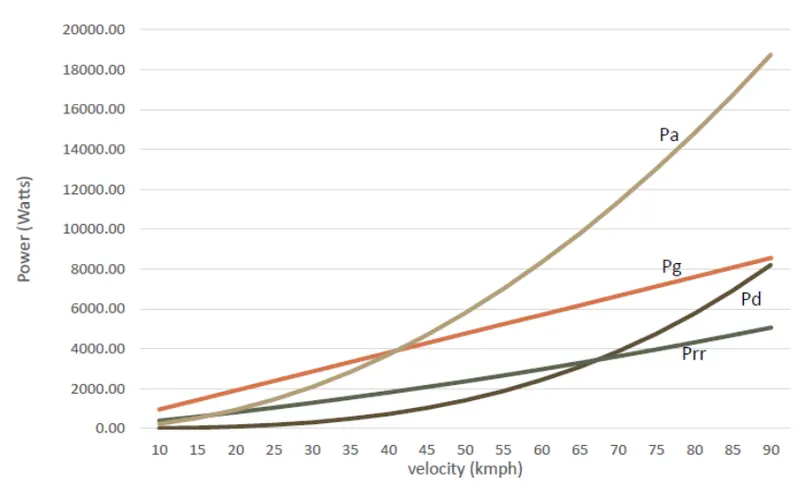
Battery can supply this demand but the cost of manufacturing such batteries is extremely high.On the other hand ultracapacitor holds very high power which it releases on demand and it can get charge quickly too.This quality of having high power density makes the ultracapacitor a perfect choice of power source for such transient power demands.
Question 2:
Consider the following components.
1) Lead acid battery 2) Nickel cadmium battery 3) Nickel Metal hydride battery 4) Lithium ion (specify chemistry) battery 5) Ultra Capacitor
Note: In case of a range of energy density, take the average value for the plot.
Create a plot with energy density on the X Axis and cell voltage on the Y axis.
Comment on the capabilities of these batteries based on the plot created.
Question 3:
For the above-mentioned components on the same plot (retain the previous plot) created in the previous
Create a plot with power density on the X axis and cell voltage on the Y axis.
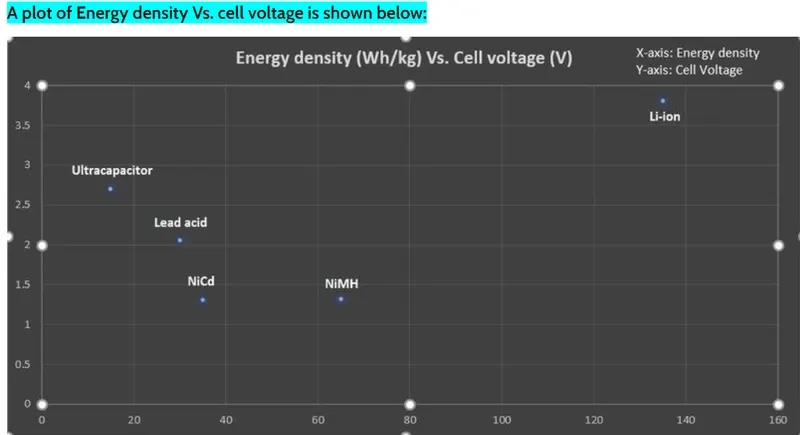
Ultracapacitor:It can be seen that UC cant be used for high energy demanding applications.Its voltage is greater than that of lead acid NiCd and NiMH.They are widely used in electric or hybrid vehicles to provide a quick burst of acceleration over short distances,or to start the main motor.
NiMH &NiCd:Nickel metal hydride and nickel cadmium have almost similar cell voltage value but energy density of NiMH is very high than NiCd.NiMH batteries are highly recommended in applications that call for long duration but not a high amp load.Nicd are best suitable for portable power application.
Lead Acid:Lead acid batteries has low energy density as compared to NiMH and NiCdd but cell voltage value is high.Lead-acid batteries are used in emergency lighting and to power sump pumps in case of power failure.they were the first choice of energy in BEV.But now they have been replaced by other batteries cause they require frequent maintainance.
Lithium-ion:There are many types of lithium ion battery.They are mainly classified on the basis of cathode material used cause anode remains same in all the cases.In plot we have shown the average energy density and high cell voltage as well amongst all.
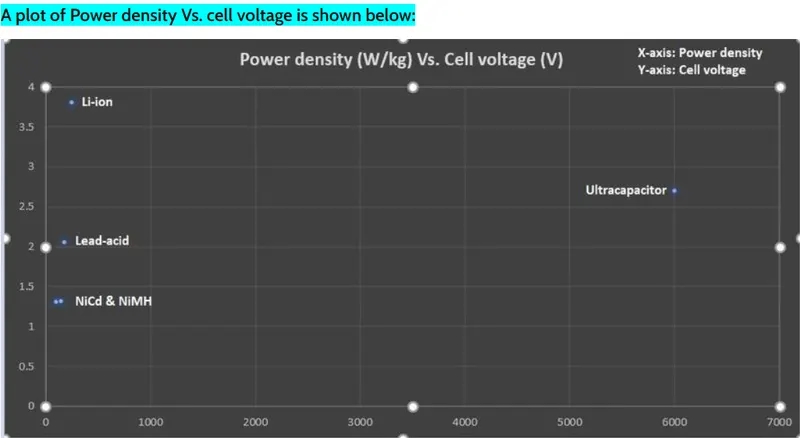
Surprisingly there is very less data available related to the power densities of above shown ESS.Generally the values lies between a certain range but the plot shown above represents the average value.Clearly we can see the Ultracapacitor as high.
Question 4:
Consider the following scenario:
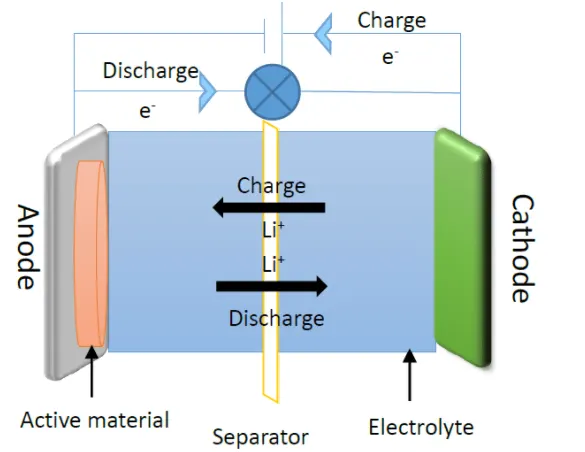
A battery has just been manufactured in the battery and has been connected to a charger for the first time. The electrode marked as (1) in the picture below is the negative electrode.
- True
- False
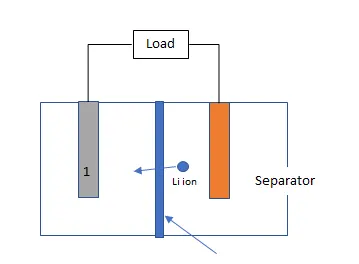
The statement above is true. Because during charging process the positive elctrode(cathode)loses the electron and this electron travels to the anode as a reverse voltage is applied to the battery.We should remember that in almost all the electronics devices cathode is -ve and anode is +ve but battery being the active material has cathode termed as +ve and anode as negative.Thats why behaviour of electrodes in batteries is explained in two ways i.e while cahrging and discharging.Below fig represents what has been theoretically said.
Conclusion:Since we have disussed the power/energy source, cell voltage v/s energy density and power density of various ESS.