Week 5 Challenge
1.
FALSE
Ultra-Capacitor is a better choice to supply power than the battery in the scenario where an aggressive driver is accelerating very rapidly and braking harshly in a city driving.
Because:
- UC has higher specific power than the battery thereby, a large amount of current/power can be produced for the application.
- If the battery is used in this condition, there will be lithium-ion plating on the electrodes due to the rapid chemical reaction taking place inside the battery, hence SOH(state of health) of the battery reduces, whereas in UC there is no chemical reaction taking place hence SOH almost remains constant even if used for a long period of time.
2.
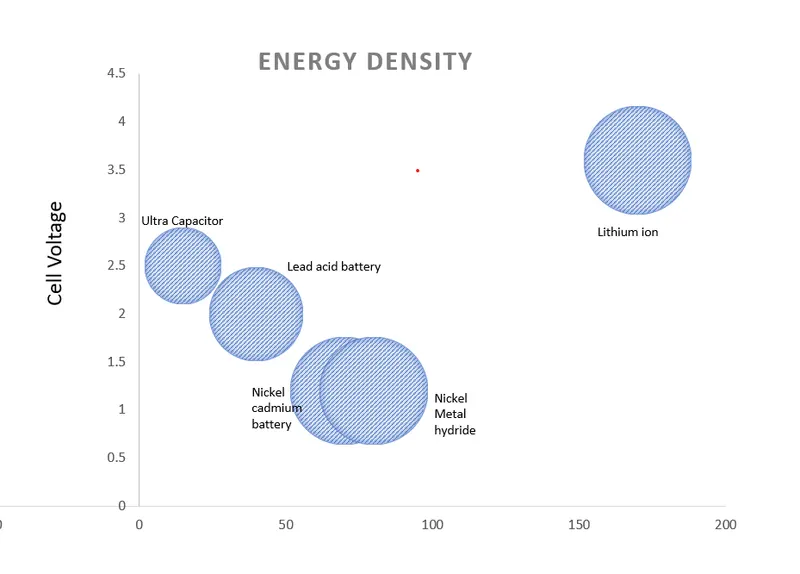
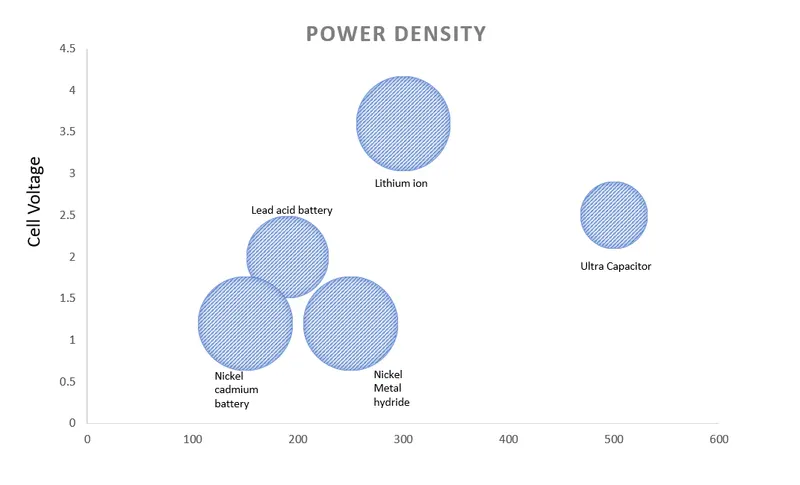
Evidently, lithium ion-based batteries have the greatest energy density and cell potential, which is why they are currently the most preferred
battery choice. Toyota uses NiMH batteries in its Prius HEV and its Mirai 2021 FCEV, possibly because it is more durable and carries a lower risk
of a thermal runaway than lithium-ion. The lead-acid battery represents the oldest rechargeable battery technology. Lead-acid batteries can be found in a wide variety of applications, including small-scale power storage such as starting, lighting, and ignition power sources for automobiles, along with large, grid-scale power systems. Ultracapacitors are always used as a supplement to a battery but become the primary power source during transient states for better load management for the battery and the overall powertrain system, since its ability to charge and discharge quickly, is unparalleled in the battery
world currently
3.
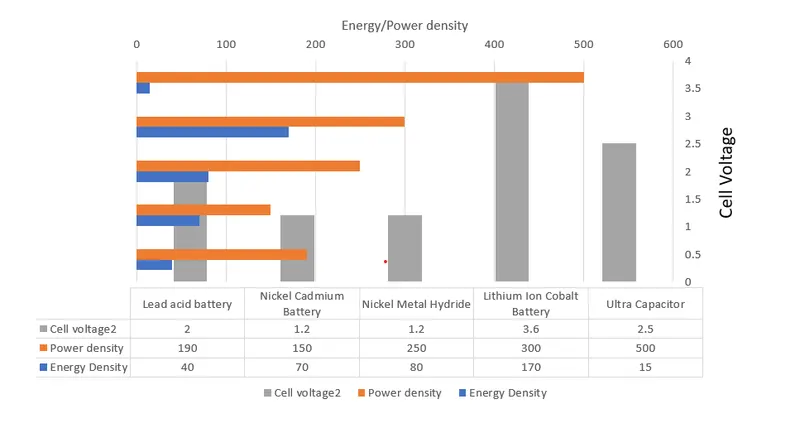
By combining both the charts we get,
4.
A battery has just been manufactured in the battery and has been connected to a charger for the first time. The electrode marked as (1) in the picture below is the negative electrode.
TRUE
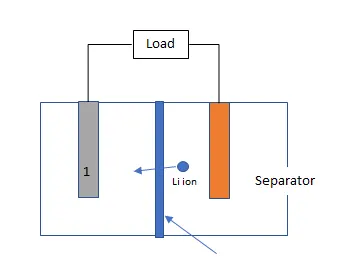
Every metal ion is a positive ion and always attracts towards the negative part(either while charge or discharge) hence, the electrode marked 1 is the negative electrode.
The same can be verified by the below image.
Further, During discharging, the intercalated lithium ions travel from anode (negative) to cathode (positive). So during charging, those lithium
ions need to be transferred back from the cathode to the anode to increase the cell potential. Especially during the first charge, there will be little to no lithium ions present at the graphite anode, so they certainly need to travel to the anode to intercalate between the graphite layers to
load up on a charge.