Week 5 Challenge
Question 1:
Consider a scenario where an aggressive driver is accelerating very rapidly and braking harshly in a city driving. Is battery better a choice to supply power than UC in this scenario?
- True
- False
Why?
For decades, batteries have been the preferred storage device for portable electronics, mainly because of their ability to store energy (high energy density). But batteries take a long time to discharge and recharge, which limits their ability to deliver power. Overcoming this power deficit is difficult, if not impossible, and even newer battery technologies such as lithium ion are still a poor solution for high power applications. In applications demanding high power, over-engineering the battery will rarely be the right solution, and will typically result in increased size, weight, and cost, and/or reduced cycle life and energy.
Ultracapacitor Construction :-
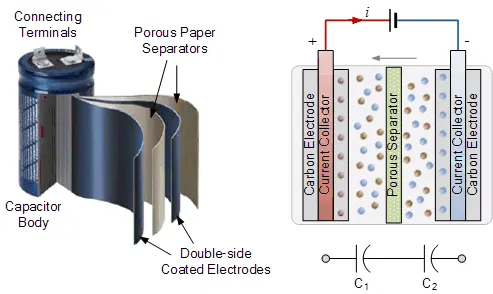
Ultracapacitors are another type of capacitor which is constructed to have a large conductive plate, called an electrode, surface area (A) as well as a very small distance (d) between them. Unlike conventional capacitors that use a solid and dry dielectric material such as Teflon, Polyethylene, Paper, etc, the ultracapacitor uses a liquid or wet electrolyte between its electrodes making it more of an electrochemical device similar to an electrolytic capacitor.
Although an ultracapacitor is a type of electrochemical device, no chemical reactions are involved in the storing of its electrical energy. This means that the ultra-capacitor remains effectively an electrostatic device storing its electrical energy in the form of an electric field between its two conducting electrodes as shown.
Supercapacitor Characteristics
- Charge/Discharge Time: Milliseconds to seconds
- Operating Temperature: -40°C to +85C°
- Operating Voltage: Aqueous electrolytes ~1V; Organic electrolytes 2 – 3V
- Capacitance: 1mF to >10,000F
- Operating Life: 5,000 to 50,000 hrs (a function of temperature and voltage)
- Power Density: 0.01 to 10 kW/kg
- Energy Density: 0.05 to 10 Wh/kg
- Pulse Load: 0.1 to 100A
- Pollution Potential: No heavy metals
Supercapacitor Advantages
- Provide peak power and backup power
- Extend battery run time and battery life
- Reduce battery size, weight and cost
- Enable low/high temperature operation
- Improve load balancing when used in parallel with a battery
- Provide energy storage and source balancing when used with energy harvesters
- Cut pulse current noise
- Lessen RF noise by eliminating DC/DC
- Minimise space requirements
- Meet environmental standards
Ultracapacitors VS batteries:-
Ultracapacitors have several advances over batteries: practically instant charging and discharging, efficient operation in extreme temperatures, extremely high power, high reliability, and safety.
The difference comes from the fact that ultracapacitors store energy in an electric field, rather than in a chemical reaction, like batteries. This is also the reason for the difference in lifetime - ultracapacitors work for 15+ years without maintenance.
Ultracapacitors have very little internal resistance (down to 0,12 mΩ), allowing them to work at close to 100% efficiency. They are also significantly lighter than batteries and generally don’t contain harmful chemicals or toxic metals.
Batteries and ultracapacitors are complementary technologies: batteries provide energy for the long term while ultracapacitors provide the fast reaction and high power. Together, ultracapacitors and batteries are the future of electrification.
No the battery isn’t a better choice to supply power than UC in the scenario mentioned above.
If we discussed a scenario where there is aggressive acceleration by the driver and even there is hard braking , in this specification the power required by the vehicle to accelerate to fast and to achieve the desired speed in specific time period there’s a lot of demand of power and the battery cant provide such amount of power as we know that the C rates are too less as compared to the ultracapacitors. As we have discussed the theoretical background of ultracapacitor and there characteristics and advantages , ultracapacitors are capable of delivering such amount of high power which is required by the vehicle.
And if we consider the second scenario , where there is harsh braking at that time the regenerative barking is in picture , at this time the energy is produced due to regenerative braking but due to limitations of battery characteristics the battery cant be charged to rapidly so we cant achieve overall efficiency from the regenerative barking , but as we know that the ultracapacitors can even be charged instantly in few milli seconds , the ultracapacitor can be used here.
Question 2:
Consider the following components.
1) Lead acid battery 2) Nickel cadmium battery 3) Nickel Metal hydride battery 4) Lithium ion (specify chemistry) battery 5) Ultra Capacitor
Note: In case of a range of energy density, take the average value for the plot.
Create a plot with energy density on the X Axis and cell voltage on the Y axis.
Comment on the capabilities of these batteries based on the plot created.
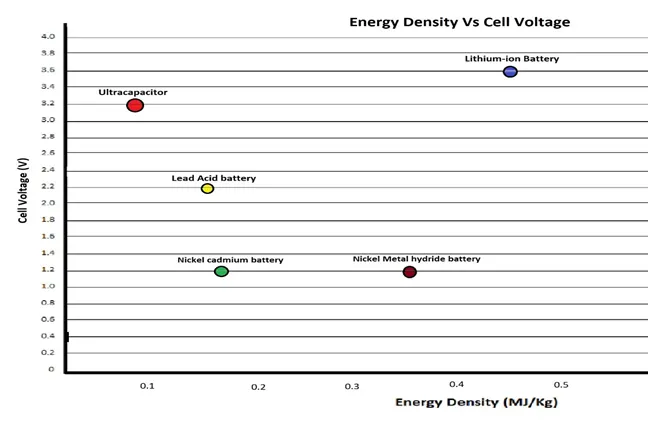
From the graph we can conclude that the lead acid battery has higher cell voltage than the nickel cadmium battery and nickel metal hydride battery it can be used to as backup power in many appliances.
If we compare Nickel cadmium and Nickel Metal Hydride battery they have same cell voltage but different energy density , The Nickel metal hydride battery has more energy density than ultracapacitor , nickel cadmium and nickel metal hydride battery it means that this battery will work or supply more energy for a longer amount of time period but it can run heavy appliances on it.
The lithium ion battery has higher cell voltage and even higher energy density , it can deliver more energy for a longer time and due to higher cell voltage the no. of cell used will be less ehich will make light in weight , which is suitable for EVs.
The Ultracapacitor has more cell voltage then lead acid , metal hydride and nickel cadmium battery but less energy density as compared to all other types of batteries. Which means that the Ultracapacitor will not work for a longer time.
Question 3:
For the above-mentioned components on the same plot (retain the previous plot) created in the previous
Create a plot with power density on the X axis and cell voltage on the Y axis.
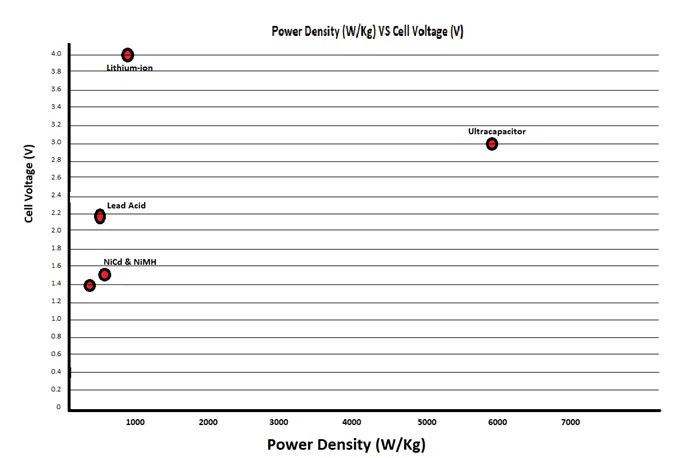
Here we can see that the Ultracapacitor has the highest Power Density as compared to rest of the batteries or the chemical storage devices. The ultracapacitor is capable to provide a higher power density whenever required by the system .
Question 4:
Consider the following scenario:
A battery has just been manufactured in the battery and has been connected to a charger for the first time. The electrode marked as (1) in the picture below is the negative electrode.
- True
- False
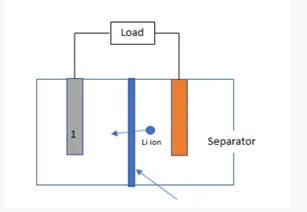
The above statement is true.
During charging process , the positive electrode losses an electron undergoing oxidation. Negative electrode accepts an electron during charging known as reduction. During charging process positive electrode i.e cathode loses electron and this electron travels to the anode side as reverse voltage is applied to the battery.
References :-
https://www.electronics-tutorials.ws/capacitor/ultracapacitors.html
https://www.electronics-tutorials.ws/capacitor/cap_3.html
https://www.cap-xx.com/resource/the-supercapacitor-advantage/