Battery characteristics using drive cycle
Aim: To plot the discharge characteristics of a Li-ion battery for a UDDS drive cycle.
Model-Based Analysis in MATLAB
Simulink Model: In the model below, we have used a 7.2 V and 5.4 Ah Lithium-ion battery. The UDDS cycle contains speed vs time, which here is converted into the current vs time profile. The current profile has been entered using the signal builder bloc. The value of current is then given to the battery and then a bus selector is connected to a scope to realise the results.
(in this case, the aging and temperature analysis is not done for the battery)
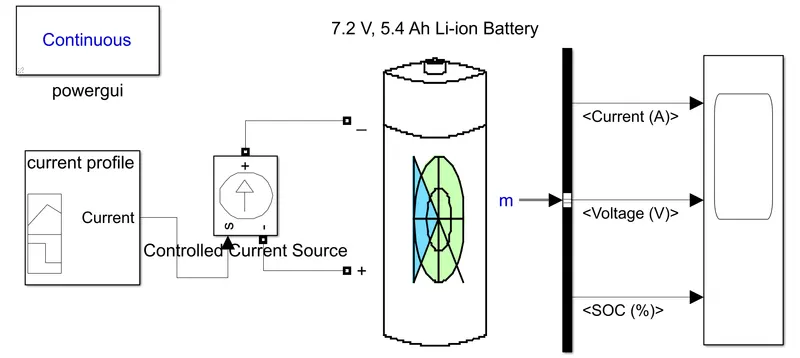
Blocs Used:
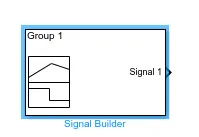
Signal Builder: The Signal Builder block allows you to create interchangeable groups of piecewise linear signal sources and use them in a model. You can quickly switch the signal groups into and out of a model to facilitate testing. In the Signal Builder window, create signals and define the output waveforms.
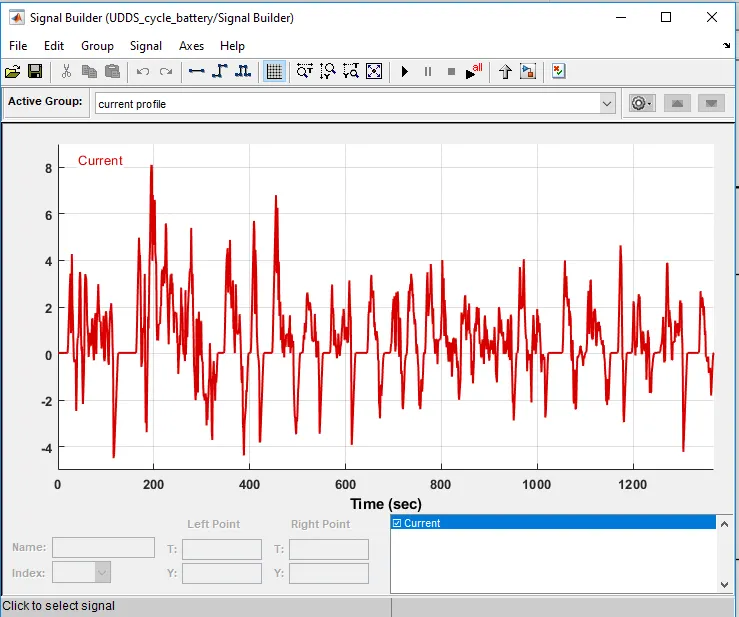
Here, in this example, we have used the following data that is fed into the signal builder bloc as the current profile for the UDDS drive cycle.
Click here to see the data file for the current vs time.
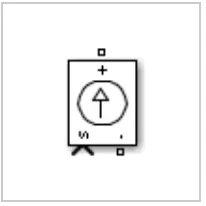
Controlled Current Source: The Controlled Current Source block converts the Simulink input signal into an equivalent current source. The generated current is driven by the input signal of the block. The positive current direction is as shown by the arrow in the block icon.
Battery Model:
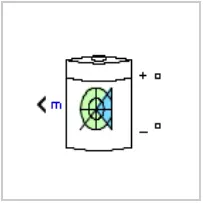
The Battery block implements a generic dynamic model that represents the most popular types of rechargeable batteries.
This figure shows the equivalent circuit that the block models.
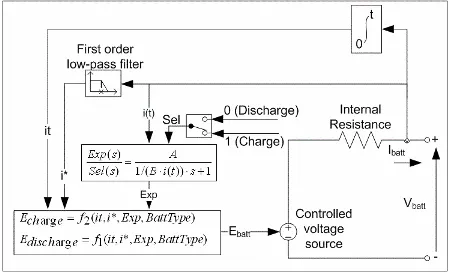
For this case, we have taken a battery of 7.2 V and 5.4Ah capacity. Following are the characteristics of the battery:
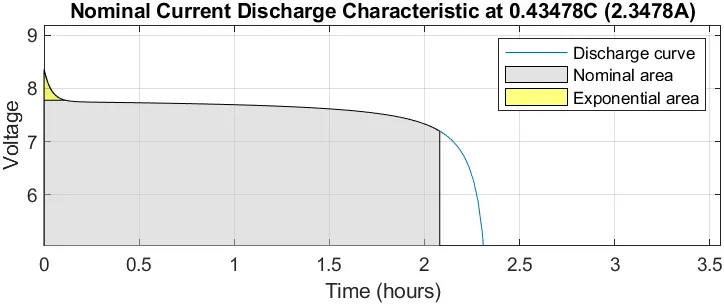
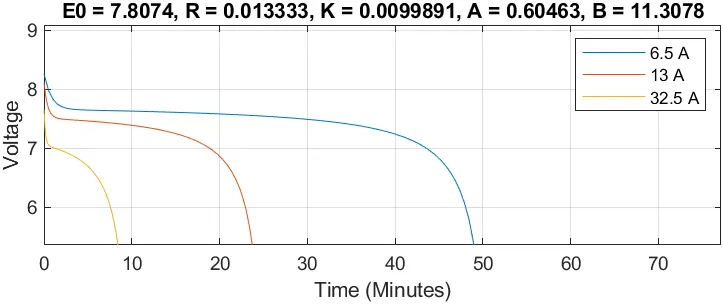
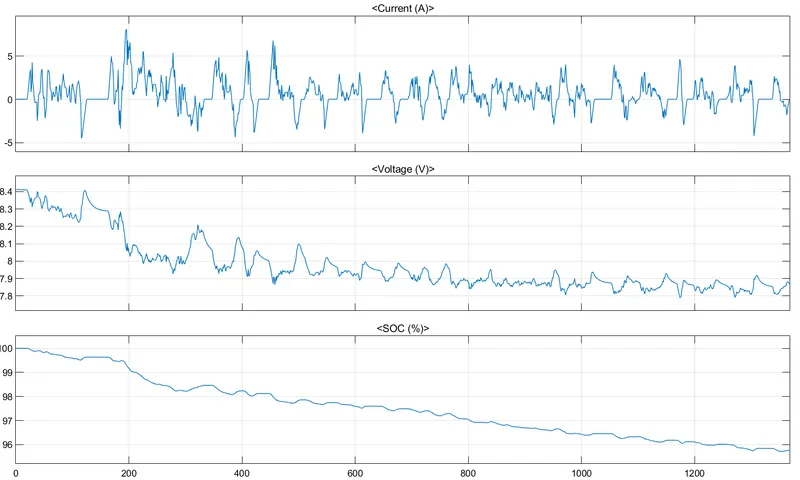
Results: The following results for Voltage and SOC were obtained:
Conclusion:
From the above curve, we can clearly infer that as time progresses there is a fall in the value of State of Charge. Thus, the discharge of the battery is evident.