Week 5.1 - Mid term project - Solving the steady and unsteady 2D heat conduction problem
Aim : To perform Steady state analysis & Transient State Analysis
1. For Steady State Case
clear all
close all
clc
%% Inputs
L = 1;        %% Domain Length
nx = 50;      %% Grid Points
omega = 1.1;  %% Relaxation Factor
error = 9e9;  %% Error
tol = 1e-4;   %% Tolerance Value
ct = 0;
ny=nx;
%% Calculations
x=linspace(0,L,nx);
dx=x(2)-x(1);
y=linspace(0,L,ny);
dy=y(2)-y(1);
%% Boundary Condition
T=300*ones(nx,ny);
T(:,1)= 400 ;    %% Left Wall
T(1,:)= 600;     %% Top Wall
T(:,end)= 800;   %% Right Wall
T(end,:)= 900;   %% Bottom Wall

T(1,1)= (400+600)/2 ;
T(1,end)= (600+800)/2 ;
T(end,1)= (400+900)/2 ;
T(end,end)= (900+800)/2 ;

Told = T;
k = 2*((dx^2+dy^2)/(dx^2*dy^2));

%% Command Prompt For Choosing Iterative Solver
prompt = "Select Iterative Solver, Jacobi = 1, Gauss-Siedel = 2, SOR = 3  ";
iterative_solver = input(prompt);

%% Iterative Solution For Jacobi Method
if iterative_solver == 1
    tic
    Jacobi = 1;
    % Convergence Loop
    while(error>tol)
        % Space Loop
        for i = 2:nx-1
            for j = 2:ny-1
                H = ((Told(i-1,j)+ Told(i+1,j))/(k*dx^2));
                V = ((Told(i,j-1)+ Told(i,j+1))/(k*dy^2));
                T(i,j) = H+V;
            end
        end
        error = max(max(abs(Told - T)));
        Told = T;
        ct = ct + 1;

    end
    time = toc;
    %% Plotting
    figure(1)
    contourf(x,y,T,'ShowText','on');
    colorbar
    colormap(jet)
    xlabel('x');
    ylabel('y');
    text = sprintf("Jacobi Method & Iterations For Convergence = %d & Time: %f s",ct ,time);
    title(text);
    set(gca,'YDIR','reverse');
end
%% Iterative Solution For Gauss Siedel Method
if iterative_solver == 2
    tic
    Gauss_Seidel = 2;
    % Convergence Loop
    while(error>tol)
        % Space Loop
        for i = 2:nx-1
            for j = 2:ny-1
                H = ((T(i-1,j)+ Told(i+1,j))/(k*dx^2));
                V = ((T(i,j-1)+ Told(i,j+1))/(k*dy^2));
                T(i,j) = H+V;
            end
        end
        error = max(max(abs(Told - T)));
        Told = T;
        ct = ct + 1;
    end
    time = toc;
    %% Plotting
    figure(2)
    contourf(x,y,T,'ShowText','on');
    colorbar
    colormap(jet)
    xlabel('x');
    ylabel('y');
    text = sprintf("Gauss Siedel Method & Iterations For Convergence = %d & Time: %f s",ct ,time);
    title(text);
    set(gca,'YDIR','reverse');
end
%% Iterative Solution For Successive Over-Relaxation Method
if iterative_solver == 3
    tic
    SOR = 3;
    % Convergence Loop
    while(error>tol)
        % Space Loop
        for i = 2:nx-1
            for j = 2:ny-1
                H = ((T(i-1,j)+ Told(i+1,j))/(k*dx^2));
                V = ((T(i,j-1)+ Told(i,j+1))/(k*dy^2));
                T(i,j) = (1-omega)*(Told(i,j)) + (omega*(H + V));
            end
        end
        error = max(max(abs(Told - T)));
        Told = T;
        ct = ct + 1;

    end
    time = toc;
    %% Plotting
    figure(3)
    contourf(x,y,T,'ShowText','on');
    colorbar
    colormap(jet)
    xlabel('x');
    ylabel('y');
    text = sprintf("Successive Over-Relaxation Method & Iterations For Convergence = %d & Time: %f s",ct ,time);
    title(text);
    set(gca,'YDIR','reverse');
end
Outputs
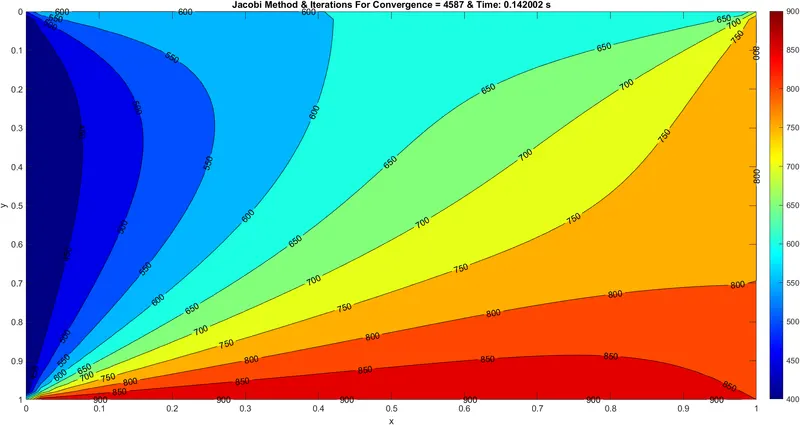
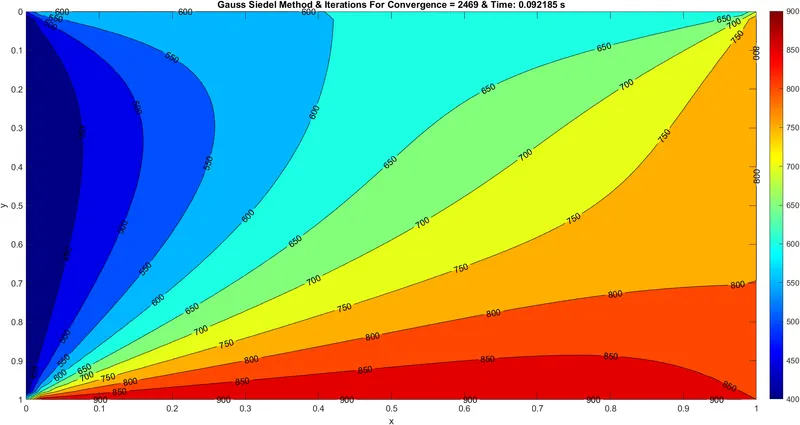
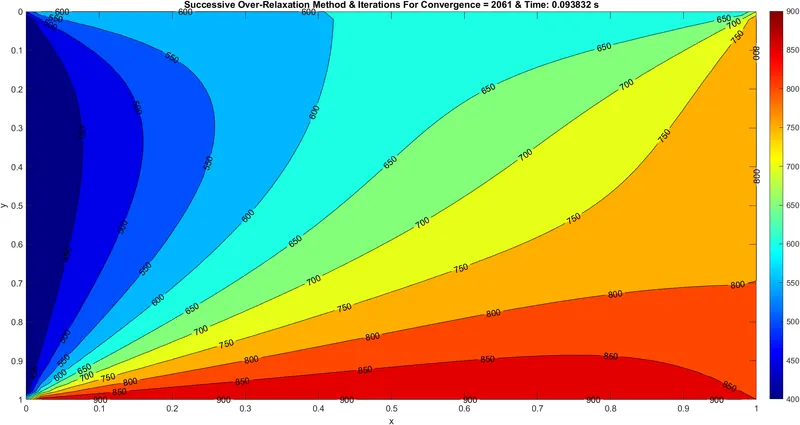
2. For Transient State Explicit Case
clear all
close all
clc
%% Inputs
L = 1;  %% Domain Length
nx = 50; %% Grid Points
ny=nx;
%% Calculations
x=linspace(0,L,nx);
dx=x(2)-x(1);
y=linspace(0,L,ny);
dy=y(2)-y(1);
%% Time Marching Step
t = 0.1;
nt = 1400;
dt = t/nt;
%% Coefficient Of Thermal Diffusion
alpha = 1.4;
%% CFL Condition
CFL_x= alpha*dt/(dx)^2;
CFL_y= alpha*dt/(dy)^2;
ct = 0;
%% Boundary Condition
T=300*ones(nx,ny);
T(:,1)= 400 ;   %% Left Wall
T(1,:)= 600;    %% Top Wall
T(:,end)= 800;  %% Right Wall
T(end,:)= 900;  %% Bottom Wall

T(1,1)= (400+600)/2 ;
T(1,end)= (600+800)/2 ;
T(end,1)= (400+900)/2 ;
T(end,end)= (900+800)/2 ;

Told = T;
k1 = (alpha*dt)/(dx^2);
k2 = (alpha*dt)/(dy^2);
%% Loop
tic
for k = 1:nt
    for i = 2:nx-1
        for j =2:ny-1
            H = (Told(i-1,j) - 2*Told(i,j) + Told(i+1,j));
            V = (Told(i,j+1) - 2*Told(i,j) + Told(i,j-1));
            T(i,j) = Told(i,j) + k1*H + k2*V;
        end
    end
    Told = T;
    ct = ct+1;
    time = toc;
end
%% Plotting
figure(1)
contourf(x,y,T,'ShowText','on');
colorbar
colormap(jet)
xlabel('x');
ylabel('y');
text = sprintf("Transient Explicit Heat Conduction Method & Iterations For Convergence = %d & Time: %f s",ct ,time);
title(text);
set(gca,'YDIR','reverse');
Output
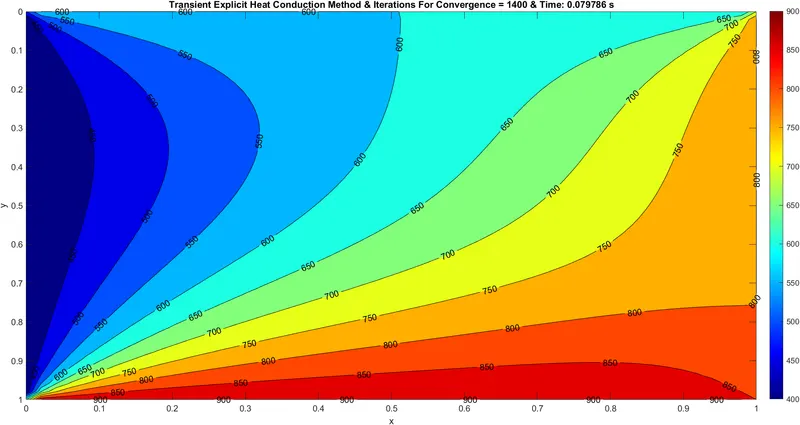
3. For Transient State Implicit Case
clear all
close all
clc
%% Inputs
L = 1; %% Domain Length
nx = 50; %% Grid Points
omega  = 1.1; %% Relaxation Factor
error = 9e9;  %% Error
tol = 1e-4;   %% Tolerance
alpha = 1.4;  %% Coefficient Of Thermal Diffusion
ct = 0;
ny=nx;
%% Time Marching Steps
t = 0.1;
nt = 1400;
dt = t/nt;
%% Calculations
x=linspace(0,L,nx);
dx=x(2)-x(1);
y=linspace(0,L,ny);
dy=y(2)-y(1);
%% Boundary Condition
T=300*ones(nx,ny);
T(:,1)= 400 ;   %% Left Wall
T(1,:)= 600;    %% Top Wall
T(:,end)= 800;  %% Right Wall
T(end,:)= 900;  %% Bottom Wall

T(1,1)= (400+600)/2 ;
T(1,end)= (600+800)/2 ;
T(end,1)= (400+900)/2 ;
T(end,end)= (900+800)/2 ;

Told = T;
T_prev = T;
k1 = (alpha*dt)/(dx^2);
k2 = (alpha*dt)/(dy^2);

%% Command Prompt For Choosing Iterative Solver
prompt = "Select Iterative Solver, Jacobi = 1, Gauss-Siedel = 2, SOR = 3  ";
iterative_solver = input(prompt);
%% Iterative Solution For Jacobi Method
if iterative_solver == 1
    tic
    Jacobi = 1;
    for k = 1:nt
        error = 9e9;
        while(error>tol)
            for i = 2:nx-1
                for j =2:ny-1
                    term1 = 1/(1+2*k1+2*k2);
                    term2 = k1*term1;
                    term3 = k2*term1;
                    H = (Told(i-1,j) + Told(i+1,j));
                    V = (Told(i,j+1) + Told(i,j-1));
                    T(i,j) = (term1*(T_prev(i,j)))+(term2*H)+(term3*V);
                end
            end
            error = max(max(abs(Told-T)));
            Told = T;
            ct = ct+1;
        end
        T_prev = T;
    end
    time = toc;
    %% Plotting
    figure(1)
    contourf(x,y,T,'ShowText','on')
    colorbar
    colormap(jet)
    xlabel('X-axis');
    ylabel('Y-axis');
    text = sprintf("Jacobi Method & Iterations For Convergence = %d & Time: %f s",ct ,time);
    title(text);
    set(gca,'YDIR','reverse');
end
%% Iterative Solution For Gauss Siedel Method
if iterative_solver == 2
    tic
    GS = 2;
    for k = 1:nt
        error = 9e9;
        while(error>tol)
            for i = 2:nx-1
                for j =2:ny-1
                    term1 = 1/(1+2*k1+2*k2);
                    term2 = k1*term1;
                    term3 = k2*term1;
                    H = (T(i-1,j) + Told(i+1,j));
                    V = (Told(i,j+1) + T(i,j-1));
                    T(i,j) = (term1*(T_prev(i,j)))+(term2*H)+(term3*V);
                end
            end
            error = max(max(abs(Told-T)));
            Told = T;
            ct = ct+1;
        end
        T_prev = T;
    end
    time = toc;
    %% Plotting
    figure(2)
    contourf(x,y,T,'ShowText','on')
    colorbar
    colormap(jet)
    xlabel('X-axis');
    ylabel('Y-axis');
    text = sprintf("Gauss Siedel Method & Iterations For Convergence = %d & Time: %f s",ct ,time);
    title(text);
    set(gca,'YDIR','reverse');
end
%% Iterative Solution For Successive Over-Relaxation Method
if iterative_solver == 3
    tic
    SOR = 3;
    for k = 1:nt
        error = 9e9;
        while(error>tol)
            for i = 2:nx-1
                for j =2:ny-1
                    term1 = 1/(1+2*k1+2*k2);
                    term2 = k1*term1;
                    term3 = k2*term1;
                    H = (T(i-1,j) + Told(i+1,j));
                    V = (Told(i,j+1) + T(i,j-1));
                    T(i,j) = (1-omega)*(Told(i,j)) + (omega*((term1*(T_prev(i,j)))+(term2*H)+(term3*V)));
                end
            end
            error = max(max(abs(Told-T)));
            Told = T;
            ct = ct+1;
        end
        T_prev = T;
    end
    time = toc;
    %% Plotting
    figure(3)
    contourf(x,y,T,'ShowText','on')
    colorbar
    colormap(jet)
    xlabel('X-axis');
    ylabel('Y-axis');
    text = sprintf("Successive Over-Relaxation Method & Iterations For Convergence = %d & Time: %f s",ct ,time);
    title(text);
    set(gca,'YDIR','reverse');
end
Output
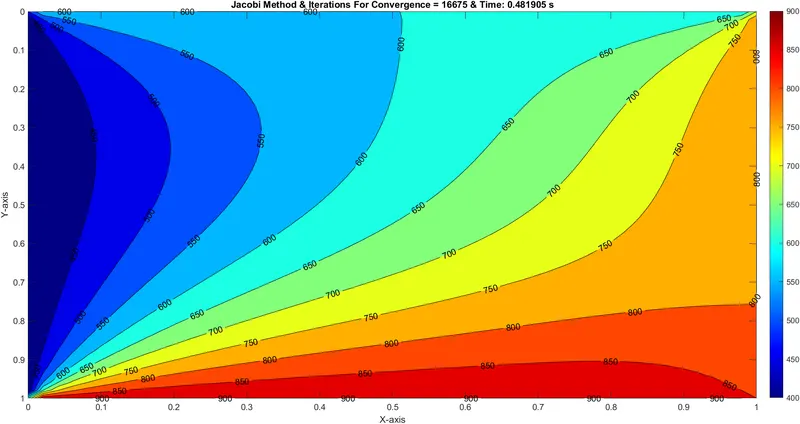
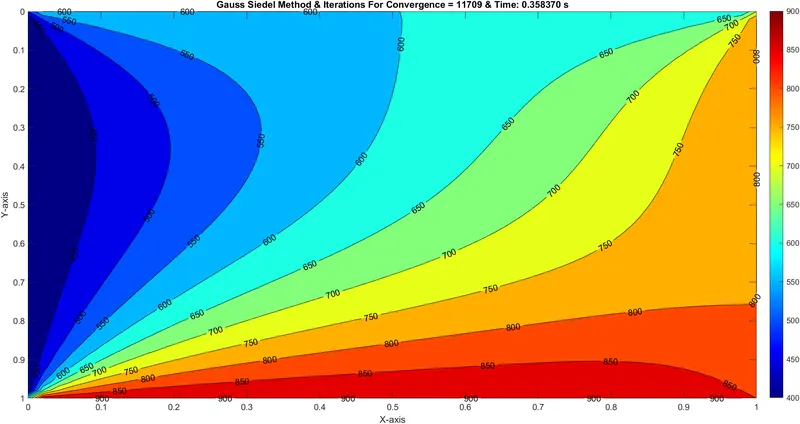
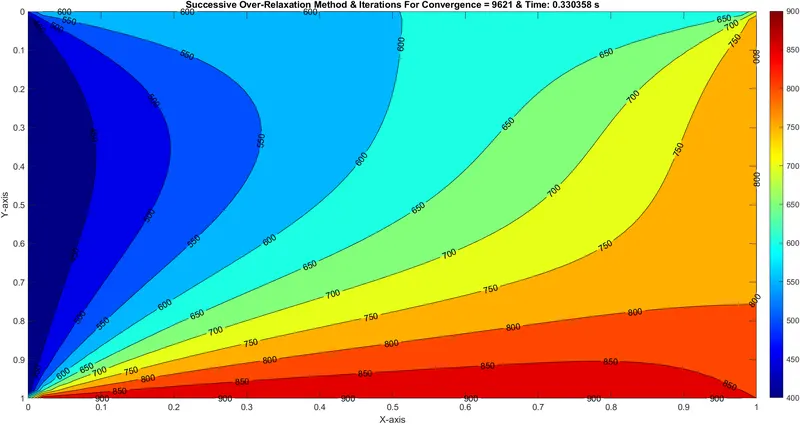
Compare the convergence rate [Number of iterations] of the steady state and transient [explicit and implicit] simulations and justify the numerics.
| Method | Iterations For Convergence | Time Taken To Reach Convergence(seconds) |
| Jacobi Method For Steady State Case | 4587 | 0.140518 |
| Gauss Siedel Method For Steady State Case | 2469 | 0.087779 |
|
SOR Method For Steady State Case
|
2061 | 0.089496 |
| Transient Explicit Method | 1400 | 0.082067 |
| Jacobi Method For Transient State Case(Implicit) | 16675 | 0.472450 |
| Gauss Siedel Method For Transient State Case(Implicit) | 11709 | 0.349222 |
| SOR Method For Transient State Case(Implicit) | 9621 | 0.326980 |
- From the above analysis, we can conclude that for steady case and transient implicit case, the order of convergence is Jacobi Method > Gauss Siedel Method > SOR Method i.e Jacobi takes the most no of iterations and SOR Method takes up the least no of iterations for reaching convergence.
- Coefficient Of Thermal Diffusion can help us in attaining convergence faster but very high Coefficient Of Thermal Diffusion values can also cause Divergence
- SOR Method tries to extrapolate value which helps us in reaching convergence with the help of relaxation factor,but very high value of relaxation factor can also lead to divergence
- Transient Explicit Method is converging way faster than SOR Method also, as in explicit case CFL Factor and Coefficient Of Thermal Diffusion comes into play which is helping us in reaching convergence faster.