Week 5.1 - Compact Notation Derivation for a simple Mechanism
Compact Notation Derivation for a simple Mechanism
Aim
In this challenge, we will derive the reaction rate ODEs & production of each species for the simple reaction mechanism given below and also use the compact notation that was discussed in the Week 5 lecture videos (Part 1&2) and write down the desired matrices.
Theory
The overall reaction of a mole of fuel with a moles of an oxidizer to form b moles of combustion products can be expressed by the global reaction mechanism
`F+aOx->bPr`
From experimental measurements, the rate at which the fuel is consumed can be expressed as:
`(d[X_F])/(dt)=-k_G(T)*[X_F]^n*[X_Ox]^m`
where the notation `[X_i]` is used to denote the molar concentration (kmol / m3) in SI units or gmol / cm3 in CGS units) of the ith species in the mixture. This above equation states that the rate of disappearance of the fuel is proportional to each of the reactants raised to a power.
The constant of proportionality, `k_G` , is called the global rate coefficient, and, in general, is not constant, but rather is a strong function of temperature. The minus sign indicates that the fuel concentration decreases with time. The exponents n and m relate to the reaction order. the reaction is nth order with respect to the fuel, mth order with respect to the oxidizer, and (n + m)th order overall. For global reactions, n and m are not necessarily integers and arise from curvefitting experimental data.
In general, a particular global expression in the form of the above equation holds only over a limited range of temperatures and pressures, and may depend on the details of the apparatus used to define the rate parameters. For example, different expressions for `k_G(T)` and different values for n and m must be applied to cover a wide range of temperatures.
The use of global reactions to express the chemistry in a specific problem is frequently a “black box” approach. Although this approach may be useful in solving some problems, it does not provide a basis for understanding what is actually happening chemically in a system. For example, it is totally unrealistic to believe that a oxidizer molecules simultaneously collide with a single fuel molecule to form b product molecules, since this would require breaking several bonds and subsequently forming many new bonds. In reality, many sequential processes can occur involving many intermediate species.
Unimolecular reactions involve a single species undergoing a rearrangement (isomerization or decomposition) to form one or two product species, i.e.,
A→B
Termolecular reactions involve three reactant species and correspond to the reverse of the unimolecular reaction at low pressures. The general form of a termolecular reaction is
A + B+M→C+M
- The study of the detailed processes of reaction mechanisms is important for many reasons, including the help it gives in understanding and controlling chemical reactions.
- Many reactions of great commercial importance can proceed by more than one reaction path; knowledge of the reaction mechanisms involved may make it possible to choose reaction conditions favouring one path over another, thereby giving maximum amounts of desired products and minimum amounts of undesired products.
- Furthermore, on the basis of reaction mechanisms, it is sometimes possible to find correlations between systems not otherwise obviously related. The ability to draw such analogies frequently makes it possible to predict the course of untried reactions.
- Finally, detailed information about reaction mechanisms permits unification and understanding of large bodies of otherwise unrelated phenomena, a matter of great importance in the theory and practice of chemistry.
- Generally, the chemical reactions whose mechanisms are of interest to chemists are those that occur in solution and involve the breaking and reforming of covalent bonds between atoms—covalent bonds being those in which electrons are shared between atoms.
- Interest in these reactions is especially great because they are the reactions by which such materials as plastics, dyes, synthetic fibres, and medicinal agents are prepared and because most of the biochemical reactions of living systems are of this type.
- In addition, reactions of this kind generally occur in timescales convenient for study, neither too fast nor too slow, and under conditions that are easily manipulated for experimental purposes. There are a number of techniques by which the mechanisms of such reactions can be investigated.
MECHANISM
Since mechanisms may involve many elementary steps and many species, a compact notation has been developed to represent both the mechanism, e.g., R.1–R.4 . . . , and the individual species production rates.
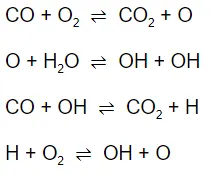
Let us consider a global reaction made up of elementary reactions as :
`CO+O_2<=>CO_2+O` ->R1
`O+H_2O<=>OH+OH` ->R2
`CO+OH<=>CO_2+H` ->R3
`H+O_2<=>OH+O` ->R4
Here, when carbon-monoxide reacts with oxygen, it forms carbon-dioxide and oxygen radical(Radicals or free radicals are reactive molecules or atoms that have unpaired electrons.
Let `k_(fi) &k_(ri)` be the forward and backward reaction rates for the ith reaction respectively.
The rates of reaction for individual species can be represented as follows:
`(d[O_2])/(dt)=k_(r1)*[CO_2]*[O]-k_(f1)*[CO]*[O_2] +k_(r4)*[OH]*[O]-k_(f4)*[O_2]*[H]`
Likewise doing this for all the species,
`(d[CO])/(dt)=k_(r1)*[CO_2]*[O]-k_(f1)*[CO]*[O_2] + k_(r3)*[CO_2]*[H]-k_(f3)*[CO]*[OH]`
`(d[CO_2])/(dt)=k_(f1)*[CO]*[O_2]-k_(r1)*[CO_2]*[O]+k_(f3)*[CO]*[OH]-k_(r3)*[CO_2]*[H]`
`(d[O])/(dt)=k_(f1)*[CO]*[O_2]-k_(r1)*[CO_2]*[O] + k_(r2)*[OH]*[OH]-k_(f2)*[O]*[H_2O]+k_(f4)*[H]*[O_2]-k_(r4)*[OH]*[O]`
`(d[H_2O])/(dt)=k_(r2)*[OH]*[OH]-k_(f2)*[H_2O]*[O]`
`(d[OH])/(dt)=k_(f2)*[H_2O]*[O]-k_(r2)*[OH]*[OH] + k_(f4)*[H]*[O_2]-k_(r4)*[OH]*[OH] + k_(r3)*[CO_2]*[H]-k_(f3)*[OH]*[CO]`
`(d[H])/(dt)=k_(f3)*[CO]*[OH]-k_(r3)*[CO_2]*[H] + k_(r4)*[OH]*[O]-k_(f4)*[O_2]*[H]`
Note that we get seven ODE's(Ordinary Differential Equations). These equations are coupled in nature, which becomes very difficult to solve these equations analytically. The only way to solve these equations is numerically integrating them.
Let us use a compact notation to simplify these above equations as follows:
| j | Species |
| 1 | `O_2` |
| 2 | `CO` |
| 3 | `CO_2` |
| 4 | `O` |
| 5 | `H_2O` |
| 6 | `OH` |
| 7 | `O` |
| i | Reaction |
| 1 | R1 |
| 2 | R2 |
| 3 | R3 |
| 4 | R4 |
Let `v_(ji)'`->No of moles of species j in reaction i on reactant side
Let `v_(ji)''` ->No of moles of species j in reaction i on product sid`
Then `v_(ji)'`=
| `O_2` | `CO` | `CO_2` | `O` | `H_2O` | `OH` | `O` | |
| R1 | 1 | 1 | 0 | 0 | 0 | 0 | 0 |
| R2 | 0 | 0 | 0 | 1 | 1 | 0 | 0 |
| R3 | 0 | 1 | 0 | 0 | 0 | 1 | 0 |
| R4 | 1 | 0 | 0 | 0 | 0 | 0 | 1 |
Similarly,`v_(ji)''``
| `O_2` | `CO` | `CO_2` | `O` | `H_2O` | `OH` | `O` | |
| R1 | 0 | 0 | 1 | 1 | 0 | 0 | 0 |
| R2 | 0 | 0 | 0 | 0 | 0 | 2 | 0 |
| R3 | 0 | 0 | 1 | 0 | 0 | 1 | 1 |
| R4 | 0 | 0 | 0 | 1 | 0 | 1 | 0 |
Let `v_(ji)=v_(ji)''-v_(ji)'`
Then `v_(ji)=`
| `O_2` | `CO` | `CO_2` | `O` | `H_2O` | `OH` | `O` | |
| R1 | -1 | -1 | 1 | 1 | 0 | 0 | 0 |
| R2 | 0 | 0 | 0 | -1 | -1 | 2 | 0 |
| R3 | 0 | -1 | 1 | 0 | 0 | -1 | 1 |
| R4 | -1 | 0 | 0 | 1 | 0 | 1 | -1 |
The following two relations compactly express the net production rate of each species in a multistep mechanism:
`omega_j=sum_(i=1)^L v_(ji)*q_i`
where
`q_i=k_(fi)*prod_(j=1)^N [X_j]^(v_(ji)')-k_(ri)*prod_(j=1)^N [X_j]^(v_(ji)'')`
We have to use the above matrix for getting the value of `v_(ji)` and check with the appropriate species.
For the first reaction,
`q_1=k_(f1)*[O_2][CO]-k_(r1)*[CO_2]*[O]`
Similarly,
`q_2=k_(f2)*[O][H_2O]-k_(r2)*[OH]^2`
`q_3=k_(f3)*[OH][CO]-k_(r3)*[CO_2]*[H]`
`q_4=k_(f4)*[O_2][H]-k_(r4)*[OH]*[O]`
Note that 1 corresponds to oxygen(shown in the table)
Then `omega_1=v_(11)q_1+v_(12)q_2+v_(13)q_3+v_(14)q_4`
`omega_1=k_(r1)*[CO_2]*[O]-k_(f1)*[CO]*[O_2] +k_(r4)*[OH]*[O]-k_(f4)*[O_2]*[H]`
`omega_2=k_(r1)*[CO_2]*[O]-k_(f1)*[CO]*[O_2] + k_(r3)*[CO_2]*[H]-k_(f3)*[CO]*[OH]`
`omega_3=k_(f1)*[CO]*[O_2]-k_(r1)*[CO_2]*[O]+k_(f3)*[CO]*[OH]-k_(r3)*[CO_2]*[H]`
`omega_4=k_(f1)*[CO]*[O_2]-k_(r1)*[CO_2]*[O] + k_(r2)*[OH]*[OH]-k_(f2)*[O]*[H_2O]+k_(f4)*[H]*[O_2]-k_(r4)*[OH]*[O]`
`omega_5=k_(r2)*[OH]*[OH]-k_(f2)*[H_2O]*[O]`
`omega_6=k_(f2)*[H_2O]*[O]-k_(r2)*[OH]*[OH] + k_(f4)*[H]*[O_2]-k_(r4)*[OH]*[OH] + k_(r3)*[CO_2]*[H]-k_(f3)*[OH]*[CO]`
`omega_7=k_(f3)*[CO]*[OH]-k_(r3)*[CO_2]*[H] + k_(r4)*[OH]*[O]-k_(f4)*[O_2]*[H]`
where `[omega_i]=[(d[X_i])/(dt)]`
Now that we have converted into a matrix form, it will help us in simplifying the equations so that a code can be created to solve this set of equations.
References
1. Introduction to Combustion:Concepts and Applications by Stephen A Turns
2. Reaction Mechanism:Britannica