Week 5.1 - Compact Notation Derivation for a simple Mechanism
AIM: Compact Notation Derivation for simple Mechanism:-
Objective: Derive the reaction rate ODEs & production of each species for the simple reaction mechanism given below and use the compact notation. Also writing the desired matrices.
Reaction Mechanism:-
One of the major reasons for studying chemical kinetics is to use measurements of the macroscopic properties of a system, such as the rate of change in the concentration of reactants or products with time, to discover the sequence of events that occur at the molecular level during a reaction. This molecular description is the mechanism of the reaction; it describes how individual atoms, ions, or molecules interact to form particular products. The stepwise changes are collectively called the reaction mechanism.
In an internal combustion engine, for example, isooctane reacts with oxygen to give carbon dioxide and water:
2C8H18 + 25O2 ⇒ 16CO2 + 18H2O
For this reaction to occur in a single step, 25 dioxygen molecules and 2 isooctane molecules would have to collide simultaneously and be converted to 34 molecules of product, which is very unlikely. It is more likely that a complex series of reactions takes place in a stepwise fashion. Each individual reaction, which is called an elementary reaction, involves one, two, or (rarely) three atoms, molecules, or ions. The overall sequence of elementary reactions is the mechanism of the reaction. The sum of the individual steps, or elementary reactions, in the mechanism must give the balanced chemical equation for the overall reaction.
Given Reaction Mechanism:-
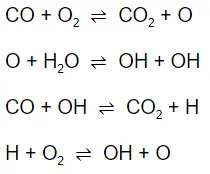
For this Mechanism we are using Compact notations i.e, 'J' represents the number of species and 'i' represents number of reactions.
| j | Species Composition |
| 1 | CO |
| 2 | O2 |
| 3 | CO2 |
| 4 | O |
| 5 | H2O |
| 6 | OH |
| 7 | H |
| i | Reactions |
| 1 | R1 |
| 2 | R2 |
| 3 | R3 |
| 4 | R4 |
- In the Mechanisms we are derive the each of the reaction with respect to each species Form the given set of the reactions we mentioned above.
- After this we can convert these or derived reactions into Matrices form.
Matrix for Reactants:
vji' = 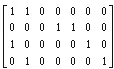
Matrix for Products:
vji'' = 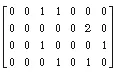
- Here, we represents vji'= Reactants and vji" = Products matrices. and all the given set of reactions are Forward reactions only.
- j represnts species from 1 to 7 and values in matrices represents the Moles of the Each Species in the Given reactions need to be balanced.
- Columns represents the Each species i.e, 7 moles and Rows repesents the number of reactions i.e, 4.
Derivatives of the Composition of each species:
`d[CO]/dt` = -kf1[CO][O2] - kf3[CO][OH]
`d[O2]/dt` = kf1[CO][O2] - kf4[H][O2]
`d[CO2]/dt`= 0
`d[O]/dt` = -kf2[O][H2O]
`d[H2O]/dt` = -kf2[O][H2O]
`d[CO]/dt` = -kf3[CO][OH]
`d[CO]/dt` = -kf4[H][O2]
As we consider vji" = 0 hence, the derivatives of the reverse reaction is not included
vji = vji" - vji'
vji = -
Net production rate of each Species:
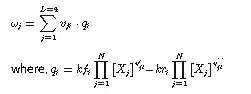
So, we have total four reactions:
q1 = kf1[CO][O2]
q2 = kf2[O][H2O]
q3 = kf3[CO][OH]
q4 = kf4[H][O2]
As per now by using all the above equations we can derive all the Compact notations:
Let us take an example of species "CO"
`omega 1` = v11*q1 + v13*q3
`omega 1` = kf1[CO][O2] - kf3 [CO][OH]
The ODE can be written as, ODE = d(ω1)/dt = d[CO]/dt
The obtained equation is same as we defined above extracted equations.
For example, For O2
`omega 2` = v21*q1 + v24*q4
`omega 2` = - kf1[CO][O2] - kf3 [H][O2]
The ODE can be written as, ODE = d(ω2)/dt = d[O2]/dt
The obtained equation is same as we defined above extracted equations.
Similarly, extracted for all the species these ODE equations and then Convert them into Marices form and After that these matrices can solve by Cantera and also by different Intregration pakages.
`omega1 = [omega1; omega2.....]` = `[d/dt(X)1; d/dt(X)2........]`
X = represents the each species
`omega` = Net production rate of particular species.