Week 4 -Wire Bending Challenge
Objective: To compare the equivalent stress and strain on the wire made of 3 different materials. The materials used are Copper Alloy(Non Linear), Aluminium Alloy(Non Linear) and Magnesium Alloy(Non Linear).
Materials:
| Youngs Modulus | Poisson Ratio | Yield Strength | Target Modulus | |
| Copper Alloy NL | 11000 | 0.35 | 280 | 1150 |
| Aluminium Alloy NL | 72000 | 0.33 | 280 | 500 |
| Magnesium Alloy NL | 45000 | 0.34 | 193 | 920 |
Model: (Common for all 3 cases)
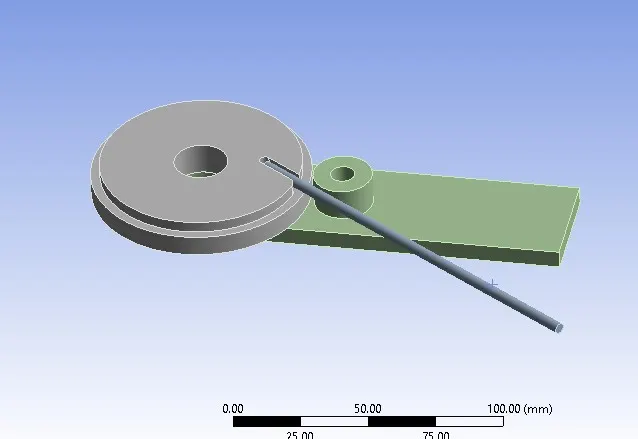
It consists of 3 Parts: Whee, wire and Lever.
Connections:(common for all 3 cases)
1. Contacts sets:
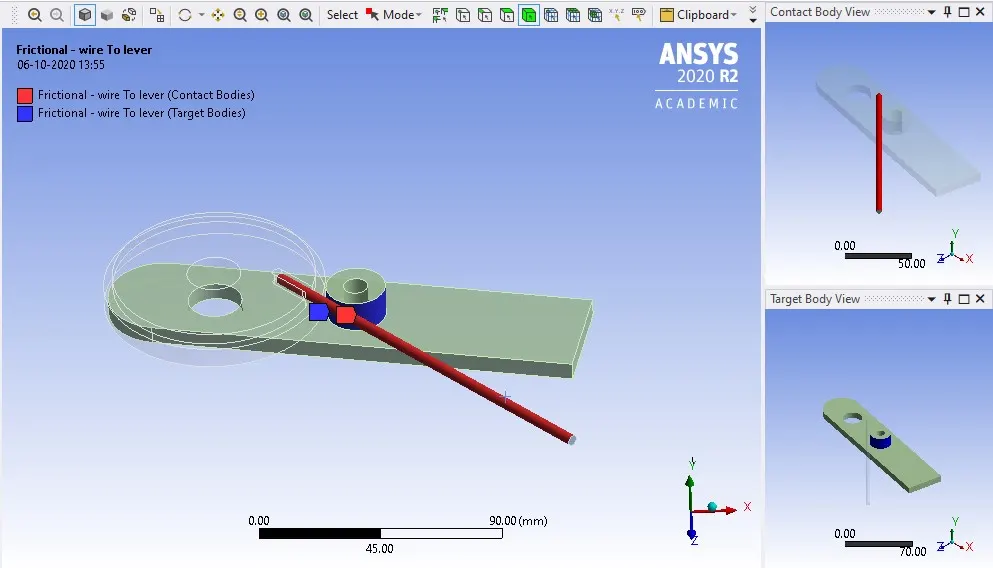
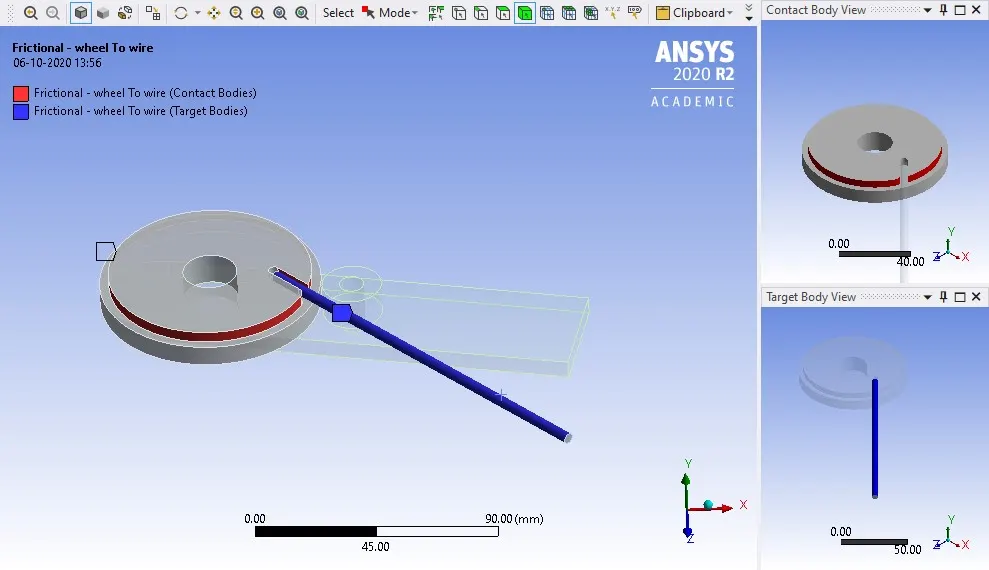
All the contact sets are frictional with a frictional coefficient of 0.2.
A contact set is established between the lever and the wire.
Another contact set is established between wheel and wire.
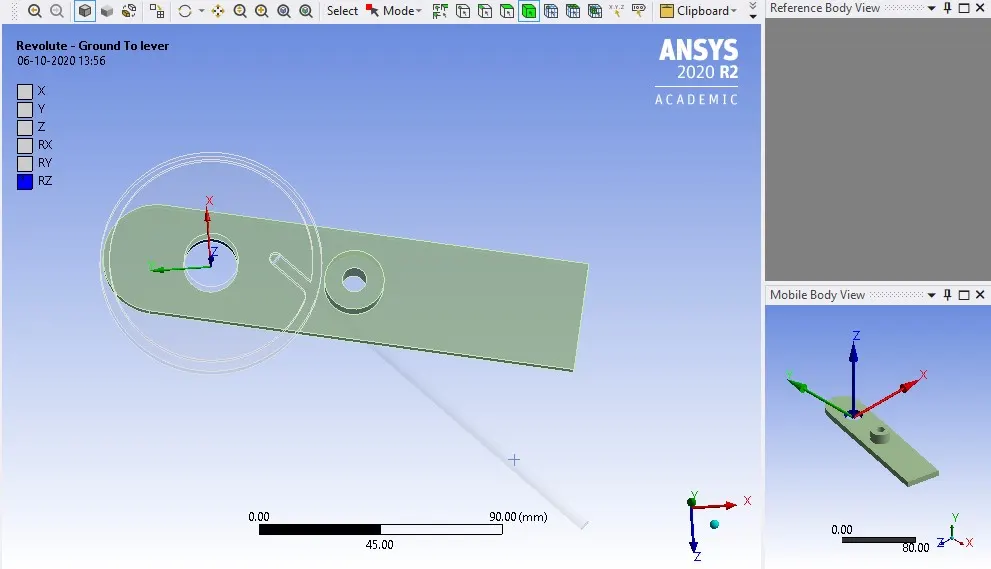
2. Revolute joint: A revolute joint is set up between the ground and lever. Rotation os along the Z-axis.
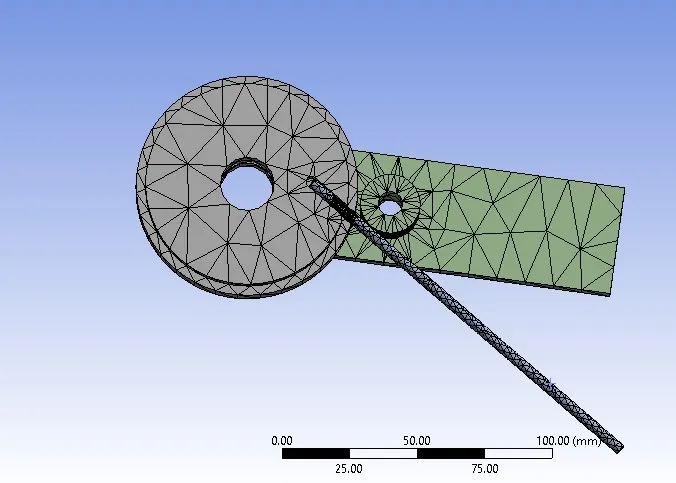
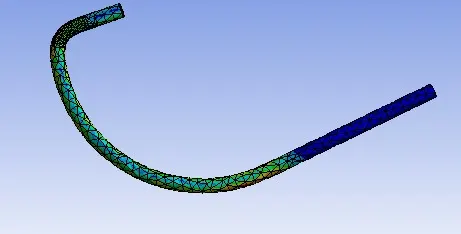
Mesh: The meshing is done in 3 steps in order to get fine mesh.
1. Method- Tetrahedrons. it is applied to all 3 bodies to get tetrahedrons structure.
2. Sizing- 2.2mm. The outer face of the lever which is contact with the wire is more refined to better results.
3. Sizing- Sphere of radius 7mm . A sphere is created around the region where the wire bends when rotated by the lever. This is done to get accurate values.
Nodes - 8129:
Elements - 4082:
Analysis Settings:
it is divided into 8 steps. Large deflection is turned on along with the output controls.
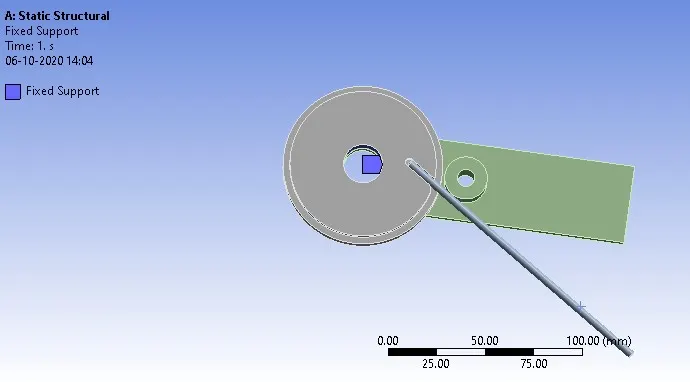
1. Fixed Support: Wheel is fixed.
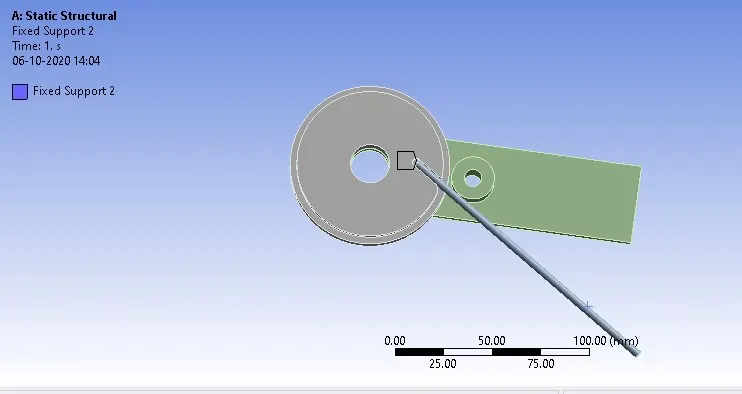
2.Fixed Support 2: The wire beginning is fixed to prevent slipping.
Results:
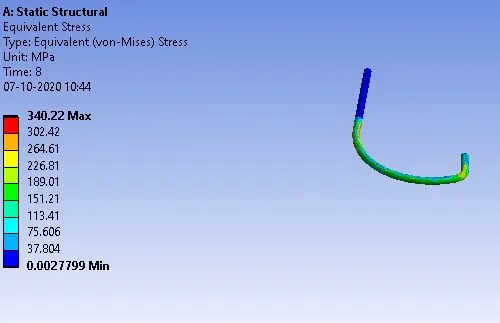
1. Equivalent Stress:
a. Copper Alloy NL
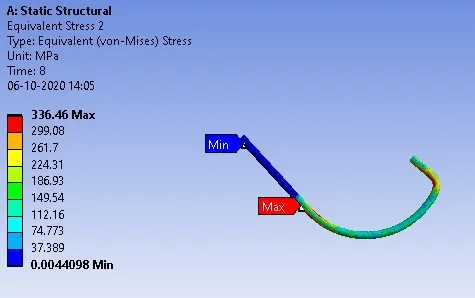
b. Aluminium Alloy NL
c. Magnesium Alloy NL
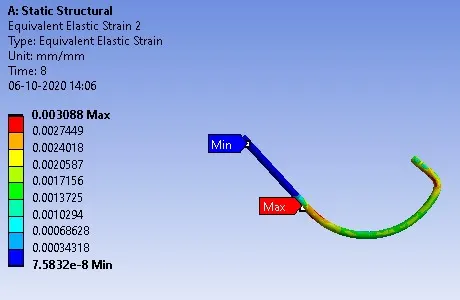
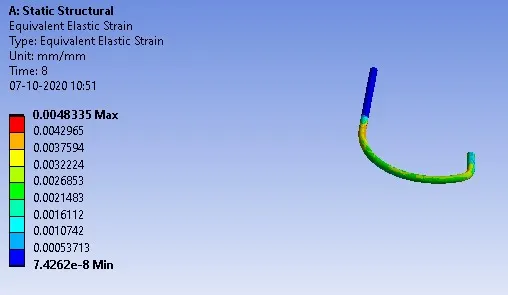
2. Equivalent Strain
a. Copper Alloy NL
b. Aluminium Alloy NL
c. Magnesium Alloy NL
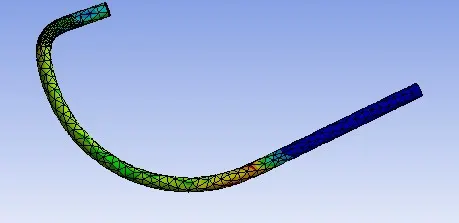
| Max values | Equivalent Stress(MPa) | Equivalent Strain |
| Copper Alloy NL | 336.46 | 0.003088 |
| Aluminium ALloy NL | 340.22 | 0.0048335 |
| Magnesium Alloy NL | 246.71 | 0.0014989 |