Week 3 Sheet metal Bending challenge
Objective: The objective of this simulation is to find out the equivalent stress and strain(Von Mises) and total deformation of sheet along Y-axis made of Aluminium alloy NL, Copper Alloy NL and Magnesium Alloy NL and compare the results obtained. Also for the simulation of ALuminium Alloy NL change the friction coefficient to 0.19 and calculate the equivalent stress and strain(VOn Mises) and total deformation along Y- axis. The last objective is to refine the mesh and compare the differences in the results obtained in the 2 cases.
Materials: For the case 1 Materials used are Aluminium alloy NL, Copper Alloy NL and Magnesium Alloy NL. For the case 2 and 3 the materials used is ALuminium alloy NL.
| Young's Modulus(MPa) | Poission ratio(MPa) | Yield Strength(MPa) | Target Modulus(MPa) | |
| Aluminium Alloy NL | 62000 | 0.33 | 140 | 209.46 |
| Copper Alloy NL | 1.1E+005 | 0.34 | 280 | 1150 |
| Magnesium Alloy NL | 45000 | 0.35 | 193 | 920 |
Setup:
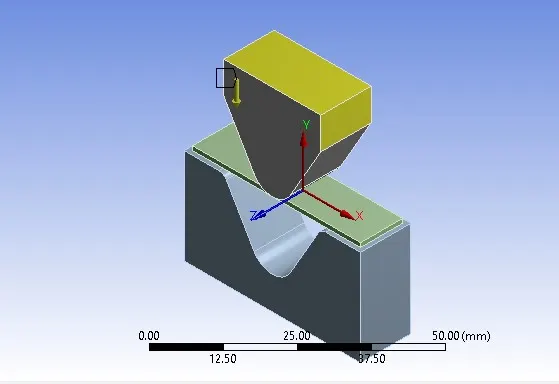
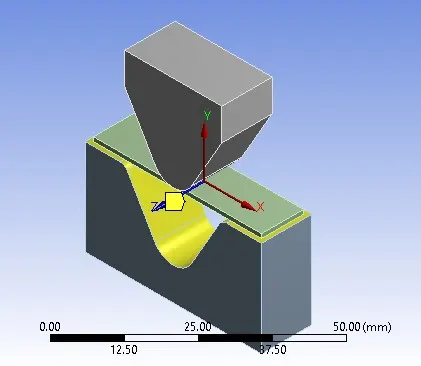
Geometry: It is made of a punch, die and sheet.(Common for all cases)
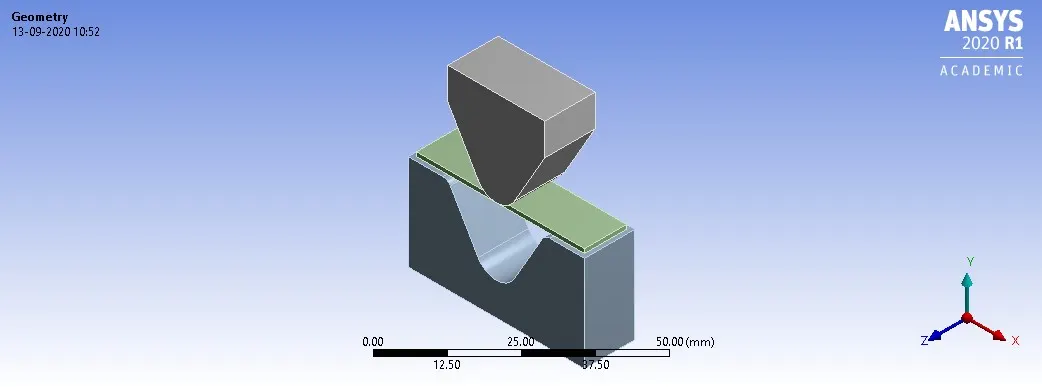
Contact sets: Contact set exists between the punch and sheet and sheet and the die.(Common for all cases)
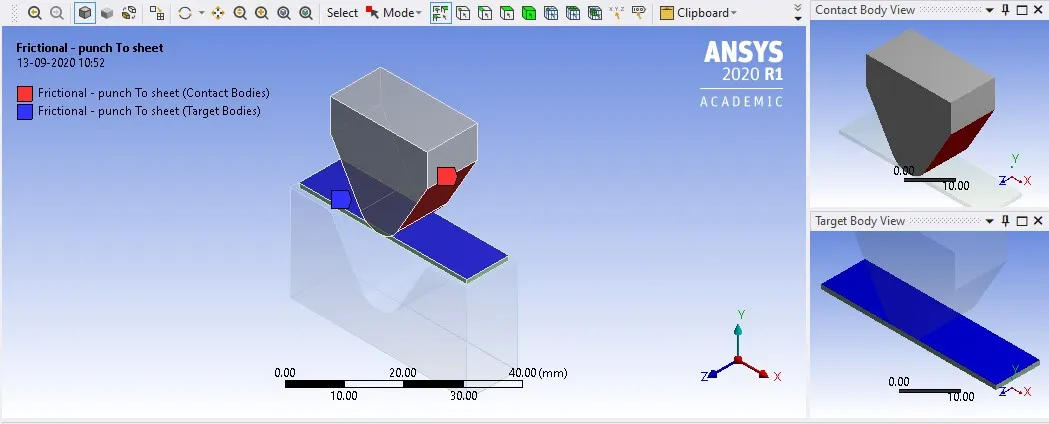 (Between punch and sheets)
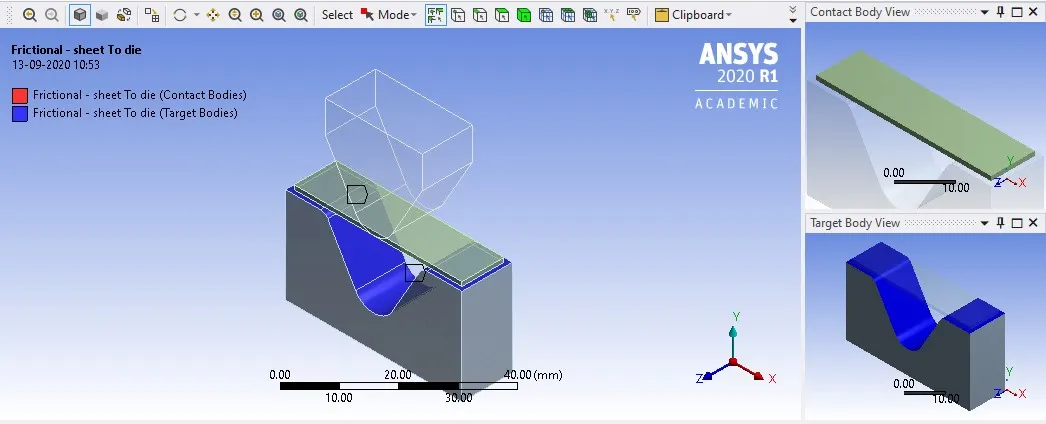 (Between sheet and the die)
The frictional coefficient is 0.1 .
Mesh:
| Body sizing 1(punch and die) | Body sizing 2(sheet) | Face sizing(faces which come in contact with the sheet) | Method | No of Nodes | Elements | |
| Case 1: | 4 mm | 1 mm | 1 mm | Tetrahedrons | 17904 | 6262 |
| Case 2: | 4 mm | 1 mm | 1 mm | Tetrahedrons | 17904 | 6262 |
| Case 3: | 4 mm | 0.75 mm | 0.8 mm | Tetrahedrons | 29921 | 12030 |
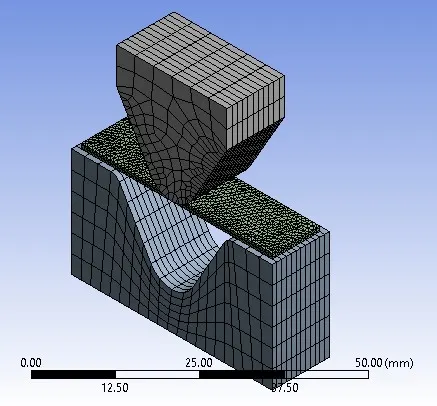
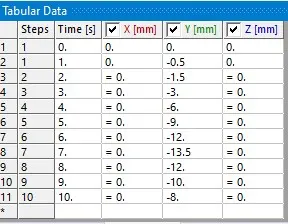
Analysis Setup: It is divided into 10 steps. Large deflection is turned on for all steps. Solver type is direct and the stabilization is turned on with the energy dissipation ratio set to 0.1.
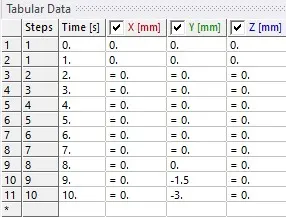
Displacement 1: The upper faces of the punch are selected and the values are noted in tabular data.
Displacement 2:
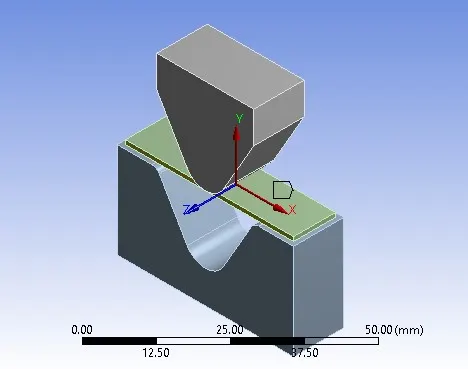
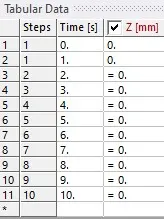
Displacement 3:
Case 1:
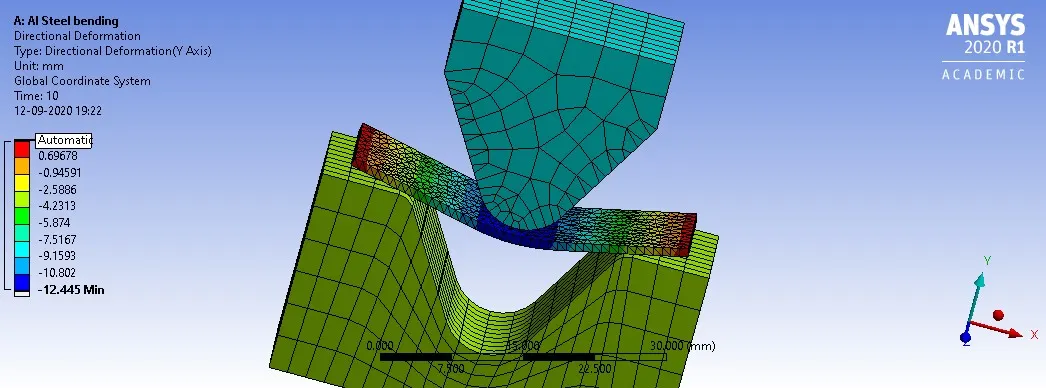
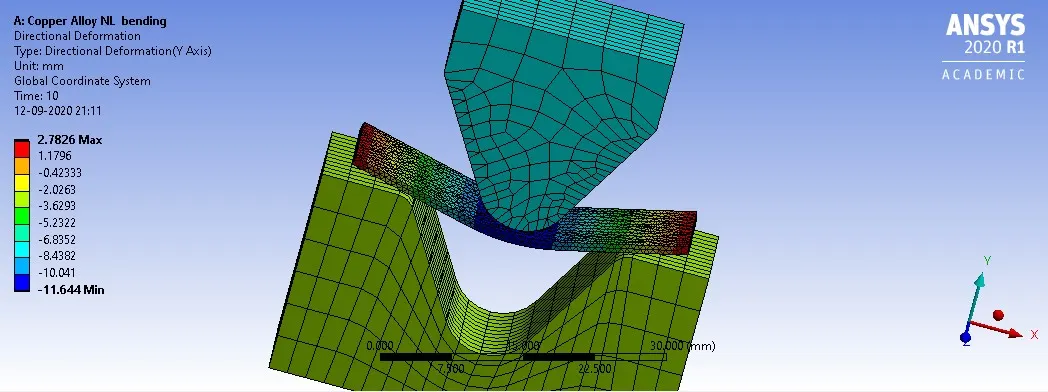
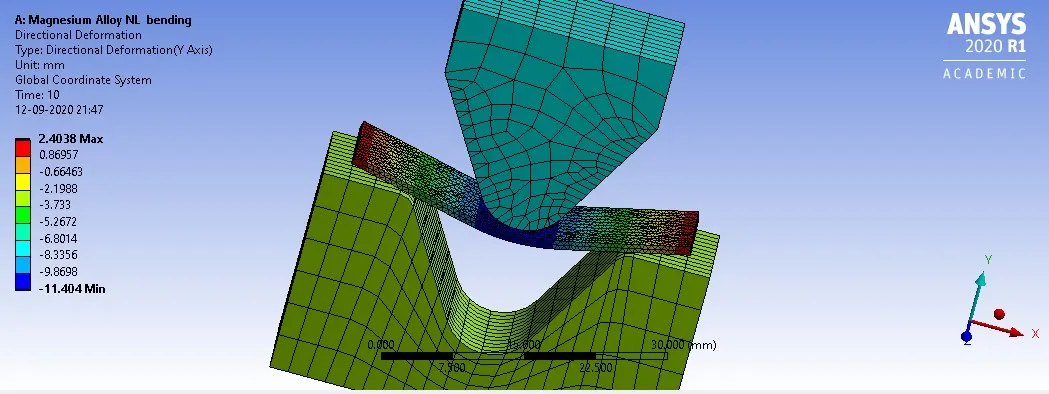
1. Total Deformation(Y-axis)
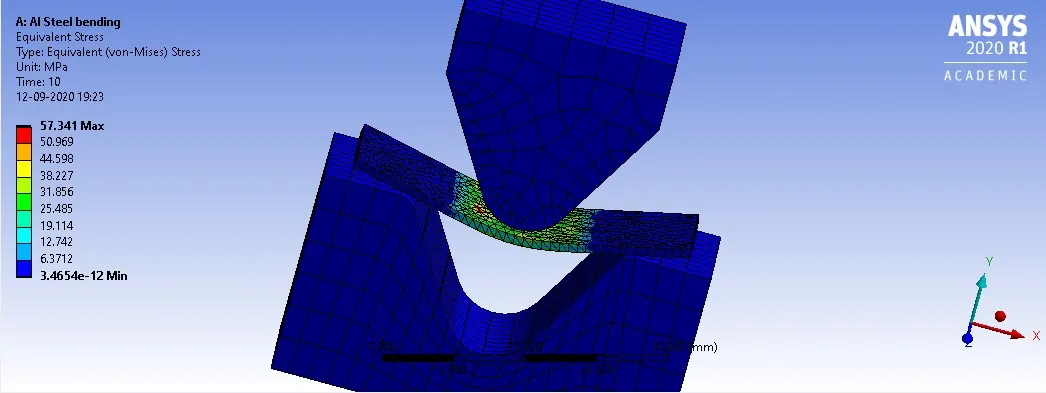
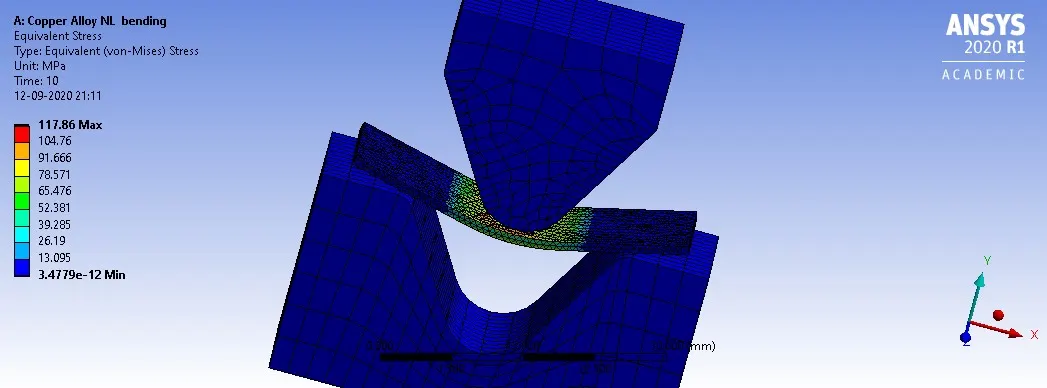
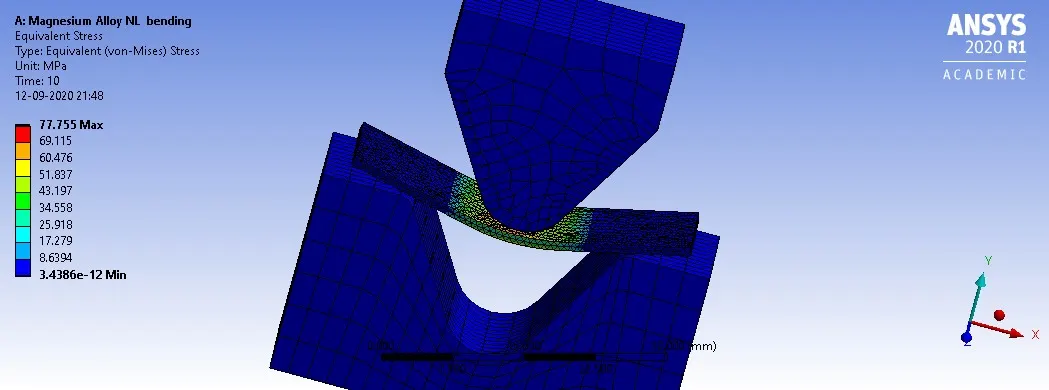
2. Equivalent Stress(Von Mises)
3. Equivalent Strain(Von Mises)
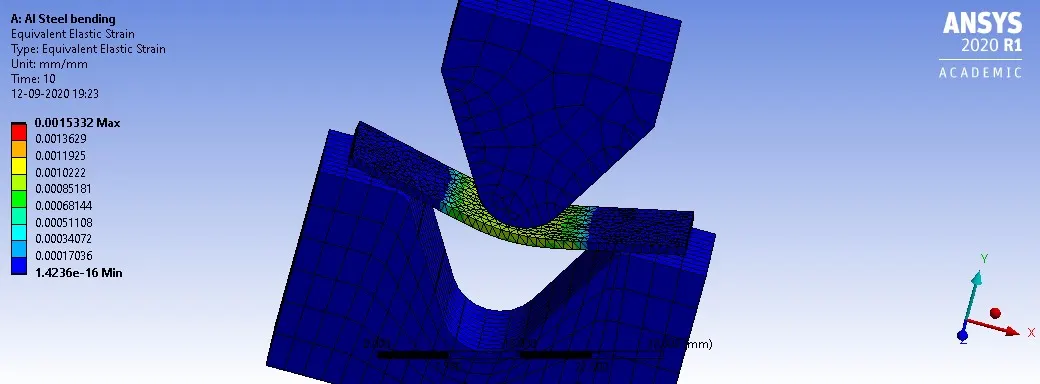
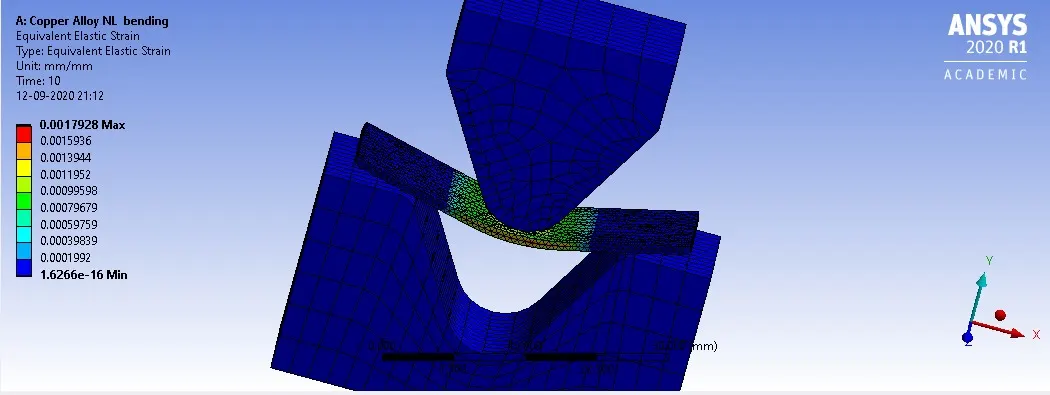
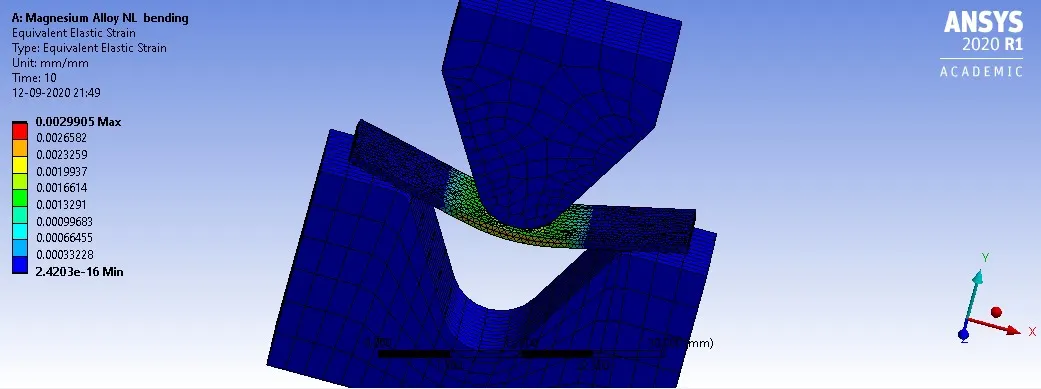
| (Maximum Values) | Total deformation(mm) | Equivalent Stress(Von Mises) (MPa) | Equivalent Strain(Von Mises) |
| Aluminium Alloy NL | 2.3393 | 57.314 | 0.0015332 |
| Copper Alloy NL | 2.7826 | 117.86 | 0.0017928 |
| Magnesium Alloy NL | 2.4038 | 77.755 | 0.00299905 |
From the above results, we can conclude that Copper Alloy NL undergoes maximum deformation and maximum stress developed. This is because Copper has higher Yield strength than ALuminium Alloy NL and Magnesium Alloy NL.
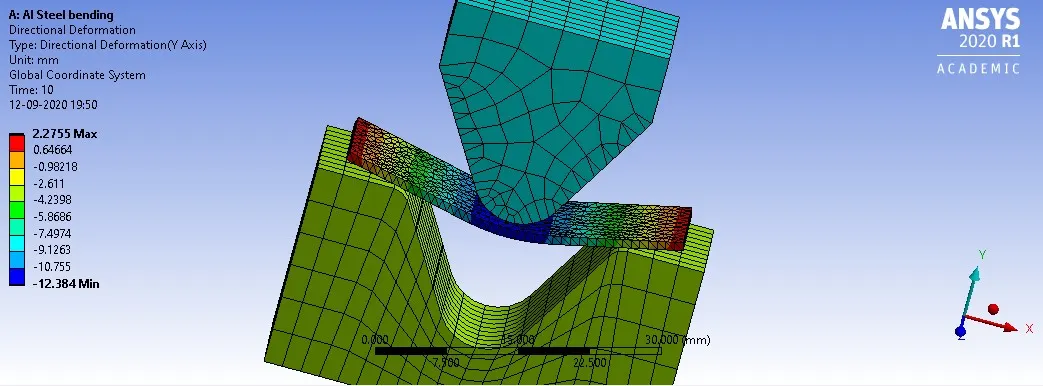
Case 2: Compare the results for frictional coefficient - 0.19.
Results:
Total deformation(Y-axis):
Equivalent Stress(Von Mises):
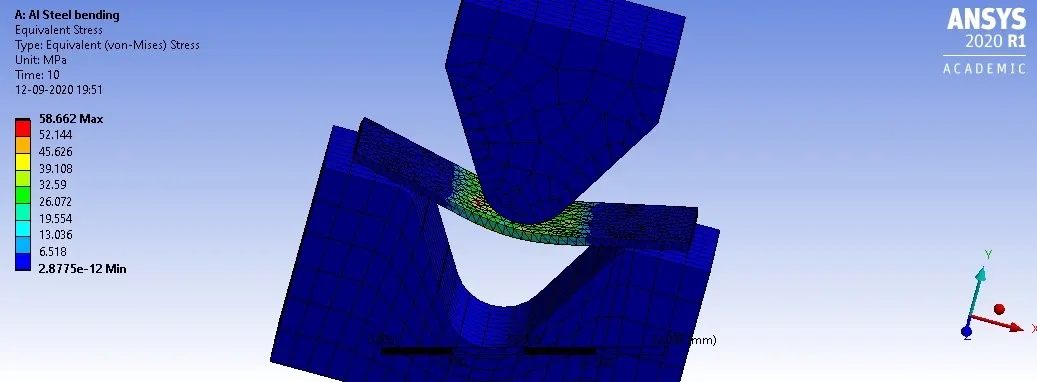
Equivalent Strain(Von Mises):
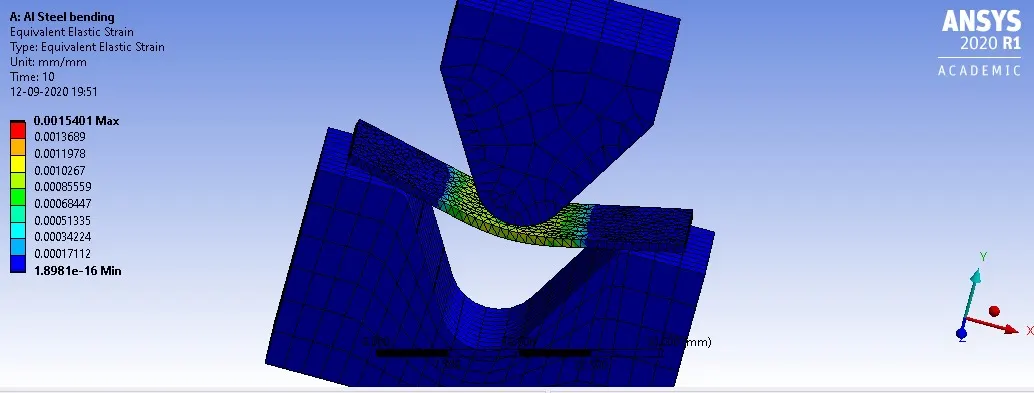
| Total deformaton(mm) | Equivalent stress(MPa) | Equivalent Strain | |
| Frictional Coefficient =0.1 | 2.3393 | 57.314 | 0.0015332 |
| Frictional Coefficient=0.19 | 2.2755 | 58.662 | 0.0015401 |
Case 3: Refinement of the Mesh
| Body sizing( punch and die) | Body Sizing(Sheet) | face sizing(faces which are in contact with the sheet) | Method | no of Nodes | Elements | |
| Case 1 | 4 mm | 1 mm | 1 mm | tetrahedrons | 17904 | 6262 |
| case 3 | 4 mm | 0.75 mm | 0.8 mm | tetrahedrons | 29921 | 12030 |
Results:
Total Deformation(Y-axis):
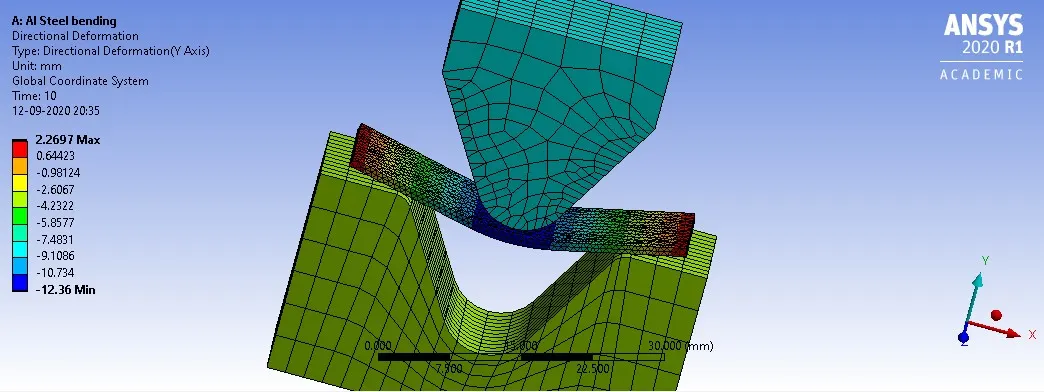
Equivalent Stress(Von Mises):
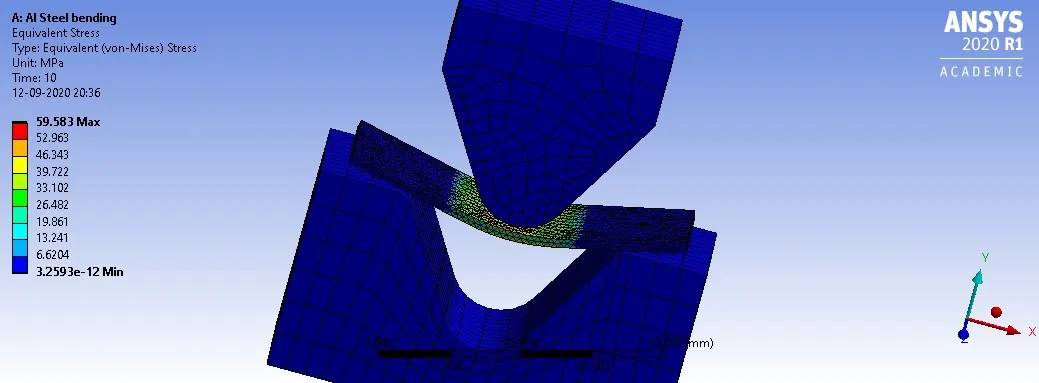
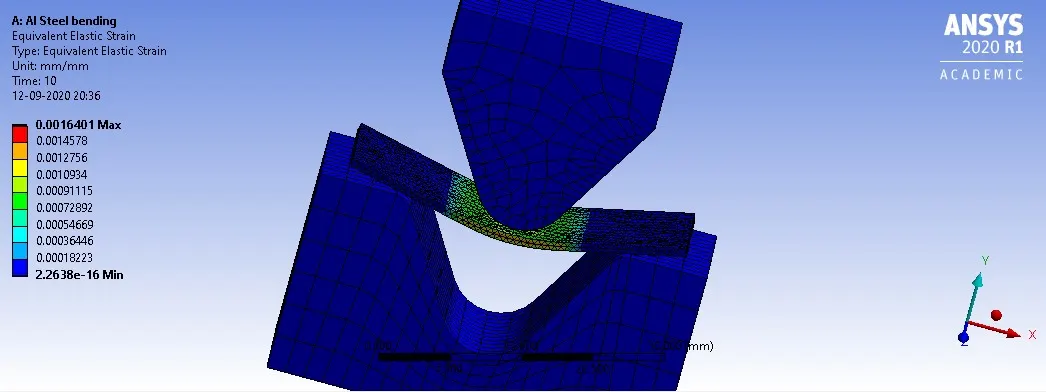
Equivalent Strain(Von Mises):
| Total Deformation(mm) | Equivalent stress(MPa) | Equivalent Strain | |
| Case 1: | 2.3393 | 57.314 | 0.0015332 |
| Case 3: | 2.2697 | 59.583 | 0.0016401 |