Week 4 Session 5
Explain the various applications of Power converters in an Electric vehicle. For Example what type of converter will you use for Horn which requires DC and less than 10V. Likewise come up with different applications
Different kinds of power converters are used in electric vehicles (EVs) to control the flow of electrical energy between various parts and systems.
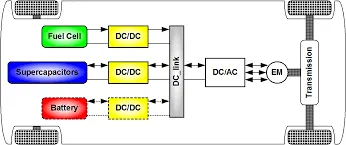
In electric vehicles (EVs), power converters are essential because they control the flow of electrical energy between various parts and systems. By ensuring that the various electrical systems in an electric car receive the proper voltage and current, these power converters maximise efficiency and improve the vehicle's overall performance and dependability. Depending on the precise voltage and power requirements for each application, different converter types and designs can be chosen.
DC-DC Converter
A DC-DC converter is a type of electrical circuit used to change the voltage level of DC electricity. Step-up or step-down voltage is possible.Chopper is another name for this kind of converter.The voltage needs of the electric parts within the car vary; most of them operate at significantly lower voltages. This includes air conditioning, radio, dashboard readouts, and built-in computers and displays.Either one of the two directions can be used.Because the majority of the parts are bidirectional, power can flow from the battery to the inverter, which turns the motor.The motor is now turning as a generator when the car is braking; this drives electricity back through the inverter and charges the battery.The traction battery pack's higher voltage DC electricity is converted via a DC-DC converter into the lower voltage DC power required to operate vehicle accessories and replenish the auxiliary battery.
DC-AC Convertor
A symmetric ac output voltage with the desired frequency and magnitude can be produced from a dc input voltage using a DC-AC converter.An inverter is another name for this kind of converter.By altering the alternating current's frequency, the inverter can modify the motor's rotational speed. The accelerator pedal signals the controller when the car needs to accelerate, and the controller changes the frequency of the AC electricity coming from the inverter to the motor to change the vehicle's speed.
AC-DC Converter
An AC-DC converter transforms a harmonic AC input into a DC output.Another name for these concerters is rectifiers.
The primary function of inverters in Ev/Hev is on-board charging. Rectifiers are utilised in AC-DC conversion because the battery stores DC power while the car is charged using AC electricity from the charging stations.
APPLICATIONS
- Charger for batteries:
An EV's battery charger is a sophisticated device that is essential to the car's overall functionality, economy, and safety. Technological developments in charging continue to enhance the convenience, speed, and integration of EVs with the wider electrical grid.The battery charger, which transforms external electrical current into the proper form for charging the vehicle's battery, is an essential part of electric vehicles (EVs).
AC/DC converters are one type of converter.
The required voltage is usually between 200 and 800 volts DC, depending on the battery specifications.
- DC/DC Conversion for Systems with Low Voltage:
Kind of Converting DC-DC Conversion
Required Voltage: Provides auxiliary systems with lower-voltage DC (12V or 48V) by converting high-voltage DC (200V to 800V) from the main battery.
- Electronics, lights, and other accessory systems:
DC/DC Converter is the type of converter.
Required Voltage: Usually in the range of 12V, this device converts high-voltage DC to lower-voltage DC for powering various auxiliary systems inside the car, such as lighting and electronics.
- The Horn:
DC/DC Converter is the type of converter.
The required voltage for the horn system is less than 10V, and it is obtained by converting high-voltage DC to that precise low voltage.
- System of Power Steering:
DC/DC Converter is the type of converter.
Required Voltage: Transforms high-voltage DC into the voltage—typically between 12 and 48 volts—that is necessary for the electric power steering system.
- The HVAC system:
DC/DC Converter is the type of converter.
Required Voltage: This converts high-voltage DC to the voltage—possibly between 12 and 48 volts—that the heating, ventilation, and air conditioning (HVAC) system needs.
- In-Board Battery:
AC/DC Converter is the type of converter.
Required Voltage: This device transforms AC power from an external source into the voltage needed to charge the primary battery of the car.
- System for Thermal Management:
DC/DC Converter is the type of converter.
Required Voltage: Usually between 12 and 48 volts, this voltage regulates power flow to maintain the proper working temperature of various components, including the motor and battery.
- System of Regenerative Brakes:
Bidirectional DC/DC Converter is the type of converter.
Required Voltage: Manages the energy flow in both directions while braking, transforming excess energy into the proper voltage for main battery storage.
- Propulsion system inverter:
DC/AC Inverter is the type of converter.
Required Voltage: Transforms the battery's high-voltage DC into alternating current (AC), which the electric motor can run at several hundred volts.