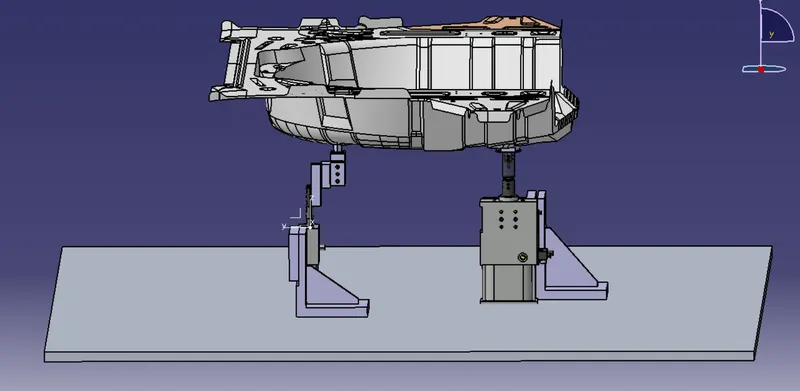
Week 4:- Pin Unit Design Challenge
PIN UNIT DESIGN
OBJECTIVE:
To design 2 different types of fixed pin unit and retractable pin unit such with different pins risers, blade and block
ABSTRACT:
In industry while assembling a car several processes has to be performed on it at part level so that It is fit for the roads. The process that is performed at the part level can be summarized in one word as joining processes, And to precisely do this operations on a car panel requires the panel to be held properly at the same position so; that the work upon it, T. hold the panel in position we use various fixtures which is an assembly of various units like rest pin units, fixed Pin units retractable pin units, rough locator units, sensor units, base unit etc. This project focuses on the design of fixed pin unit and retractable pin unit with design considerations which are usually taken 'into account while making a fixture.
SOFTWARE USED: CATIA-V5
FUNDAMENTALS:
3-2-1 principle: Our ultimate intention for using pin unit IS to fix the work piece so that it does not deviate from the position while the operation is being performed on it For this reason we use 3-2-1 principle.
Every component we know has 6 degrees of freedom they are listed below:
- Translational motion along x-axis,
- Translational motion along y-axis.
- Translational motion along z-axis.
- Rotational motion along x-axis.
- Rotational motion along y-axis.
- Rotational motion along y-axis.
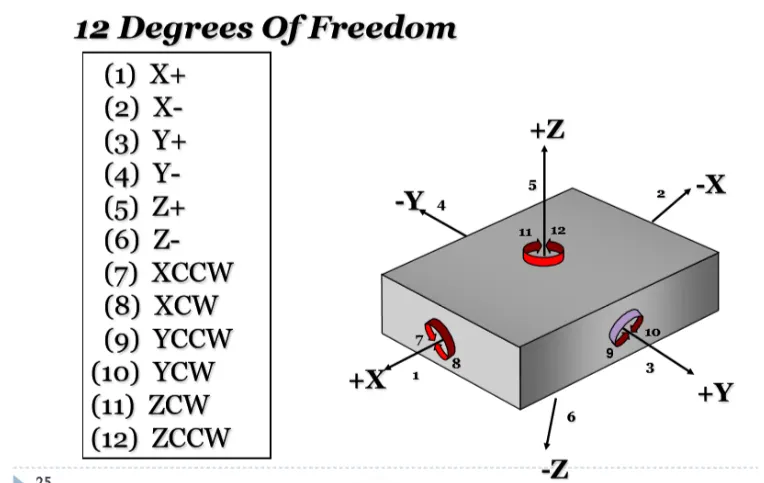
Fig. Degrees of Freedom
Degrees of freedom can be simply understood as the direction in which any component cam move .These 6-degrees becomes 12 if we consider translation along negative and rotation in anti-clockwise direction too. That means, every component can move in all the direction when it is free But processes like welding, stamping or others and in fact every ether cannot be carried out on such free to move body for obvious reasons. Thus the body must be constrained in all the major direction in order for workman to work upon it. This constrain on motion is achieved by 3-2-1 principle.
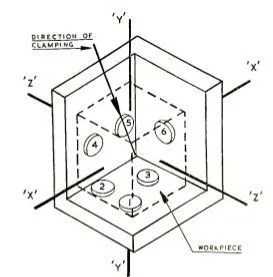
In 3-2-1 principle we make use of locating pin sin the given order to fix if on a fixture
- 1.3 pins are located on the bottom side of the component. These pins constrain the translation motion of the body in Z direction and rotational motion along x-axis and y-axis. Thus 3 degrees are restricted. But the body still can rotate along z-axis and translate in x axis and y-axis.
- 2.2 pins are located on the back side of the -Component. These pins constrain the translation motion along x-axis and rotational motion along Z-axis Thus we have constrained 5 degrees in total. But translation along Y axis is still possible.
- 1 pin located on the adjacent side of the 2 pins we can constrain the last degree that is translation along Y axis.
Thus we can constrain all the degrees of freedom of a body using 3-2-1 principle which used 6 pins for the same. The video explains the 3-2-1 principle: https.//www.youtube.com/Watch?v*NVTEKYFMHLU
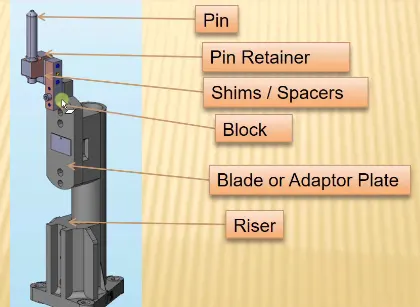
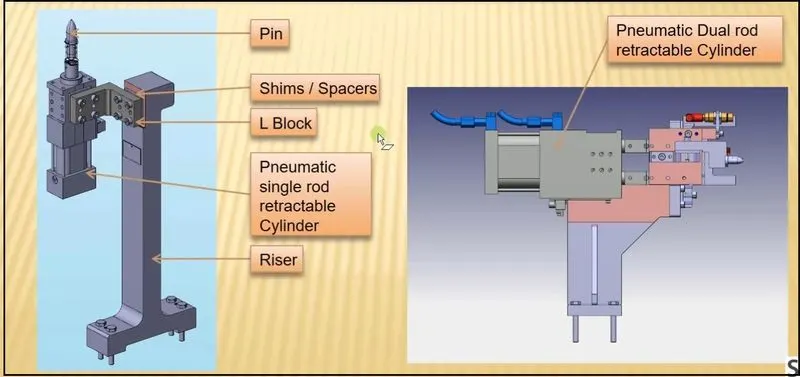
Components-of-fixed-and-retract l pin-unit : The components used in both the units are nearly same with just one main difference in retractable pin unit as it uses cylinder in addition to retract the pin from its initial position, The components for both of them are listed below.
FIXED PIN UNIT:
- Locating pin
- Pin retainer
- Shim pack (2 way adjusting)
- L-block
- Blade
- Riser
Retractable Pin Unit :
- Locating Pin Unit
- Retainer(Optional depending on the cylinder being used)
- L-Block
- Shim Pack
- Blade (Optional depending on design )
- Cylinder
- Riser
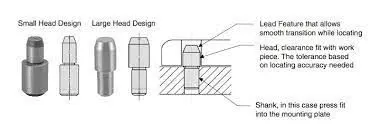
Locating pins:
locating pins are used for controlled, fine tolerance positioning of a work piece. For example, a pallet that is moved along one axis, where the drive mechanism is not accurate and stable enough to place it in a position sufficiently accurate to execute a particular process, the use of locating pins maybe the best solution. Usually two locating pins are enough to properly locate the work piece on one plane. We should also consider the following points while choosing the locating pins.
- Pin should engage 3-5mm from car part entry surface.
- All pins should be accommodated with 2-way adjustable shims irrespective of direction of arresting.
- Round pins should be used in case of 4-way arresting of car part if the hole is round.
- Round pins can be used in 2-way arresting of car part if the hole is slotted.
- Diamond pins should be used in case of 4-way arresting of car part if the hole slotted.
- Diamond pins can be used in 2-way arresting of car part if the hole is round.
Purpose-
Design 2 different types of Fix pin unit & Retractable pin unit pin unit is a unit designed to locate the car panel using pin.
- Pin unit consist of riser. blade, block a shims or spacer, pin retainer & pin.
- pin unit is the part of the 3-2-1 locating principle of fixture design. It restricts 6 degrees of freedom of the part.
Fundametal of pin unit design-
it is necessary to have 2 pins to locate a car panel & here one pin must arrest 4 way(4 translational) & other must arrest 2 way(i.e. 2 rotational) of a car panel
- The axis of the car panel hole & the axis of the pin should be same (in general)
- The pin tolerance for a geo pin will be of closer tolerance i.e. -0.15mm & for re-spot pin is -0.28mm
- Pin should engage 3 to 5 mm from car panel entry surface.
- Alt pins should be accomodated with 2 way adjustable shims irrespective of direction of arresting.
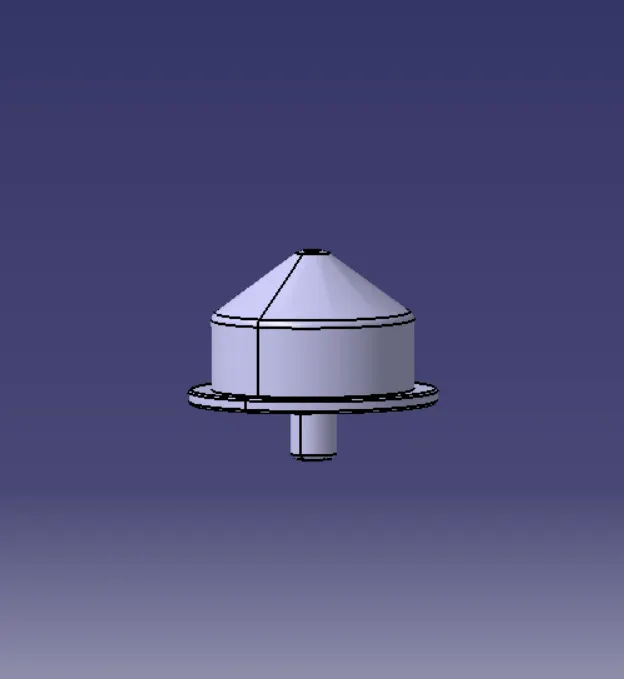
- Round pins should be used in case of 4 way arresting of car part if the hole is round.
- Round pins can be used for 2 way arresting of car part only if the hole IS slot.
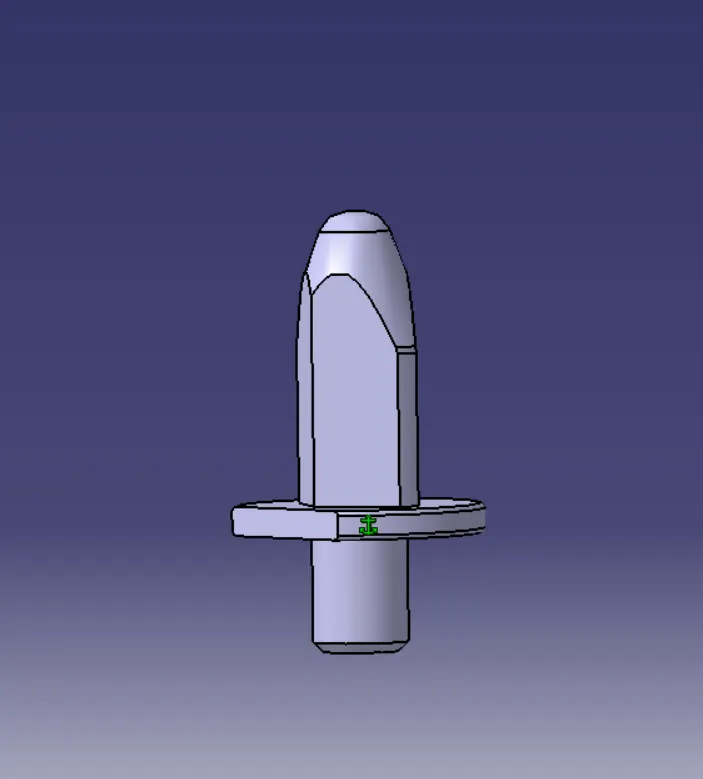
- Diamond pins should be used in case of 2 way arresting of car part if hole is round 6)Diamond pins should be used in case of 4 way arresting of car part if hole is slotted.
It can be divided into following 2 types
- Fixed pin unit- In this type of unit the pin is fixed by means of pin retainer & riser.
- Retractable pin unit- In this type of unit there is the provision of moving of pin in up-down direction.
Following are the requirements need to be taken into account while desiging the parts
Pin- Pin is the part which locates the car panel It can be a make part Or standard part.
- Pin should be grinding surface on shaft with fits on to which the pin retainer wilt befitted.
- The mounting surface of the pin should be a fine machined surface.
- The pin should have a step machine surface to lock the rotation, which matches with the pin retainer.
- All machined planes should be perpendicular to axis of the pin shaft.
- Pin must have a provision like tapped hole from the bottom or a v-groove from the side.
- A pin must be hardened (Heat treatment) & black oxide finished in general.
Typically, locating pins are used for controlled, fine tolerance positioning of a work piece. For example, a pallet that is moved along one axis, where the drive mechanism is not accurate and stable enough to place it in a position sufficiently accurate to execute a particular process, the use of locating pins may be the best solution.
The Diamond Shape is a critical feature that helps with machining inaccuracies and smoother (locating operation. When two round head pins are installed onto one plate, the distance between two mounting holes must be extremely precise and even then, the work piece wilt not be placed on the base as easily as it would with the use of a diamond Shape pin.
Pin Retainer- A pin retainer is a part which hold the pin in position, the pin retainer can either be a make part or a standard part.
- Pin retainer should have a hole with a fit, on to which the pin will be fixed.
- The pin mounting surface of the pin retainer should be a machined surface.
- The pin mounting surface of the pin retainer should have a step to lock the rotation of the pin
- The pin mounting surface of the pin retainer to the blocks should be a machined surface.
- The pin retainer will be fixed to a block or a L block to the riser with 2 dowel holes (pins) & at least with one screw hole to maintain the tolerance.
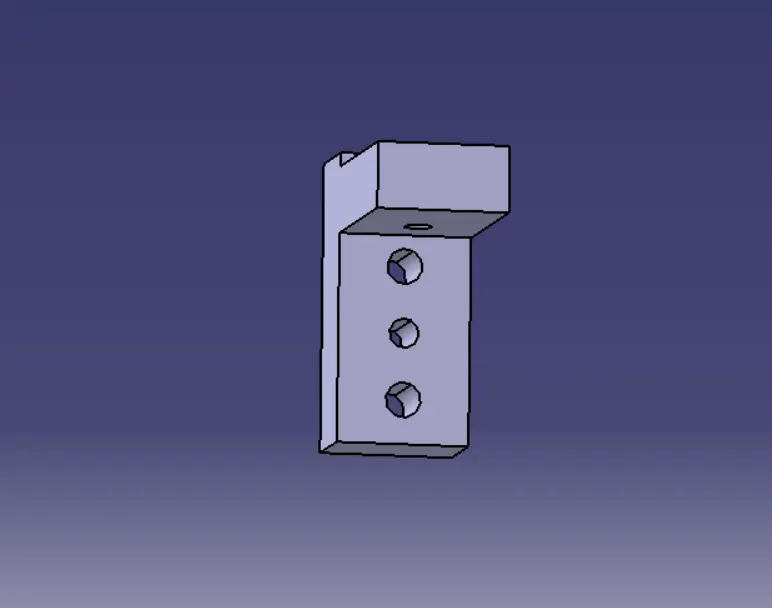
L-BLOCK :
These parts are mainly used to accomodate the shimming directions as per fundamental in general. Also in some cases used for other design feasibility.
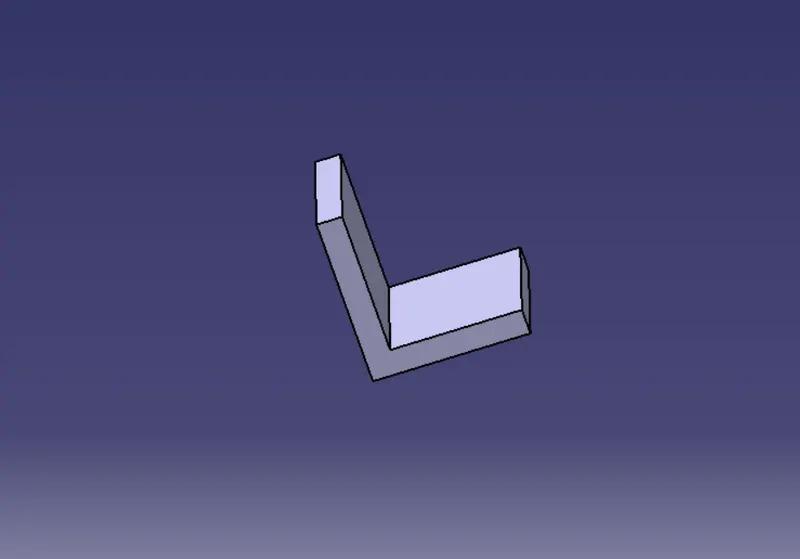
Shims/Spacers-
Shims & Spacers are some standard parts in general, which are used for adjustments of locators(NC Blocks & pin retainers) for desired values for the precise working of a unit with respect to car part. In general to adjust the design to manufacturing deviation.
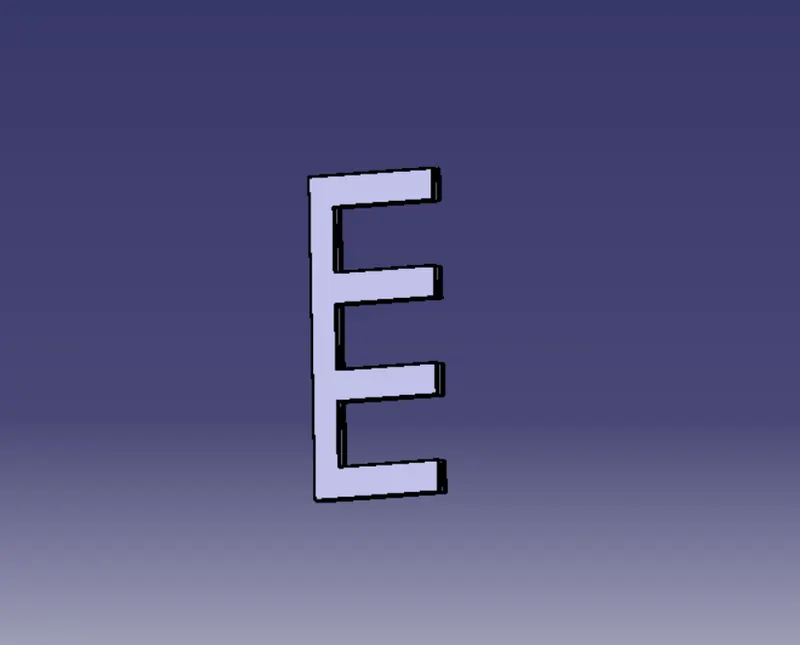
Blade:-
Blade is part like a plate, which connects the parts on a unit to a riser. In general the blade can be either a make part or a standard part.
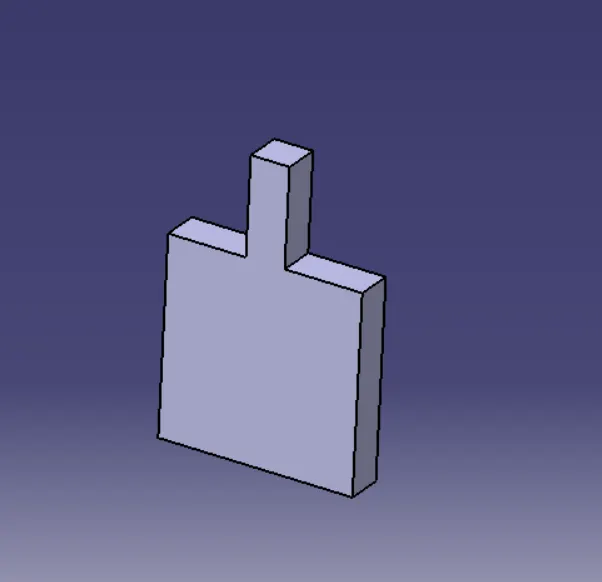
Riser:- It is a part on which all the parts of a unit are mounted & is mounted on the base plate of a tool
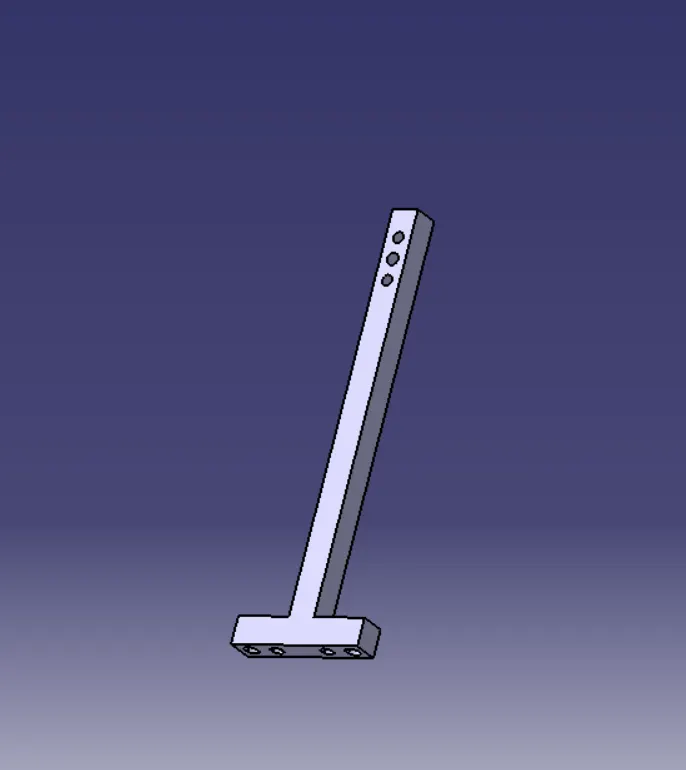
Design Fixed Pin Unit:-
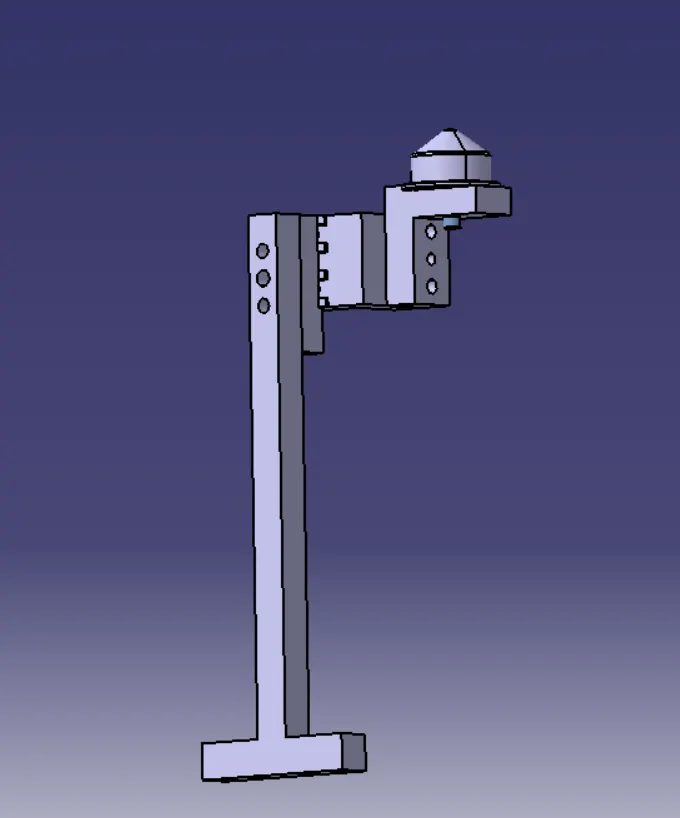
fig. shows Fixed pin unit
Fixed pin unit with Dimond pin :-
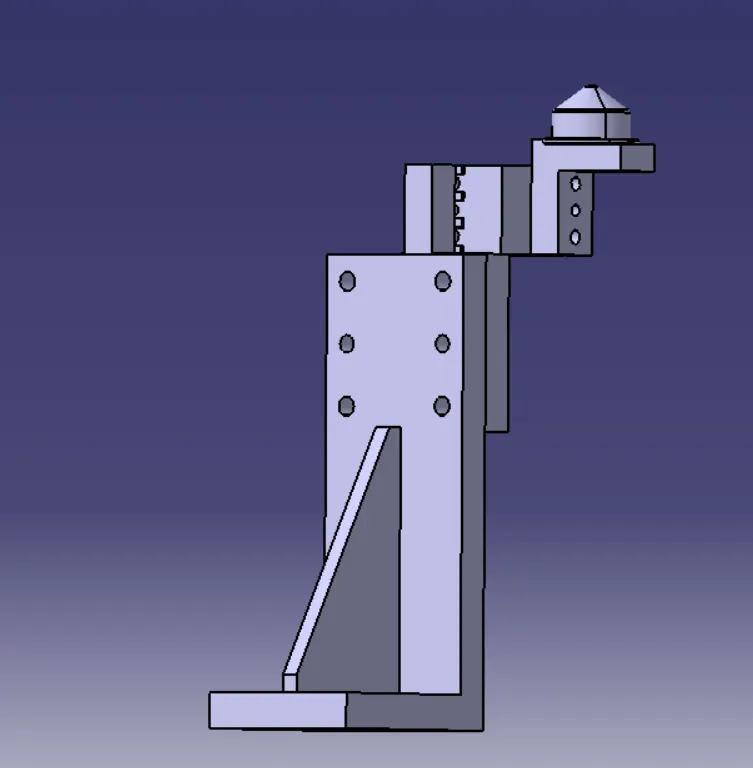
Assembly:-
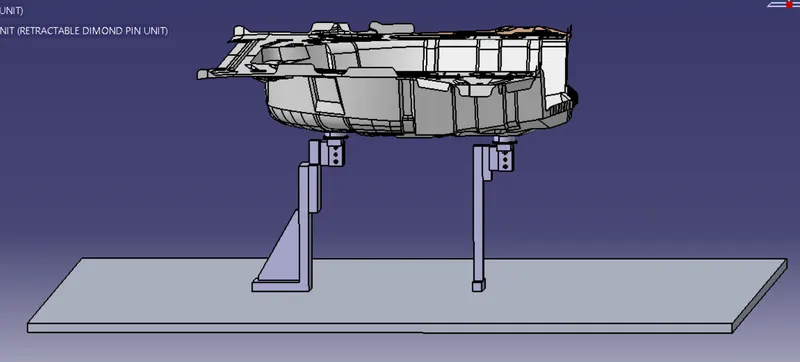
Retractable pin unit:
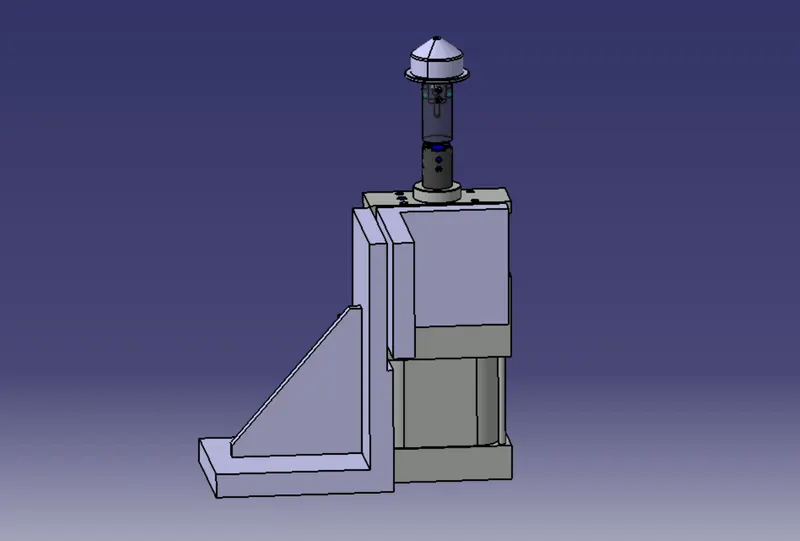
Dimond Pin unit:-
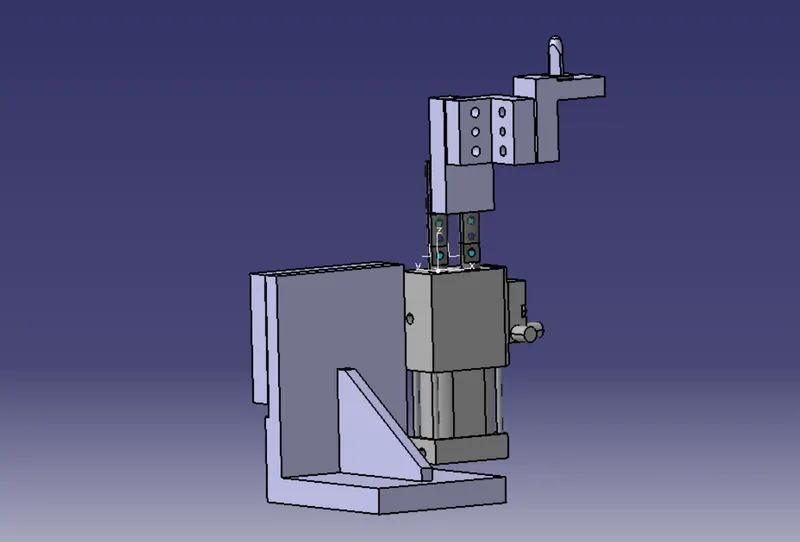
Assembly:-