Week 4 - Combustion Efficiency Calculation after Preheating
Aim: Combustion efficiency calculation for recuperator at different preheating temperatures.
Objectives:
- To determine the effect of preheating on the adiabatic flame temperature?
- Change pre-heating from 298 to 600K
- Assume that the furnace exit temperature is 1700K (For this case assume that the combustion products are CO2, H20, and N2).
- Write the formula for combustion efficiency
- Plot the effect of pre-heat temeprature on combustion efficiency
Introduction:
In this process we will be using recuperator, A recuperator is a heat exchanger in which energy from a steady flow of hot combustion products in furnace is transferred to the air supplied to the combustion temperature.
Since the flue gases are supplied to air the air gets preheated, the recuperator acts same as that of heat exchanger.
The preheated air is mixed with the fuel and transferred again for combustion process.
When the air is preheated there is change in adiabatic flame temperature we will find out a changes by writing python code.
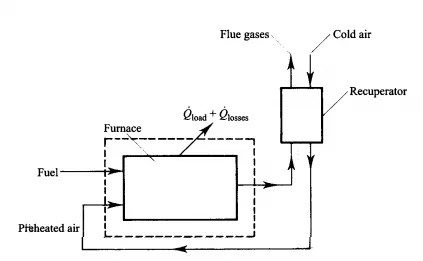
(Recuperator fig)
CASE1:
In this process we will be using simple reaction of mixture of air and fuel to produce products.
CH4+ a(O2+3.76N2) ---> products
a = (x + y/4)/ϕ
where x, and y are no of moles of carbon and hydrogen, and ϕ is equivalence ratio.
For this process let us assume ϕ = 0.9
we get , a = 2.22
Thus equation turns out to be
CH4+ 2.22 O2+8.35 N2 ---> products
By using this equation we will find enthalpy of reactants and using cantera we can find adiabatic flame temperature at different preheated temperatures.
CASE2:
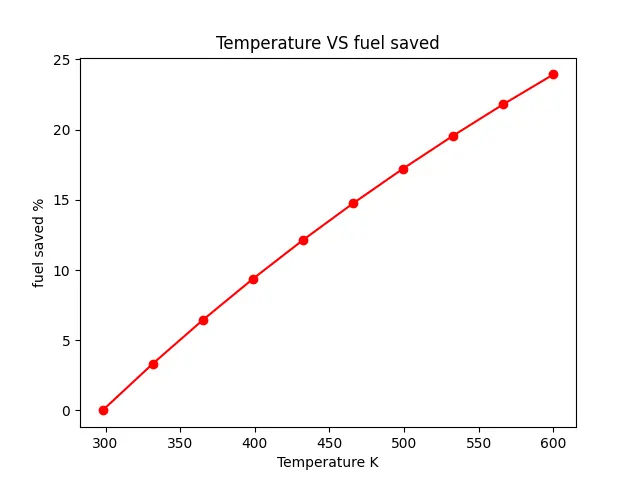
In this case we will determine the fuel saved as the result of preheating for different temperatures
For this we should write a energy balance for the control volume assuming both heat transferred to the load and heat losses are same, with or without preheat.
heat loss = -Qdot = -Qload - Qloss = mdot(hproducts - hreactants)
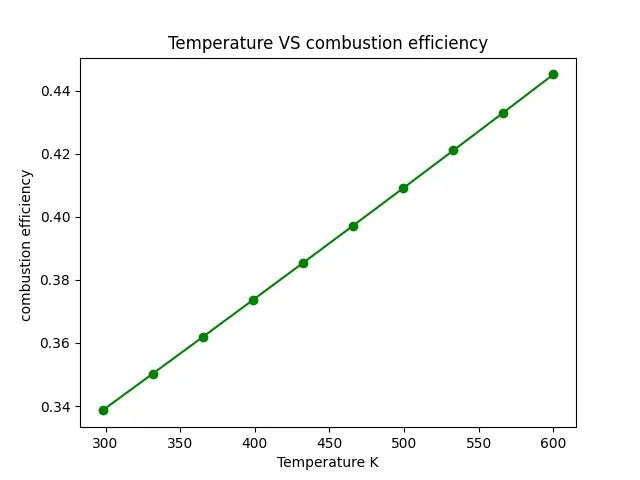
Fuel combustion efficiency can be given by formula
η = Qdot / mf *LHV
It is divided with lower heating value for comparison of heat loss with it which will result in calculation of efficiency.
Also Qdot = -([(A/F)+1]*h(products) - (A/F)*h(air) - h(fuel))
For calculating (A/F) we have formula as:
(A/F)= (A/F)stiochiometry / ϕ
where,
(A/F)stiochiometry = 17.1
ϕ = 1
we get value for combustion efficiency by using above assumptions and formula also value for LHV = 50 MJ/kg
Now same formula can be used by changing preheated temperature to get combustion efficiency, and for calculation of fuel saving we can use formula as:
savings = 1 - (η(298)/η(Ti))
Ti = range of temperature
Python code to run both cases:
import cantera as ct
import matplotlib.pyplot as plt
import numpy as np
import math
from prettytable import PrettyTable

cases = input('Enter the case to be analyzed = ')
case = int(cases)

if case==1:
	Tad_ct = []
	gas = ct.Solution('gri30.xml')
	phi = 0.9
	#preheating effect
	T = np.linspace(298,600,10)

	for i in range(0,len(T)):
		#calculating the mole fraction of reactants to use in equation
		N_total = 1+(2.22/phi)+(8.35/phi)
		N_CH4 = 1/N_total
		N_O2 =(2.22/phi)/(N_total)
		N_N2 = (8.35/phi)/(N_total)
		gas.TPX = T[i],101325,{'CH4':N_CH4 , 'O2':N_O2, 'N2':N_N2}
		gas.equilibrate('HP','auto')
		Tad_ct.append(gas.T)

	table = PrettyTable(['Preheated tenperature','adiabatic flame temperature'])
	for x in range(0,len(T)):
		table.add_row([T[x],Tad_ct[x]])
	print(table)

	#plotting
	plt.plot(T,Tad_ct,'o-b')
	plt.xlabel('Preheated temperature in K')
	plt.ylabel('Adiabatic flame temperature in K')
	plt.title('Variation of Adiabatic flame temperature with preheated temperature')
	plt.savefig('recuperator.png')
	plt.show()

elif case==2:
	#Assumption
	#calculation of air by fuel ration
	# A/F = (A/F)stiochiometry/ equivalence ration
	#Assuming equivalence ratio as 1 we have value for (A/F)stiochiometry as 17.12
	# which give us a value for A/F as 17.12
	A_F = 17.12
	#lower heating value
	LHV =50016 # 50Mj
	gas = ct.Solution('gri30.cti')
	T  = np.linspace(298,600,10)

	#Calculating enthalpy of fuel
	A  = ct.Quantity(gas)
	A.TPX = 298,ct.one_atm,'CH4:1'
	A.moles = 1
	h_fuel = A.enthalpy_mass


	#enthalpy of air
	#Due to pre-heating of air we will calculate enthalpy of air at different preheated temperature
	h_air = []
	for i in range(0,len(T)):
		B = ct.Quantity(gas)
		B.TPX = T[i],ct.one_atm,{'O2':1,'N2':3.76}
		B.moles = 2
		h = B.enthalpy_mass
		h_air.append(h)


	#enthalpy of products
	C = ct.Quantity(gas)
	C.TPX = 2300,ct.one_atm,{'CO2':1 ,'H2O':2 ,'N2':7.52}
	C.moles = 1
	h_prod = C.enthalpy_mass


	#To calculate combustion efficiency for different temperature range of preheated air
	Qdot = []
	eta = []
	for i in range(0,len(T)):
		Qdot = -((A_F+1)*h_prod - A_F*h_air[i] - h_fuel)
		eta.append(Qdot/(LHV*1000))


	saving = []
	for i in range(len(T)):
		saving.append((1 - (eta[0]/eta[i]))*100)


	table = PrettyTable(['Temperature in K','combustion efficiency','fuel saving in %'])
	for x in range(0,len(T)):
		table.add_row([T[x],eta[x],saving[x]])
	print(table)

	plt.plot(T,saving,'o-',color = 'r')
	plt.xlabel('Temperature K')
	plt.ylabel('fuel saved %')
	plt.title('Temperature VS fuel saved')
	plt.savefig('recuperator1.png')
	plt.show()
Tabular colums:
CASE1:
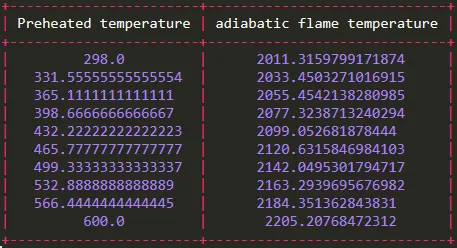
This table states that adiabatic flame temperature increases with increse in preheat temperature.
CASE2:
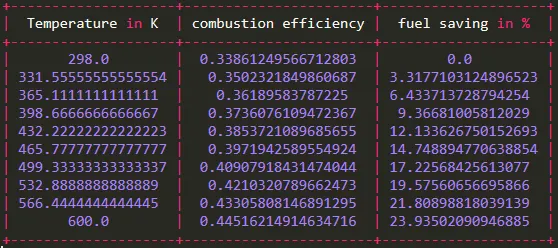
This table states that as preheat temperature increases more fuel is saved. but nitric oxide emissions may be affected, since peak temperature will increase as a result of preheat.
Plots:
CASE 1:
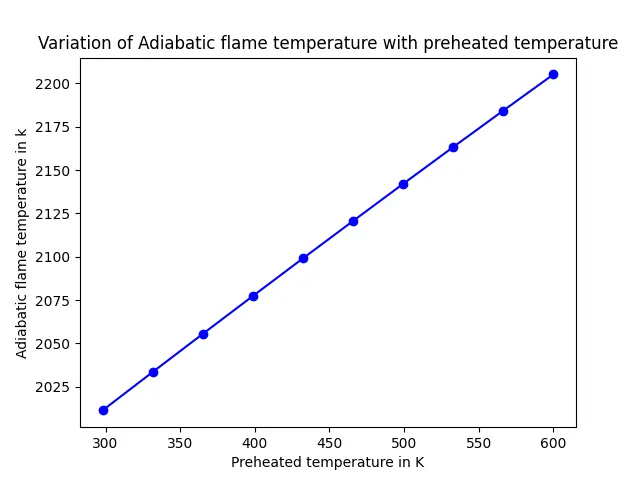
CASE 2:
The fixed exit furnace temperature depends on various factors such as the fuel used the flue gas species and preheat temperature in our study we just assumed it to calculate the enthalpy of products which is wrong.
Also we can observe by changing the value of exit furnace temperature we get that at greater temperature the efficiency increases.
Conclusion:
By using recuperator the combustion process can be optimized, it increases efficiency, and also saves fuel hence cost effective method. But the nitric oxide emissions is only the downside with can be reduced by Flue gas treatment techniques, such as selective cata- lytic reduction (SCR) processes, can remove NOx.