Week 4 - Combustion Efficiency Calculation after Preheating
1. Effect of preheating on Adiabatic Flame Temperature:
Considering stoichiometric combustion of methane,
`CH_4 + 2(O_2+3.76N_2) = CO_2 + 2H_2O+7.52N_2`
A code is written in Python using Cantera. The quantity class is used to define air and methane.
Initially, an object 'air' is created using the quantity class. Then its temperature, pressure and mole fraction are provided. The temperature is the preheat temperature and is varied. Pressure is given as 1 atm.
The temperature is varied from 298 K to 600 K. linspace command is used to create an array of temperature values. 40 values of preheat temperature are considered for which AFT should be calculated.
Mole fractions are provided as 0.21 for oxygen and 0.79 for nitrogen. From the previous problem, we know that for a stoichiometric combustion, no. of moles of of air should be 9.52. Using moles function, no. of moles of air is provided.
Another object 'fuel' is created using the quantity class. As above, its temperature is given as 298.15K, pressure as 1 atm and mole fraction as 1 (as it contains only one species). Using moles function, no. of moles of methane is given as 1.
Another object 'M' (mixture) is created which adds the air and fuel mixtures for combustion.
Using equilibrate function and assuming combustion happens at constant pressure, AFT is calculated.
A plot is calculated to show the variation of air preheat temperature with AFT.
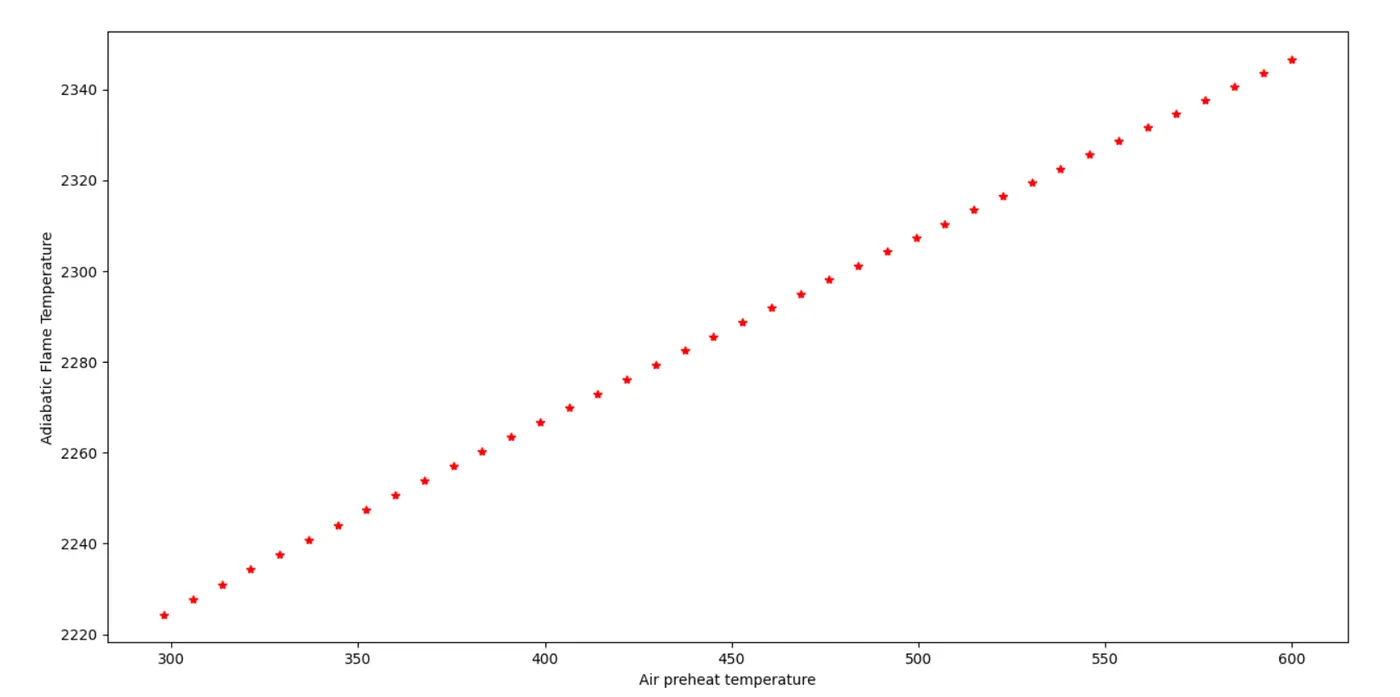
From the above plot, it is observed that as temperature of air is increasing, AFT is increasing and the trend is almost linear.
As air is heated prior, its energy (enthalpy) is at a higher level even before the start of combustion. It mixes with the fuel and the mixture temp. will be a bit higher even before combustion. This extra energy adds to the energy of the combustion products thereby increasing their temperature.
2. Finding combustion efficiency:
In this, the furnace exit temperature is kept constant (1700 K) and the combusiton products are assumed only to be CO2, H20 and N2.
The air temperature is varied from 298 K to 600 K and its effect on combustion efficiency is studied.
The ratio of amount of heat liberated by the fuel-air mixture during combustion to the total energy the fuel contains is the combustion efficiency.
Total energy of the fuel is the product of the mass of fuel and its lower heating value (LHV).
`eta = Q/(m_f*LHV)` ---> (1)
`m_f` is the mass of fuel
LHV = lower heating value (in this case methane) = 50e6 J/kg
For calculating total heat liberated, applying conservation of energy principle,
Energy of the fuel + Energy of the air = Heat liberated + Energy of the combustion products.
Here, heat liberated = heat used for work + heat loss
assumig heat loss = 0, so total heat liberated is used for generating work.
Therefore,
`m_ah_a + m_fh_f = Q + m_(ex)h_(ex)`
where `m_a` is mass of air, `h_`a` is enthalpy of air, `h_f`is enthalpy of fuel
`m_(ex)` is mass of exhaust products = `(m_a + m_f)` (conservation of mass principle)
`h_(ex)`is enthalpy of exhaust products (at temperature 1700 K)
Obtaining an expression for Q,
Q = ``m_ah_a + m_fh_f - m_(ex)h_(ex)`
Q = `m_f*((m_a/m_f*h_a) + h_f - ((m_a/m_f* + 1)*h_(ex)))` --->(2`
Subsituing (2) in (1),
`eta = ((m_a/m_f*h_a) + h_f - ((m_a/m_f* + 1)*h_(ex)))/(LHV)` --->(3`
Equation (3) is solved in python using cantera at various air preheat temperatures.
As in the previous problem, air and fuel objects are created for the quantity class and the air temperature is varied between 298 K to 600 K. Input pressures for both air and fuel are given 1 atm.
Mole fractions of air are 0.21 for oxygen and 0.79 for nitrogen and total no. of moles of air are 9.52.
For stoichiometrc combustion, no. of moles of methane is given 1 at 298.15 K temperature.
A separate onject for combustion products 'prods' is created in he quantity class. Its temperature and pressure are given 1700 K and 1 atm respectively.
For stoichiometric combustion, combustion products will be carbon dioxide, water vapour and nitrogen and the mole fractions of these species are
mole fraction of carbon dioxide = 1/10.52 = 0.095
mole fraction of water vapour = 2/10.52 = 0.19
mole fraction of nitrogen = 7.52/10.52 = 0.714
total no. of moles = 10.52
The above information is provided in the dictionary of 'TPX' function and no. of moles in 'moles' function.
Also the mass of air and fuel is calculated using 'mass' function.
Enthalpies of air, fuel and exhaust products are obtained by 'enthalpy' function.
'air.h' to get enthalpy of air in J/kg
'fuel.h' to get enthalpy of fuel in J/kg
'prods.h' to get entahlpy of exhaust products in J/kg.
The combustion efficiency is calculated using eq. (3) and a graph is plotted to show the relation between air preheat temperature and combustion efficiency.
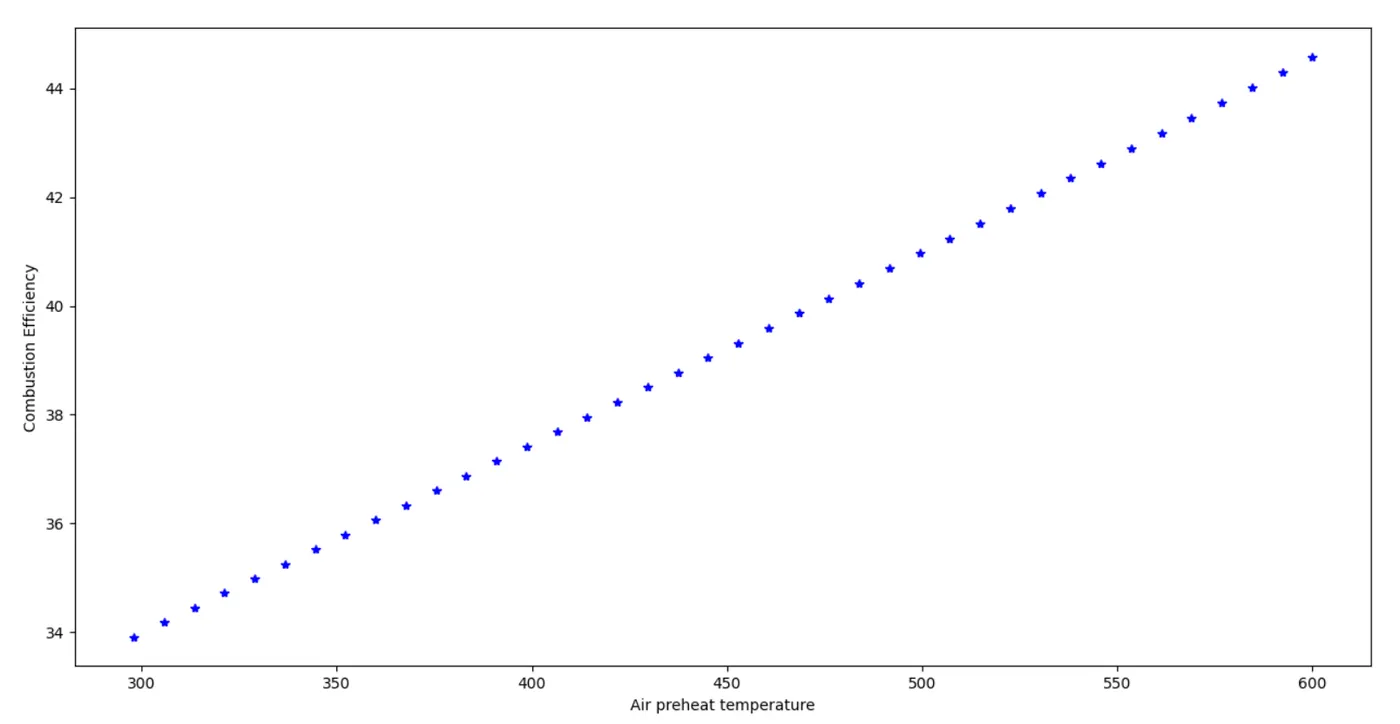
From the above plot, it is observed that the efficiency is increasing with increase in air temperature.
So, for a same quantity of fuel, amount of heat liberated is increasing and this heat can be converted into useful work. That means, by increasing air temperature, more useful work can be obtained for the same quantity of fuel. Therefore, fuel is saved if preheating is done.
Efficiency is a function of amount of heat liberated.
Amount of fuel saved is calculated between air tempearture at 600 K and air temperature at 298 K.
Fuel saved = `(Q_(600) - Q_(298))/Q_(298)`
Amount of heat generated at 600 K that can be converted to useful work is around 31% more compared to heat generated at 298K. So, 31% of fuel can be saved if the air is preheated to 600 K.
It is good to maintain the furnace temperature constant. Lets say we want to preheat the air to 600 K. If maximum amount of heat generated is used for work, energy of the combustion products which are used to preheat the air will be less and could not be possible to heat the air for next cycle. This results in loss of efficiency. But one constraint here is that the air is actually preheated to generate more work.
Also, in a safety perspective, its is good to maintain a constant furnace temperature because if the furnace temperature keeps on varying and at some time if the temperature becomes high, the air gets preheated to a higher temperature and when it mixed with fuel in mixing chamber, fuel might auto ignite. So, the furnace exit temperature must be such that it does not make the fuel auto ignite i.e., it must be ensured that after preheating the air, temperature of the air is less than the fuel's ignition temperature. This can be done by maintaining the furnace temperature at a constant value.
So, an ideal temperature value must be maintained such that it preheates the air in a manner where it generates good amount of work without losing much efficiency and also ensuring that it doesnot auto ignite the fuel.
Google Drive link for codes:
https://drive.google.com/drive/folders/1GOdVsuXoTHApc6nq1SnkumgOjMHyuXVW