Week 4 - CHT Analysis on Exhaust port
Simulation Part:
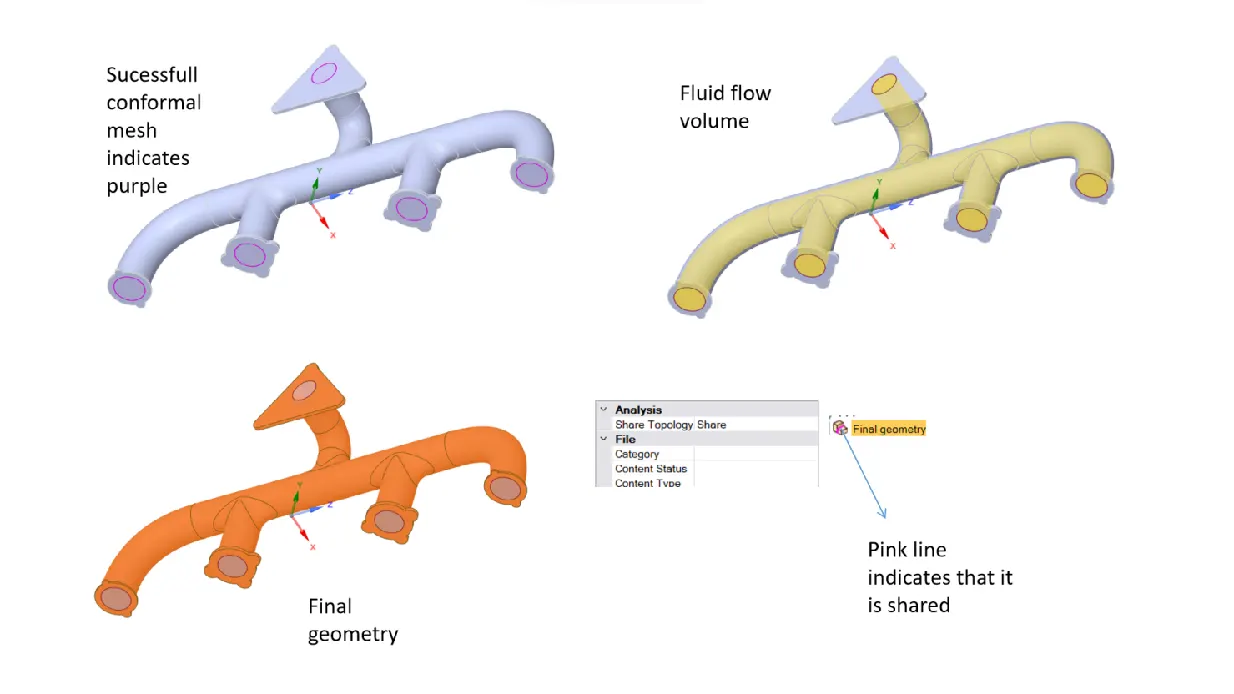
1. Geometry
- Open Spaceclaim and import geometry.
- We are changing Units to our convenience.
- Delete the duplicate entities through extra edges.
- Extract the fluid flow volume alone through volume extraction by edges.
- Check on share topology from the properties outline once the share prep is done.
- Constantly create new components and delete the empty ones to avoid unnecessary errors.
The figure for Geometry:
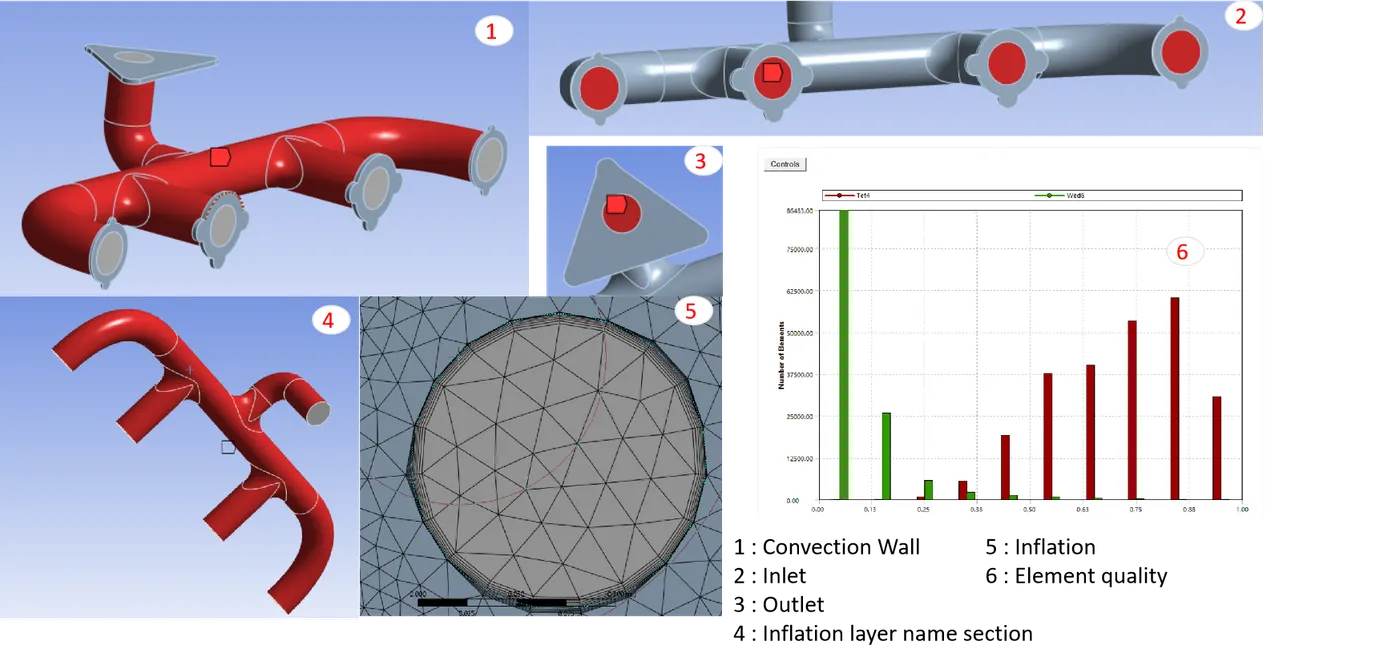
2. Mesh
- The beauty and possible ideas can be obtained from the base mesh.
- Name the sections.
- While naming sections, create a name section for Inflation.
- Hitting F9, the part will be hidden and give an easy section for naming.
- Enable total thickness and choose appropriate layers for refinement.
- Assumptions made here are: Maximum inflation layers 5, sizing for Adiabatic body 10 mm, and essential element size is 0.15 m
- Enable the Sizing for further use of available nodes in the Adiabatic part of the mesh.
- Enable the curvature size and element size.
The figure for Mesh:
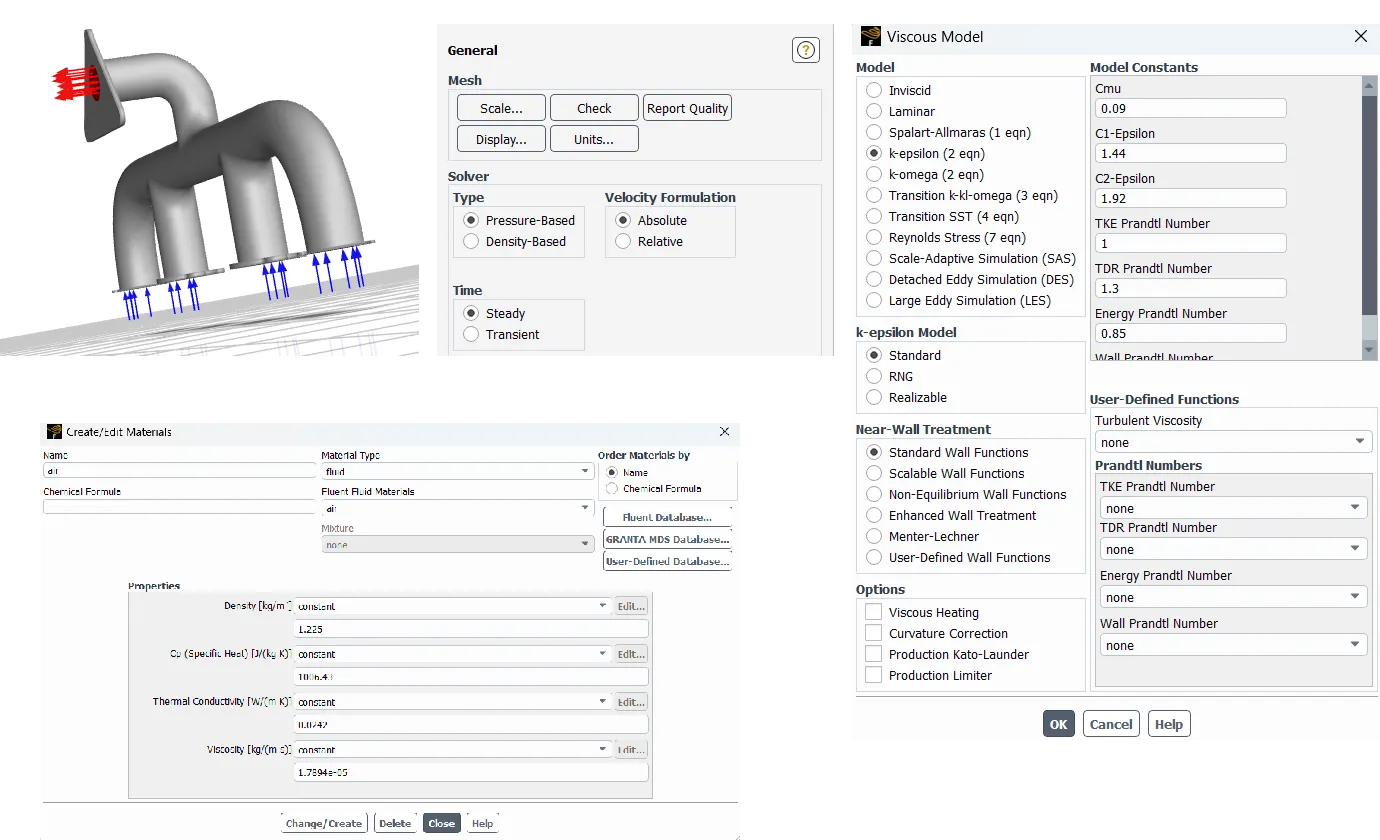
3. Setup and Results:
- Pressure-based, Steady and Energy conditions are enabled.
- K epsilon model is used.
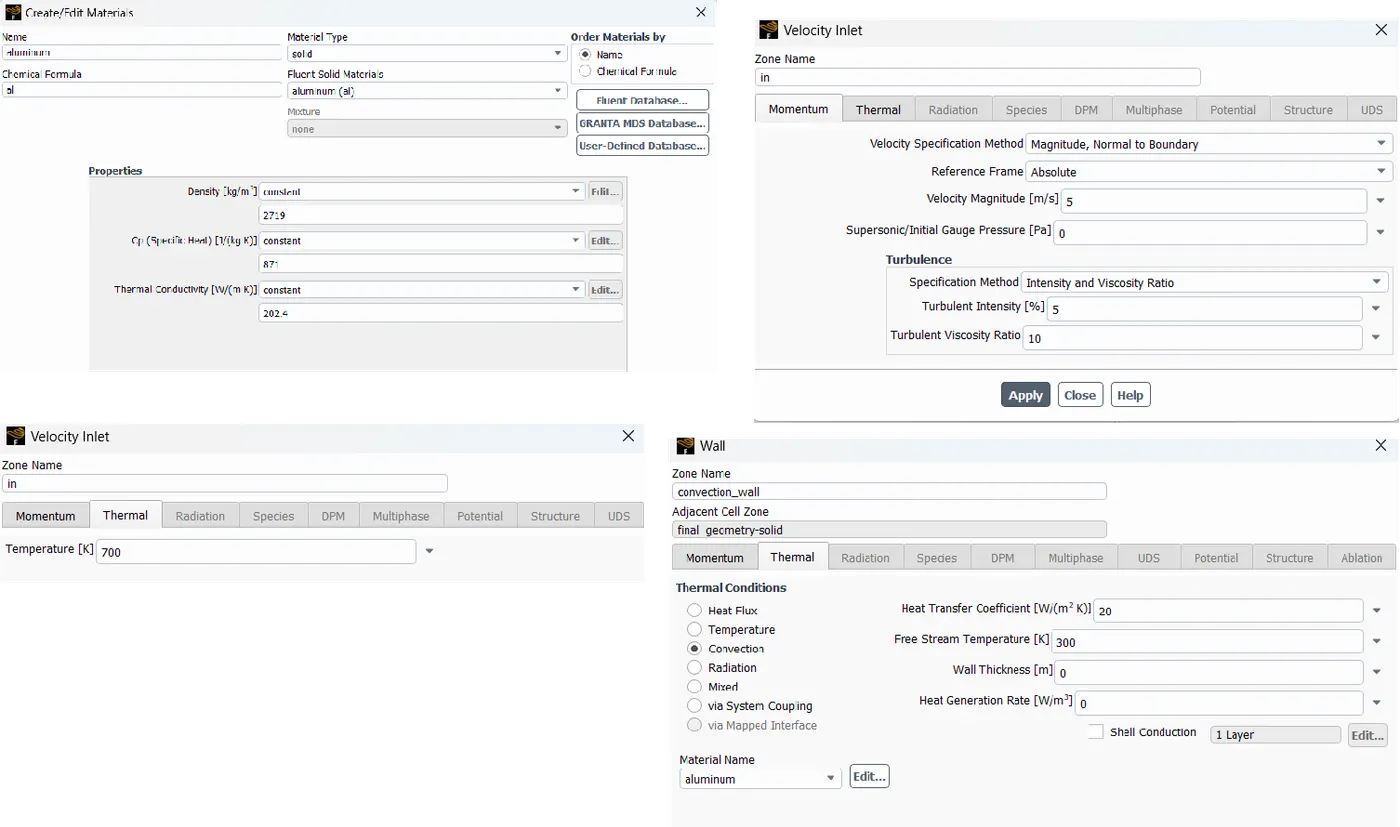
- The fluid is air, and the solid is Aluminium.
- Boundary conditions are inlet at five m/s with a temperature of 700 K.
- Convection Walls have a heat transfer coefficient of 20 W/m^2 K, and the material is Aluminium.
- Heat transfer of Adiabatic walls is Zero.
- Initialise the Solution (Hybrid).
- Enable Contour for temperature and respective animation.
- Run the calculations.
Figures:
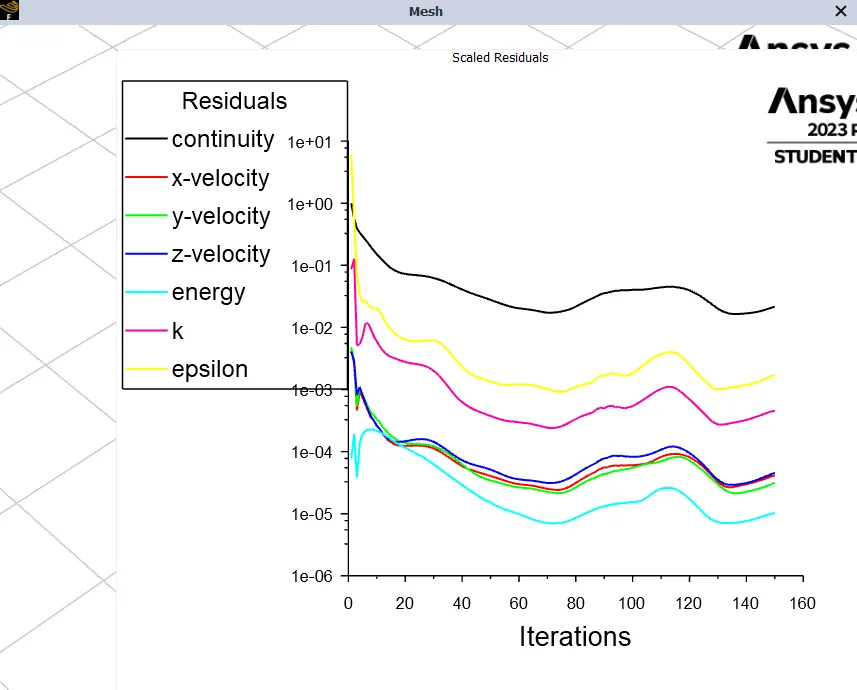
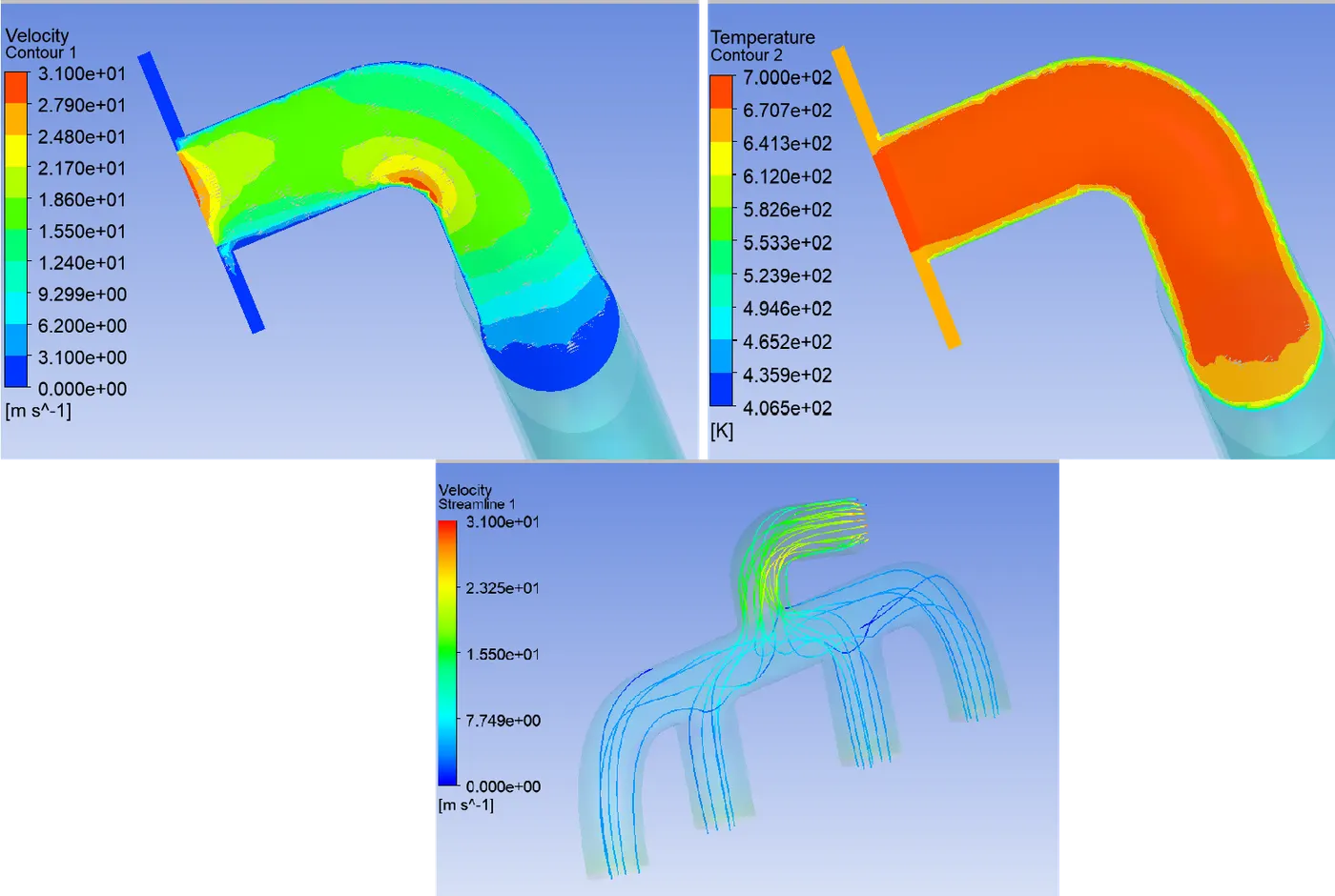
ANIMATION:https://drive.google.com/file/d/13KAZLEKhLB-d78ZXagqaWdIGVn_Mh_Kr/view?usp=sharing
---------------XXXXX---------------
Objective: 1
Give a brief description of why and where a CHT analysis is used.
Answer 1:
Conjugate Heat Transfer
CHT is a short form for Conjugate Heat Transfer. Conjugate heat transfer (CHT) analysis is a computational simulation technique used in engineering and physics to study and analyse the simultaneous heat transfer in solids and fluids that are in thermal contact. This approach is particularly relevant in scenarios with significant interaction between solid structures and surrounding fluids, leading to heat exchange, like exhaust ports and frying pans.
Why Conjugate Heat Transfer Analysis is Used:
-
1. Realistic Modeling:
-
CHT analysis is employed when a more accurate and realistic representation of heat transfer is required.
-
Traditional analyses often simplify the system by considering either solid or fluid heat transfer alone, which may not capture the actual physics in scenarios where both are involved.
-
2. Coupled Phenomena:
-
In many engineering applications, such as electronic cooling, combustion chambers, and industrial processes, solids and fluids are intimately coupled, and heat transfer occurs between them.
-
CHT allows for the simulation of these coupled phenomena.
-
3. Temperature Distribution Prediction:
-
CHT is crucial for predicting temperature distributions in complex systems where there is a need to understand how heat is transferred between different materials and phases.
-
4. Improved Design Optimisation:
-
By considering the interaction between solids and fluids, CHT analysis provides valuable insights into the thermal performance of a system.
-
Engineers can use these insights to optimise designs for enhanced efficiency and reliability.
-
5. Understanding Phase Change:
-
CHT analysis is essential when a phase change occurs, such as boiling or condensation.
-
It helps predict how phase transitions affect heat transfer between the solid and fluid domains.
Usage of Conjugate Heat Transfer Analysis:
-
1. Electronics Cooling:
-
CHT analysis is commonly applied in designing electronic devices and circuit boards to ensure efficient cooling and prevent overheating.
-
2. Automotive Applications:
-
In automotive engineering, CHT is used to study heat transfer in engine components, exhaust systems, and other parts where there is interaction between solids and fluids.
-
3. Aerospace:
-
Aircraft and spacecraft components often involve complex thermal interactions. CHT analysis helps in understanding and optimising heat transfer in these systems.
-
4. Industrial Processes:
-
Various industrial processes, such as metal casting, chemical reactors, and heat exchangers, benefit from CHT analysis to improve thermal performance.
-
5. Energy Systems:
-
CHT is used to analyse energy systems, including nuclear reactors and renewable energy devices, to study heat transfer in different materials and media.
Conjugate heat transfer analysis is critical in understanding and optimising thermal performance in various engineering applications.
---------------XXXXX---------------
Objective: 2
Maintain the y+ value according to the turbulence model and justify the results.
Answer: 2
- The y+ value is a dimensionless wall distance used in computational fluid dynamics (CFD) simulations, particularly in the context of turbulence modelling.
- It represents the distance of the first grid node from the solid wall normalised by the molecular viscosity of the fluid. Maintaining an appropriate y+ value is crucial for accurate and reliable simulation results, especially when employing wall functions or wall-resolved models for turbulence.
- CFD simulations commonly use wall functions to model the near-wall region without resolving the entire boundary layer.
- The y+ value is crucial in this approach because it determines whether the flow is in the viscous sublayer (low y+) or the log-law layer (high y+).
- A y+ value within the range of 30 to 300 is often recommended for standard wall functions. The y+ value, according to the turbulence model, is essential for accurate and reliable CFD simulations.
- The choice of turbulence model, along with the corresponding y+ range, depends on the specific characteristics of the flow and the simulation objectives.
- It is essential to carefully consider these factors to ensure the appropriate representation of the near-wall turbulent behaviour in the simulation results.
---------------XXXXX---------------
Objective: 3
Calculate the wall/surface heat transfer coefficient on the internal solid surface & show the velocity & temperature contours in appropriate areas.
Answer: 3
---------------XXXXX---------------
Objective: 4
How would you verify if the HTC predictions from the simulations are right? On what factors does the accuracy of the prediction depend on?
Answer: 4
Verifying the accuracy of heat transfer predictions from simulations involves comparing the simulation results with experimental data or analytical solutions, if available. Here are some steps and factors to consider in this process:
Verification Steps:
-
Experimental Data:
-
Compare simulation results with actual experimental measurements. This could include temperature measurements at various points, heat flux measurements, or other relevant data.
-
Ensure that the experimental setup closely resembles the conditions simulated.
-
Analytical Solutions:
-
If analytical solutions exist for the simulated heat transfer problem, compare simulation results with these solutions.
-
Analytical solutions can provide a benchmark for validating simulation accuracy.
-
Grid Independence Study:
-
Perform a grid independence study by running simulations with different mesh sizes. The results should converge as the mesh becomes finer, indicating that the solution is not highly dependent on the mesh size.
-
Time Step Sensitivity Analysis:
-
If the simulation involves transient heat transfer, perform a time-step sensitivity analysis. Ensure that the solution converges and remains stable with different time step sizes.
Factors Affecting Accuracy:
-
Modelling Assumptions:
-
The accuracy of heat transfer predictions depends on the assumptions made in the simulation model. Ensure that the chosen model accurately represents the physical system.
-
Material Properties:
-
The accuracy of material properties (thermal conductivity, specific heat, etc.) used in simulations is crucial. Use accurate and up-to-date material property data.
-
Boundary Conditions:
-
An accurate representation of boundary conditions is essential. Ensure that heat flux, temperatures, or other boundary conditions are correctly specified based on the real-world scenario.
-
Geometry and Mesh Quality:
-
The system's geometry and the mesh quality significantly impact the simulation accuracy. Ensure that the mesh is refined enough to capture the critical features of the geometry.
-
Solver Convergence:
-
The convergence of the simulation solver is critical. Monitor convergence criteria to ensure that the solution is numerically stable and consistent.
-
Experimental Validation:
-
Whenever possible, validate simulations with experimental data. Experimental validation is a direct way to assess the accuracy of the simulation predictions.
By carefully considering these verification steps and factors affecting accuracy, you can enhance confidence in the reliability of simulation heat transfer predictions.
---------------XXXXX---------------