Week 4 - CHT Analysis on Exhaust port
CHT analysis-
The Conjugate Heat Transfer (CHT) analysis type allows for the simulation of heat transfer between solid and fluid domains by exchanging thermal energy at the interfaces between them. Typical applications of this analysis type exist as but are not limited to, the simulation of heat exchangers, cooling of electronic equipment, and general-purpose cooling and heating systems.
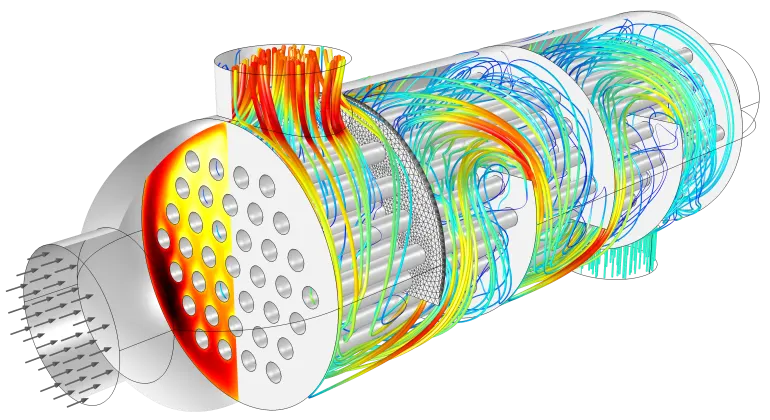
Why CHT analysis-
The CHT approach has an advantage over FE thermal analyses in that wall heat transfer coefficient and their local variations on surfaces are directly calculated within the model rather than based on simplified empirical calculations. The CHT approach, therefore, has benefits for those applications where heat transfer is either non-uniform or difficult to calculate empirically.
Where CHT analysis is used-
The CHT method has become a more powerful tool for modelling and investigating natural phenomena and engineering systems in different areas ranging from aerospace and nuclear reactors to thermal goods treatment and food processing, from complex procedures in medicine to atmosphere/ocean thermal interaction in meteorology, and from relatively simple units to multistage, nonlinear processes.
CASE 1: Default Mesh
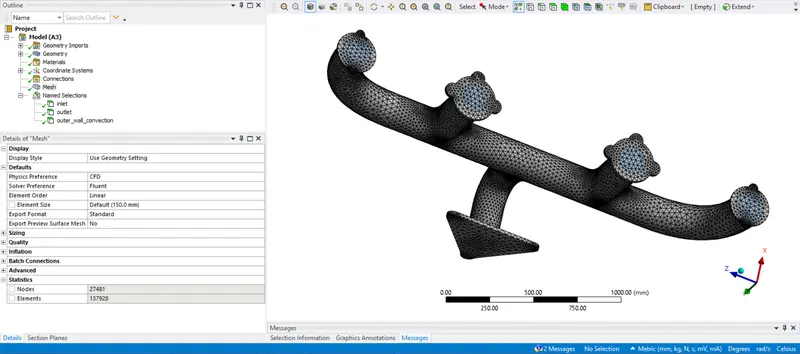
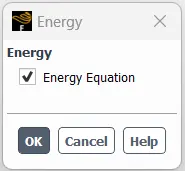
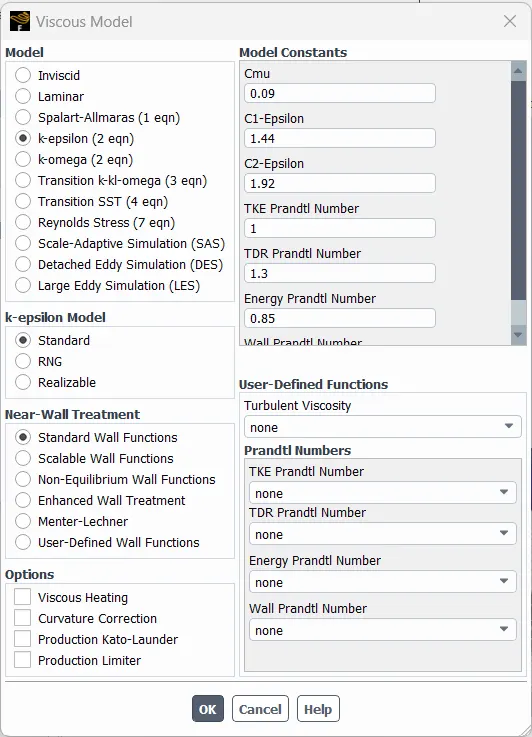
Model & Energy Equation:
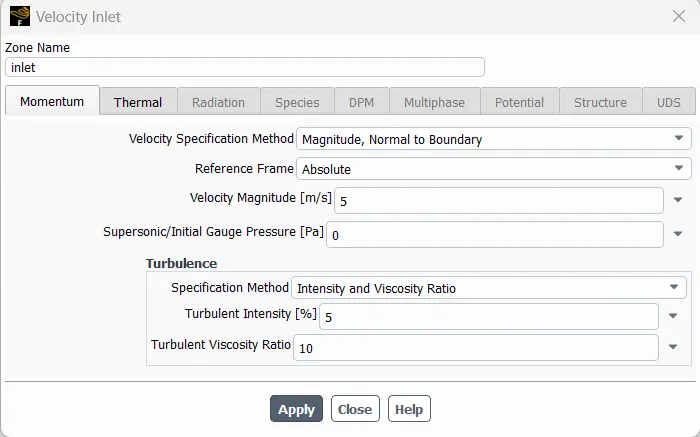
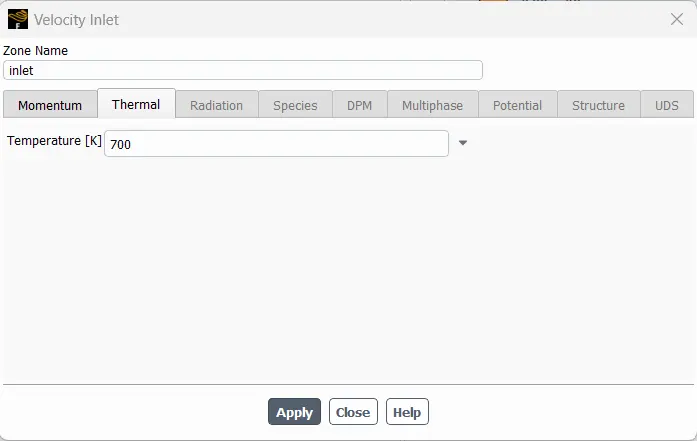
Boundary Condition: Inlet velocity and temperature
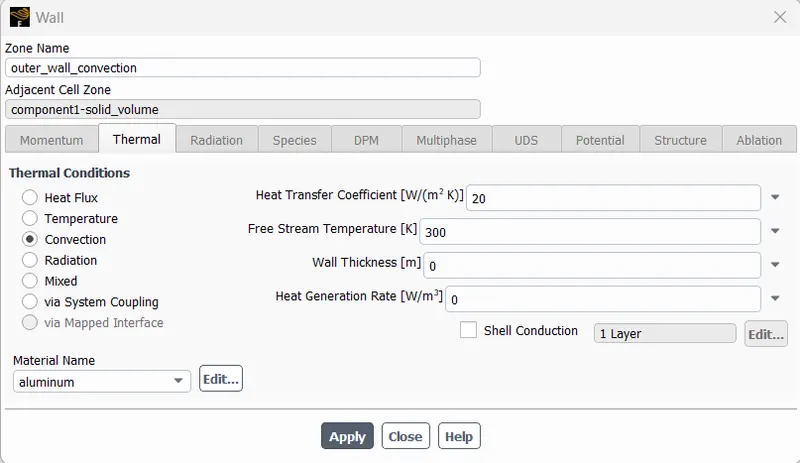
Boundary Condition: Outer Wall Convection
Re = Reynolds number = 56896.2319
μ = dynamic viscosity = 0.000017894 kg/m.s
k = thermal conductivity = 0.0242 W/m.K
D = diameter of the inlet = 0.1662206m
`C_p` = specific heat capacity = 1006.43 J/kg.K
Now, Pr = Pranditll number = `(mu*C_p)/k` = `(1.7894*10^(-5)*1006.43)/0.0242` = 0.744
n = 0.3 as heat transfer takes place from fluid to solid
Dittus Boelter Equation
Nu = Nusselts number = `0.023* (Re)^(4/5)*Pr^n` = `0.023*(56896.2319)^(4/5)*0.744^0.3` = 134.05
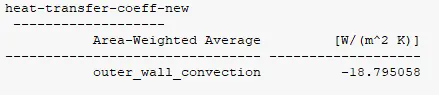
h = convective heat transfer coeff = `(Nu*k)/D` = `(134.05*0.0242)/0.1662206` = 19.516 W/m^2.K
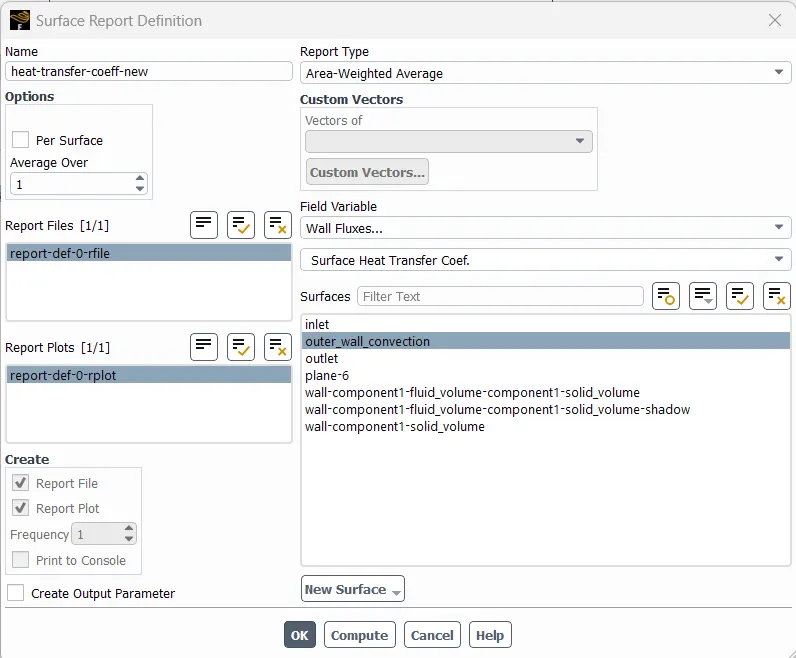
Surface Report: Heat Transfer Coefficient
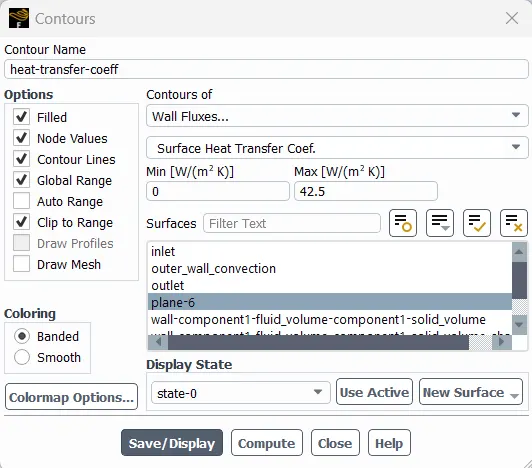
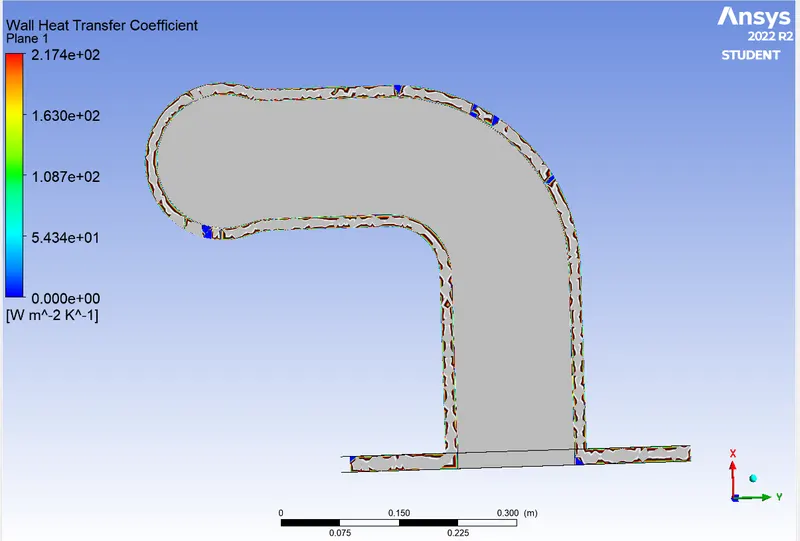
Contours: Heat Transfer Coefficient
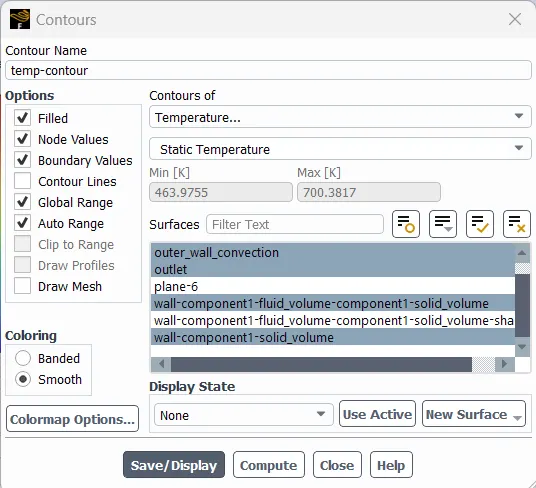
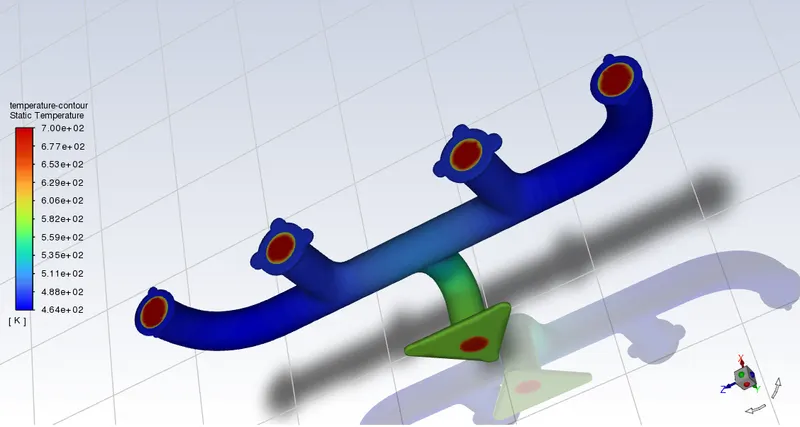
Contours: Temperature
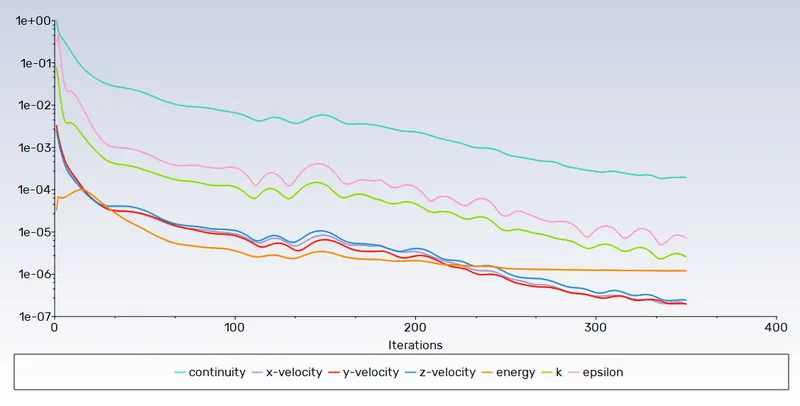
Residual Plot:
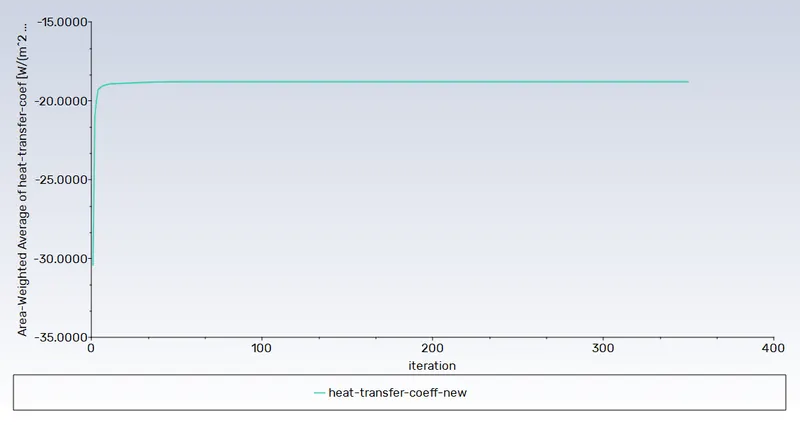
Heat Transfer Coeff Plot:
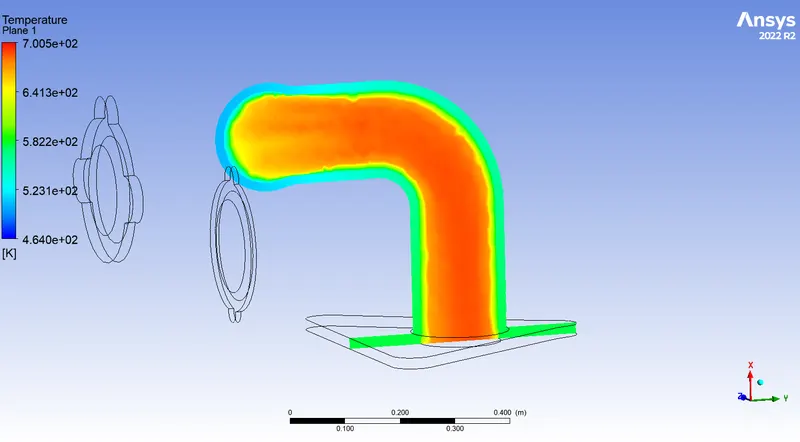
Temperature Contour:
Wall Heat Transfer Coeff:
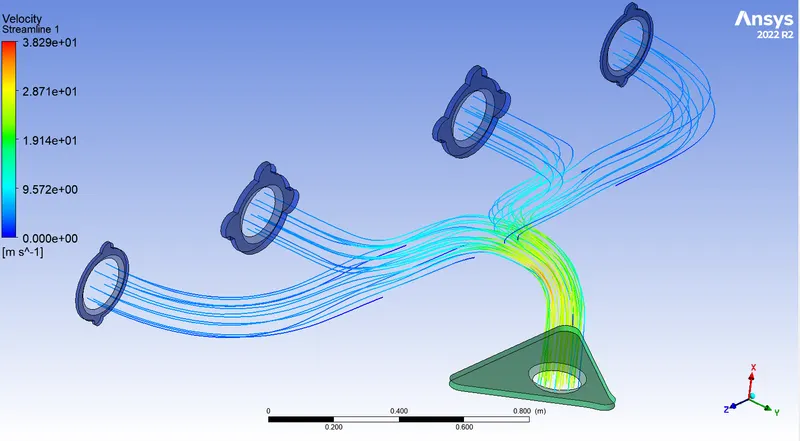
Streamline:
Temperature Contour:
CASE 2: Finer Mesh
y+ value:
The unmeasurable variable Y-plus is a distance with no dimensions and is used to express the distance from the wall to the centre of the first grid cell. In other words, Y-plus makes the vertical distance between the centre of the element and the wall dimensionless; using this value, the proportionality of the height of the grid element to the borders of the wall is assessed. On the other side, Y-plus represents the ratio of laminar to turbulent flow effects in a cell. The flow of the cell is laminar if Y-plus is low. If Y-plus is too tiny, the flow in the cell will be laminar slow, and the wall functions won't work because if Y-plus is too large, the current in that cell will be turbulent.
The calculation for first layer thickness:
U∞ = freestream velocity = 5m/s
ρ = freestream density = 1.225kg/m^3
μ = dynamic viscosity = 0.000017894kg/m.s
L = diameter of the inlet = 0.1662206m
y+ = 1
Reynolds number, Re = `(ρ*U∞*L)/mu` = `(1.225*5*0.1662206)/0.000017894` = 56896.2319
Skin friction coefficient, `C_f` = `0.058/(Re)^(0.2)`` `0.026/56896.2319` = 0.00649249
Wall shear stress, `tau_(wall)` = `(C_f*ρ*U∞^2)/2` = `(0.00544096214*1.225*(5)^2)/2` = 0.099416
Friction velocity, U_friction = `(tau_(wall)/ρ)^(1/2 )` = `(0.099416/1.225)^(1/2)` = 0.284878`
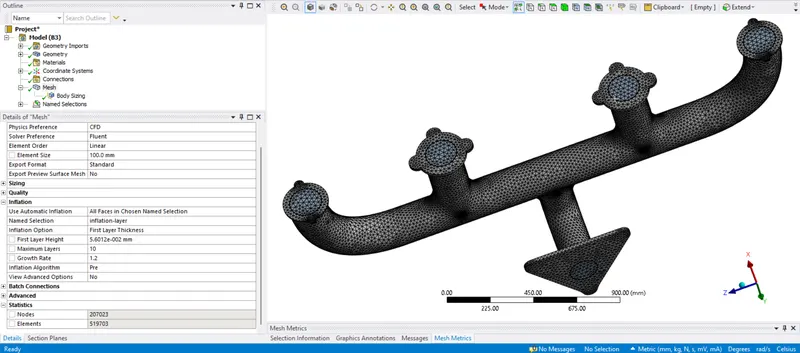
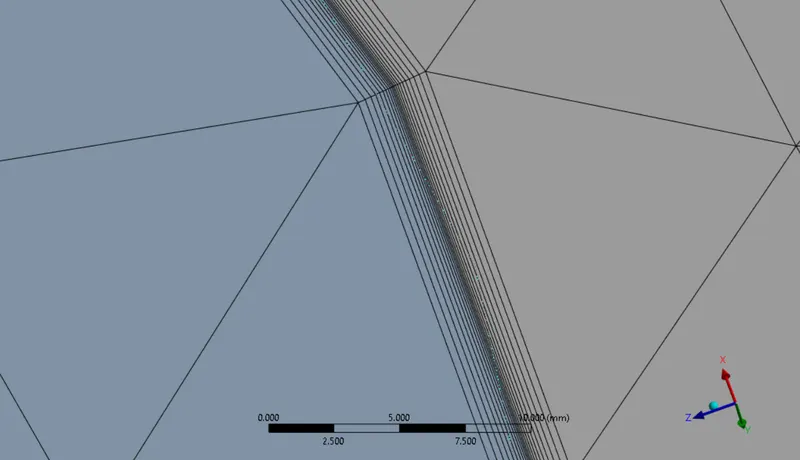
First layer thickness , Δs = `(y+ * μ)/(U_(Friction)*ρ)` = `(1*0.000017894)/(0.2848787*1.225)` = 0.00005127567 m = 0.05127567 m`
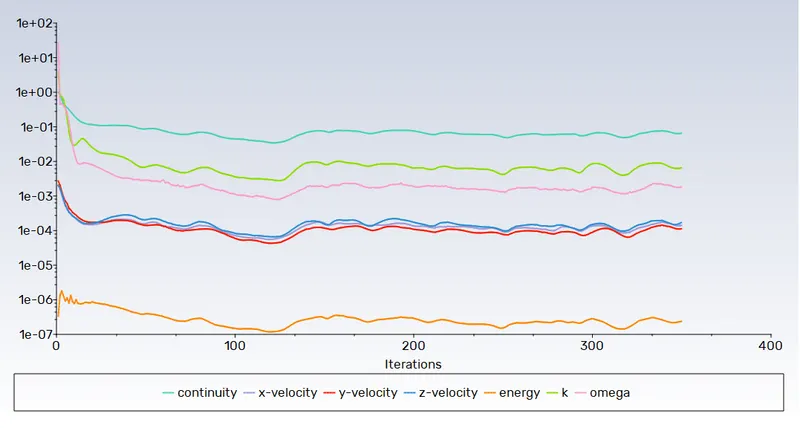
Residual Plot:
Heat Transfer Coeff Plot:
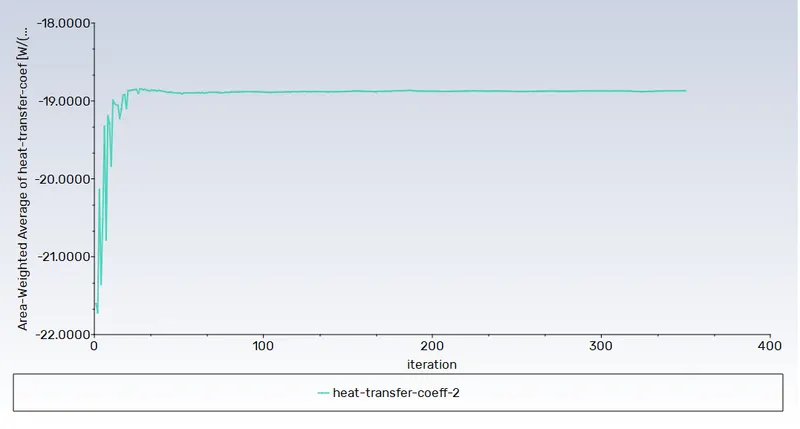
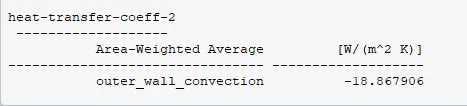
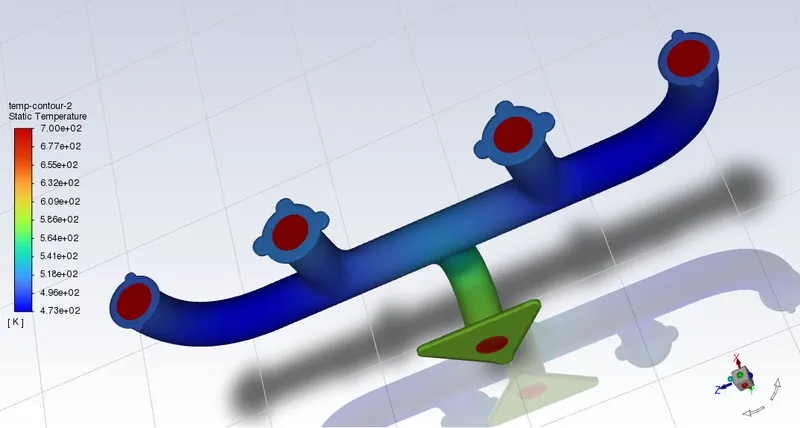
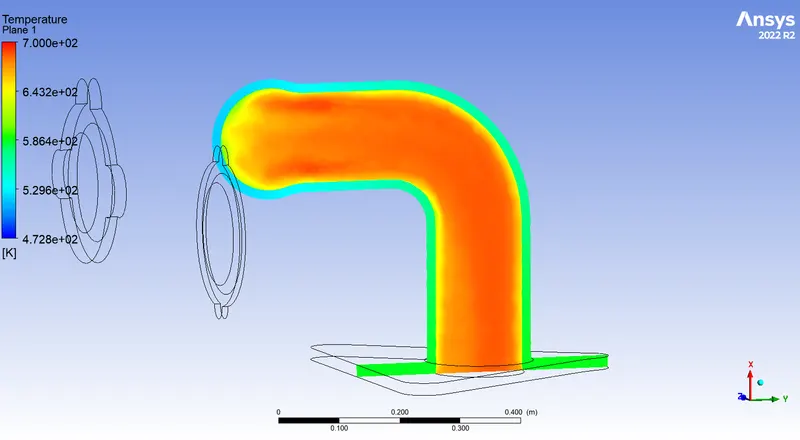
Temperature Contour:
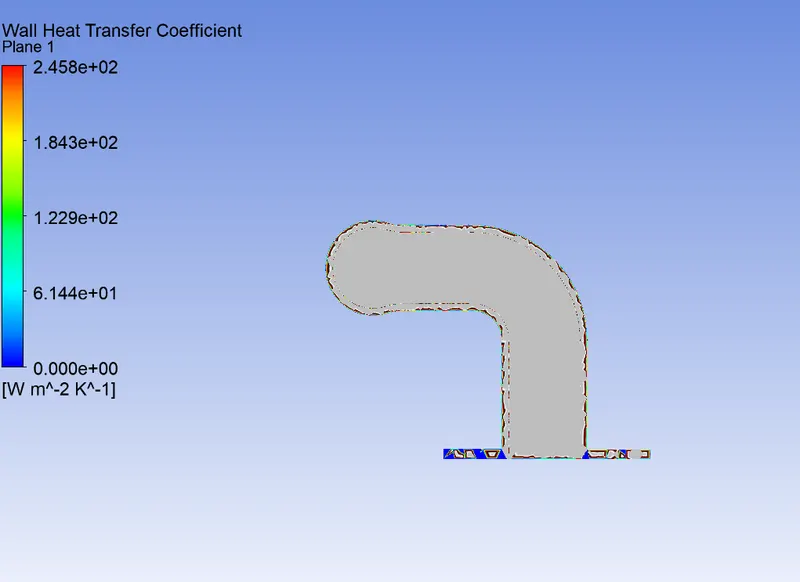
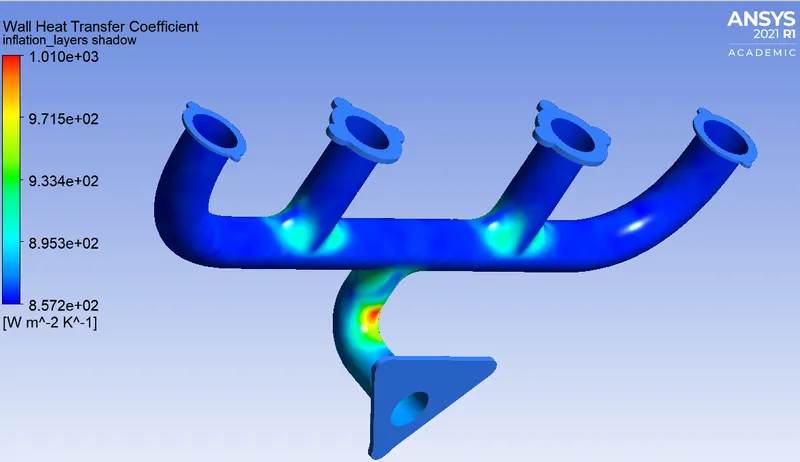
Wall Heat Transfer Coefficient:
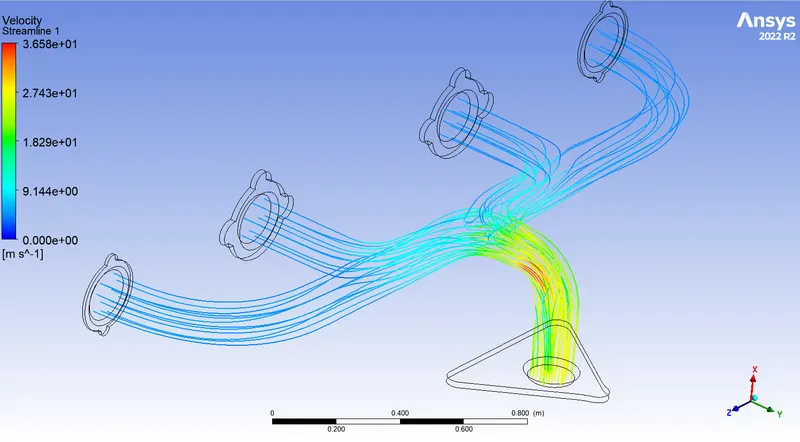
Streamline:
Temperature Contour:
Verifying HTC predictions from the simulation-
As we know, the Nusselt number is the ratio of convective to conductive heat transfer across a boundary.

And,

where,

So, the heat transfer coefficient is directly proportional to the Reynolds number which is again proportional to velocity. So if you increase the velocity then there will be an increase in the convective heat transfer coefficient.
As shown below, we have observed velocities are high at the bend section of the outlet manifold hence a higher Reynolds number which has high Heat transfer coefficients. Therefore predictions from our simulations can be considered correct.
Factors affecting the accuracy of the prediction-
- The purpose of the share topology operation is to ensure that connected bodies have shared faces, which helps facilitate the creation of a conformal mesh.
- It is necessary to select the exact turbulent model according to the desired y+ value.
- Since at the interface it is very important as we want to calculate the heat transfer at that place we need to take that region and create inflation layers so that flow is captured exactly.
- Mesh quality greatly impacts the accuracy of predicted value from our simulations which can be observed by comparing outlet velocity and heat transfer coefficient.
- Appropriate boundary conditions and solvers are one of the most important factors which lead to all the calculations in solving the equations
Conclusions-
- Here we have the analytic value and the computational value of the thermal-specific heat transfer coefficient to be 19.516 W/m^2.K and 18.86 W/m^2.K. The deviation of numerical heat transfer coefficient values from the analytical solution was found to be within 5% to 10% for the second mesh refinement found to be in compliance with the industrial standards.
- The presence of the boundary layer is quite visible near the inlet of the wall where the velocity near the wall is to be close to 0 to be the zero slip boundary condition so the viscous force is dominant near the inlet but near the outlet, the velocity is the highest so giving the highest Reynolds number.
- At the bend, we have a high heat transfer coefficient as there we can see high velocity.