Week 4 - CHT Analysis on Exhaust port
Objective :
In this challenge,
-
We will ,give a brief description of why and where a CHT analysis is used.
-
We wil simulate both fluid flow and also the heat transfer to the solid i.e., CHT Analysis on an Exhaust port
-
Then we will calculate the wall heat transfer coefficient on the internal solid surface & show the velocity & temperature contours in appropriate areas.
- We will verify the HTC predictions from the simulations are right? And mention the factors that the accuracy of the prediction depend on.
Conjugate Heat Transfer (CHT) analysis :
Conjugate Heat Transfer analysis allows for the simulation of heat transfer between solid and fluid domains by exchanging thermal energy at the interfaces between them and transported via conduction within solids and adiditionally via convection within fluid domains.Conjugate heat transfer analysis can accurately predict heat transfer by simultaneous solving all the relevant solid and flow field heat transfer processes.Conjugate heat transfer corresponds with the combination of heat transfer in solids and heat transfer in fluids. In solids, conduction often dominates whereas in fluids, convection usually dominates. Conjugate heat transfer is observed in many situationsfor example: conduction through solids, free and forced convection in the gases/fluids and thermal radiation.
- The three main modes of heat transfer:
‐ Conduction is heat transfer that occurs when a temperature difference exists across a stationary medium.
‐ Convection is the heat transfer between a surface and a moving fluid when there is a temperature difference between the two.
‐ Radiation(thermal radiation) is the emission of energy in the form of electromagnetic waves. In the absence of an intervening medium ,there is net heat transfer by radiation between two surfaces at different temperatures.
Conduction :
- Conduction is thermal energy transmission through solid or fluid by the action of translational, rotational and vibrational motion of atoms and molecules.
- Molecular collisions transfer energy from more energetic molecules to less energetic ones. Higher temperature = Increased atomic/molecular motion
- Conduction occurs in all fluid and solid media.
- Due to the Second Law of thermodynamics, heat must always be conducted from higher to lower temperatures.
- Conduction problems often involve fluid flows at the boundaries of the solid, which serve as a mechanism for heating or cooling the solid.
- Conduction is the transfer of energy from more energetic to the less energetic particles of a substance via interactions between the particles at molecular levels due to a temperature difference.
- Temperature at any point can be associated with the energy of random translational, internal rotational and vibrational motions of gas molecules.
- Molecular collisions transfer energy from more energetic molecules to less energetic ones .
- Higher molecular energies are associated with higher temperatures, and the energy transfer always occurs in the direction of decreasing temperature in the presence of a temperature gradient.
- The mechanism of conduction is the same for liquids as the molecules are closely spaced and the molecular interactions are stronger and more frequent than gases.
- In the case of solids, conduction is associated with atomic activity in the form of lattice vibrations. In the case of an electrical conductor, the translational motion of free electrons also contributes to energy transfer.
- The heat transfer process can be quantified in terms of appropriate rate equations which are used to compute the amount of energy being transferred per unit time.
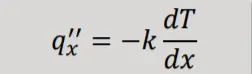
- In the case of heat conduction, the rate equation is Fourier’s law. For a one-dimensional plane wall
this is expressed as
- Here,
‐ 𝑞_𝑥^′′(𝑊/𝑚^2) is the heat transfer rate per unit area(heat flux) in the x-direction.
‐ 𝑘 is the thermal conductivity (𝑊/𝑚𝐾) and is a characteristic of the wall material.
‐ The negative sign signifies the fact that the heat transfer is in the opposite direction of the temperature gradient
Convection :
- Convection is transfer of heat by the combination of the bulk motion of a fluid and random molecular motion (diffusion).
- Heat is transferred to/from the fluid via conduction at walls.
- Fluid carries thermal energy to other parts of the system.
- Heat transfer only due to the bulk motion of the fluid (no diffusion) is referred to as advection.
- Convection heat transfer can be classified into:
- Forced convection: Flow is caused by external means, such as by a fan, a pump or atmospheric winds.
- Free (or natural) convection: Flow is induced by buoyancy forces, caused by density differences due to the temperature variations in the fluid.
- Mixed (combined) connection: Forced and natural convection can also exist if both external driving forces and buoyancy forces exist.
- Heat transfer by convection is rooted in the idea that the heat transfer rate is proportional to the temperature difference between a fluid and a heated/cooled body.
- This idea is called Newton’s Law of Cooling. The parameter governing the rate of heat transfer is the heat transfer coefficient, usually denoted ℎ.

Here, 𝑞′′ = Convective heat flux
𝑇𝑠= Temperature of the solid surface
𝑇∞= Temperature of the fluid
- One of the central problems in convection is determining the heat transfer coefficient for a given flow field.
- The heat transfer coefficient depends on the conditions in the boundary layer, and it is affected by the surface geometry, the nature of the fluid flow and various fluid thermodynamic and transport properties.
Radiation Heat Transfer :
- Thermal radiation heat transfer is the emission of energy via electromagnetic waves.
- All matter at a nonzero temperature emits thermal radiation.
- This emission is due to changes in the electron configurations of the atoms or molecules, and the energy is transported via electromagnetic waves (or photons).
- Radiation intensity depends on body temperature and surface characteristics.
- Unlike conduction or convection, radiation does not require the presence of a material medium and can occur in a vacuum.
- Radiation is an important mode of heat transfer at high temperatures.
- It is also the only mode of heat transfer in outer space, and this is how the solar energy reaches Earth.
Heat transfer in solids and heat transfer in fluids are combined in the majority of applications. This is because fluids flow around solids or between solid walls, and because solids are usually immersed in a fluid. An accurate description of heat transfer modes, material properties, flow regimes, and geometrical configurations enables the analysis of temperature fields and heat transfer. Such a description is also the starting point for a numerical simulation that can be used to predict conjugate heat transfer effects or to test different configurations in order, for example, to improve thermal performances of a given application.
CASE SETUP
Geometry creation
- Import cad design in SpaceClaim.
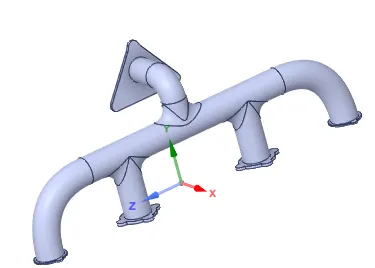
- Extract volume

- extracted volume.
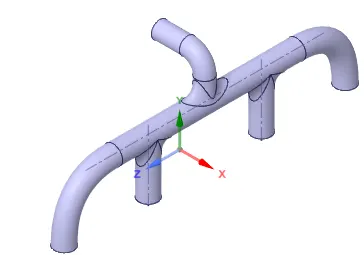
- extracted volume.
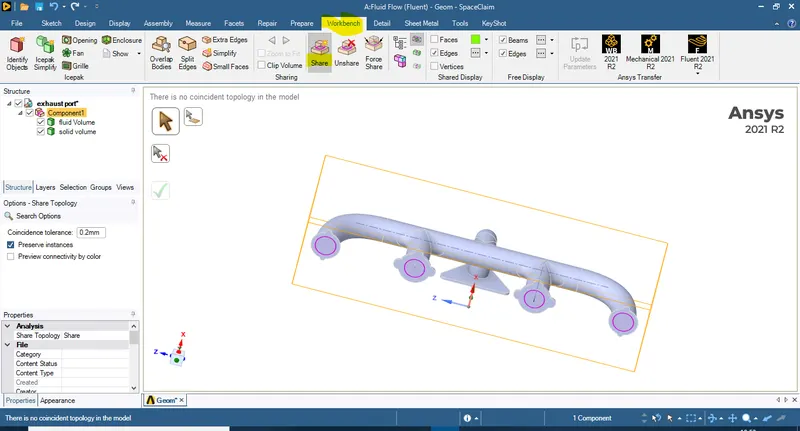
- Share topology to make sure that generated mesh is conformal mesh.
CASE 1
Meshing
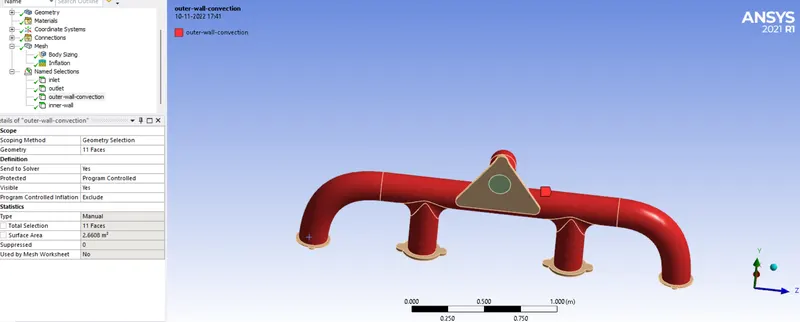
Before meshing, the Named selection. It is important to give convective boundary as the name for outer wall because if we didn't done it, we have to do air meshing outside
The meshing is done as shown below
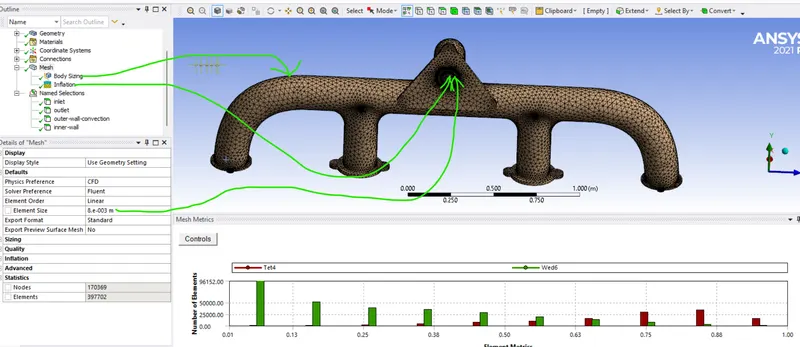
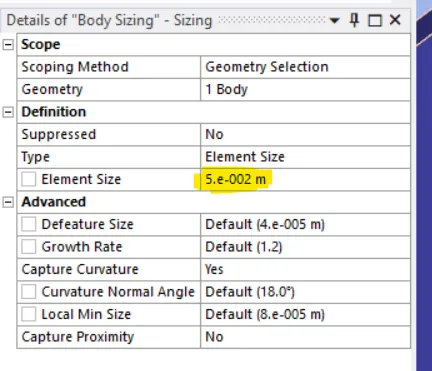
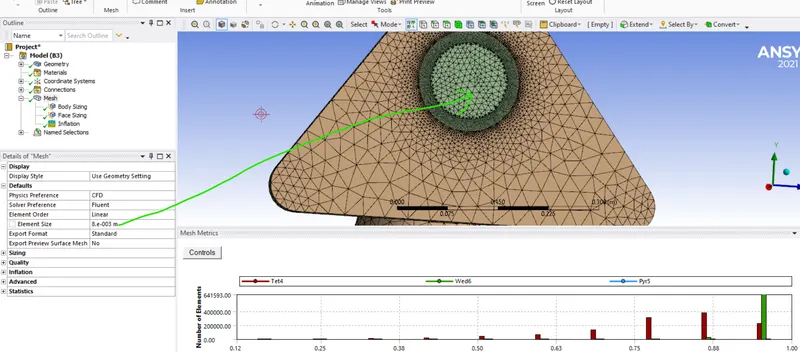
The mesh sizing of 0.008 m is given to fluid volume. The inflation layer is also given to fluid volume.
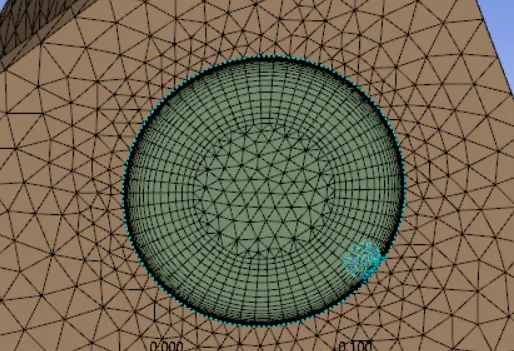
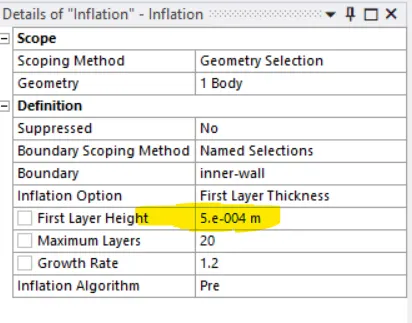
The body sizing is given to outer solid volume
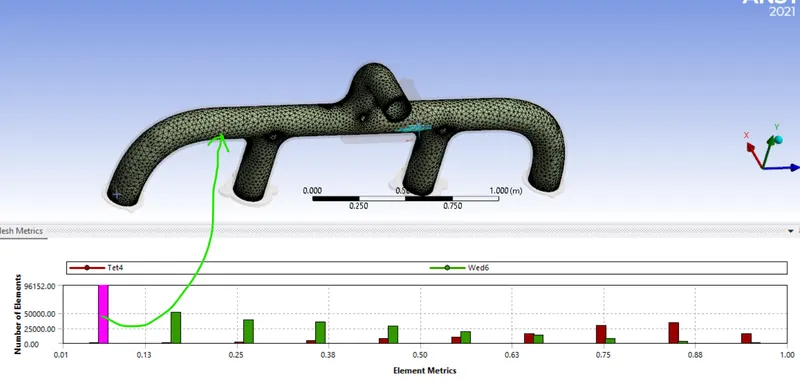
Here, the element quality is low at the wall of the fluid volume. This indicates that we cannot guarantee the solution accuracy of convective heat transfer coefficient.

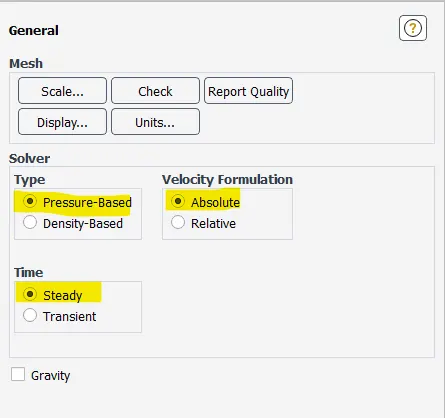
Ansys setup
- Physics setting.
- Solver type : Pressure Based.
- Velocity formulation : absolute
- Time : steady state
Turbulence model is K-Epsilon with standard wall function

- Material selection.
- fluid: Air
- Solid: Aluminum
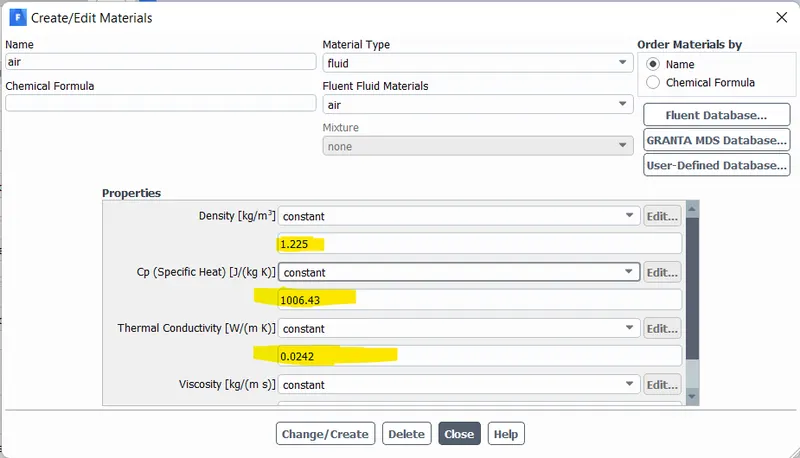
As we are not changing the density,Cp,Thermal Conductivity as per kinetic theory, we are doing this only for demo purpose. Actually all these parameters are temperature dependent
- Change boundary conditions.
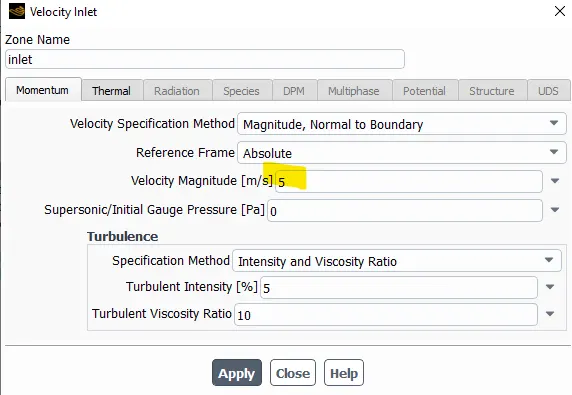
- Inlet
- Velocity: 5m/sec.
- Temperature: 700K.
- Outer wall convection
- Heat transfer coefficient: `20W/(m^2.K)`
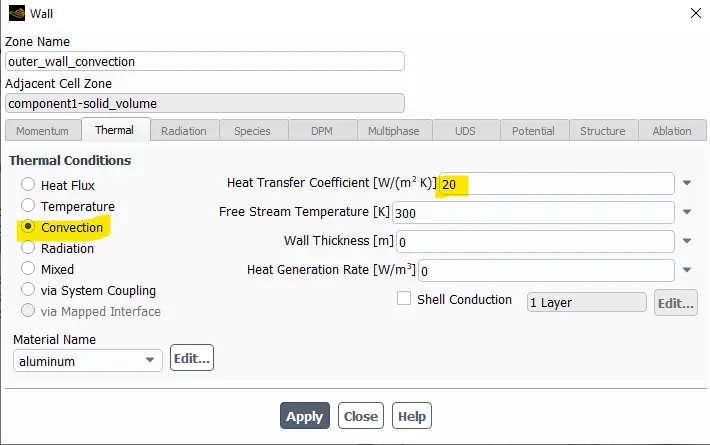
- Heat transfer coefficient: `20W/(m^2.K)`
- Inlet
Theory behind assuming heat transfer coefficient=20 W/m2K is given below
Assume that the air is moving with small free stream velocity of approx = 4.63x10^(-4) m/sec. Then take d=0.15 m, which is the pipe dia as characteristics length. Then find Reynold's number = 472.
Prandtl number for air = 0.7.
Use Nu = 0.023 X Re^(0.805) X Pr^(0.3), to find Nusselt number.
Also Nu = h_ext X L / k_air;
k_air = 0.0242,
L=d=0.15 m characteristics length
Use these 2 equation for Nusselt number and then we get the value for h=20 W/m2K
Do the simulation and find the average heat transfer coefficient on the inner wall of solid. Basically we are getting the solution in a wrong manner, because we didn't considered other parameters while doing simulation.
The importance of cup mixing temperature is to be considered for simulation. We have to develop an appropriate function for cup mixing temperature and velocity along the length of the exhaust port and then put that function in the reference values of temperature. This is a variable flux heat problem along the exhaust port.
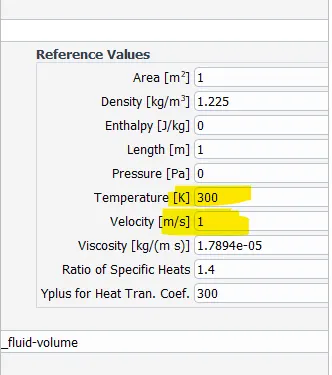
Here, I put the reference values of temperature as 670 K as I obtained the values of average surface heat transfer coefficient as 49.500306 W/m2K.
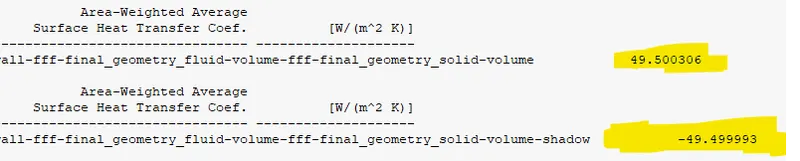
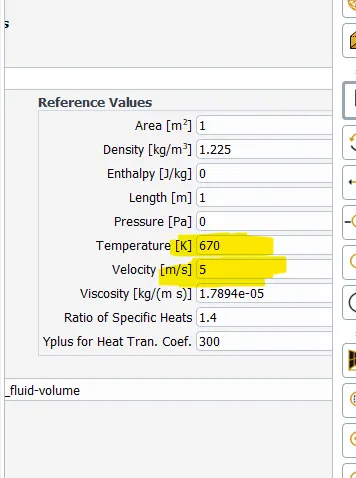
The average of surface nuselt number is shown below

As, we are not writing the function of temperature and velocity for varying flux, we cannot say that our results are accurate. If we use the equation for Nusselt number
Nu = 0.023 x Re^0.805 x Pr^n, it is applicable only for a particular cross section of the pipe.
Basically heat transfer coefficient means the value of h in Newton's law of cooling. It is measured from wall to first cell height only. As, we cannot use low value for y+, we should develop a function for mixing cup temperature and put it in the reference value.
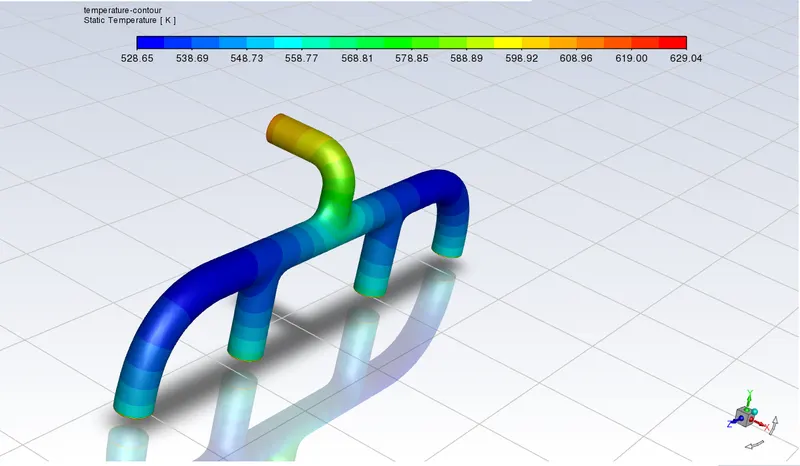
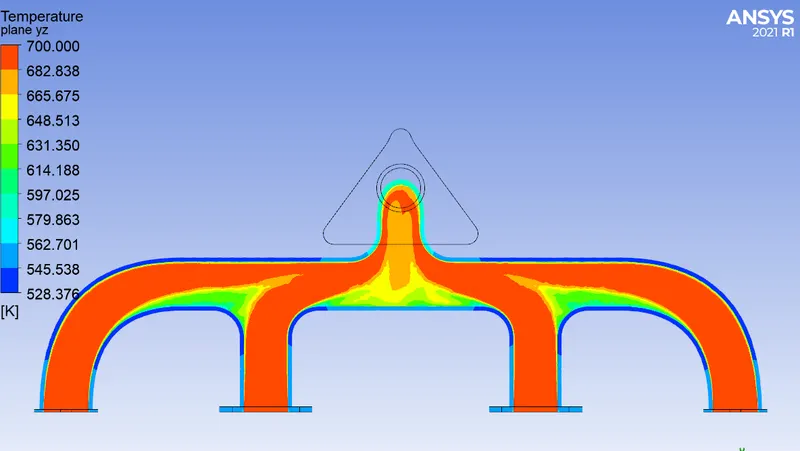
The temperature contour on the inner wall of pipe is shown below
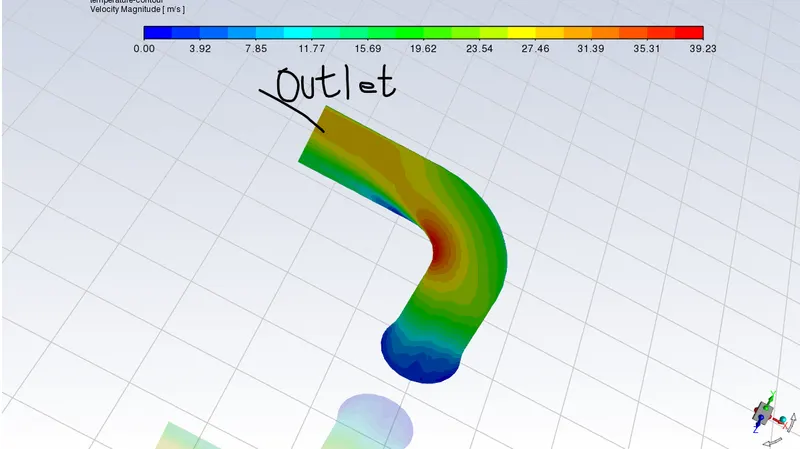
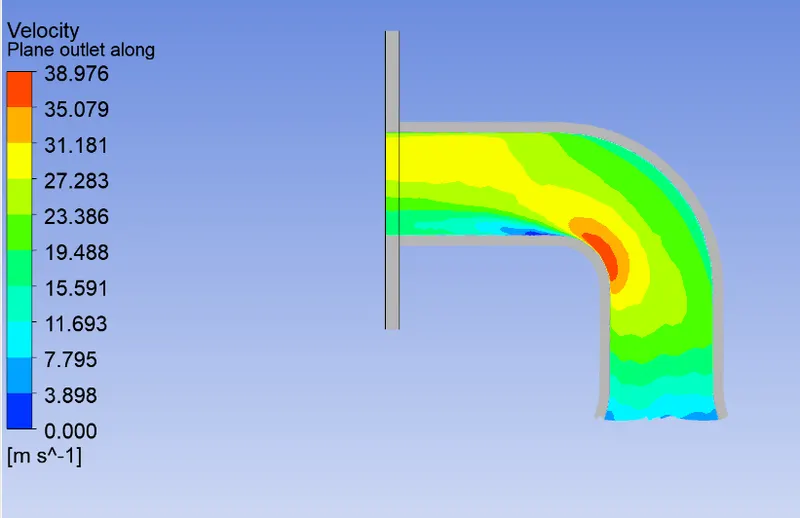
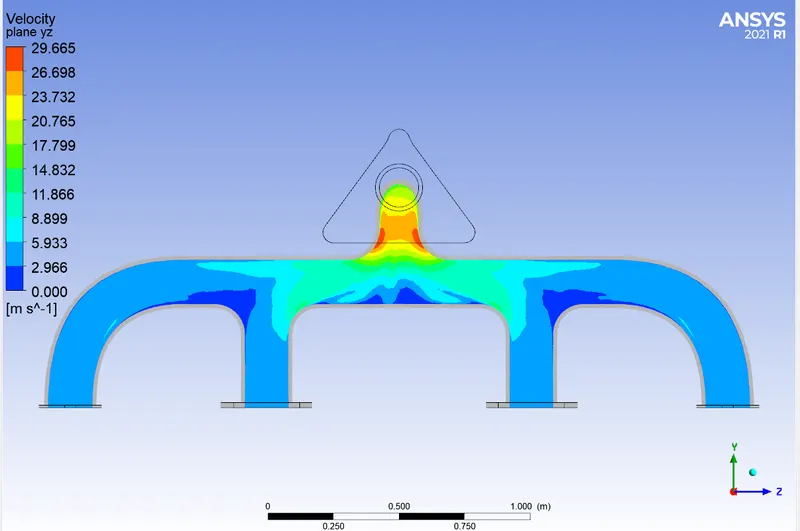
The velocity contour for the plane along the outlet is shown below
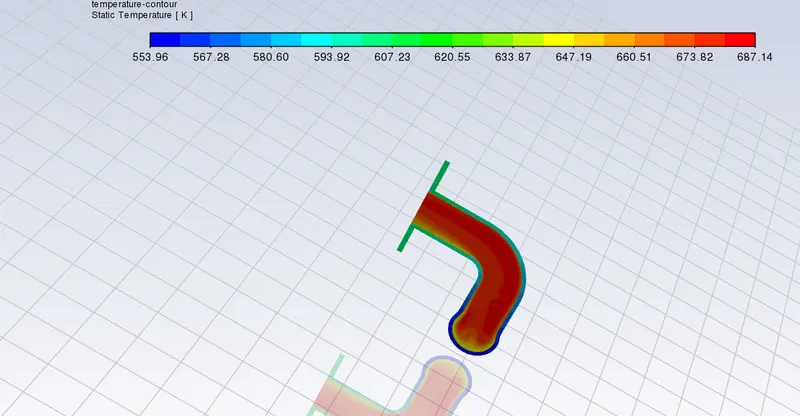
The temperature contour for the plane along the outlet is shown below
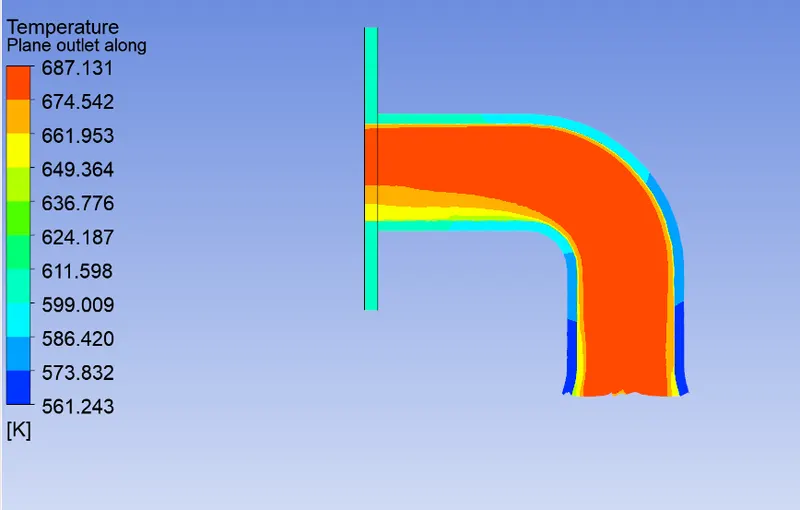
Temperature profile along the cut section of inlet and the pipe
Velocity profile along the cut section of inlet and the pipe
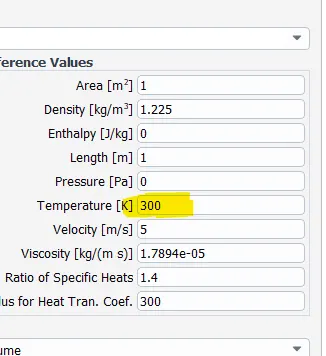
When I used the reference value of 300 K, I get surface heat transfer coefficient = 22.659405 W/m2K.
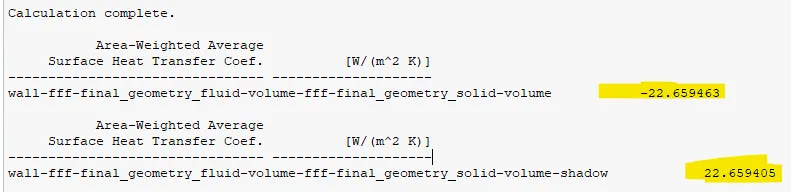
The Average of Surface Nusselt number = 936.34143.

This means that the reference value have high impact on the final result.
Q)Maintain the y+ value according to the turbulence model and justify the results
Answer
As we are using wall functions to calculate the surface heat transfer coefficient, we should write a function for reference temperature and velocity. then only, our result becomes correct.
If we use y+=1, our mesh size is very fine of the order of 10^-5 m, but if we refine our mesh in smaller order, the proper study of quality of mesh to be done. The mesh quality should be maintained at maximum. In this case, the fluent does not evualuate the wall function. Fluent give result based on small refined mesh size.
CASE 2
Mesh
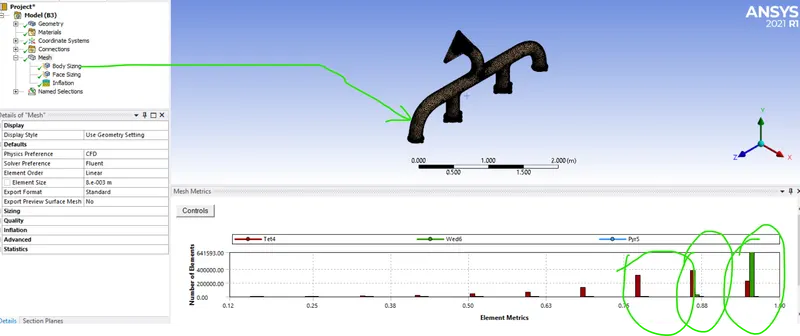
Here, the mesh quality is good.
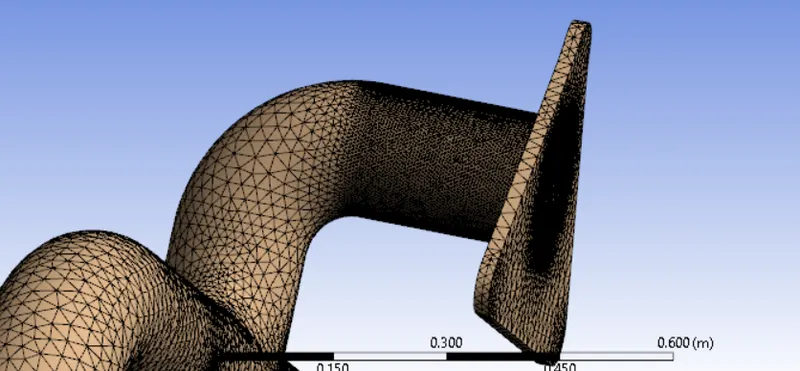
The mesh size is shown below
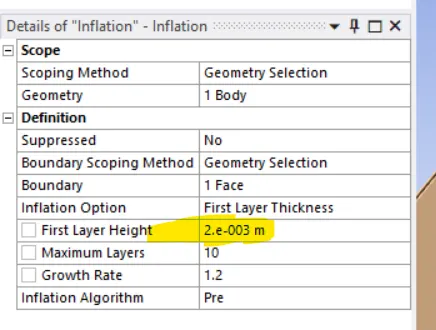
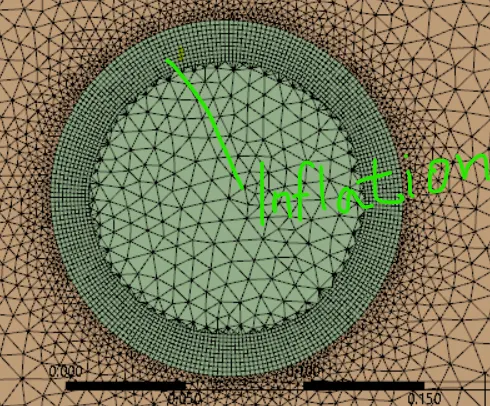
Inflation is shown below
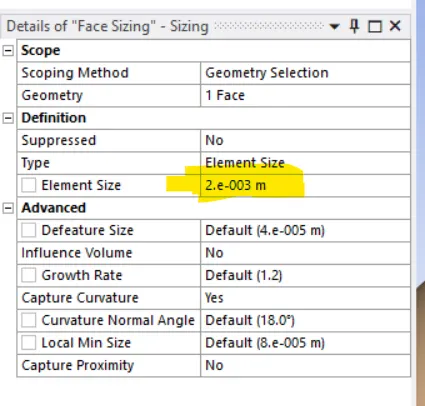
Face sizing is done only for outlet
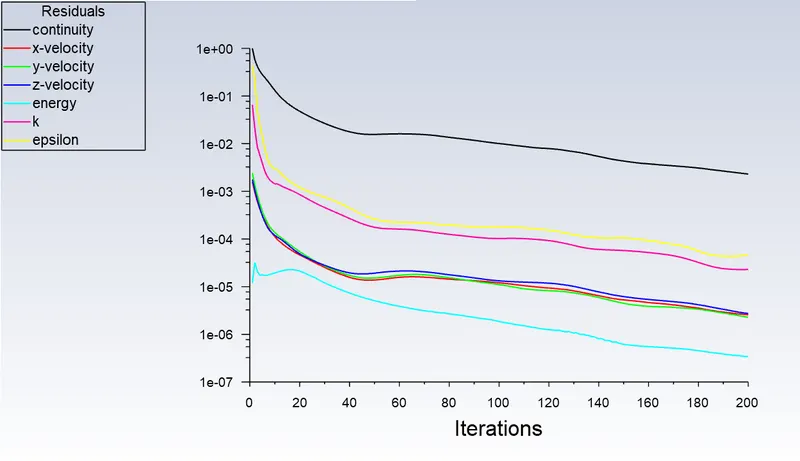
RESIDUAL PLOT
RESULTS
The surface heat transfer coefficient value = 26.598279 W/m2K.
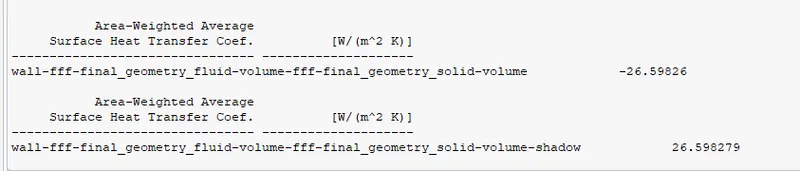
The reference values are shown below
The average of surface nusselt number = 1099.1017

How would you verify if the HTC predictions from the simulations are right? On what factors does the accuracy of the prediction depend on?
As we are not using any proper method, we cannot verify our result with the standard formula for the Nusselt number to check the value of convection heat transfer coefficient. The function for mixing cup temperature and velocity to be developed along the length if the pipe. These functions to be put in the reference values of temperature and velocity. If we obtain mesh with high quality with low y+ values, we don't need to find a function for mixing cup temperature and velocity.
Nu = 0.023 x Re^0.805 x Pr^n;
Nu = h X D/k;
Re= Reynold's number
Pr= Prandtl number
n=0.3 for cooling
n=0.4 for heating
D = characteristic length = diameter of the pipe
k = thermal conductivity of fluid
h = convective heat transfer coefficient.
If we use a proper method, we can easily check the value of h from these 2 equations of Nusselt number