Week 4 - CHT Analysis on Exhaust port
Aim :
To perform CHT analysis on exhaust port for a velocity of 5m/s.
Objectives:
- Give a brief description of why and where a CHT analysis is used.
- Maintain the y+ value according to the turbulence model and justify the results.
- Calculate the wall/surface heat transfer coefficient on the internal solid surface & show the velocity & temperature contours in appropriate areas.
- How would you verify if the HTC predictions from the simulations are right? On what factors does the accuracy of the prediction depend on?
Introduction:
CHT analysis:
Conjugate heat transfer is a type of heat transfer analysis between solids and fluid(s). This type of heat transfer includes both convection (between fluids) and conductive (between solids) heat transfer, as well as both forced and natural convection. Common applications and use cases of this thermal simulation type include electronics cooling, heat exchangers, industrial machinery, some AEC cases, and more. In order to demonstrate best practices for this application type, an electronics cooling application will be used as an example.
Types of heat transfer:
-
Conduction is the transfer of energy from one molecule to another by direct contact. This transfer occurs when molecules hit against each other, similar to a game of pool where one moving ball strikes another, causing the second to move. Conduction takes place in solids, liquids, and gases, but works best in materials that have simple molecules that are located close to each other. For example, metal is a better conductor than wood or plastic.
-
Convection is the movement of heat by a fluid such as water or air. The fluid (liquid or gas) moves from one location to another, transferring heat along with it. This movement of a mass of heated water or air is called a current.
-
Radiation is the transfer of heat by electromagnetic waves. When you stand in the sun, you are warmed by the electromagnetic waves, mainly infrared radiation (and to a lesser extent, visible light), that travels from the sun to Earth. In addition to the sun, light bulbs, irons, and toasters also transfer heat via radiation. Note that, unlike conduction or convection, heat transfer by radiation does not need any matter to help with the transfer.
Geometry:
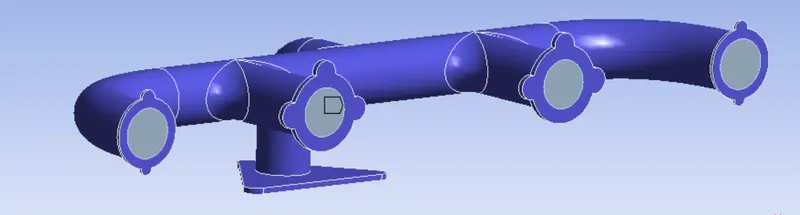
Import the geometry in the ansys spaceclaim geometry. And check for any extra edges and delete them if any exists using the extra edges command .
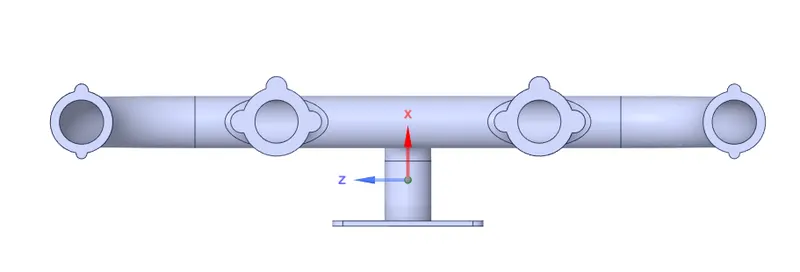
Now use the volume extract to extract the fluid volume. And combine the solid and fluid volume to a new component and delete empty commands.
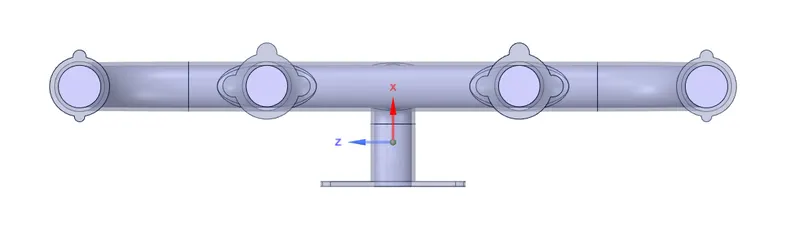
Combined solid and fluid volume.We do this to make the mesh components of the solid and fluid volume to align perfectly or there would be a deviation from the concurrence of the mesh.
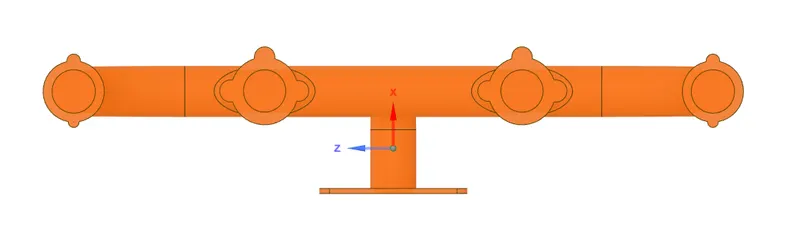
Now use the share topology option to share the topology of the fluid and solid volume in the geometry properties and share option from the workbench.


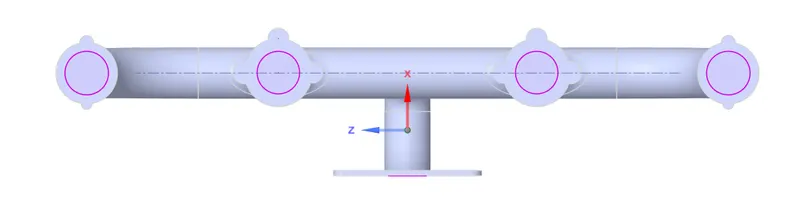
Mesh setup:
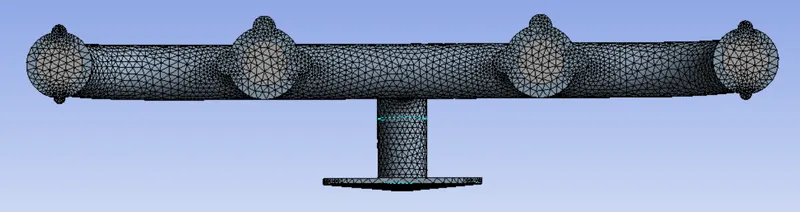
Create a baseline mesh.Craeate named selection.

Inflation:
We use inflation to create a body fitted mesh and it is important to have the mesh near the inlet and outlet to be finer and smaller to get accurate results.We select the fluid volume by creating the named selection inflation layer.
We use first layer thickness as we use k - omega SST viscous model ,so the desired Y+ =1.For k- omega SSt model the Y+ ranges 0.1 to 10.But here the desired Y+ value is 1.
To find the first layer thickness,we calculate
free stream velocity u =5m/s
density `rho`=1.225 kg/m^3
kinematic viscosity `mu`=1.7894810^-5 kg/ms
L= dia of inlet =0.1662206m
Y+=1
Re=`(rho*u*L)/mu`=(1.225 *5*0.1662206)/1.7894*10^-5
`C_f=0.026/(Re)^(1/7)`=0.00544096214
`Wall shear stress = (C_f*rho*u^2)/2`=0.08331473
`U_(Fricition)=((wall shear stress)/rho)^0.5`=0.26079115
First layer thickness `Deltas=(Y+*u)/(U_(Friction)*rho`=0.056011665mm

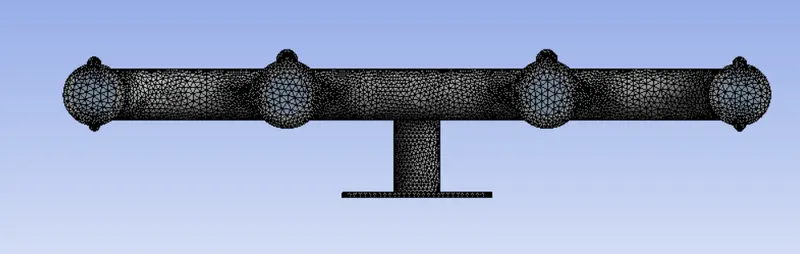
Create a body sizing mesh and select and element size as 10 mm
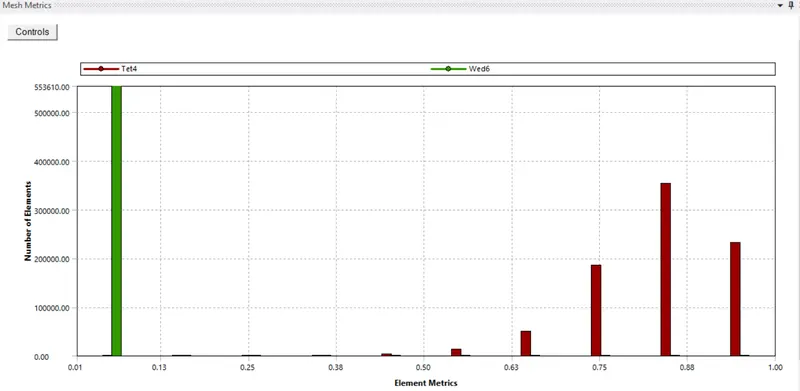
Element quality from quality of the mesh metrics:
Solver setup:
We use a steady state pressure based solver and we solve for the energy equation.
The viscous model is set to k -omega SST model
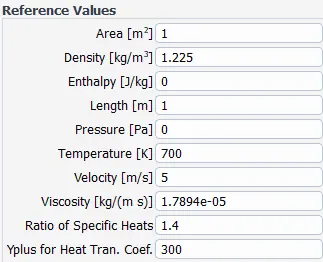
Set the initial and boundary conditions,The inlet velocity and temperature is set to 5 m/s and 700K respectively.
We use air as the fluid an aluminium as the solid.
The outlet pressure is 0 Pa
The outer wall convection - heat transfer coefficient is set to 20W/m^2K and the other walls heat flux is set to 0.
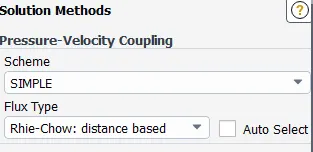
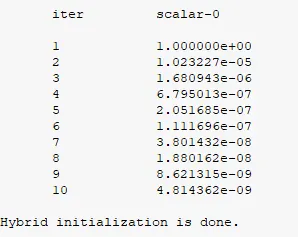
We use Hybrid initialization and SIMPLE method.
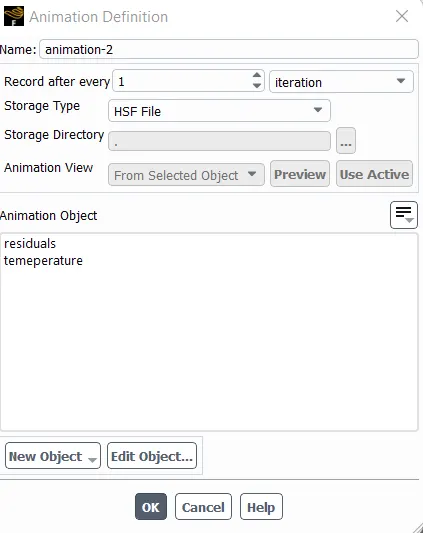
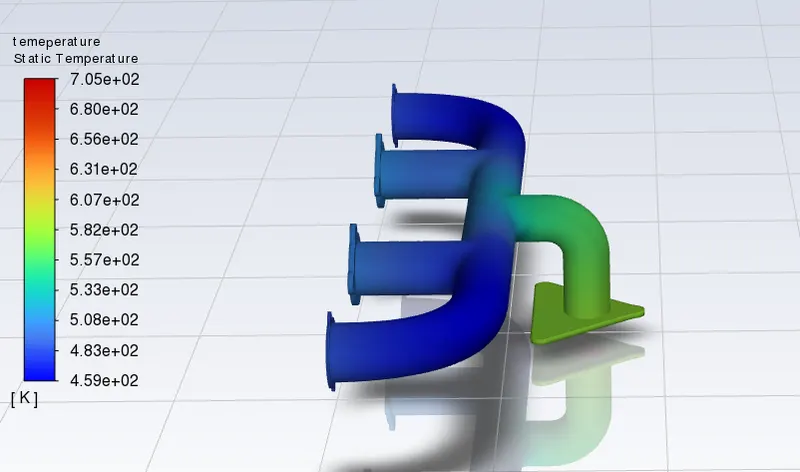
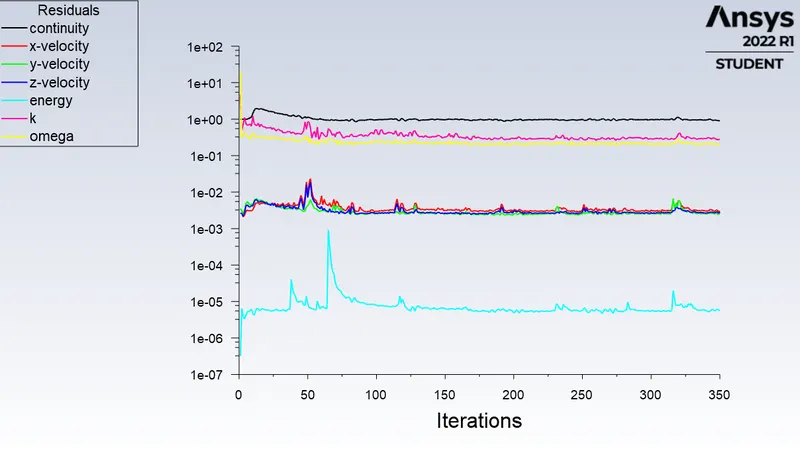
We initialize the solution and set the reference values and set the temperature contour and create animation for the temperature contour
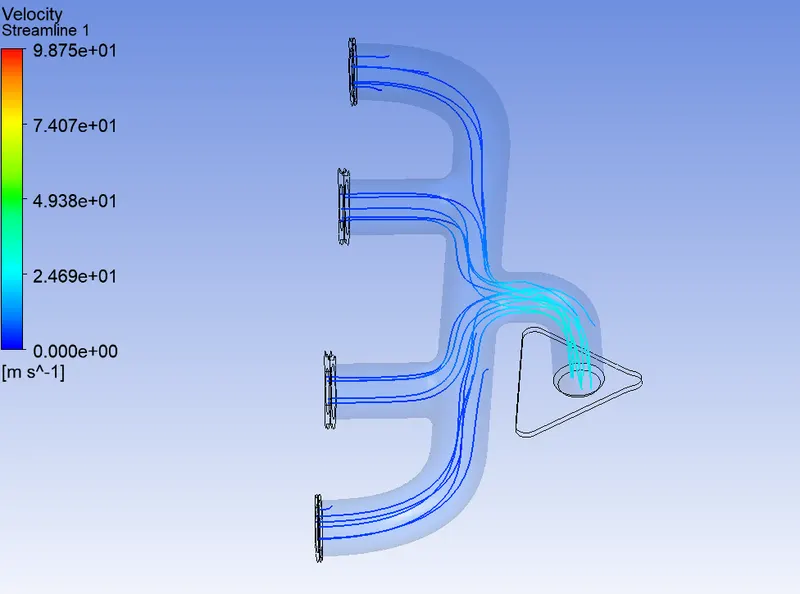
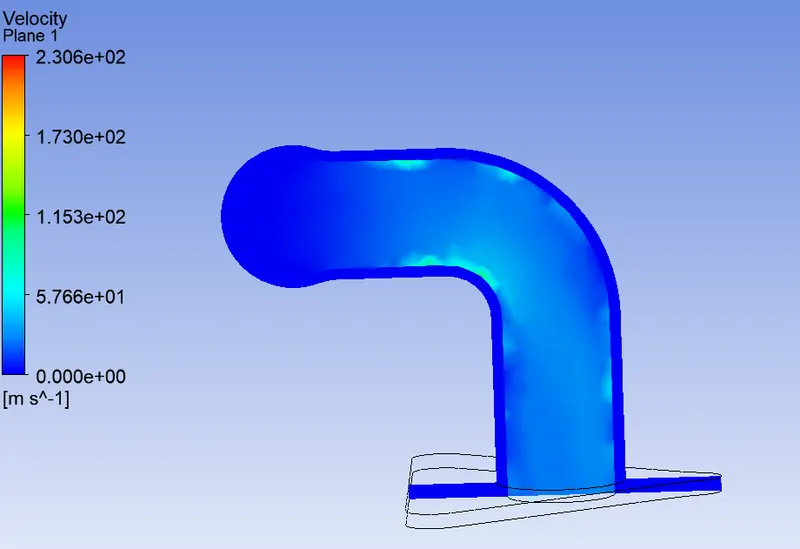
Velocity contour:
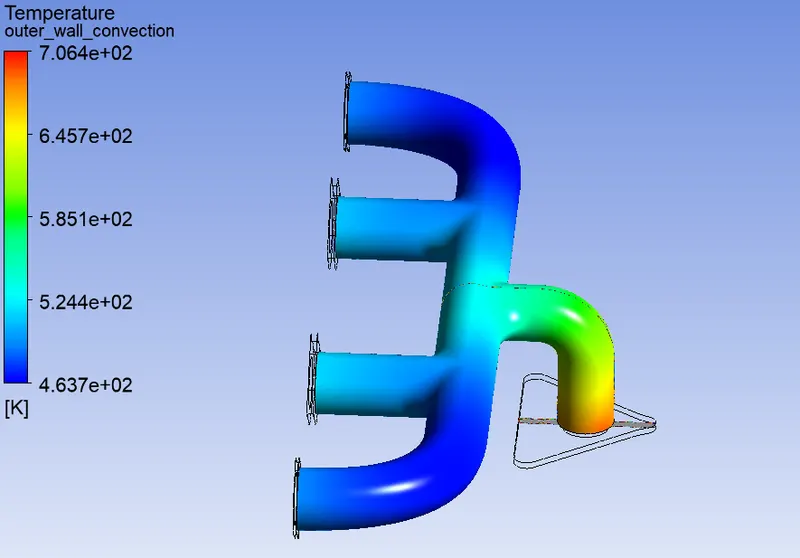
Temperature contour :
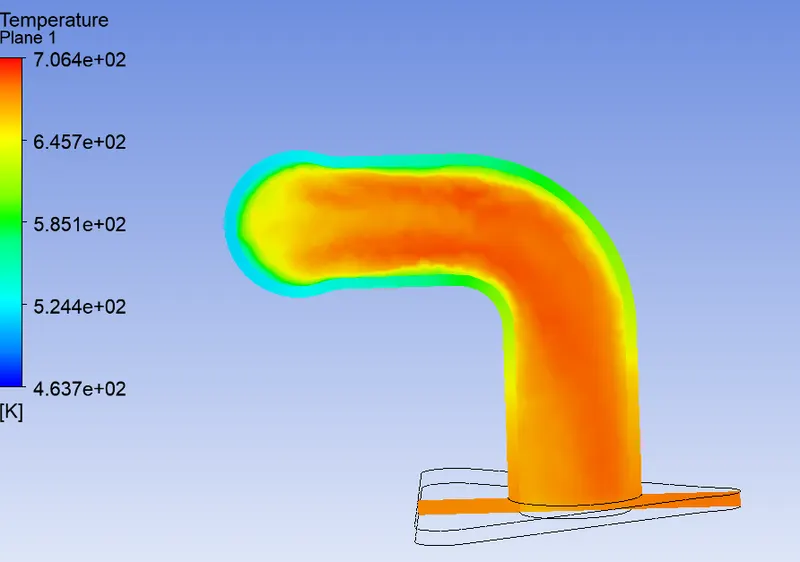
Velocity contour on the plane:
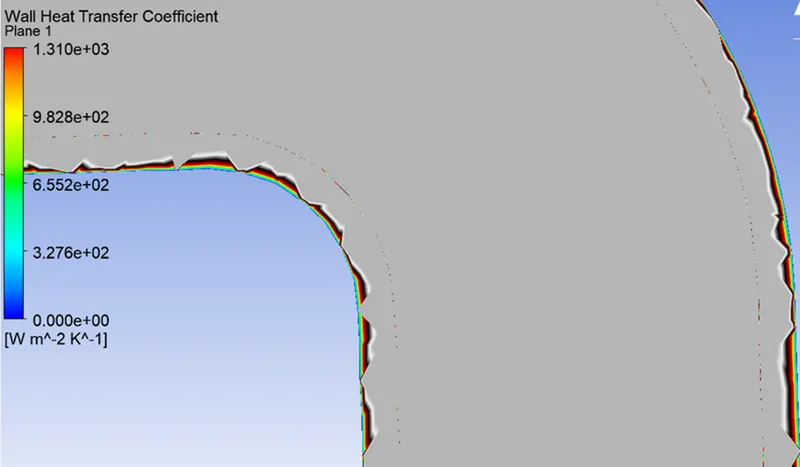
Wall heat transfer coefficient:
To verify if the HTC predictions from the simulations are right:
The reynolds number for the given flow is turbulent in nature,the Dittus bolter heat transfer coefficient can be used to find the nusselt number.
`N_(ud)= 0.023 8Re_D^(4/5) * P_r^n`
`P_r= mu*c_p/K`where k is thermal conductivity and mu is kinematic viscosity
`c_p=1006.43J/(kg K)`
`P_R= 0.744`
n=0.3 is a constant heattransfer takes place from fluid to solids
`N_(uD)`=136.4827
h=Nu*K/D = 19.4287 W/m^2K
So if we observe that the heat transfer coefficient is directly proportional to Reynolds Number.So if we increase the velocity the heat transfer coefficient will increase.
Conclusion:
Making the mesh finer by adding th inflation or using the body fitted mesh and the body sizing mesh increase the accuracy of the results.
We choose the k-omega model as we run simulation considering the heat transfer coefficient which includes walls so it is better to use K-omega SST model to run the simulation and we have chosen Y+ =1 as the desired value.
The maximum heat transfer is resulted at the bent portion of the outlet as the velocity is higher at that portion because of the velocity of the four inlet meeting at a point which has a high Reynolds number that is sufficient to make turbulent flow and resulting in high nusselt number at pipe bent at the exit.