Week-4 Challenge WOT Condition Part-2
QUESTION 1:
What is the difference between mapped and dynamic model of engine, motor and generator? How can you change model type?
MAPPED ENGINE:
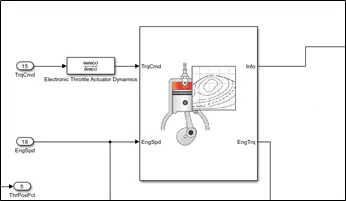
Mapped engine is a default arrangement in a powertrain blockset.It is used to measure performance parameter of the vehicle by using steady-state look-up table.The table provides overall engine characterstics including actual torque,fuel flow rate,BSFC and engine out exhaust emission.This kind is used when we have engine data from a dynomometer or design tool like GT-Power.This type of model is less accurate as it dosenot contain in-depth information and simulation time is also less than the dynamic type.
DYNAMIC ENGINE:
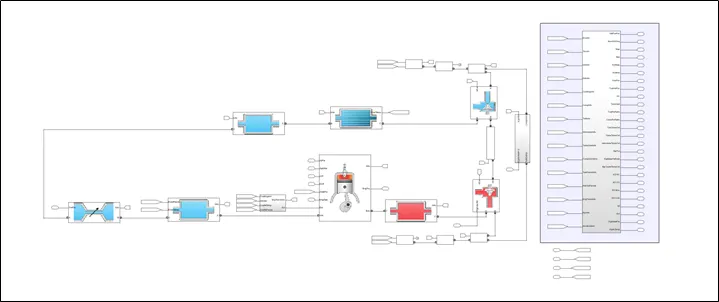
Dynamic engine uses real time data given by the user at the time of simulation.It is used to measure performance parameter of the vehicle by using component level data to analyse the impact of individual component on overall performance.This type of model is more accurate when compared with mapped models and simulation time is more when compared to the simulation time of mapped engine. This model calculate Brake torque using either the torque structure or simple torque model,fuel flow,Air mass flow,Air-fuel ratio and exhaust temperature and exhaust mass flow rate.
MAPPED MOTOR:
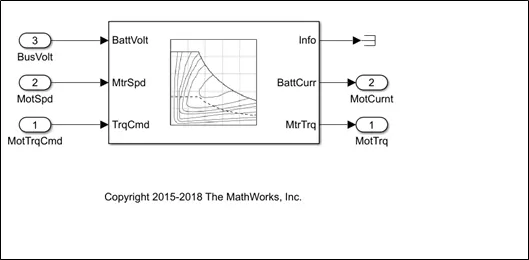
Mapped motor will operate in torque control mode. Output torque traces the torque reference demand and changes are made accordingly.This type of motor is used for faster simulation without knowing the motor parameters like motor power and torque .In this model we can specify the input torque,speed,maximum motor power and some electrical losses.
DYNAMIC MOTOR:
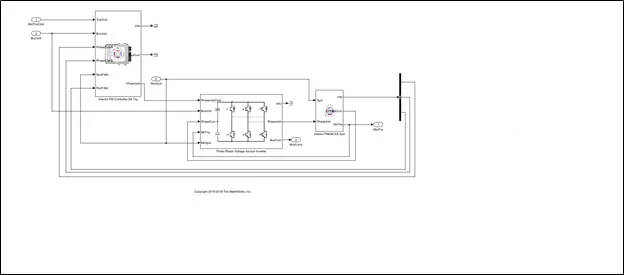
Dynamic motor uses three phase interior permanent magnet synchronous motor(PMSM). The block uses the three phase voltage source invertor that generates line to neutral voltage commands for a balanced three phase load.This type of motor is more accurate.
MAPPED GENERATOR:
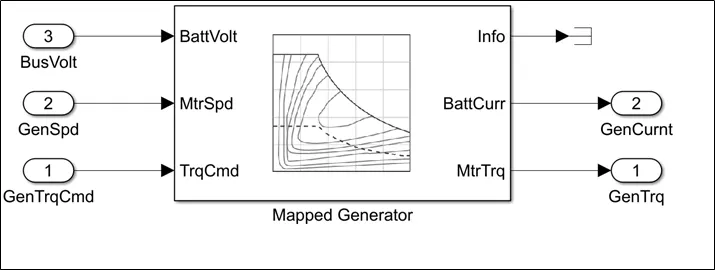
Mapped generator block is similar to the mapped motor block and data is given in the form of look-up tables and it is not accurate model and simulation time is less.
DYNAMIC GENERATOR:
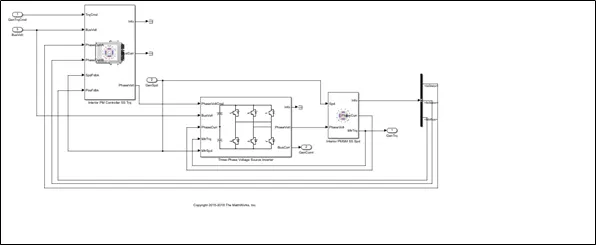
Dynamic generator is similar to the dynamic motor this block also uses three phase interior permanent synchronous generator(PMSG).It is a kind of real time simulation and the result will be accurate as the simulation is more when compared to the mapped model.
TO CHANGE THE MODEL TYPE:
GENERATOR
VIEW>VATIANT MANAGER>PASSANGER CAR>ELECTRIC PLANT>GENERATOR>RIGHT CLICK ON GEN DYNAMICS>SET AS LABEL MODEL ACTIVE CHOICE
MOTOR
VIEW>VATIANT MANAGER>PASSANGER CAR>ELECTRIC PLANT>MOTOR>RIGHT CLICK ON MOTOR DYNAMICS>SET AS LABEL MODEL ACTIVE CHOICE
ENGINE
VIEW>VATIANT MANAGER>PASSANGER CAR>ENGINE>DYNAMIC SI ENGINE>RIGHT CLICK ON SI DYNAMICS>SET AS LABEL MODEL ACTIVE CHOICE
QUESTION 2:
How does the model calculate miles per gallon? Which factors are considered to model fuel flow?
MILES PER GALLON GASOLINE EQUIVALENT (MPGe) is a measure of the average distance travelled per unit of energy consumed is used by the United States Envirnomental Protection Agency(EPA) to compare energy consumption of alternative fuel vehicles,plug in electric vehicle and other advanced technology vehicles with energy consuption of conventional internal combustion vehicles rated in miles per U.S gallon.
The unit of energy consumed is 33.7kWh (121 megajoules) without regard to the efficiency of conversion of heat energy into electrical energy also measured in kWh.The equivalence of this unit to energy in a gallon of gasoline is true if and only if the heat engine,generating equipment,and power delivery to the car battery are 100% efficient.
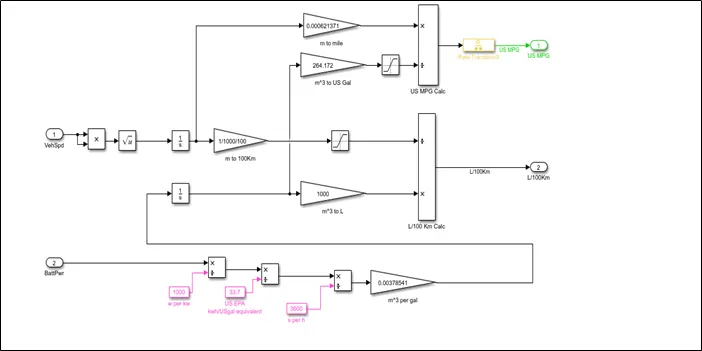
As we discussed earlier 1 gallon of gas equals to 33.7kWh of electricity so the battery power is converted W to kW by dividing by 1000 (W/1000) and then the value is divided by 33.7kWh/us-gallon and then hour is converted to sec by dividing by 3600 and the value will be in the US -gallon. The vehicle speed is integrated to get the distance and it will be in meters and converted to miles by multiplying by the term 0.000621 (1 meter = 0.000621 mile) and divided by 264.172 to convert from m^3 to US-gallon.
let us assume that 'x' W is obtained from the battery,
xW------->`(xW)/1000`------> xkW -------> `(xkW)/((33.7kWh)/(US gallon)`------->`(x US gallon)/(33.7h)`------->`x/(33.7*3600) (US gallon)/(sec)`------>`(x*0.00378)/(33.7*3600) m^3/(sec)`
--------> `(x*0.00378*264.172)/(33.7*3600) US gallon`
QUESTION 3:
Run the HEV ReferenceApplication with WOT drive cycle. Change the grade and wind velocity in the environment block. Comment on the results.
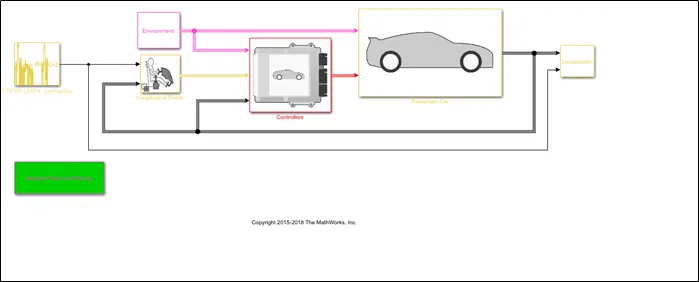
HEV reference application model consist of
DRIVE CYCLE SOURCE BLOCK: Generates a standard or user specified drive cycle velocity versus time profile.Block output is the selected or specified vehicle longitudinal speed.
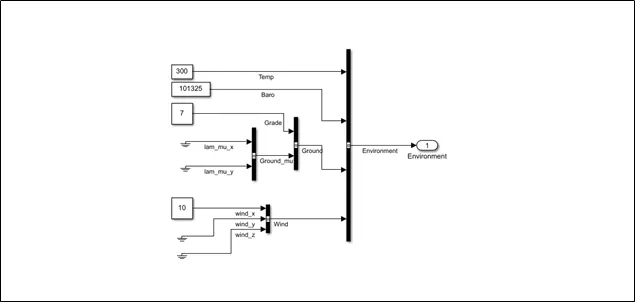
ENVIRONMENT SUBSYSTEM: Creates environmental variables including road grade ,wind velocity ,atmosphere temperature and pressure.
LONGITUDINAL DRIVER SUBSYSTEM: Uses longitudinal driver or open loop variant to generate normalized acceleration and braking commands.
CONTROLLER SUBSYSTEM: Implements a powertrain control module(PCM) containing a hybrid control module(HCM) and an engine control module(ECM).
PASSANGER CAR SUBSYSTEM: Implements a hybrid passanger car that contains engine,electric plant and drivetrain subsystem.
VISUALIZATION SUBSYSTEM: Displays the vehicle level performance,battey state of charge(SOC),Fuel economy,and emmision results that are usefull for powertrain matching and component selection analysis.
Assume Grade = 7%
wind velocity = 10 m/s
RESULT:
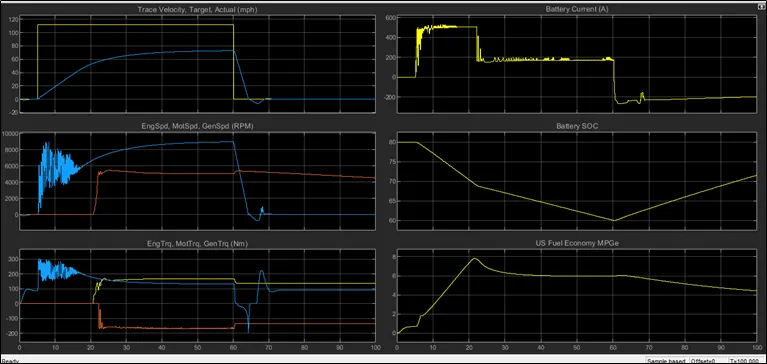
Trace velocity,Target actual (mph): The yellow plot indicate the required velocity to overcome the grade and wind velocity in WOT case and blue plot indicate the traced velocity which doesn't meet the actual requirement to overcome the given grade and wind velocity and the velocity is obtained around 70mph because their is a limit for the battery current as we can clearly observe in the plot.
Engine speed,Motor speed,Generator speed(rpm): Initial speed of motor is very high hence the engine rpm remains constant and when battery is charging which means the regenerative case the generator speed is observed
Engine torque,Motor Torque,Generator Torque(Nm): Initial torque of motor is very high which means the vehicle will start on motor alone mode and the engine torque(yellow plot) and generator torque(orange plot) will be observed as the state of charge(SOC) of battery decreases.
Battery current(A): Initially the battery current is very high and reaches the maximum limit around 500 A and remains constant and it goes to negative value which indicate the vehicle is deaccelerating and in regenerating mode.
Battery SOC: As the vehicle is accelerating the SOC will decreases and when it is deaccelerating the battery will charge as the vehicle in Regenerative mode and SOC of battery increases.
US Fuel economy MPGe: Initially for 20sec the MPGe value is more because the motor offers enormous torque and afterwards the torque becomes nearly constant and MPGe value decreases.
QUESTION 4:
Keeping all other parameters same, compare the simulated results of hybrid and pure electric powertrains.
HYBRID POWERTRAIN:
ELECTRIC POWERTRAIN:
CONCLUSION:
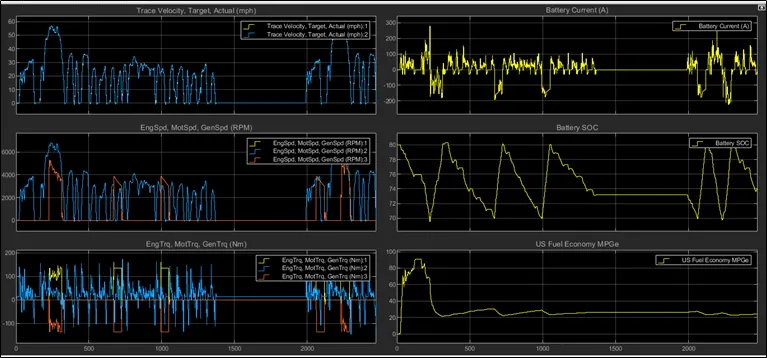
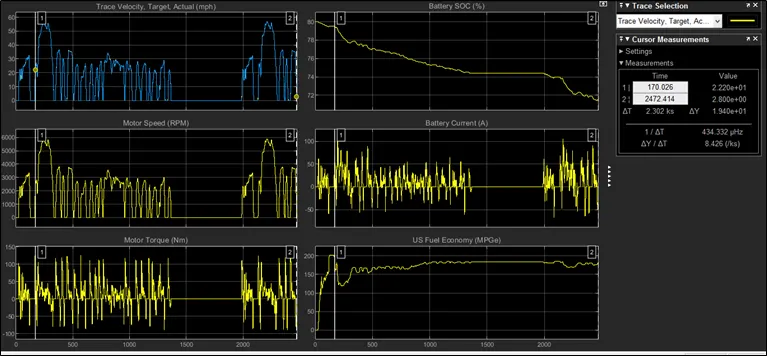
- The first plot i.e target and actual velocity plot of HEV and EV Powertrain is similar because both models is simulated under same drive cycle (FTP75)
- In Battery current plot of HEV the initial current is more when compared to EV powertrain which is around 280 A in case of HEV and the negative current limit of HEV powertrain is also more hence it offer efficient regenerative mode and also current load also decreases when engine comes into action which is advantage of HEV.
- In HEV the control startergy is Thermostat engine on/off state hence from the HEV SOC plot we can observe that when SOC reaches 70% the engine will turn on and the battery charges again which is efficient than the EV powertrain which uses the MAXIMUM SOC of PPS Control startergy.
- Motor speed in both the plots are nearly same.
- Motor Torque in case of HEV is initially more and when engine and generator comes in action the torque initiall torque of engine and generator is also more but becomes constant afterwards.
- Fuel economy initially more in HEV and then falls because of engine and generator load hence EV powertrain is more economical when compared to HEV.