Challenge

Week-4 Challenge WOT Condition Part-2

Objective -

To compare the difference between mapped and dynamic model of engine, motor and generator.

Theory -

Difference between Mapped and Dynamic Models -

Mapped Models

Dynamic Models

  • Model uses a set of steady-state lookup tables to characterize engine performance.
  • The tables provide overall engine characteristics, including actual torque, fuel flow rate, BSFC, and engine-out exhaust emissions.
  • Mapped Models use backward facing approach.
  • Most of the components are modelled by steady state maps and charts in backward facing approach.
  • Mapped engine models are suitable for analysis and design activities that do not require engine subsystem dynamic characteristics.
  • Use -
    • If you have engine data from a dynamometer or a design tool like GT-POWER.
    • For quasi steady-state engine simulations.
  • Example - In engine and transmission owertraion matching analysis for fuel economy, emissions and performance trade-offs.
  • Model decomposes the engine behavior into engine characteristics that are separated into lower-level components.
  • By combining components in this way, the models capture the dynamic effects.
  • Dynamic Model uses forward facing approach.
  • Dynamic engine models are suitable for designing control, estimator, and diagnostics algorithms that depend on dynamic subsystem states.
  • Use -
    • If you need a more detailed dynamic model and have component-level data.
    • To analyze the impact of individual engine components on the overall performance.
  • Example - Closed loop AFR control algorithm development.

--------------------------------------------------------------------------------------------------------------------------------------------------

Objective -

  • To calculate miles per gallon for the HEV reference application model.
  • To determine the factors affecting fuel low.

Theory -

Miles per Gallon (MPG) Calculation -

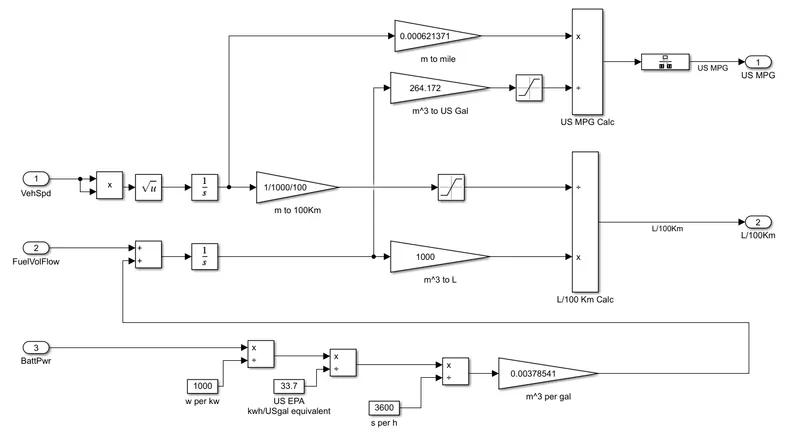
  • Given input parameters are
    • Vehicle Speed
    • Fuel Flow
    • Battery Power
  • Battery Power is converted into kilowatts then converted into US EPA (kWh/USgal equivalent), then into `m^3` per gal.
  • This adds with Fuel Volume Flow, then integrte it with respect to time to get the total fuel volume and convert it into US Gallon.
  • The vehicle speed is integrated to get the total distance covered and convert it into miles.
  • By dividing Total fuel volume consumed (in US Gallon) to the Total distance covered (in miles), we get the desired output as miles per gallon.
  • The model for the miles per gallon is given below -
Factors affecting Fuel Flow -

  • Vehicle Speed
  • Battery Power

NOTE :- Question 3 and 4 are omitted as per instruction of TSE Dr. Sree Ranjini K S.

Your portfolio, next

Ship work like this
in your own course.

Talk to a career counsellor

Free 20-minute call. We'll map the right course to where you want to work.

By submitting you agree to our Terms and Privacy Policy.

Talk to a career counsellor

Free 20-minute call. We'll map the right course to where you want to work.

By submitting you agree to our Terms and Privacy Policy.