Week-4 Challenge WOT Condition Part-2
Aim:
- To Explain the difference between the mapped and dynamic models of engine, motor, and generator and try to explain how to change the model type.
- Explain the model to calculate miles per gallon? Which factors are considered to model fuel flow
Introduction :
mapped model & dynamic model definition
| mapped model | dynamic model |
| Model uses a set of steady-state lookup tables to characterize engine performance. | Model decomposes the engine behavior into engine characteristics that are separated into lower-level components. By combining components in this way, the models capture the dynamic effects. |
|
eg- If you have engine data from a dynamometer or a design tool like GT-POWER. |
eg- To analyze the impact of individual engine components on the overall performance. |
|
If the detailed specification / lookup table data is available with us the simulation becomes easier and it gives results on the basic of data interpreted.It is also known as global based model. |
It operates dynamically depending upon the situation of operation detailed data and specification are not required and simulation gives the detailed analysis of the component simulated.It is also known as real time based model. |
Mapped model:
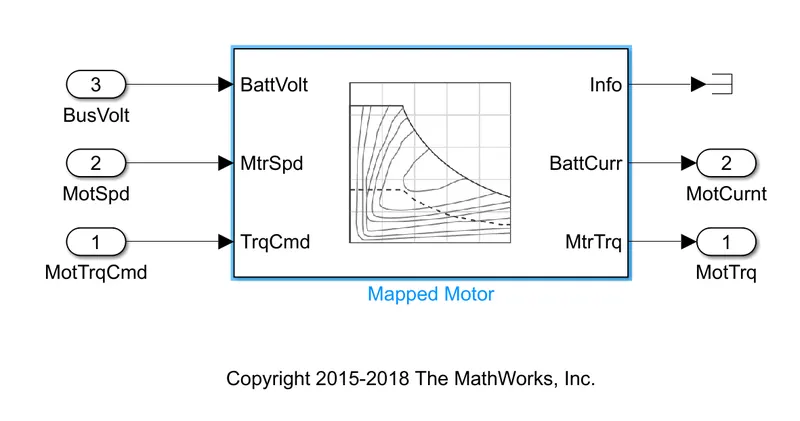
- The mapped model is one type where all the data points are pre-assigned in the lookup table.
- It requires the only inputs as an array or bunch of data and given the output as array of data.
- It requires the engine, motor and generator toque as an input and generates the required torque output simply without considering the real-time parameters of the engine, motor & generator.
- The output values are stored for the given input values of the engine motor and generator.
- The accuracy of the result is not high but the simulation will be done in much less time and the main thing is not run by real-time parameters.
- Example of the mapped model cane shown below.
Dynamic model:
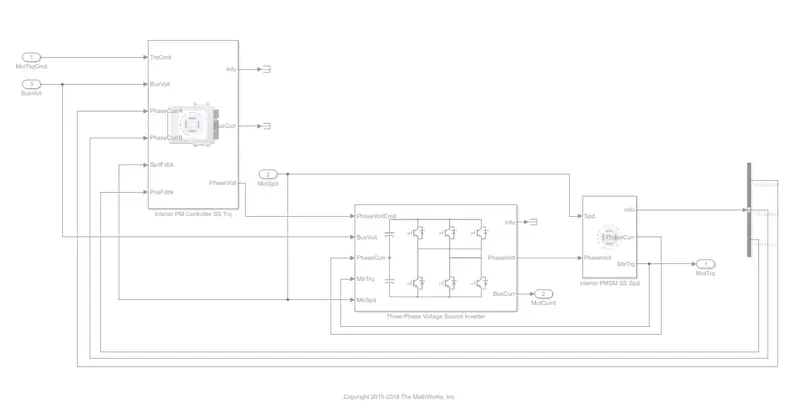
- The dynamic model on the other hand uses the combination of the output from the various subsystem to generate the output.
- It runs by the real-time simulator where the required input from the drive cycle is taken and for that individual real-time simulation gets performed and summing all the results of the subsystem gives the output for the simulation.
- The accuracy of this model is very high as it consider the real outputs from all the subsystem to generate the output.
- The simulation will take very long time to complete as it has so many individual simulation running by all subsystem of the engine,motor,generator.
- The figure shown below working of dynamic model.
| Explanation for simulation on both models |
| Engine | Engine performance could be simulated with the array of data interpreted in the system.whears all the condition such as engine operation,power,efficiency could be measured accorddingly. |
engine performance will be simulated as per the original/real engine specification of the designed vehicles chosen for simulation.All the results would be obtained with real time details. |
| Motor | Motor specification such as rpm,maximum efficiency,heat are to be entered for the simulation results |
The actual details for the same would be considered and the result would be obtained. |
| Generator |
Specification for battery torque,battery current,motor torque are to be entered for simulation. |
All the details and specification would consider as per the actual and dynamic state the results as real time simulation. |
The process to change the mapped to dynamic model and vice versa:
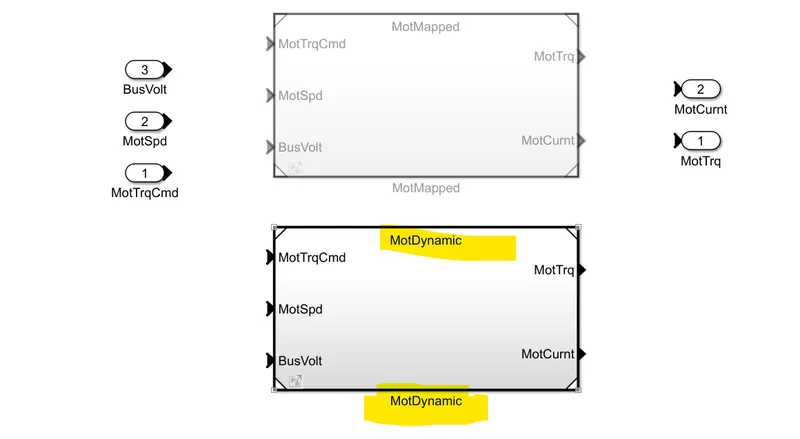
The screen attached below is a mapped motor model that has been configured for the hybrid vehicle.
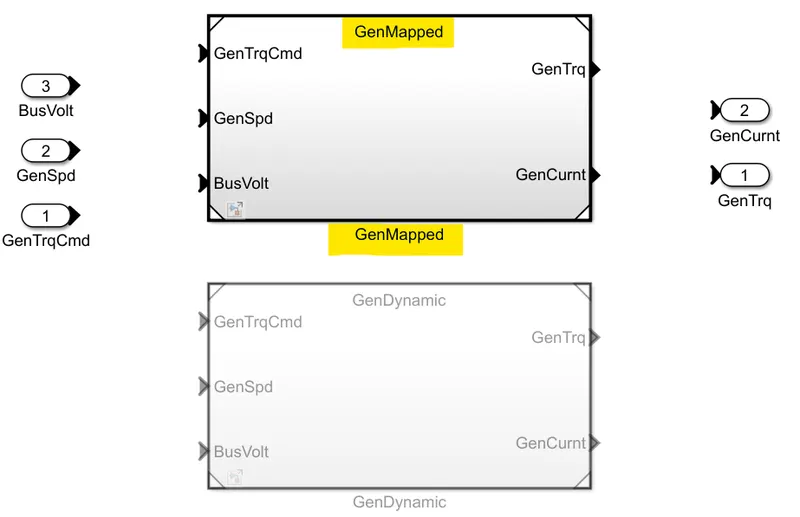
Now we have to change the mapped model to a dynamic model. for that process is just right click the motor and select the varient to open the model the following steps are mentioned below the image.
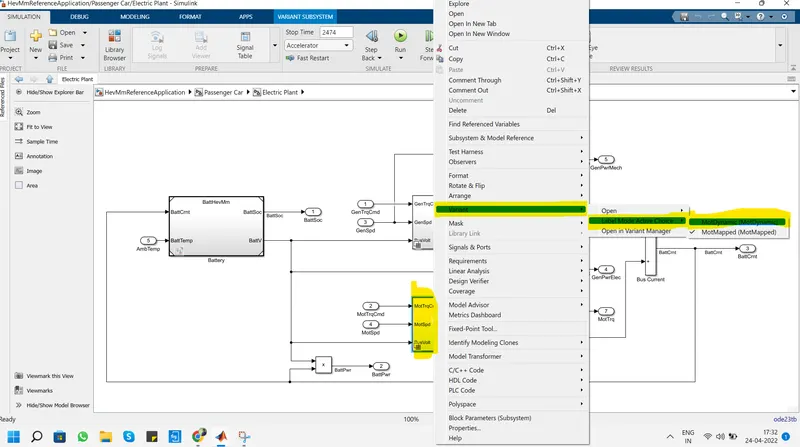
After changing the mapped model to a dynamic model the dynamic model has been configured as shown in the below image.
question-
Explain about the model calculate miles per gallon? Which factors are considered to model fuel flow ?
Miles per gallon:
- Miles per gallon is a fuel economy rating by how far a car can travel on a gallon of petrol or diesel for an engine-powered car.
- In the case of an electric vehicle, it tells us the energy which is equivalent to that of the engine-powered car to propel the car through the distance.
- The amount of fuel energy is required to move the car through the same distance and is expressed as the miles per gallon.
- The powertrain block set has a model that calculates the miles per gallon for all kinds of vehicles.
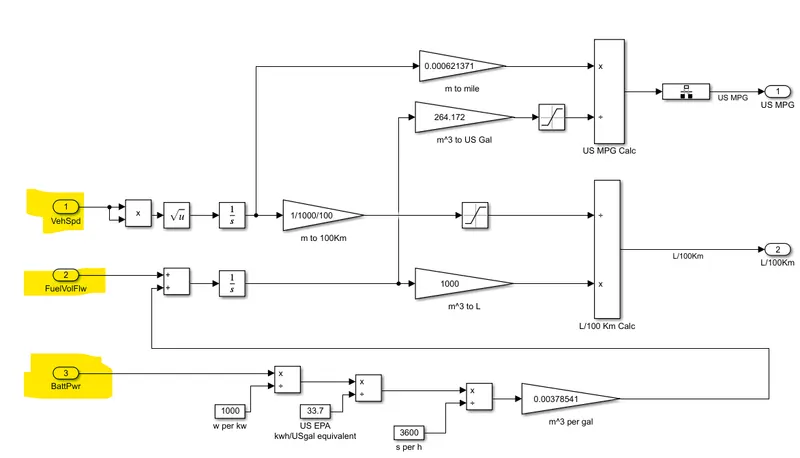
The above model was taken as the inputs of vehicle speed, fuel flow, and battery power.
Vehicle speed and fuel flow:
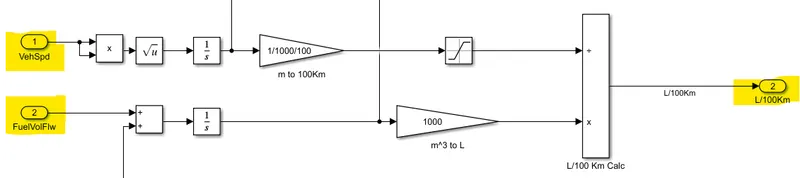
- The vehicle speed is an important factor when considering the fuel consumption at that particular time so, as to determine the fuel consumption throughout the drive cycle.
- To convert speed to the distance we can integrate with time and we are doing the same of converting the velocity to get the distance covered by integrating.
- Then the fuel flow is expressed as the mass flow rate (i.e) the amount of fuel at each moment in kg/sec now integrating will result in the mass of the fuel and by using this one we convert it to the volume and multiplied by 1000 to get it in liters.
Battery power:

- The amount of energy from the battery power required to propel the vehicle equivalent to that of the engine is calculated here.
- The battery power is given in watts and it is converted to KW by dividing with 1000.
- Then we convert the power into energy by multiplying the time into KWh.
- Then we convert the energy KWh to to equivalent energy in US gallons of automotive gasoline by dividing by 33.7.since we got the energy in US gallons equal to KWH we are trying to get the energy of equivalent LIS gallon per second and we do this by dividing with 3600 and we convert the hour to second.
- Then multiplying with 0.00378541 we convert the US gallon
- Finally the battery energy equivalent in kg/s is given as a input for the fuel flow parameters in order to find the equivalent US gallon energy and estimate the miles per gallon.
Calculating the miles per gallon:
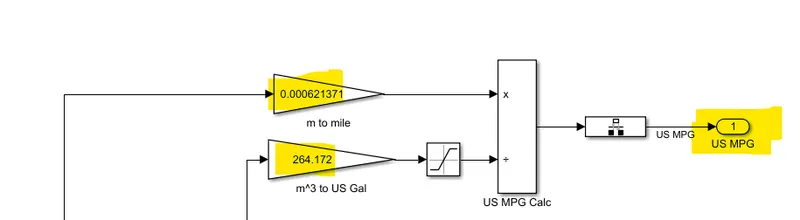
- Then the inputs from the vehicle speed (I.e) the distance we found ( in Meters ) is taken into calculation and it is converted to the miles by multiplying by 0.000621371.
- Then the inputs from fuel flow which is battery energy and fuel energy is taken and it is converted to us gallon by multiplying with264.172.
- Then the two inputs miles are covered and equivalent US gallon is divided to got MPG miles per gallon
conclusion:
The final output of MPG is calculated by keeping in consideration of the battery output, fuel output, speed & distance traveled by the vehicle. Therefore the fuel efficiency is calculated and it is converted after the required calculation to find the US MPG.
Note:
On live session As guided by Dr.sree ranjani (EV batch 13) Q3 and Q4 are skipped.please consider that for my grading)