Week-4 Challenge WOT Condition Part-2
WOT CONDITION PART – 2
AIM:
To find the following
- What is the difference between mapped and dynamic model of engine, motor and generator? How can you change model type?
- How does the model calculate miles per gallon? Which factors are considered to model fuel flow?
- Run the HEV ReferenceApplication with WOT drive cycle. Change the grade and wind velocity in the environment block. Comment on the results.
- Keeping all other parameters same, compare the simulated results of hybrid and pure electric powertrains.
1.What is the difference between mapped and dynamic model of engine, motor and generator? How can you change model type?
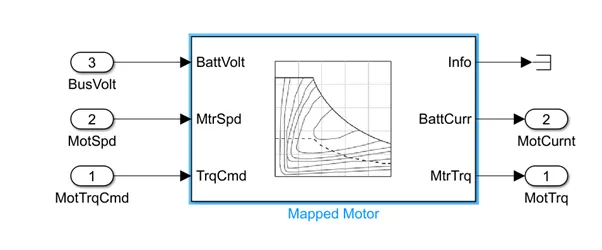
Mapped Model of Engine, Motor and Generator:
Mapped Model uses a set of steady-state lookup tables to characterize engine performance.
The tables provide overall engine characteristics, including actual torque, fuel flow rate, BSFC, and engine-out exhaust emissions.
Mapped engines represent macro engine behavior as a set of lookup tables (brake torque, fuel flow, air mass flow, exhaust temperature, efficiency, and emissions) as functions of commanded load and measured engine speed.
If you have engine data from a dynamometer or a design tool like GT-POWER and for quasi steady-state engine simulations Mapped Model is used.
Mapped engine models are suitable for analysis and design activities that do not require engine subsystem dynamic characteristics, for example, in engine and transmission powertrain matching analysis for fuel economy, emissions, and performance tradeoffs.
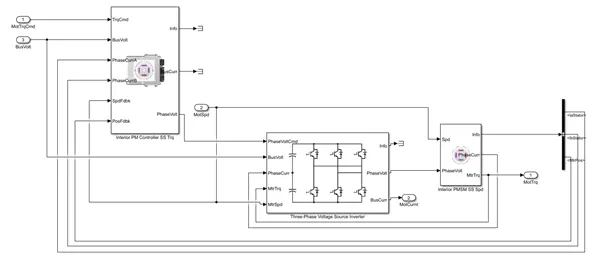
Dynamic Model of Engine, Motor and Generator:
Dynamic Model decomposes the engine behavior into engine characteristics that are separated into lower-level components. By combining components in this way, the models capture the dynamic effects.
Dynamic engines decompose engine behavior into individual component models that account for engine dynamics, most notably intake airflow and turbocharger dynamics.
If you need a more detailed dynamic model and have component-level data and To analyze the impact of individual engine components on the overall performance Dynamic Model is used.
Dynamic engine models are suitable for designing control, estimator, and diagnostic algorithms that depend on dynamic subsystem states, for example, in closed-loop AFR control algorithm development.
|
Mapped Model |
Dynamic Model |
|
Simple |
Complex |
|
uses a set of steady-state lookup tables to characterize engine performance |
decomposes the engine behavior into engine characteristics that are separated into lower-level components |
|
suitable for analysis and design activities that do not require engine subsystem dynamic characteristics |
suitable for designing control, estimator, and diagnostic algorithms that depend on dynamic subsystem states |
|
Compiling Time is Low |
Compiling Time is High |
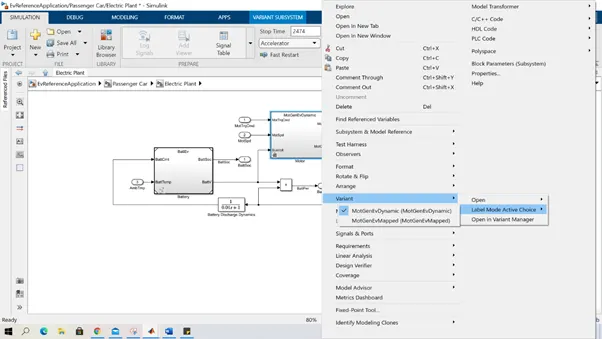
Switching between Mapped and Dynamic Model in Ev Reference Application:
Both Mapped and Dynamic Mode Model has been created as a Variant of the Motor Subsystem.
- To switch, Right click on the Motor Sub system
- From the Popup menu, Select Variant -> Label Mode Active Choice -> MotorGenEvDynamic (or) MotorGenEvMapped
2.How does the model calculate miles per gallon? Which factors are considered to model fuel flow?
Miles per Gallon is the measure of Fuel Economy of Automobile and it relates the Distance travelled by the vehicle to the amount of Fuel consumed.
To calculate Miles per Gallon (MpG) value the Distance travelled and Amount of Fuel Consumed must be known. In an EV, Electric Power from Battery is used as Fuel. The Electric Power is converted into its equivalent amount of Fuel.
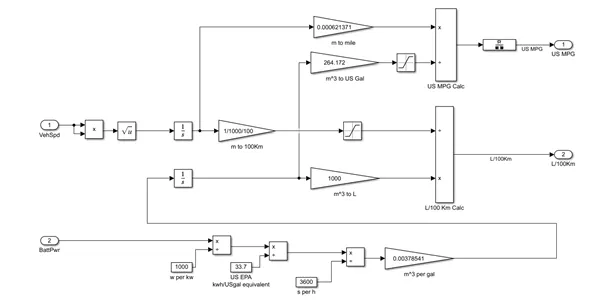
Distance Travelled is calculated by integrating speed of the Vehicle over Time.
Battery Power is converted into its equivalent Gallon quantity by dividing with 33.7
Battery Power and Speed are considered to model Fuel Flow.
3.Run the HEV ReferenceApplication with WOT drive cycle. Change the grade and wind velocity in the environment block. Comment on the results.
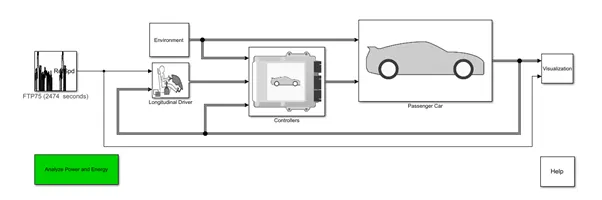
HEV Reference Application Model:
Environment Block:
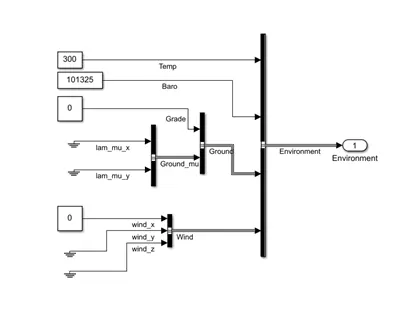
The Environment Block gives Four Data namely Temp, Baro, Grade and Wind as Input to Controllers and Vehicle Sub-system. By Default, Wind Speed and Grade values are Zero. Wind Speed influences the opposing Aero Drag Force and Grade influences the Torque required.
OUTPUT:
- WOT with Wind Speed = 0 , Grade =0 :
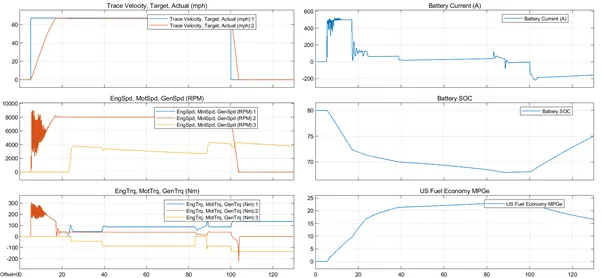
Max Velocity achieved is 67.5 mph in 17.2 secs.
Peak Current is 524A at 8.82 secs
Battery SOC at the end of 130 sec WOT drive cycle is 75%
Vehicle propulsion is provided totally by Motor while The Engine runs the Generator to charge the Battery.
Max Motor RPM = 8991
Max Motor Torque = 305 Nm
- WOT with Wind Speed = 3 , Grade =0 :
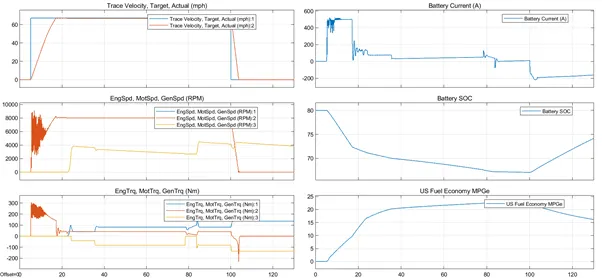
Max Velocity achieved is 67.4 mph in 17.2 secs.
Peak Current is 520A at 6.66 secs
Battery SOC at the end of 130 sec WOT drive cycle is 74.2%
Vehicle propulsion is provided totally by Motor while The Engine runs the Generator to charge the Battery.
Max Motor RPM = 9119
Max Motor Torque = 304 Nm
- WOT with Wind Speed = 6 , Grade =0 :
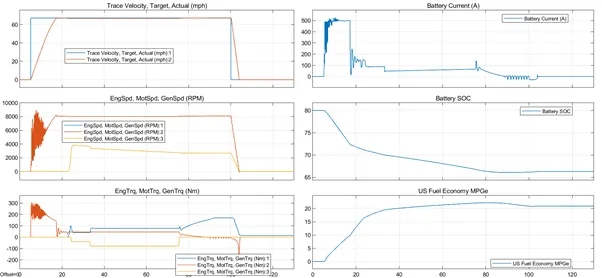
Max Velocity achieved is 67.4 mph in 17.4 secs.
Peak Current is 526A at 10.3 secs
Battery SOC at the end of 130 sec WOT drive cycle is 66.3%
After 75.4 sec (Battery SOC below 66.8%), Motor Torque is slowly ramped down while the Engine takes over. Motor switches into generation mode after 88.5 sec.
Max Motor RPM = 8901
Max Motor Torque = 304 Nm
- WOT with Wind Speed = 9 , Grade =0 :
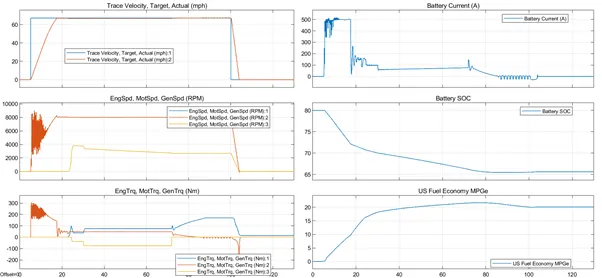
Max Velocity achieved is 67.4 mph in 17.6 secs.
Peak Current is 515.5A at 11 secs
Battery SOC at the end of 130 sec WOT drive cycle is 65.6%
After 71.8 sec (Battery SOC below 66.2%), Motor Torque is slowly ramped down while the Engine takes over. Motor switches into generation mode after 85.5 sec.
Max Motor RPM = 9033
Max Motor Torque = 303.7 Nm
- WOT with Wind Speed = 9 , Grade =5 :
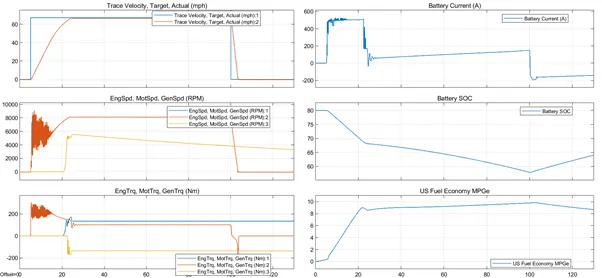
Max Velocity achieved is 66.8 mph in 24.4 secs.
Peak Current is 528A at 11.9 secs
Battery SOC at the end of 130 sec WOT drive cycle is 64%
After 100 sec, Motor Torque and RPM is ramped down. Motor switches into generation mode after 100.2 sec. Engine starts and drives the Generator to charge Battery when the Battery SOC falls below 70%.
Max Motor RPM = 9113
Max Motor Torque = 303.8 Nm
- WOT with Wind Speed = 9 , Grade =10:
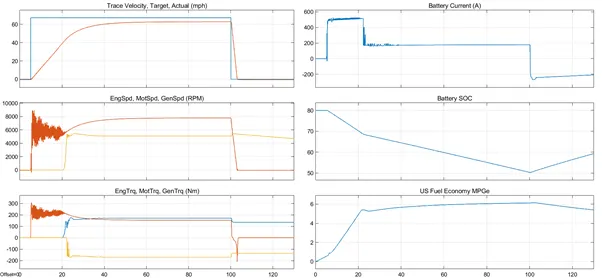
Max Velocity achieved is 62.7 mph in 87.7 secs.
Peak Current is 524.5A at 19.8 secs
Battery SOC at the end of 130 sec WOT drive cycle is 59.3%
After 100sec Motor Torque and RPM is ramped down. Motor switches into generation mode after 100.3 sec. Engine starts at 20.3 sec (Battery SOC drops below 70%) and runs continuously to drive Generator and charge the Battery.
Max Motor RPM = 8908
Max Motor Torque = 306.6 Nm
- WOT with Wind Speed = 9 , Grade =15:
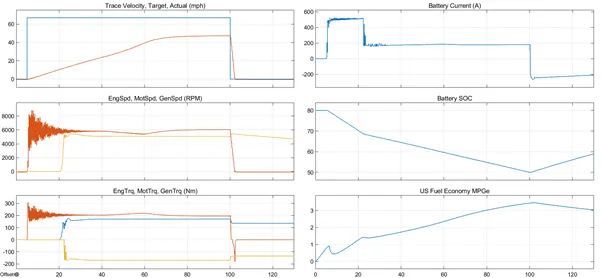
Max Velocity achieved is 47.3 mph in 95.8 secs.
Peak Current is 524.4A at 8.9 secs
Battery SOC at the end of 130 sec WOT drive cycle is 59%
After 100sec Motor Torque and RPM is ramped down. Motor switches into generation mode after 100.3 sec. Engine starts at 20.4 sec (Battery SOC drops below 70%) and runs continuously to drive Generator and charge the Battery.
Max Motor RPM = 8814
Max Motor Torque = 306.6 Nm
Inference:
As the Grade increases Max Speed decreases and Time taken to reach the Max Speed increases. Battery SOC also decreases.
4.Keeping all other parameters same, compare the simulated results of hybrid and pure electric powertrains.
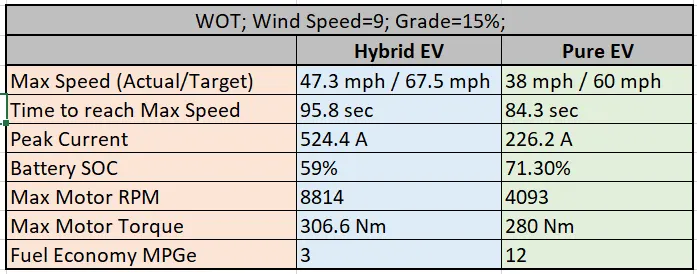
HEV with WOT and with Wind Speed = 9 , Grade =15:
Max Velocity achieved is 47.3 mph in 95.8 secs.
Peak Current is 524.4A at 8.9 secs
Battery SOC at the end of 130 sec WOT drive cycle is 59%
After 100sec Motor Torque and RPM is ramped down. Motor switches into generation mode after 100.3 sec. Engine starts at 20.4 sec (Battery SOC drops below 70%) and runs continuously to drive Generator and charge the Battery.
Max Motor RPM = 8814
Max Motor Torque = 306.6 Nm
Pure EV with WOT and with Wind Speed = 9 , Grade =15:
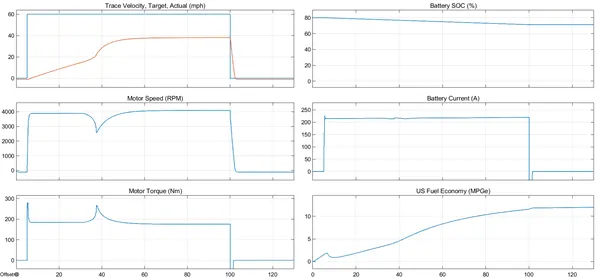
Max Velocity achieved is 38 mph in 84.3 secs.
Peak Current is 226.2A at 5.5 secs
Battery SOC at the end of 130 sec WOT drive cycle is 71.3%
Max Motor RPM = 4093
Max Motor Torque = 280 Nm
Inference: