Week-4 Challenge WOT Condition Part-2
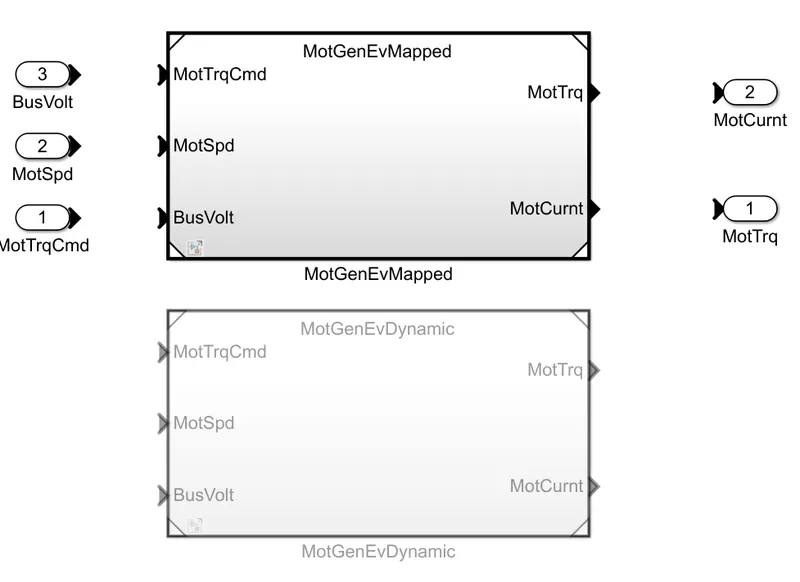
Q1. What is the difference between the mapped and dynamic model of engine, motor and generator? How can you change model type?
Sol.
|
Implementation |
When to Use |
|
|
Mapped |
The model uses a set of steady-state lookup tables to characterize engine performance. The tables provide overall engine characteristics, including actual torque, fuel flow rate, BSFC, and engine-out exhaust emissions. |
|
|
Dynamic |
The model decomposes the engine behavior into engine characteristics that are separated into lower-level components. By combining components in this way, the models capture the dynamic effects. |
|
To change between mapped & dynamic model:
- Open the powertrain module blockset for the required vehicle.
- Click on passenger car/vehicle block and select electric plant or engine.
- Right-click on Engine/EV motor/generator based on vehicle model and select variant.
- Under variant, scroll to label model active choice and choose mapped or dynamic for the required calculation.
Q2. How does the model calculate miles per gallon? Which factors are considered to model fuel flow?
Miles per gallon (MPG) is a fuel economy rating determined by how far a car can travel on a gallon of gasoline or diesel for a conventional IC Engine vehicle. In the case of an electric vehicle, this is a measure of how much electrical energy is consumed by the battery pack to travel a fixed distance.
The powertrain block has an inbuilt model for this which can be found inside the visualization block.
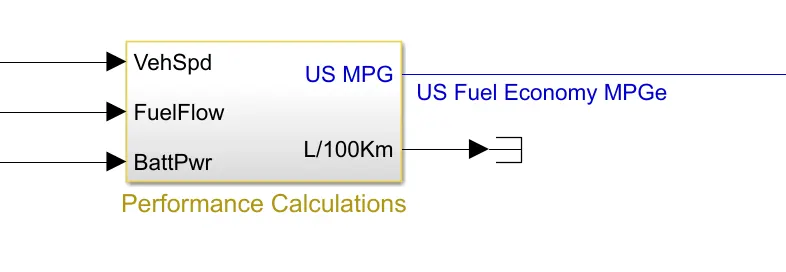
The actual MPG calculations can be seen in the blocks below:
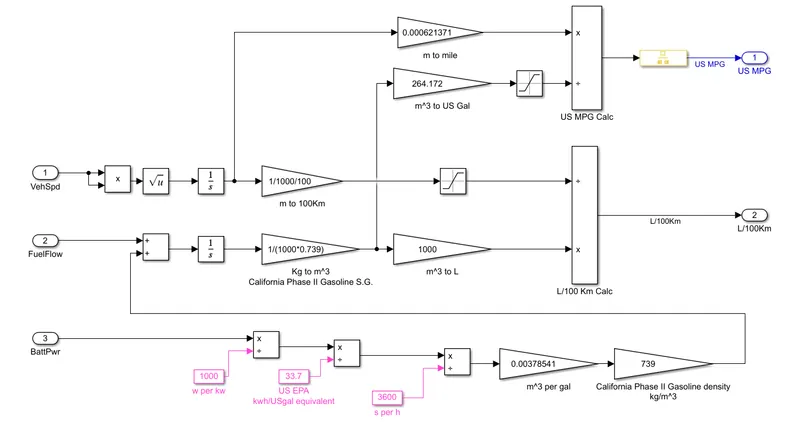
From the above diagram, it can be concluded that Fuel Flow can be calculated using Vehicle Speed and Battery Power.
Q3. Run the HEV ReferenceApplication with WOT drive cycle. Change the grade and wind velocity in the environment block. Comment on the results.
HEV Powertrain Blockset:
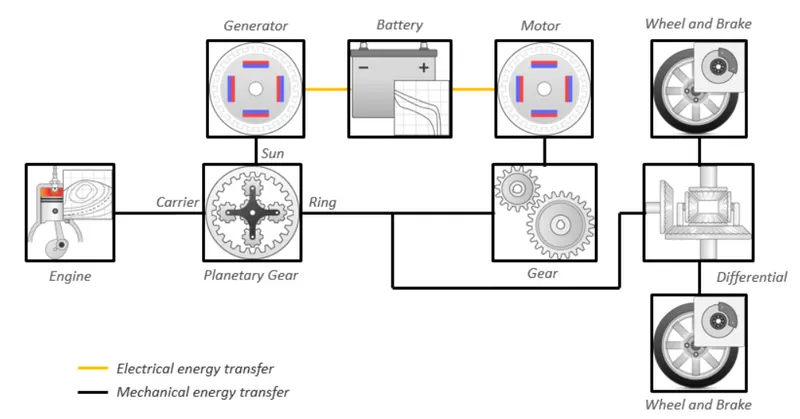
HEV Reference Application Blockset:
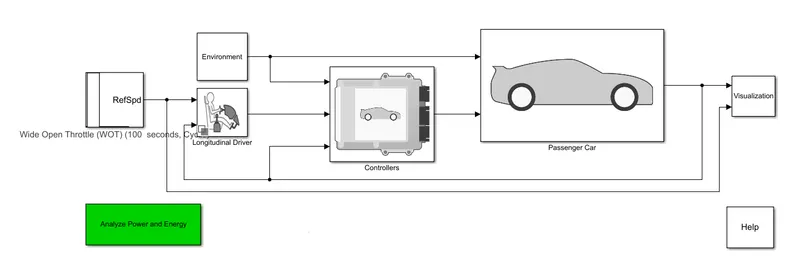
WOT Drive Cycle Inputs:
- Total Simulation Time = 100s
- Nominal Speed = 50s
- Deacceleration Time = 30s
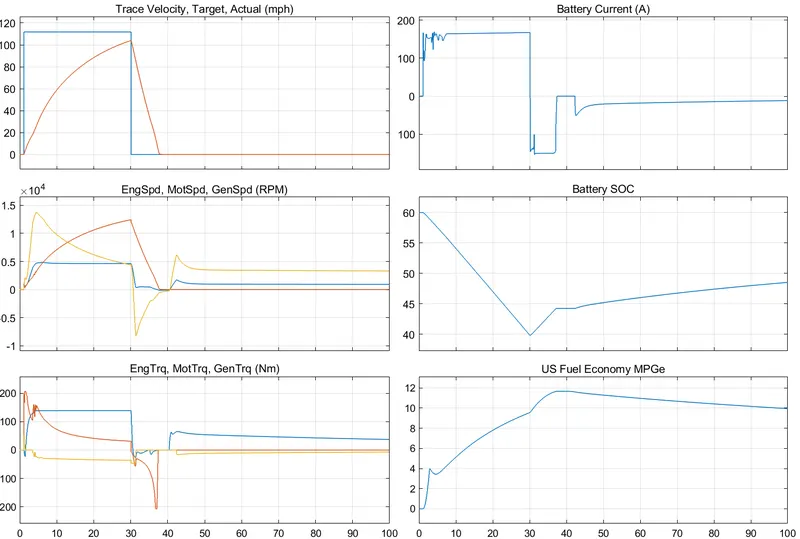
Case I: Default Grade (0 degrees) and wind velocity (0 m/s)
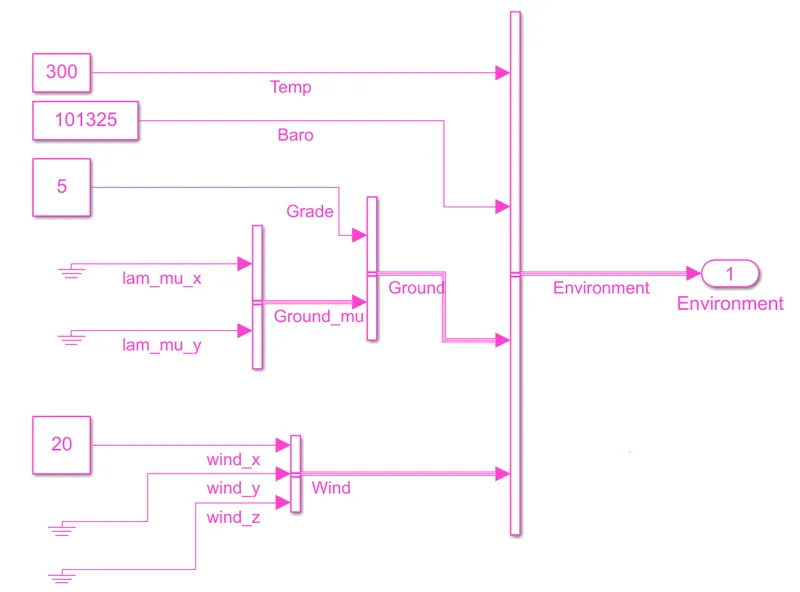
Case II: Grade = 5 degrees and Wind Velocity = 20 m/s.
Output Graph:
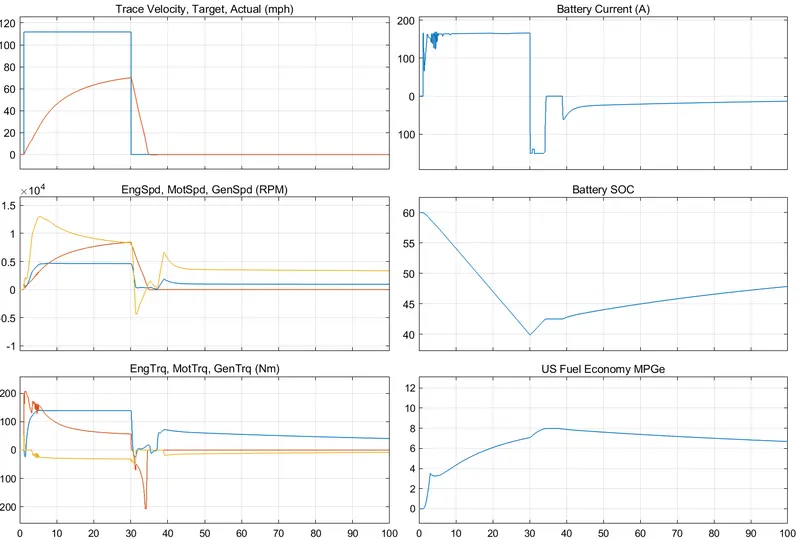
Observations:
- There is a visible difference in the Velocity between the two graphs due to the limitations of power available from the energy source.
- Since more energy is required to overcome the given constraints, i.e., Grade and Wind Speed, the battery SOC and the fuel economy decreases.
- The rest of the factors remain the same during the simulation.
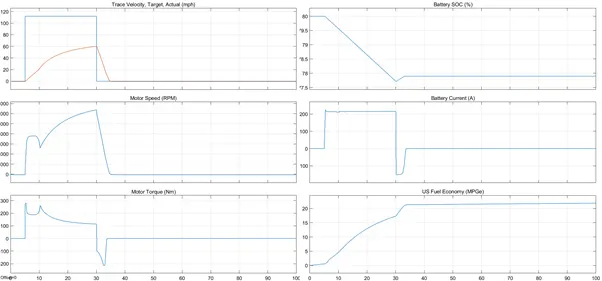
Q4. Keeping all other parameters same, compare the simulated results of hybrid and pure electric powertrains.
EV Powertrain Blockset:
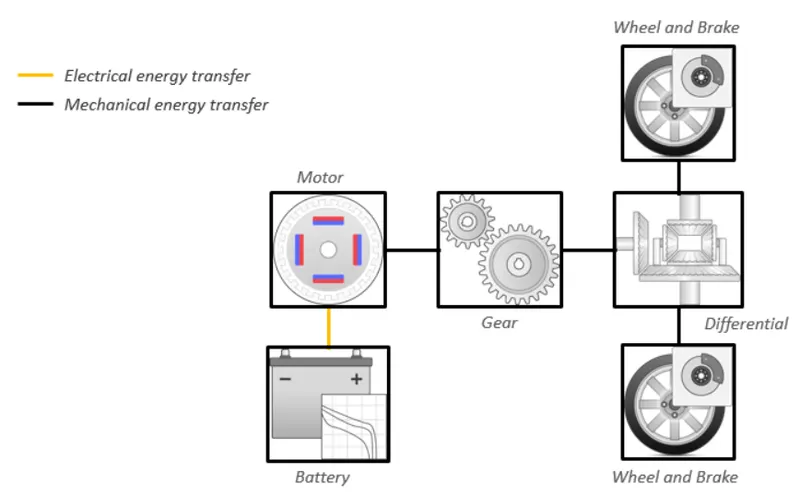
EV Reference Application Blockset:
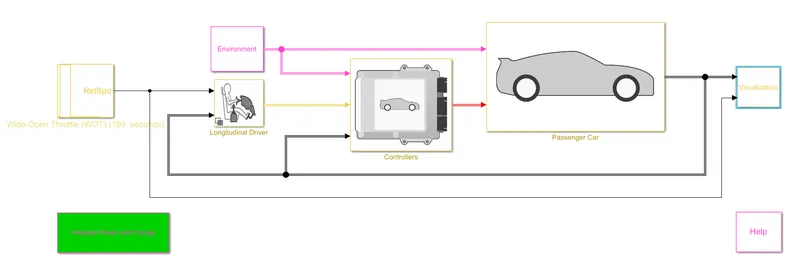
WOT Drive Cycle Inputs:
- Total Simulation Time = 100s
- Nominal Speed = 50s
- Deacceleration Time = 30s
Case I: Default Grade (0 degrees) and wind velocity (0 m/s)
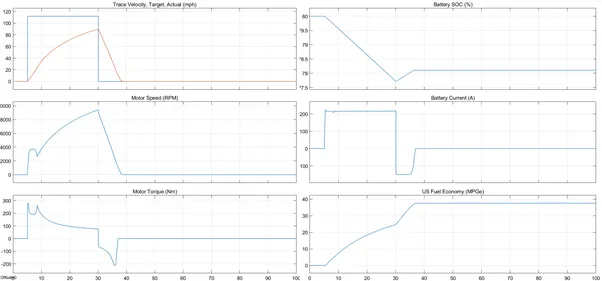
Case II: Grade = 5 degrees and Wind Velocity = 20 m/s.
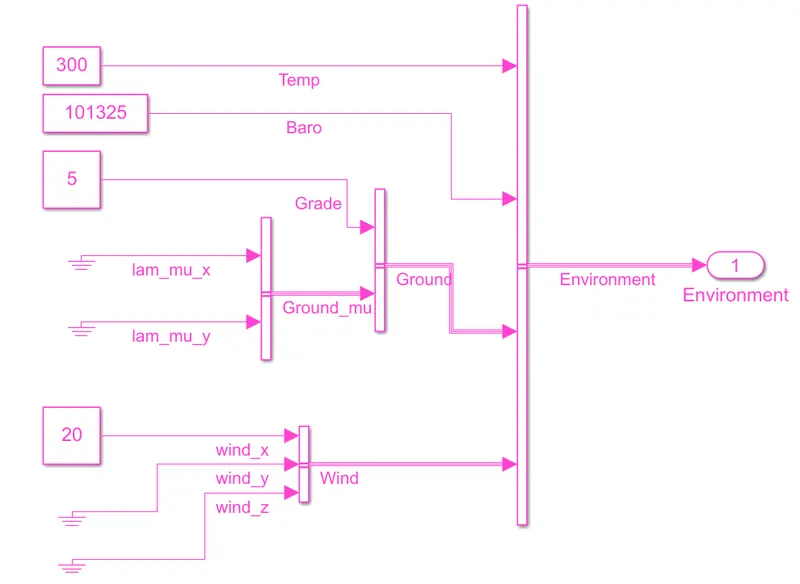
Output Graph:
Conclusion:
- The velocity of HEV is much higher than that of an EV.
- EV has much more fuel efficiency as compared to the conventional HEV.
- The conventional HEV's use lead-acid batteries whereas the EVs use lithium-ion cells with more energy density.
- The battery current capacity of pure EV is much higher than that of HEV since the EV battery is the only driving unit.
- Since the motor is the only propulsion source in an EV powertrain, the motor needs higher rated power and generates the instantaneous start-up torque to propel the vehicle.